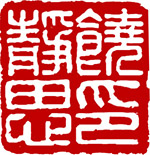
There is an interesting verse said to be by Fù Dàshì (傅大士) — also known as Shanhui Dashi (善慧大士) or Fu Xi (傅翕), the lay Buddhist figure of the Liang dynasty (497–569):
有物先天地
無形本寂寥
能為萬象主
不逐四時凋
There is a thing prior to Heaven and Earth
Formless, originally Still and Void
It can be master of the myriad images
It does not wither with the four seasons
It is a gāthā (sutra) on dharmakāya (true nature) that appears as the second of the Sòng èr shǒu (頌二首; “Two Gāthās”) in the Shànhuì Dàshì yǔlù (善慧大士語錄; “Recorded Sayings of the Great Being Shanhui”)1. It is also widely quoted in later Chan compendia and commentaries.
It deliberately echoes Dàodéjīng ch. 25:
there is a thing formed in chaos, born before Heaven and Earth; silent and void, standing alone and unchanging… it can be mother of all under Heaven2
The verse is evocative of the concept of wújí (無極; the limitless) from Daoism. It is found in the preface of a Shinkage-ryū densho I encountered in my research. The line “Formless, originally Still and Void”3 maps directly onto the core Yagyū teaching of the mukei no kurai (無形の位; the “formless position”), and the tradition’s deep Zen entanglement, including Takuan’s Fudōchi Shinmyōroku (不動智神妙録; “The Marvelous Record of Immovable Wisdom”) addressed to Yagyū Munenori, maybe makes the Fù Dàshì Chan gāthā an unsurprising choice.
This work began with a riddle, the phrase seikōsui, in my examination of Jikishinkage-ryū mokuroku of Naganuma Kunisato as part of my book The Truth of the Calm Spirit (2025). This cryptic phrase dates back to the Chan parable of Layman Páng. In investigating its entry into Shinkage-ryū, I was drawn into the Tsuki no Shō (月之抄; “Notes at the Moon”) of Yagyū Mitsuyoshi (Jūbei). I began the task of reading its content and was struck by the phrase’s significance as a capstone gokui of Yagyū Shinkage-ryū during his time. The Edo line of Yagyū Shinkage-ryū is said to have declined over time but I was aware that Yamada Ippūsai, the founder of Kashima-shinden Jikishinkage-ryū practiced in a branch of that transmission before returning to his practice of Takahashi Jikiōsai’s Jikishin Seitō-ryū and becoming his successor. To find an Edo Yagyū gokui in Jikishinkage-ryū mokuroku points to a merging of the two lines of practice in Ippūsai’s transmission. As we will see, the term derives from a death-bed waka of Yagyū Sekishūsai, and is regarded in the mid-Edo period Edo branch of Yagyū practice to be a teaching above marubashi. In naming that gokui as part of his own writing, Ippūsai is claiming inheritance of a sort of the essence of Edo Yagyū in his continuation of Ogasawara Genshinsai’s line of practice. The later embrace of gekiken by this school of kenjutsu influenced both late Edo martial institutions and the rise of modern swordsmanship in Japan, as detailed in my companion work From the Kōbusho to the Butokukai (2026).
I examine a number of primary sources in collating this work. All are related to early teachings of the Shinkage tradition of swordsmanship during the Edo period of Japan. Below we describe this register in brief; an extensive bibliography is found at the end of this work, along with a glossary and index of commonly used terms. The use of machine translation and artificial intelligence tools to search and relate information was invaluable in preparing this work. It would not have been completed without it. We not only provide translations of works previously not available in the English language, but also provide attestations of philosophical and religious terms from the Buddhist, Daoist, and Shugendō source canon when available. It is my hope that doing so helps put these arts in their broader philosophical and religious context, which had multiple influences.
Sigla
The recurring primary sources are cited in the notes by the short forms below; each is described in full in the sections that follow, with complete entries in the bibliography.
| Siglum | Work (author) | Edition · how cited |
|---|---|---|
| TnS | Tsuki no Shō 月之抄 — Yagyū Mitsuyoshi | Imamura 1967 transcription; by page (TnS p. 27) or section title |
| HK | Heihō Kadensho 兵法家伝書 — Yagyū Munenori | Fukui 1937; by scroll — Setsunintō 殺人刀 · Katsujinken 活人劔 · Mutō no maki 無刀之卷 — and section |
| HS | Honshiki sanmondō 本識三問答 — anonymous; a senior Yagyū disciple (1915 kaidai) | Bujutsu sōsho, NDL 945805 |
| Sotomono | Shinkage-ryū Sotomono 新陰流外物 — Nabeshima Naotomo | Fukui 1937 vol. 2; by article |
| Shinpishō | Yagyū-ryū Shinpishō 柳生流新祕抄 — Sano | Bujutsu sōsho 1915 |
| Fudōchi Shinmyōroku 不動智神妙録, Taiaki 太阿記 — Takuan Sōhō | cited by name | Takuan Zenshū 1897; Bujutsu sōsho |
| CBETA | Chinese Buddhist canon (Taishō T · Zoku X · Jiaxing J) | by work-id (CBETA, T48n2008) |
| Kanripo | Chinese classics and the Daozang | by KR-id (Kanripo, KR5c0045) |
| SGD | Nihon Daizōkyō, Shugendō shōsho | by volume + NDL frame (SGD, Vol II, koma 94); shared with Volume I |
Works by Takuan
We provide new translations of two works attributed to Takuan, the Fudōchi Shinmyōroku and Taiaki, from sources found in the Meiji era Takuan Zenshū (1897) and the Bujutsu sōsho (1915). These works can be found elsewhere in scholarly and popular translations and analyses — we encourage readers to consult those standard works. These are working translations and not meant to replace existing scholarship, but this content is important to examine to determine the origin of the phrases and idiom of Yagyū Munenori and Mitsuyoshi. One effort we make is to determine whether Zen content in their writings is due to Takuan’s influence or from earlier Shinkage-ryū teachings of Sekishūsai or his teacher Kamiizumi. The content is provided here to aid in cross-referencing, analysis, and discussion.
Fudōchi Shinmyōroku
The Fudōchi Shinmyōroku (不動智神妙録; “The Marvelous Record of Immovable Wisdom”) is the longest of the three sword-and-Zen writings of the Rinzai monk Takuan Sōhō (沢庵宗彭, 1573–1645), alongside the Taiaki (太阿記) and the Reirōshū (玲瓏集; “The Clear Sound of Jewels”). It is a letter addressed to Yagyū Munenori (柳生宗矩, 1571–1646), the shogunal fencing-master and head of the Edo Yagyū Shinkage-ryū line, expounding swordsmanship in the terms of Chan practice. The base text we work from is the letter as printed in the Meiji 沢庵全集 (Takuan Zenshū; ed. Ashin’an Setsujin (阿心菴雪人), Ueda-ya Shoten, printed Meiji 30 / 1897, reprinted Meiji 31 / 1898) NDL doi:10.11501/1088656 (Takuan Sōhō 1898).
Taiaki
The Taiaki (太阿記; “Record of the Taia [sword]”) is one of the three sword-and-Zen writings attributed to Takuan Sōhō, alongside the Fudōchi Shinmyōroku and the Reirōshū. It expounds the “master” (名人) of swordsmanship in Chan terms, taking its title from the legendary sword Taia (太阿) — here a figure for the mind itself. The translation we provide is made from the kanbun as printed in the Bujutsu sōsho, which sets the Taiaki with an Edo-period vernacular commentary (和解).
Bujutsu Sōsho
The Bujutsu sōsho (武術叢書) was published by the Kokusho Kankōkai (国書刊行会 編; represented by Hayakawa Junzaburō) in 1915 (Taishō 4), collated by Yoshimaru Kazumasa (吉丸一昌), and is available online4 (国書刊行会 (Kokusho Kankōkai, ed.) 1915). It is a landmark anthology, gathering some twenty Edo-period bujutsu treatises in one volume, including the Honchō Bugei Shōden (Hinatsu Shigetaka 1716), Gekiken Sōdan (撃剣叢談; “Collected Tales of Fencing”), Gorin no Sho, Fudōchi, Taiaki, Tengu Geijutsu-ron (佚斎樗山 (Issai Chozanshi) 1729), Jōseishi Kendan, and others.
Yoshimaru was a student of Yamada Jirōkichi, the fifteenth head of the Odani-ha of Jikishinkage-ryū. The work’s colophon line reads roughly: “On completing the collation, I gratefully acknowledge the gracious support of my teacher in the Way of the sword (劒道), Master Yamada Jirōkichi.”5 Yoshimaru notes his work was “based on the manuscript held by Mr. Yamada Jirōkichi.”6
It is from this work that we examine the Gekiken Sōdan and Honshiki sanmondō, and it provides a second witness to works of Takuan described above.
The Gekiken Sōdan
The Bujutsu sōsho includes a copy of the Gekiken Sōdan (撃剣叢談) from Kansei 2 (1790) (Mikami Genryū 1790), which inventoried, in its five kan (volumes), the kenjutsu schools and master-houses Mikami Genryū (三上元龍) saw and heard about while moving between Okayama and Edo across the 1760s–1790s. It records on the order of 114 ryūha, organized by lineage-system across the five volumes — volume one opening with Kage-ryū and the Shinkage-ryū schools, volume two with Shintō-ryū and the Kashima/Katori schools, volume three with Chūjō-ryū and the Ittō-ryū schools, volume four with Musashi/Enmei-ryū and other distinctive famous schools, and volume five with local, regional lines.
Honshiki sanmondō
The Honshiki sanmondō (本識三問答; “Three Dialogues on the Original Consciousness”) (Kimura Kyūho n.d.) is, in Yoshimaru’s description, a treatise on Yagyū-ryū swordsmanship,7 available at NDL 945805.
It provides an interesting point of comparison to Munenori’s Heihō Kadensho. Yoshimaru prints the Honshiki sanmondō together with the Unchū-ryū Kenjutsu Yōryō as a single item (本識三問答附運籌流劒術要領, one volume), noting: “collated from three copies held by Yamada Jirōkichi.”8
On authorship he reports, on the authority of the Kenjutsu fushiki-hen (劒術不識篇; “Swordsmanship: On Not Knowing”), that the Honshiki sanmondō is by a senior disciple (高弟) of 「柳生宗頼」 (so printed), and that the Yōryō, which expounds the Unchū-ryū (運籌流) as a continuation of the Yagyū-ryū,9 is by the author of the Fushiki-hen itself, named in the next entry as Kimura Kyūho (木村久甫) of Kaga.
Hirayama Kōzō (平山行蔵, 1759–1828; imina Sen/Hisomu 潜, azana Shiryū 子龍, gō Heigen 兵原 / Renbudō 練武堂 / Unchū Shinjin 運籌真人, common name Kōzō 行蔵), who died of illness in the 12th month of Bunsei 10 (1827) aged 70, appears in the same preface as the author of the Kensetsu (劒說) and its companion Kenchō (劒徵). Hirayama was a late-Edo period military scientist and swordsman. “Unchū Shinjin” is his own gō, following the name Unchū-ryū.
Heihō Kadensho
Heihō Kadensho (兵法家伝書; “The Book of Family-Transmitted Military Arts”) by Yagyū Munenori is a work in three volumes. We examine a version provided in volume 2 of Fukui Kyūzō’s Hiseki daimyō bunko (秘籍大名文庫; 1937) (Fukui Kyūzō 1937).
Its three scrolls — Setsunintō (殺人刀), Katsujinken (活人劔), Mutō no Maki (無刀之卷) — describe the history and philosophy of the Shinkage-ryū of Munenori in great detail. It has been translated several times into English, but it sets the stage around which further analysis occurs. This copy, from Saga, has not to our knowledge been translated previously, and we provide a new gloss of its text.
The Tsuki no Shō
The Tsuki no Shō is Yagyū Mitsuyoshi’s (a son of Munenori) personal attestation and notes on his practice of swordsmanship including descriptions of oral teachings of his father and grandfather. This work serves to contextualize, explain, and expand upon ideas presented in a more formal register in Munenori’s Kadensho, and provides a window into how a master swordsman grappled with the inner concepts of his family practice. Original copies are located in Nara and not digitized, but Imamura (1967) provides a transcription (Imamura Yoshio (今村嘉雄) 1967; Imamura Yoshio 1995).
We work from that transcription but do not reproduce it or Imamura’s commentary here — those interested can consult the original work, which was reissued in 1995. Instead, we developed a working translation and then summarize each section of the work, examining for important sections how they relate to Zen (Chan), mikkyō and Shugendō writings, beliefs, and practices. We believe this contribution to be novel and is one of the core efforts of this work.
Kyushu University Library Holdings
The Shūyūkan (修猷館) of Kuroda Han Shinkage-ryū (黒田藩傳柳生新陰流兵法) provided in 2025 a complete set of seven Shinkage-ryū densho of Meiwa 3 (1766), with an Ansei 6 (1859) accompanying letter, to the Historical Records Section, Manuscript Library, Kyushu University.(“Kuroda-han-den Yagyū Shinkage-ryū heihō densho 黒田藩傳柳生新陰流兵法” 1766) They give a view of another early branch of the Yagyū transmission, later taught alongside portions of the Hikita Kage-ryū. The scrolls are described and analyzed in full in Shinkage-ryū in Kyushu.
The Yagyū-ryū Shinpishō
The Yagyū-ryū Shinpishō (柳生流新祕抄; “New Secret Notes of Yagyū-ryū”) of Sano Kanai Minamoto no Katsuhisa (佐野嘉内源勝舊), later tsūshō (1721) Sano Yojizaemon (佐野與次左衞門) provides a later window on the Edo line of Yagyū. Collected in the 1915 Bujutsu sōsho (国書刊行会 (Kokusho Kankōkai, ed.) 1915) — the same collation as the Honchō Bugei Shōden and Gekiken Sōdan — it gives insight into Shinkage-ryū as practiced in Edo in the early 18th century, around the time Yamada Ippūsai may have studied a branch of the art. Sano’s work provides extensive narrative on the composition and purpose of the kata curriculum of Yagyū Shinkage-ryū and helps contextualize the other primary sources we examine.(Sano Kanai Minamoto no Katsuhisa 1716)
Shinkage-ryū Sotomono
Fukui’s second 1937 volume also includes the Shinkage-ryū Sotomono (新陰流外物), a text on practical military matters set out in numbered articles, written down from memory by Nabeshima Naotomo (鍋島和泉守直朝), ninth son of Nabeshima Katsushige, lord of Saga, on 寶永2年6月21日 (1705) and transmitted to Yamazaki Jinzaemon. It provides a practical counterpoint to the theory espoused by the Yagyū writings — in it we see the matters that concerned early Edo period daimyo regarding warfare.
Waseda University Library Holdings
There are three Jikishinkage-ryū densho available for study in the ke05 1032 collection of Waseda University Library.
The first two are attributed to 写自筆 and are dated as being from 1768. The first (0001) (opens in a new tab) is an example with small red annotation script, while the second (0002) (opens in a new tab) is a shorter example without annotation (Yoshida Katsunori (吉田克禮) 1768; Yoshida Katsunori (吉田克禮) 1768). The third (0003) (opens in a new tab) is an example signed by 小川彌 dated at 1800 with cursive continuous script(Ogawa Yashichi (小川彌七) 1800).
Naganuma Kunisato’s Jikishinkage-ryū mokuroku kudensho (直心影流目録口伝書) is dated Hōreki 14 / 1764 (Karukome, founder-table); the ke05 0001/0002 items above are 1768 copies of Kunisato-stage material; 0003 is the 1800 copy. Note that Karukome and Sakai date the Suzuka-bunsho witness of the kudensho (全日本剣道連盟蔵) as an 1806 (Bunka 3) copy of the 1764 conferral to Shimizu Sukezaemon (Karukome Yoshitaka and Sakai Toshinobu 2013).
Canonical Sources
CBETA (Chinese Buddhist canon)
Buddhist citations — Chan and mikkyō loci behind the densho such as “having used the blown-hair sword, you must quickly whet it again”10 or 西江水 — are checked against CBETA, the digital Chinese Buddhist canon (Taishō T, Zokuzōkyō X, Jiaxing J and related collections), and cited by work-id. https://www.cbeta.org (opens in a new tab)
Kanripo (Chinese classics)
Classical Chinese and Daoist sources are checked against the Kanseki Repository (Kanripo, 漢籍リポジトリ) and cited by KR-identifier (KR5b0305 = 梅仙觀記); its texts are kyūjitai, so shinjitai densho terms are normalized before searching.
Shugendō Shōsho
The Shugendō canon is the 1920 three-volume Nihon Daizōkyō, Shugendō shōsho (日本大蔵経 宗典部 修験道章疏; NDL 952642 / 952662 / 952663), cited in both volumes by the siglum SGD with volume and NDL frame — SGD, Vol II, koma 119 — never by the raw NDL number. The three corpora and their holdings are described more fully in Thin Places.
End Notes
Contents: Mikkyō, Zen, and Daoist Sources in Shinkage-ryū · The Yagyū in the Gekiken Sōdan →
-
Shànhuì Dàshì yǔlù 善慧大士語錄, Sòng èr shǒu 頌二首 — CBETA X69n1335: 「有物先天地,無形本寂寥,能為萬象主,不逐四時凋」 (yǒu wù xiān tiāndì, wúxíng běn jìliáo, néng wéi wànxiàng zhǔ, bù zhú sìshí diāo). The Fù Dàshì (傅大士) gāthā; widely re-quoted across the Chan recorded-sayings literature (e.g. Wǔdēng huìyuán 五燈會元 X80n1565). ↩
-
Dàodéjīng 道德經, ch. 25 二十五章 — Kanripo KR5c0045 (道德真經): 「有物混成,先天地生,寂兮寥兮,獨立而不改」 (yǒu wù hùn chéng, xiān tiāndì shēng, jì xī liáo xī, dú lì ér bù gǎi). The Laozi passage the gāthā echoes through 先天地. ↩
-
無形本寂寥 (wúxíng běn jìliáo) ↩
-
As part of the National Diet Library (NDL) Next Digital Library at https://lab.ndl.go.jp/dl/book/945805 and https://lab.ndl.go.jp/dl/book/1764781. ↩
-
「校訂を終るに臨みて我劒道の師山田次郞吉先生の高誼を鳴謝す」 ↩
-
「山田次郞吉氏所藏の寫本による」 ↩
-
柳生流の劒法を說けるもの ↩
-
「本書は山田次郞吉氏所藏の三本を以て校合す」 ↩
-
柳生流を祖述したる運籌流 ↩
-
吹毛用了急須磨 ↩