Shinkage-ryū (新陰流) is the swordsmanship of Kamiizumi Ise-no-kami and the schools that descend from it, among them the Yagyū lines and Kashima-shinden Jikishinkage-ryū, which I have practiced since 2008. My writing on it is gathered here: two books, and the essays, translations and analyses of densho that grew up around them. Lineage and training-group information for Jikishinkage-ryū is kept at jikishinkageryu.org (opens in a new tab).
Books
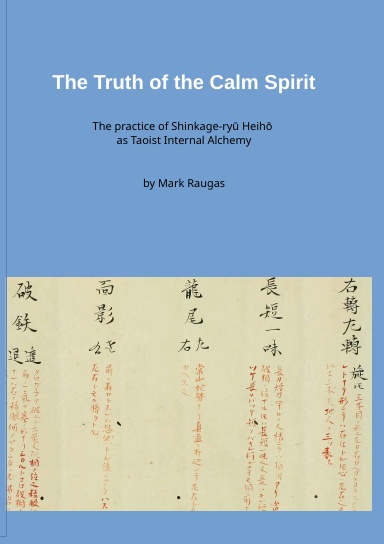
The Truth of the Calm Spirit. Inner Dharma, 2025. 368 pages. An examination of the practice of Jikishinkage-ryū kenjutsu through the lens of internal martial arts.
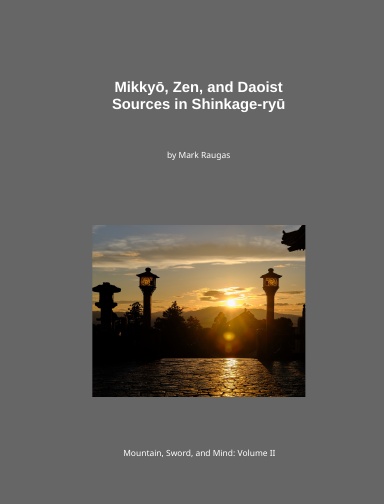
Mikkyō, Zen, and Daoist Sources in Shinkage-ryū. Mountain, Sword, and Mind, Volume II. Inner Dharma, 2026. 437 pages. The Heihō Kadensho, the Tsuki no Shō and Takuan’s writings in translation, with the later Shinkage-ryū tradition.
Essays and Articles
Translations of densho, analyses and essays on Shinkage-ryū and Jikishinkage-ryū. The same pieces appear in the full list of writing.
- Yamada Ippūsai Mitsunori: Yamada Ippūsai Mitsunori (山田一風斎光徳) studied Jikishin Seitō-ryū as a youth and then studied Yagyū Shinkage-ryū heihō in a faction of the Edo line of that art. Later in life he returned to his first training, and eventually inherited that line of practice. July 2026
- Shinkage-ryū in Kyushu: The Kyushu area Shinkage-ryū densho and the Tsuki no Shō of Yagyū Mitsuyoshi both provide descriptions of gokui and kuden level Shinkage-ryū teachings, the first in the form of makimono that list topics and the second in commentary by Mitsuyoshi. July 2026
- The Shinkage-ryū Sotomono of Nabeshima Naotomo (1705): We provide a translation of a text on military strategy by Nabeshima Naotomo, as related to Yamazaki Jinzaemon in 1705 when Nabeshima was ninety years of age. From Fukui 1937’s multi-volume work on the Tokugawa. July 2026
- Comparing the Heihō Zakki (1708) to the Mokuroku Kudensho (1764): Summarizing Karukome’s analysis of the content of two Edo period Jikishinkage-ryū transmission documents. July 2026
- Analysis of Jikishinkage-ryū Densho Commentary: Using NDL cursive OCR models Waseda University Jikishinkage-ryū densho holdings allows us to better gloss commentaries in cursive script as well as small block character notes. July 2026
- Drifting East, Mooring West: A short translation of a matching-rhyme quatrain, brushed on a slip and bound into the front matter of the 1898 Takuan Zenshū, likely by Takuan, that turns on Zen imagery of drifting with conditions and remaining untouched by the world. July 2026
- Taisha-ryū, Denrinbō Raikei, and Hikosan Shugendō: Ming Chinese master of Taisha-ryū and Shugendō practitioner. Some contrasts between Hiko Shugendō and Dewa Shugendō and a digression to a famous school of sword smiths. June 2026
- Evolution of Jikishinkage-ryū Densho: Summarizing Karukome’s research into the composition of written densho of Jikishinkage-ryū, especially where Kashima-centric claims enter the art. June 2026
- Memorial Steles of Jikishinkage-ryū: A survey of Jikishinkage-ryū memorial steles across Kashima Jingū and Chiba — their texts, and the succession dispute they record. June 2026
- Matsuzaki Namishirō and Katōda Shinkage-ryū: Matsuzaki Namishirō (松崎浪四郎, 1833–1896) of Kurume: his training in Katōda Shinkage-ryū, his musha shugyō and gekken years, the Shunpūkan, and his place in the early kendō world. June 2026
- Fixed measurement and the three accordances: Sōjaku-no-koto (相尺之事; mutual distance or measure) is one of the formal matters listed in historical mokuroku of Jikishinkage-ryū kenjutsu. We examine its relationship to Sino-Japanese philosophical concepts. June 2026
- Eight Phases and Eight Extremes: Detail of Hassō Happa from the 1800 Kashima-shinden Jikishinkage-ryū Hōjō densho of Naganuma Tadasato, copied by Ogawa Yashichi, its place in Hōjō swordsmanship, and how the eight phases may relate to the eight extremes of Daoist Huainanzi geography. June 2026
- Kodachi: The ura of Hōjō: Discussion of kodachi and habiki practice in Jikishinkage-ryū Seitō-ha as informed by an examination of Saitō Akinobu (1901) Gokui Kyōju Zukai, explaining brief oral teachings. May 2026
- Late Ming Chinese Influence on Ogasawara Genshinsai: The writings and practice of Ogasawara Genshinsai, his travels in late Ming China, and what Wú Shū’s 1662 preface shows about the direction of sword transmission between Japan and China. May 2026
- A-Un, Gogyō, Godai and Beyond: A brief discussion of the seasonal mappings of kata in Jikishinkage-ryū kenjutsu and how those relate to Daoist complementarity, five phase theory, and partially to Mikkyō concepts. May 2026
- On Researching Gokui: Reflections on researching and writing about inner principles of Japanese swordsmanship and relating those back to philosophical topics. April 2026
- Sente, Kuzushi and Marobashi: Reading the kata of Jikishinkage-ryū through kuzushi — from the hidden order of initiative in tō-no-kata, through the turning point at its capstone, to the close-quarter application of kodachi — framed by the triad of heaven, earth, and man. June 2025
- Hōjō ken Kokoro-e sho: Text, with a translation, on Jikishinkage-ryū Hōjō (foundational) swordsmanship, provided for reference based on Jikishinkage-ryū Sōhonbu and Hōbyōkan material. This is typically chanted or recited before performance of the Hōjō kata of Jikishinkage-ryū. December 2024
- Divergence and Unification in Shinkage-ryū (opens in a new tab): An essay on kata, heihō and shugyō, comparing and contrasting different surviving lines of Shinkage-ryū, with reflections on my own practice. Kogen Budo, 2024.