From Shugendō and Heihō, the first volume of Mountain, Sword, and Mind.
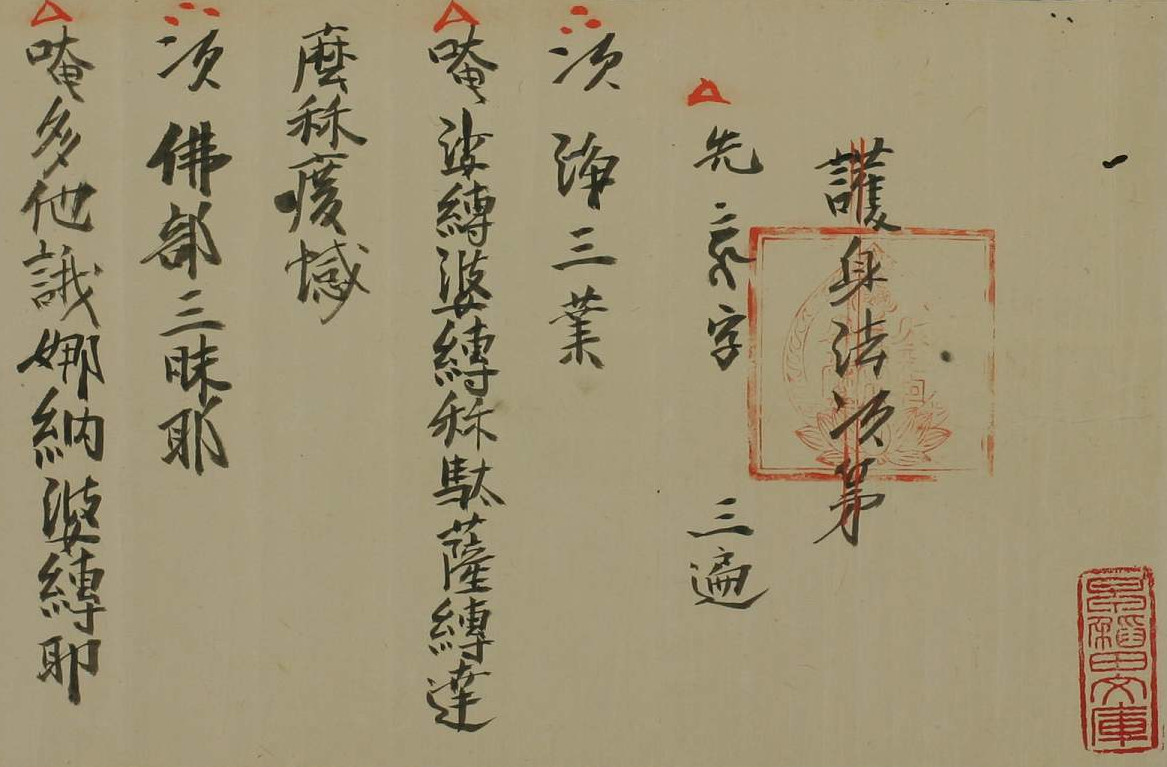
We look at the 1675 Goshinhō Shidai (opens in a new tab) (護身法次第), a mikkyō (esoteric Buddhist) self-protection ritual manual dated Enpō 3 (1675), received by Yokoi Masatake (横井正武) under the title and seals of a Dai-Ajari Hōin (大阿闍梨法印). Goshinhō shidai 護身法次第 [Order of self-protection methods]. Manuscript scroll, Enpō 3 (1675), 12th month [kinoto-u year]. 18.1 × 840.0 cm; ink annotations; insect damage; scroll mounting; appended catalog of contents (附: 目録之次第). Call no. ケ05 01033. Waseda University Library Kotenseki Sōgō Database, Tokyo.
The Yokoi 1675 Goshinhō Shidai, classified by Waseda University Library under “ancient military affairs” (軍事-古代兵事), is preserved in the same archival cluster (call no. ke05 01033) as the Jikishinkage-ryū transmission scrolls ke05 01032 0001–0003. Beyond his signature, the scroll says nothing about its recipient.
The 1675 Goshinhō contains protective rituals used by warriors of the time period, so I examine it in some detail below. This document would be contemporary with the Takahashi Danjō Shigeharu (6th-generation, Jikiōsai) and Yamada Mitsunori (7th-generation, Ippūsai) period of Jikishinkage-ryū transmission and thus from the milieu in which Jikishinkage-ryū’s transmission was being formalized.
The seal 大阿闍梨法印 (Dai-Ajari Hōin):
- 大阿闍梨 (Dai-Ajari) — “Great Ācārya,” from Sanskrit ācārya. This is the highest rank for a Buddhist master qualified to transmit esoteric (mikkyō) teachings. The title is used in Tendai (天台宗) and Shingon (真言宗) Buddhism, and also in Shugendō (修験道), which integrates esoteric Buddhist transmission with mountain asceticism.
- 法印 (Hōin) — “Dharma-Seal,” the highest of three formal Buddhist ranks (above 法眼 Hōgen and 法橋 Hokkyō).
Dai-Ajari Hōin identifies the grantor as a fully-ranked esoteric Buddhist master with authority to perform transmission rites. The colophon sets the title at the end of the scroll, followed by a two-graph name that appears to read 日榮 and two seals, with Yokoi’s signature beside the date: this is Yokoi receiving from a Dai-Ajari Hōin in 1675.
護身法次第 (Goshinhō Shidai)
Goshinhō (護身法; “method of protecting the body”) is a zengyō (前行; “preliminary rite”) inherited by Shugendō from mikkyō, where it opens essentially any ritual sequence in both the Shingon and Tendai traditions. It belongs to the class of kaji (加持; adhiṣṭhāna; “sustaining power”), not to the class of rites performed to obtain an external result.1
Adhiṣṭhāna (अधिष्ठान) is adhi + ṣthā, “to stand upon, stand over.” The root image is standing, basing, presiding. Its semantic range runs:
- basis, substratum, seat, abode (Abhidharma: the physical base of a sense faculty)
- presiding over, superintendence, authority
- sustaining power, empowerment, grace — the Buddha’s power upholding a bodhisattva’s speech
- resolve, determination — as in adhiṣṭhāna-pāramitā
Abhiṣeka (अभिषेक) is abhi + ṣic, “to sprinkle, pour upon,” and in contrast means anointing. It covers royal consecration (rājyābhiṣeka) and, in tantric usage, initiation by sprinkling from the kalaśa vase — rendered in Japanese as kanjō (灌頂; lit. “pouring on the crown of the head”).
In the Japanese ritual vocabulary Kūkai’s gloss splits the compound word kaji:
- 加 is the Buddha’s compassion descending upon the practitioner
- 持 is the practitioner’s mind holding and reflecting it back.
The standard ritual sequence is five-part and only the fifth is protective in the ordinary sense, and it is explicitly armor-imagery. The first four constitute the practitioner as a ritually fit vessel — purified, then affiliated to the three families of the maṇḍala. What “protects” is the resulting identity with the deity, not an operation performed on the practitioner’s surroundings.
In the goshinhō sequence, gosho kaji (五処加持; empowerment of the five places) has the practitioner touch a mudrā to forehead, right shoulder, left shoulder, heart, and throat. Gesturally this resembles chrismation but nothing is applied — no oil, no water, no ash. The mudrā contacts the body and the empowerment is effected by that contact in association with its respective mantra.
This particular document is titled “Order of Self-Protection Methods” and begins with a series of mikkyō rituals, each with a Sanskrit mantra transliterated in Chinese characters and a procedural rubric:
- Jō-sangō (浄三業; purification of the three karmas — body, speech, mind)
- Butsubu sanmaya (仏部三昧耶; buddha-family samaya)
- Rengebu sanmaya (蓮華部三昧耶; lotus-family samaya)
- Kongōbu sanmaya (金剛部三昧耶; vajra-family samaya)
- Hikō goshin (被甲護身; donning the armor for self-protection)
Purifying the Three Karmas is associated with the mantra:
唵婆縛婆縛秫駄薩縛達麼秫度憾
oṃ svabhāva-śuddha sarva-dharma … śuddho ‘haṃ
This part of the document is not school-specific; any mikkyō master would transmit this. Its presence simply confirms the document is from authentic esoteric Buddhist transmission, not a popular or syncretic adaptation.
The goshu goshin (五種護身; “five protections”) — 淨三業, 佛部三昧耶, 蓮華部三昧耶, 金剛部三昧耶, 被甲護身 — is the standard esoteric self-empowerment sequence. Its opening, the purification of the three karmas (淨三業), is the svabhāva-śuddha mantra, canonically 「唵、娑嚩婆嚩秫馱、薩嚩達磨、娑嚩婆嚩、秫度憾」 (oṃ svabhāva-śuddha sarva-dharma svabhāva-śuddho ‘haṃ);2 the document’s 唵婆縛婆縛秫駄薩縛達麼秫度憾 is a shortened transliteration that omits the second 娑嚩婆嚩. The closing 被甲護身 (hikō goshin, “donning armor”) is likewise standard in the core esoteric canon, as is the 智拳印 (Chiken-in, Mahāvairocana’s Vajradhātu jñāna-muṣṭi mudrā).3 The sequence is thus authentic Tendai/Shingon kaji.
九字大事 (Kuji daiji)
The famous Nine-Character Mantra, each character paired with its prescribed mudrā (hand seal):
- 臨 Rin 普賢三昧耶印 (Fugen Samaya-in)
- 兵 Pyō / Hyō 金剛輪印 (Kongōrin-in)
- 鬪 Tō 内獅子印 (Naishishi-in)
- 者 Sha 外獅子印 (Geshishi-in)
- 皆 Kai 外縛印 (Gebaku-in)
- 陳 Jin 内縛印 (Naibaku-in)
- 烈 Retsu 智拳印 (Chiken-in)
- 在 Zai 日輪印 (Nichirin-in)
- 前 Zen 宝瓶印 (Hōbyō-in)
The set closes with 「次口傳」, “next, the oral transmission,” and the lattice mark — the grid itself is left to oral instruction.
This is the kuji-in — the nine syllables cut with their mudrās — whose Daoist origin in the Bàopǔzǐ and crossing through Tanluan into mikkyō and Shugendō Nine Syllables traces; here it appears in its settled Shugendō form, a pre-combat protective ritual.
Apart from its first seal, this is the common Japanese mudrā set for the nine syllables: the vajra-wheel, the two lion seals, the outer and inner bonds, 智拳印 (Chiken-in), the sun-disc and the treasure-vase. Two features set it apart. The first syllable takes 普賢三昧耶印 (Fugen samaya-in), where the common set has the single-pronged vajra mudrā (獨鈷印) and one Shugendō set a needle-seal (針印); and 鬪 and 者 take the inner and outer lion seals in that order, as in the 九字印大事 of the Tōzan-ha 符咒集 set out in the next section, Tōzan-ha Military Kuji, rather than the reverse order of that collection’s second set. The mudrās therefore do not place the document in a Honzan-ha (Tendai-affiliated) lineage; if anything they sit nearer the Tōzan-ha material, which also carries the scroll’s ten-character set (below).
十字大事 (Jūji daiji)
Next follows 十字大事 (jūji daiji), “the great matter of the ten characters.” Under a ten-character heading the scroll gives nine graphs, each with the occasion on which it is to be written in the left palm and carried:4
- 天 Ten — going before daimyō, great houses and high officials
- 龍 Ryū — crossing sea or river, by boat or bridge
- 虎 Ko — traveling broad moors, deep mountains and great mountains
- 王 Ō — bow and arrow, weapons, army camps, mountain bandits and sea pirates, and traveling by night
- 命 Mei — unease about another person, or suspicion of poison in tea or wine
- 勝 Shō — lawsuits, market dealing and contests
- 唵 On — escaping plague, or entering a plague house
- 水 Sui — dark places, unfamiliar rooms in a great house, and heavy drinking
- 大 Dai — ties with bad men, and meeting madmen
This Jūji extension is the more idiomatically Japanese piece of the document — the Nine-Character core is Sino-Japanese standard mikkyō, but the Ten-Character list with situational applications is a more specialized elaboration.
The Nine Characters are pan-Japanese esoteric Buddhist; thousands of documents transmit them. The Ten-Character extension with practical situational applications is far rarer, and its specific content here is highly suggestive:
- Travel-protection emphasis (crossing rivers, deep mountains, night travel) — this is the practical world of an itinerant practitioner. Yamabushi (山伏; mountain ascetics), or shugenja, were exactly this kind of itinerant figure, moving between mountain pilgrimage sites and lay communities.
- Combat/danger emphasis (王 for soldiers and bandits) — this fits both Shugendō practitioners (who needed protection in remote areas) and martial practitioners (who needed it in combat).
- Commerce protection (勝 for market dealing and lawsuits) — Shugendō practitioners often served as itinerant ritual specialists for lay communities, including merchants, and the Jūji daiji with commerce protections is the kind of practical kuji-yōhō (九字用法, “applied uses of the kuji”) that Shugendō transmission collected.
- Disease protection (唵 for plague) — Shugendō practitioners served as kitōshi (祈祷師, prayer-specialists) for plague mitigation and healing rituals; this fits.
- Status-related protection (天 for daimyō, great houses and high officials) — relevant to both warrior-class practitioners and Shugendō figures who served warrior patrons.
The composite picture is of a practical protection-ritual handbook designed for someone who moves through a range of mundane situations carrying spiritual risk — i.e., either a Shugendō practitioner in his pastoral role or, equally plausibly, a lay practitioner who received this transmission as a personal protection set for his own life situations. Yokoi Masatake’s name without a Buddhist title (he is just Yokoi Masatake, not Yokoi Masatake Hōin or similar) suggests he was a lay recipient, who received the Goshinhō from a Dai-Ajari Hōin master as a personal protection transmission.
Historical Context
In December 1675, some relevant cultural-historical conditions:
-
Tokugawa Ietsuna’s reign (4th shōgun, r. 1651–1680). The bakufu had stabilized; samurai families were transitioning from active warriors to administrative officials, but the cultural memory and practice of martial-spiritual integration was still very alive.
-
Shugendō was at a peak of institutional power in this period, with both Honzan-ha (Tendai-affiliated, Shōgo-in) and Tōzan-ha (Shingon-affiliated, Daigo-ji Sanbō-in) operating substantial networks. The Edo bakufu had regulated Shugendō with the Shugendō Hatto of 1613, formalizing the two-school structure, but the practice itself remained widespread.
-
Samurai patronage of mikkyō and Shugendō transmission was standard. Many samurai families had ongoing relationships with specific temples or Shugendō lineages for protective ritual purposes. A samurai receiving a Goshinhō transmission in 1675 from a Dai-Ajari Hōin master would be entirely normal.
-
Yokoi (横井) is a samurai surname borne by several warrior houses; the late-Edo political theorist Yokoi Shōnan came from one of them, in the Kumamoto (Higo) domain.
The document is signed:5
Enpō 3 [1675], kinoto-u year, 12th month, an auspicious day. Yokoi Masatake (横井正武). Dai-Ajari Hōin (大阿闍梨法印), with a two-graph name that appears to read 日榮, and two seals.
Comparing against Shingon Kuji
Comparing against another Kuji document from 1812 (opens in a new tab):
“This document is from the Honma Sōsho (本間叢書), the Honma family collection from Sakata in Dewa Province (modern Yamagata), formerly owned by Count Honma Hyakuri (伯爵本間百里旧蔵).”[^goshinhō-kanji-1]
The document is dated Bunka 9 (1812), late mid-spring (around March of 1812). Copyist is Honma Hyakuri (本間百里) with seals 源百里印 and 百里. The transmission chain visible in the colophon includes Mizushima Bokuya (水嶋卜也), Itō Jin’emon (伊藤甚右衛門) and several individuals using the Yuki-character (幸氏, 幸尭, 幸督, 辛督) as a family-marker — these appear to be members of a samurai house whose tsūji (通字; the given-name graph shared down a family line) is 幸. Final endpoints Matsuoka Seisuke (松岡清助) and Honma Yoichi/Hyakuri (本間與一/本間百里).
It has four titled sections:
- 九字大事 (Kuji Daiji) — Great Matter of the Nine Characters
- 十字秘曲 (Jūji Hikyoku) — Secret Composition of the Ten Characters
- 護身法大事 (Goshinhō Daiji) — Great Matter of the Self-Protection Method
- 護身法 (Goshinhō) — Self-Protection Method
Both documents share the same broad ritual architecture, but have significant differences.
The Yokoi 1675 document for Rin lists 普賢三昧耶印 (Fugen Samaya), whereas the 1812 document lists 小釼印 (Shōken-in, “Small Sword”). In the 3rd and 4th places of the kuji, the inner and outer lion depictions are swapped. Differences of this kind are what distinguish one kuji transmission from another.
The Honma includes a second column for each character giving its associated deity:
- 臨 多聞天 (Tamonten / Vaiśravaṇa)
- 兵 持國天 (Jikokuten / Dhṛtarāṣṭra)
- 鬪 増長天 (Zōchōten / Virūḍhaka)
- 者 廣目天 (Kōmokuten / Virūpākṣa)
- 皆 降三世 (Gōzanze / Trailokyavijaya)
- 陳 軍荼利 (Gundari / Kuṇḍalī)
- 烈 金剛夜叉 (Kongōyasha / Vajrayakṣa)
- 在 大威徳 (Daiitoku / Yamāntaka)
- 前 不動明王 (Fudō Myōō / Acalanātha)
This is the canonical Four Heavenly Kings + Five Wisdom Kings (四天王 + 五大明王) deity-pairing system — a standard Shingon arrangement also found in Tendai. The first four characters get the four heavenly kings (the protectors of the four directions); the last five get the five wisdom kings (the wrathful manifestations who subdue obstacles).
The Jūji content is substantively different:
- Yokoi 1675 (十字大事): 天 龍 虎 王 命 勝 唵 水 大 — nine graphs under a ten-character title, for the hazards of a man moving about the country: great men, rivers, mountains, soldiers and bandits, poison, lawsuits and trade, plague, dark houses and drink, bad men.
- Honma 1812 (十字秘曲): 行 虎 善 神 佛 散 心 破 勝 一 光 — primarily religious-practice situations: road prayers, mountain paths, shrine visits, Buddha images, when enemies come, night travel, facing the enemy, boat-boarding
Only 虎 (Ko, mountain paths) and 勝 (Shō, victory/combat) appear in both lists. The rest of the character set differs entirely. These are not variants of the same Jūji tradition — they are parallel ten-character extensions belonging to different transmission lines.
One of those lines can now be named. The Yokoi 1675 set is not a local elaboration: it is the second jūji daiji of the Shugendō canon, graph for graph and in the same order — 天・龍・虎・王・命・勝・唵・水・大 — where the 目錄’s label 十字大事(通二) promises two transmissions and the canon duly gives a first set on one leaf and this one, headed 祕術也, on the next.6 Both witnesses write nine graphs under the ten-character title, and both set 水 before 大. The occasions agree as well, down to the suspicion of poison in tea or wine and the entering of a plague house. So the Yokoi manuscript is a witness to a canonical transmission rather than to a private one, and the Honma 1812 jūji hikyoku stands out the more sharply for not being.
The titles themselves are distinct: 大事 (“Great Matter”) for the Yokoi vs. 秘曲 (“Secret Composition/Tune”) for the Honma. The “Secret Composition” framing in the Honma suggests a more liturgical conception (something to be recited as a ritual sequence); the “Great Matter” framing in the Yokoi suggests a more doctrinal conception (something to be understood and applied).
The Honma 1812 is designed to be teachable from the scroll itself — a practitioner with no prior instruction could approximate the mudrās from the diagrams. The Yokoi 1675 requires prior instruction — the text descriptions alone (内獅子印, 外縛印, etc.) presume the reader already knows what these mudrās look like. The Yokoi is a mnemonic transmission for someone already trained; the Honma is closer to an instructional manual.
The Honma colophon names a chain of human transmitters: from Mizushima Bokuya, to Itō Jin’emon, to multiple Yuki-named figures, to Matsuoka, then Honma. This is traceable lineage. The Yokoi document gives only the title of the Dai-Ajari Hōin master, with a two-graph name (apparently 日榮) and two seals, and Yokoi Masatake’s signature: a single master and a named recipient.
The Honma format is consistent with how non-clerical bujutsu transmission lines documented their inheritance — by listing named human teachers. The Yokoi format is consistent with how clerical mikkyō transmission documented inheritance — by an authoritative master-seal whose specific identity was secondary to the institutional authority. The Honma document, for its part, carries the explicit Four Heavenly Kings + Five Wisdom Kings pairing most strongly associated with formal Shingon transmission, and uses the opposite 鬪/者 mudrā order from the Yokoi.
End Notes
-
Also commonly translated as “empowerment” or “blessing”. ↩
-
CBETA, T19n0923. ↩
-
被甲護身: CBETA, T18n0883, T18n0888, among others. 智拳印 is pervasive in both the CBETA canon and the Shugendō canon. ↩
-
Waseda ke05 01033, final frame. Each rubric closes 「此字ヲ書テ可持也」, “write this graph and carry it”; the first specifies 「左手内」, within the left hand. ↩
-
延寶三乙卯暦十二月吉日 〔横井〕正武 / 大阿闍梨法印 日榮〔?〕〔two seals〕 — Yokoi Goshinhō Shidai (1675), Waseda ke05 01033. The recipient’s surname is Waseda’s reading, queried in the catalog. ↩
-
SGD, Vol II, koma 120–121 (符咒集 卷六), the second 十字大事. Set out with its occasions and closing rubric in Tōzan-ha Military Kuji. ↩
