At the heart of the military rites lies a formula of nine graphs — rin-pyō-tō-sha kai-jin-retsu-zai-zen (臨兵闘者皆陣列在前) — the kuji (九字, “nine syllables”). It is the most famous aspect of warrior empowerment: a warrior recites it, cuts it in the air, and is armored. But it is not, in origin, Buddhist at all, and the Shugendō canon reflects that. Its history is a three-stage migration — from Daoist mountain-craft, through a Chinese Buddhist patriarch, into Japanese esoteric and finally martial practice.
The Daoist formula
The locus classicus is the Bàopǔzǐ (抱朴子; “The Master Who Embraces Simplicity”) of the alchemist Gě Hóng (葛洪, 283–343), whose “Inner Chapters” prescribe, for one entering the sacred mountains, a nine-graph incantation of the liù-jiǎ (六甲, “six jiǎ”) protective cycle: one recites it “and nothing cannot be warded off.” In its Daoist form the last two graphs read 前行 — “advance in front” — and the sequence is attested across the Daozang (道藏): e.g. the Shitei naihiketsu shugyō-hō (紫庭內秘訣修行法), 「臨兵闘者皆陣列前行、凡此九字常密祝之」 (“…advance in front; these nine graphs, constantly incant them in secret”).1
The Buddhist crossing
The formula entered Buddhism through a figure uniquely fit to carry it: Tanluan (曇鸞, 476–542), the Pure Land patriarch, who had pursued Daoist longevity arts before turning to the nenbutsu. In his Ōjōron-chū (往生論註; the Wúliàngshòu-jīng ubadaisha ganshō-ge chū 無量壽經優婆提舍願生偈註, T40n1819) — the sole occurrence of the kuji in the entire Chinese Buddhist canon, against its saturation of the Daozang and, later, the Japanese Shugendō canon: the measure of how far the “Buddhist” kuji is a Japanese esoteric rather than a Chinese-canonical development — he cites it precisely as a battlefield spell, recited by an army facing the enemy line so that the five weapons do not strike (the passage is translated in full under Canonical source below).2
Two things are important to note. First, the tail is already 在前 (“arrayed present-before”), not the Daoist 前行 — so the form the Japanese tradition would inherit is fixed on the Buddhist side by the sixth century, not invented in Japan. Second, Tanluan cites the martial spell as an analogy: as nine graphs, privately held, turn aside the five weapons, so a few concentrated nenbutsu suffice for birth in the Pure Land. And he names its source outright — 「《抱朴子》謂之要道者也」, “the Bàopǔzǐ calls this an essential Way” — so the Daoist attribution is not a modern reconstruction but a citation inside the sixth-century Buddhist text itself. The kuji crosses into Buddhism as a proof, from the world, of the power of a short, whole-hearted formula — carried by a patriarch who had lived on both sides of the Daoist–Buddhist line.
The Japanese esoteric elaboration
In Japanese mikkyō and Shugendō the nine graphs are elaborated into a longer rite. The Shugendō canon flags its provenance openly — 「九字印明、本非佛說、有道家內包朴子等」, “the nine-syllable seal-mantra is not originally the Buddha’s word; it belongs within the Daoist house, the Bàopǔzǐ and the like”; and, the note goes on, it is therefore not a practice for a monk3 — and its own text still shows the seam, printing the transitional 在前行 (「臨兵鬪者皆陳列在前行」)4 beside the settled 在前 elsewhere. Three moves build the rite on the inherited formula:
- Nine into ten. A withheld tenth graph is added — 「切九字、今入一字爲十字樣有」, “cut the nine, now insert one graph and it becomes the ten” — and unlike the nine, the tenth may not be transmitted, which is what makes the whole a 大事 (a “great matter,” a form of restricted knowledge).
- Cut over the body. The graphs are cut with the sword-mudra (刀印, tō-in) on a four-by-five lattice (四竪五横, “four vertical, five horizontal”) drawn over the practitioner’s own body — the formula written onto the flesh as armor. Nine strokes trace the nine cells; the jūji no daiji (十字大事) adds a tenth, a further vertical, taking the grid to five-by-five, as Tōzan-ha Military Kuji sets out.
- A deity-mandala. The nine are then read as a protective pantheon: 「先護身法。多門天・持國天・增長天・廣目天・軍茶利・降三世・金剛夜叉・金剛德・中央不動」5 — the Four Heavenly Kings ringing the Five Wisdom Kings with Fudō at the center, so that the recited syllables are the war-deities arrayed around their immovable ground.
This is also where the book’s two pantheons meet. The four Heavenly Kings and the five Wisdom Kings are not two lists but one nine-figure mandala — four guardians ringing the five kings, Fudō immovable at the center — and that nine is the nine syllables: the kuji counted as deities. Which makes the withheld tenth legible. The tenth graph is untransmittable and unseen; its deity is Marishiten, whose single gift is invisibility (隱形, ongyō) and who is granted, in the very same military index, a kuji of her own (摩利支天九字法).6 She is the tenth precisely because she cannot be counted in the ring of nine — the hidden term who completes the grid by never appearing in it. The nine-into-ten of the formula and the nine-plus-one of the pantheon are one structure, and its hidden tenth is the invisible goddess of the battlefield.
The corpus carries the Daoist stratum further than the formula alone. It preserves Gě Hóng’s original wording 「臨兵鬪者、皆陣列前行」, with the tail 前行, not the later Japanese 在前.7 The contents of the Shugen koji benran (修驗故事便覽; “Handbook of Shugendō Precedents”) trace the nine-graph spell to the military house — 「九字咒元出兵家事」 — and find 臨兵鬪者 in both the Daoist and the military houses (「道家兵家有臨兵鬪者九字事」).8 It keeps 禹步, the pacing of Yu the Great (= 反閇 henbai), in which the 四縱五橫 grid is traced first and the spell then introduced: 「卽咒曰。四縱五橫吾今出行。禹主衞道蚩尤辟兵」.9 And it keeps the concealment gloss 衣者隱也/所以隱形也, which is the Báihǔtōng 白虎通’s (Kanripo KR3j0023).10
From rite to sword: Yagyū Shinkage-ryū
From here the kuji passed one stage further, out of the ritual manuals and into the sword. Yagyū Shinkage-ryū inherited mikkyō practices in its early curriculum alongside its famous Zen influence. That Zen influence later eclipsed mikkyō both in the popular imagination about the art and in the writings of later practitioners. But, descending from Kamiizumi Nobutsuna and, behind him, the Kage-ryū of Aisu Ikōsai inspired by Saruhi no Mikoto — the deity who appeared to Aisu in monkey form at the Udo cave, and for whom the school’s Saruhi (猿飛; also read enpi) kata is named — and by Udo Dai Gongen, the school carried an esoteric vocabulary into the mid seventeenth century: the kuji, shuji (seed-syllable practice), and the godai (the Buddhist five elements), all of which can be found in the Shugendō ritual praxis this volume documents. One of its early gokui texts, the Tsuki no Shō (月之抄; “Notes at the Moon”) of Yagyū Mitsuyoshi (given a full textual study in Volume II), preserves that vocabulary in a compact cluster whose namesake teaching is called shuji shuriken. What matters for the present register is that the Shugendō canon holds the whole chain in view at once — the Daoist liù-jiǎ, the Buddhist analogy, the esoteric lattice — and militarizes all of it, turning a mountain-traveler’s ward into the armor of a fighting man.
The Tsuki no Shō takes over the kuji on its own account as Shingon: 「九字ノ大事トテ、真言ノ秘法ニアリ」 — a hiden method of the True Word. So the kuji reached Yagyū Shinkage-ryū through a Shingon channel and was labeled accordingly; the school did not read it out of the Daoist source directly, but the source shows through the seam. Beyond that standard ritual apparatus, three things are the school’s own: the name shuji shuriken, its reading of the nine-into-ten, and the gokui triad it belongs to. The concepts the school merely inherited — the godai and the five elements, Marishiten, Fudō — are documented elsewhere in this Part.
Nine into ten, in the sword
The Tsuki no Shō witnesses the nine-into-ten directly, and as a sword teaching: 「此クジニひとつ入テ十字也。ヨコ五ツ・タテ五ツ、トウハ『ジウ』ノ字、十也」 (Tsuki no Shō p. 21) — into these nine, insert one graph and it becomes the 十; five across and five down, so that the whole lattice reads out as the character 「ジウ」, the numeral 十. This is not an idiosyncrasy of the school’s arithmetic. The Shugendō corpus derives the identical figure with the blade — 「以刀印、四竪五横切之」11, cut with the sword-mudra, four vertical and five horizontal — nine strokes, to which one added makes five-and-five, 十. The Yagyū 十字 gloss is simply the grid-count-plus-one of the ritual manuals, transposed into the swordsman’s own hand.
The bridge from rite to kenjutsu is drawn in the corpus itself. Its 十字大事 has the ten graphs 「右此十字任其用、左手內右手釼印書」 — written into the left palm by the right hand held in the sword-mudra — and it keeps the same withheld apex the chapter has already met: 「千金莫傳。許九字不可許十字」, “do not transmit it for a thousand in gold; the nine graphs are permitted, the tenth is not.”12 That withholding is exactly why Mitsuyoshi can name his own tenth a 大事. And the Yagyū text makes the join concrete where the manuals leave it analogical: 「敵の太刀打処ヲ十字ニナルヲゆふ也。文字ヲ心得へし」 — the place where the enemy’s sword strikes is what “becomes the 十”; read it as the graph. For a school glossing its own 十字 teaching, the ritual gesture cut over the body already is a blade, and the crossing that had to be argued in the mikkyō manuals is simply what a stroke does.
Seed syllables
Shuji (種子/種字; Skt. bīja, “seed[-syllable]”) is the core Shingon-mikkyō term for the single graph that holds a deity or teaching in nuce. The Tsuki no Shō’s central gokui is written 手字手利剣 or 種字種利剣 — the head graph alternating between 手 (“hand”) and 種 (“seed”) in cursive — and glossed in katakana as シユリケン (shuji shuriken), the reading secured by four attestations (pp. 20, 21, 31, 65) and by Imamura’s p. 31 ruby 手裏剣 (Imamura Yoshio (今村嘉雄) 1967). Whether a witness writes 手 or 種 decides whether the term reads as “hand-graph” or “seed-syllable,” and the mikkyō reading depends on 種.
The doctrine behind the term is 阿字本不生 (aji honpushō), “the syllable a is originally unborn”: the letter A, first of the Sanskrit alphabet, read as the unarisen, unconditioned source of all dharmas (ādy-anutpāda). Its locus is the Dàrì jīng 大日經 (Mahāvairocana-sūtra) and above all Yīxíng’s commentary, the 大疏 the densho itself names — 「一切諸法住在阿字本不生中」, “all dharmas abide within the original non-arising [signified by] the syllable A.”13 The densho’s bīja doctrine rests on it: 「孔字者是本不生種字也」, the khaṃ-syllable is the unborn seed-graph, and 「諸字門悉心種子也」, all syllable-gates are mind-bījas.
The section is titled 十字手裏見 and its body reads 「種利剣ハ手ノ内ヲミルト云心持ナリ」 — the school technicalizing 手ノ内 into the grip. But the name-cluster it preserves — 種字 / 十字 / 手裏 — is precisely a palm-written-bīja practice: the nine-into-ten jūji above writes a syllable in the left palm. That the ritual sense survives in the heading while the body reads it as sword-mechanics is the stratification you would expect of an imported term. And here the school makes a move that is genuinely its own — one the Shugendō corpus never makes, where 種字 is only ever ordinary bīja (十二天種字, 風大種字, 不動ノ種字): the identification 種字=九字, the seed-syllable equated with the nine.
The 九字 / 護身法 / 十字 sequence the densho names is a real, ordered Shugendō praxis — shown in this chapter, in the war-deity chapters, and in the table of deity mantras — but the equation of the seed-syllable with the nine is Yagyū-internal, or from a source not in the corpus. It is the school reading its own art into the ritual vocabulary it received.14
The Yagyū gokui triad
The Honshiki sanmondō (本識三問答; “Three Dialogues on the Original Consciousness”), the text following the Tengu geijutsuron (天狗芸術論) in the Bujutsu sōsho volume (国書刊行会 (Kokusho Kankōkai, ed.) 1915), is a sympathetic exposition of Yagyū Tajima-no-kami (柳生但馬守 Munenori)’s method (「近代大和國住人柳生但馬守の工夫を以て…今天下無雙の一流」). It contains:
- A critique of fixed forms: other schools treasure a set 太刀の位 as 高上極意, but these are 組もの that only work if the 打太刀 cooperates — 兵法の迷; 「萬の構皆徒事也」, all fixed kamae are useless, and when they dissolve 「切事一つに極まる」.
- The Yagyū gokui (極意) named: 「柳生流の劔術は…手字・手裏劔・神妙劔などと云ふ事を見立分別して、夫を極意と定むる也」, practiced via 三箇三見三調子, always against a 打太刀.
This is an external, Yagyū-focused witness naming the same 極意 triad as Tsuki no Shō p. 69 — there 手字手利劔・水月・神妙劔; here 手字・手裏劔・神妙劔. The variance is informative:
- 手裏劔 (本識三問答) vs 手利劔 (Tsuki no Shō) — the same term in divergent orthography, read shuji shuriken as above; the 手裏/手利 homophony is exploited in-text at 十字手裏見 (shurimi, p. 21), so the “outsider” graphing is attested inside the tradition’s own apparatus.
- 水月 (in the Tsuki no Shō triad) is replaced by 手裏劔 here — the triad’s middle member differs, suggesting the “three 極意” set was not fully fixed across the lineage.
- 三箇三見三調子 matches the Tsuki no Shō 三箇三見 / 三段 material (pp. 58, 60) — the same three-fold pedagogy.
This is independent confirmation that shuji (手字) ・ shuriken ((手利/手裏)劔)・shinmyōken (神妙劔) was the named Yagyū gokui, with enough variance (水月 varying with 手裏劔; 手利 with 手裏) to gauge how fixed that triad was across the lineage.
The grid, named and applied
One leaf of the same 1822 Shugen jōyō hihō-shū (修驗常用祕法集; “Collection of Secret Methods in Common Shugen Use”) transmission (SGD, Vol I, koma 129, 131) prints the grid itself, and it shows two things the argument predicts. First, that the nine cells were counted — given names — and that the census was never fixed: here the nine are neither the syllables nor the four-Kings-and-five-Wisdom-Kings mandala but a third gloss, 「一靑籠・二分王・三朱雀・四除道・五玄武・六三妙・七百狐・八王女・九六合」 — a mixed set in which two directional guardians (朱雀, the Vermilion Bird of the south; 玄武, the Black Tortoise of the north) sit beside apotropaic and cosmological names (除道 “clearing the road,” 六合 “the six directions,” 百狐 “the hundred foxes,” 王女 “the jade-maiden”). The lattice is the same 四竪五橫; only the reckoning of what its nine cells “are” has shifted again.15
Second, that the grid is not only cut before battle but written. Around it the leaf lists twelve apotropaic applications, each headed by the graph to be written (天・鬼・一・龍・行・虎…命・水・王・大・合) and each a situation in which one “writes the graph” (書之): 「疫靈處行時、用之、必不移」 — going where plague-spirits dwell, “use it and [the sickness] surely does not pass to one”; 「渡海川時」 crossing sea or river; 「向病人時…諸病不移」 — before the sick, “the illnesses do not spread”; 「相大酒時…不醉」 — facing heavy drink, “one does not get drunk”; 「相兵杖賊難時」 in the peril of weapons and bandits; 「向惡人時、唱書之、一切无事」 — before an evil man, “chant and write it, and all is without incident.” The mountain-traveler’s ward has become a pocket talisman for contagion, poison, drink, and confrontation alike, sealed with the 不動劒印, the Fudō sword-mudra.15
Its offensive face is the 最勝惠印, the “supreme-victory wisdom-mudra,” carrying a crush-the-enemy verse beside a seed-syllable written in a “great” form (大, three glyphs) and a “small” one (小, one glyph), with a large seed marked ロイ (口傳, “by oral transmission”) — 「破諸魔賊、壞生死軍。諸餘怨敵、皆悉摧滅」, “smashing all demon-brigands, breaking the army of birth-and-death; all remaining foes and enemies, utterly crushed” — a verse the manual does not compose but borrows, for it is the Lotus Sūtra’s own, from the Chapter on the Former Deeds of the Medicine King, where it stands beside the invulnerability formula (火不能燒、水不能漂) that grounds the diamond-body chapter.16 And the leaf closes on a seal that reaches back to the diamond-body: the grid is grounded in 「南天竺那迦囉樹那」, Nāgārjuna of South India, and in the non-dual union of the Diamond and Womb mandalas (金剛胎藏), the supreme-victory wisdom being that two-made-one.17 The same Nāgārjuna who, in the founder-mythology, hands En no Gyōja the diamond-jewel here stands behind the warrior’s grid — the kuji and the diamond body meeting in one patriarch.
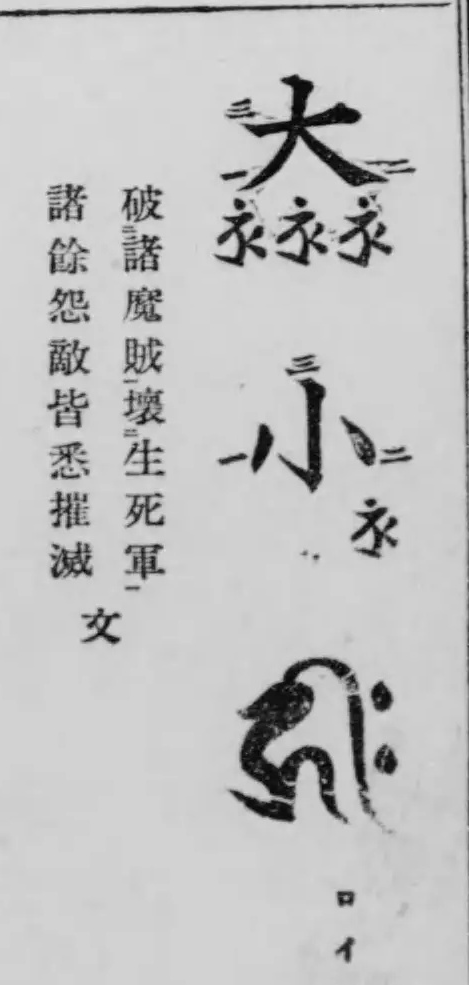
The greater (大) and lesser (小) seed-syllables of the Supreme Wisdom Seal, with the verse 破諸魔賊、壞生死軍、諸餘怨敵、皆悉摧滅 ("breaking the demon-thieves, destroying the army of birth and death, all other foes utterly crushed"). Shugendō shōsho, Vol I, koma 129 (NDL 952642).
That seal faces a diagram that makes the doctrine visible: a bīja-mandala in which nine large circles, set three by three, each hold a cluster of seed-syllables and are ringed by two courses of single-syllable circles. It is the grid in its esoteric form — the nine cells drawn not as an empty lattice or a list of names but as nine seed-syllable bodies within a bounded mandala: the 「三部九身」 (“three divisions, nine bodies”) the seal names, and the union of 「理智不二」, principle and wisdom, Womb and Diamond, made one. Here the chapter’s claim that the nine of the kuji and the nine of the pantheon are a single figure is not argued but drawn — the nine-cell lattice and the nine-body mandala the two faces, exoteric and esoteric, of one leaf. A marginal note on the fold-out records the ground- and letter-colors of the painted original for the nine circles and the courts (院) around them. The plate is reproduced below; the seed-syllables are left untransliterated here.
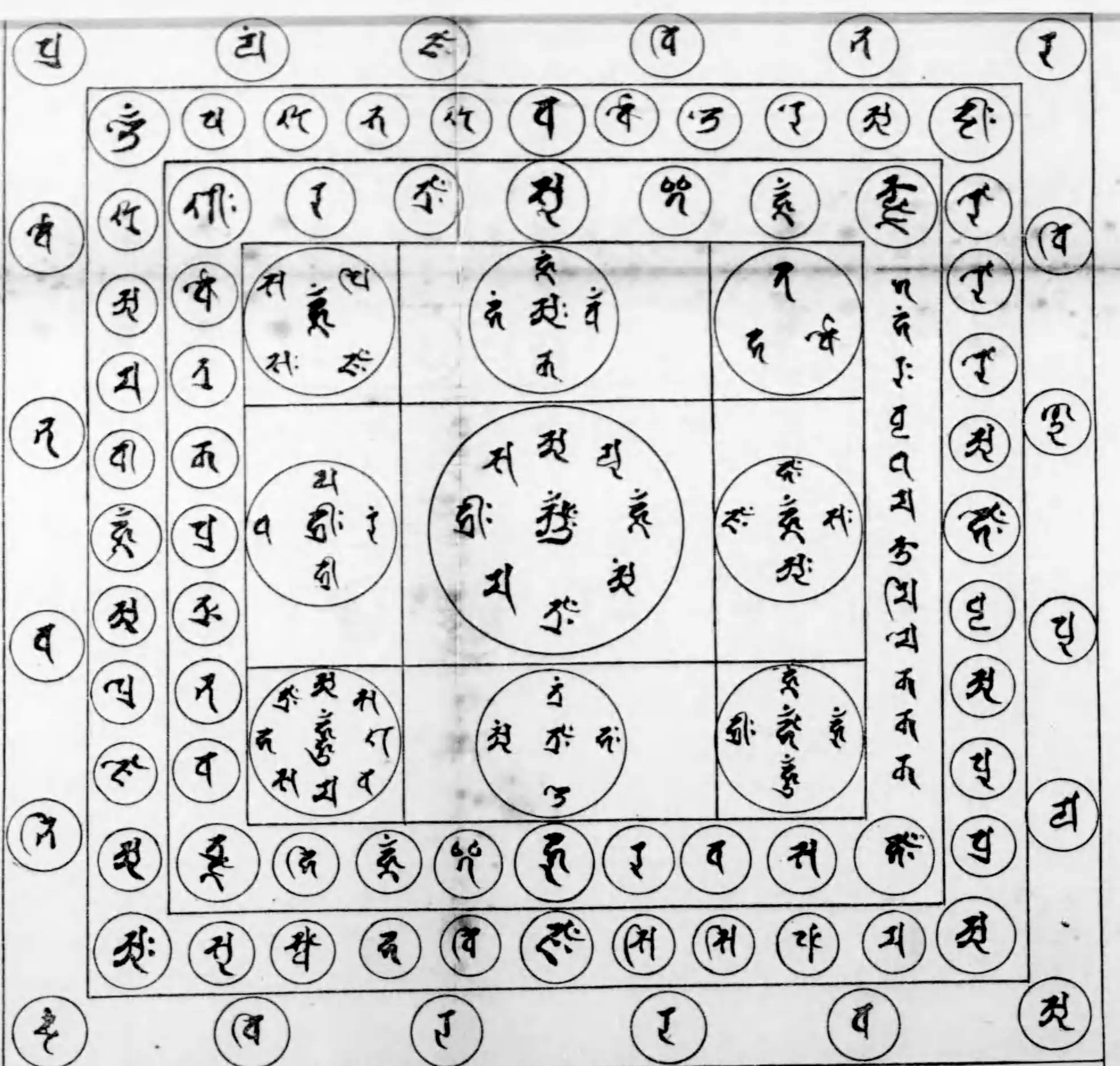
Bīja-mandala of the nine-syllable grid — nine central circles (three by three), each a cluster of seed-syllables, ringed by two courses of single-syllable circles. Shugen jōyō hihō-shū, the leaf facing SGD, Vol I, koma 129 (NDL 952642).
kanji — SGD, Vol I, koma 129 / 131 (printed p. 250 and fold-out)
〔兵法九字大事〕天、向高人時、惑書手内。鬼、疫靈處行時、用之、必不移也。一、向山野行時、書。龍、渡海川時、書唱之。行、往還書唱之、如意滿足。虎、一切合獸時、書此字也。〔…〕(傍訓カラ)、向病人時、書之、諸病不移也。命、危向食時、書之、遁害。水、相大酒時、書之、不醉也。王、相兵杖賊難時、書唱也。大、向惡人時、唱書之、一切无事也。合、對人大事用云時、書之。不動劒印。
〔九字盤〕一靑籠・二分王・三朱雀・四除道・五玄武・六三妙・七百狐・八王女・九六合。
〔最勝惠印〕大〔種子三字〕・小〔種子〕・〔種子〕(ロイ)。破諸魔賊、壞生死軍、諸餘怨敵、皆悉摧滅。文。
〔f.131〕熟以修驗最勝惠印三昧耶之軌則者、金剛胎藏各別、上摂聚合成而取、令成立而不二之教法也。而已、是則入從二而至不二、而極竟不二之深旨。此法者、是南天竺那迦囉樹那大士心藏之祕說、一乘峯中直授相承密旨也。三身互有三身、是名三部九身之法。是則理智不二定證也矣。今亦七壇之祕標者、〔…〕峯見靈之諸尊自然法爾〔種子二字〕本躰聖明也。依之備不二、登軌次第至極壇。祕深者、如何限次第差軌哉。總漫徐書之者也。
〔對頁〕種子曼荼羅 — 中央三行三列九大圓、各圓内数種子、外二重ニ單種子圓ヲ列ヌ。〔種子未釋讀〕欄外注:「九円ハ地黒円、内赤種字金粉。第〔…〕院ハ地青円、赤字黒。第〔…〕院ハ地アイ色円、白字黒。第三院ハ地赤丸、内黒字白也。但深秘等天八供四攝八大円、其外ハ小円、可〔…〕也」。
The military register
The strongest single finding is that this is not a scattering of martial allusions but a cataloged genre. Scroll six of the Shugen jinpi gyōhō fujushū (修驗深祕行法符咒集; “Collection of Secret Shugen Ritual Methods, Talismans and Mantras”) is, in effect, a military index18: the battle-array rites (陳拂法兵法番大事・陳着法兵法冠大事・陳拂法兵法雷大事), the nine- and ten-syllable “great matters,” the 摩利支天九字法, and a full run of consecrations — clothing, weapons, armor, bow and arrows, sword, whip, horse (新衣服加持作法・兵具加持大事・具足加持・弓箭加持・刀加持・鞭加持・馬加持法) — closing with the setting-out and sea-crossing rites (出行大事・船乘大事・渡海安全法). The flagship item, 兵法九字大事, is titled in the Nihon Daizōkyō’s own table of contents,19 in a group of talismans that opens with a childbirth talisman (易產符), just before the mandala-scrolls; the 兵法 material clusters across the canon’s first two volumes.20
The military rites all rest on the inherited structure already described: the Daoist formula, whose original tail 前行 is attested across the Daozang,21 regularly Buddhist-ized in the canon to 在前,22 though two pages still preserve the older 在前行;23 and the nine plus a withheld tenth, cut over the body with the sword-mudra on the 四竪五横 grid. These rites are then framed for the battlefield — guarded by the Four Heavenly Kings around a central Fudō, with applications listed flatly: 「大勝負時・一河渡海時・惡盜人不合」 (the great contest; crossing a river or sea; not meeting bandits).24 What this corpus adds to that inherited structure is the application layer built on top of it — the consecrations and subjugation rites below.
That layer is the 大事 series of weapon-consecrations25 — each a mudra, a mantra, and a waka. The armor rite (兵法甲冑大事) is the type-case: 「先護身法。次外縛深交置頂上。是甲印也。次九字」 — after the self-protection, the deeply-crossed outer-bind mudra set on the crown is the armor (甲印), sealed with the nine syllables. The long-sword rite (太刀大事) closes 「怨敵消滅」; the bow rite (繕弓大事) uses the mantra of Aizen Myōō (愛染明王; Skt. Rāgarāja)26 to “sweep the demons away with bow and arrow” (弓箭); the side-sword (脇刀大事) turns on Monju’s mantra. Fudō, Monju, Aizen, and Batō Kannon (馬頭觀音; Skt. Hayagrīva) are the deities the weapons are consecrated to.
Beneath the protective rites runs an aggressive one, a subjugation grammar, and the corpus grades it. It distinguishes chōbuku (調伏, inward subjugation) from gōbuku (降伏, outward subduing): 「內調伏衆生惡心、外降伏四魔怨敵」27 — inwardly subjugate beings’ evil minds, outwardly subdue the four Māra and the enemies — then escalates to the realm: 「摧破國家怨敵、降伏衆生作障」28, crushing the enemies of the state. Even the yamabushi’s staff is weaponized — the ringing of the khakkhara 「摧伏毒害」 (“crushes poison-harm”) — and the register runs down to the everyday, in 盜人調伏 thief-subjugation talismans (盜人除ノ札).
Together the material shows a Shugendō that has militarized the esoteric apparatus itself: the kuji becomes 兵法, the consecrations arm the warrior’s body and his weapons, the subjugation rites turn the ritual outward against enemies — all of it opening from Fudō’s still center and worked through the war-deities of The War Company.
Military & subjugation vocabulary
| Term | Sense | Occ. | Pp. |
|---|---|---|---|
| 兵法 | heihō — military method | 34 | 13 |
| 降伏 | subdue | 304 | 108 |
| 調伏 | ritual subjugation | 84 | 35 |
| 怨敵 | enemies | 65 | 31 |
| 軍 | army / troops | 374 | 129 |
| 太刀 | sword | 48 | 15 |
| 弓箭 | bow & arrow | 38 | 18 |
| 甲冑 | armor | 20 | 11 |
The ritual manual’s index
Koma 156 carries the table of contents (目次) of the Shugen jinpi gyōhō fuju zokushū (修驗深祕行法符咒續集; “Continued Collection of Secret Shugen Ritual Methods, Talismans and Mantras”),29 and it lists the martial deities’ rites among its entries: 兵法九字大事 (the military kuji, no. 5), 摩利支天日所作 (Marishiten’s sun-rite, no. 9), 不動尊祕印 (Fudō, no. 13), 毘沙門天根本印 (Bishamon, no. 15), and 大黑天祕印 (Mahākāla’s secret mudra, no. 21) — alongside 吒枳尼天, 總許可八字文殊印, 愛染明王祕印, and 火伏大事. And item 5 itself spells out the kuji’s deity-grid quoted above.5 So the four war-deities are not merely co-located but entries in one ritual manual’s index, with the kuji formally structured as a protective deity-mandala.
Canonical source
The kuji in Tanluan’s Ōjōron-chū
Tanluan’s (曇鸞) Ōjōron-chū (往生論註 / 無量壽經優婆提舍願生偈註, CBETA T40n1819):
“Again, just as when a marching army faces the enemy line one need only recite, through clenched teeth, ‘rin-pyō-tō-sha kai-jin-retsu-zai-zen’ (臨兵鬪者皆陳列在前); reciting these nine graphs, the five weapons cannot strike — the Bàopǔzǐ (抱朴子) calls this an ‘essential Way’ (要道). And one racked with cramp, warming a wood-quince (木瓜) over the fire against it, is cured; and there are those who merely call the name ‘wood-quince’ and are also cured — I have had that effect on my own body. Such near-at-hand things the whole world knows in common; how much more the inconceivable realms?”30
Contents: Shugendō and Heihō · ← Kūkai’s Secret Key to the Heart Sūtra · Tōzan-ha Military Kuji →
-
Locus classicus Gě Hóng’s Bàopǔzǐ neipian — Kanripo, KR5f0019, 抱朴子內篇, 登涉篇 (juan 17): 「宜知六甲祕祝、祝曰、臨兵鬭者皆陣列前行」 (“one should know the secret invocation of the six jiǎ; the invocation runs: rin-pyō-tō-sha kai-jin-retsu — zen-gyō [advance in front]”). The same 前行-ending form is also at Kanripo, KR5c0271, Shitei naihiketsu shugyō-hō (紫庭內秘訣修行法); the distinct alchemical KR5c0316, 抱朴子神仙金汋經, is a different text. Its primary Daozang parallel is KR5c0350. The later Japanese liturgy alters the tail to 皆陣列在前, a form attested in the Shugendō corpus (「臨兵鬪者皆陳列在前」, alongside 皆陳列前行 / 皆陣列在前行 variants). ↩
-
CBETA, T40n1819, Ōjōron-chū (往生論註 = 無量壽經優婆提舍願生偈註, Tanluan 曇鸞, 476–542): 「行師對陳、但一切齒中誦『臨兵鬪者皆陳列在前』。行誦此九字、五兵之所不中」. The kuji recurs in the Shugendō canon at SGD, Vol I, koma 113, 125; SGD, Vol II, koma 95, 118–120. ↩
-
私云。九字印明本非佛說有道家內包朴子等。云云是沙門非可行法也 — SGD, Vol II, koma 119 (符咒集 卷六, 二百 九字大事, closing note; printed p. 227). 包朴子 is so printed, for 抱朴子. ↩
-
次九字傳受。臨兵鬪者皆陳列在前行 — SGD, Vol I, koma 125 (Shugen jōyō hihō-shū; printed p. 242). ↩
-
SGD, Vol II, koma 156 (修驗深祕行法符咒續集 卷上, 五 兵法九字大事; printed p. 301). 增 and 茶 are as printed; the eighth name is printed 金剛德 with the side-gloss 大威, i.e. 大威德. ↩ ↩2
-
SGD, Vol II, koma 79 (修驗深祕行法符咒集目錄, 卷第六: 摩利支天九字法). ↩
-
SGD, Vol III, koma 60 (修驗道初學辯談, 九字祝, quoting 抱朴子內篇): 「臨兵鬪者皆陣列前行。凡九字常當密祝之。」 ↩
-
SGD, Vol III, koma 274 (修驗故事便覽 目錄, 卷第二, 二十三 九字; printed p. 527): 「九字咒元出兵家事」「言書九字言切事」「道家兵家有臨兵鬪者九字事」「急急如律令事」 — four article titles. The earlier reading 「切事、道家・兵家有」 ran the end of one title into the next. ↩
-
SGD, Vol III, koma 292 (修驗故事便覽 卷二, 二十三 九字; printed p. 562), quoting 三山施公子美’s 軍林寶鑑, 上卷 速用篇: 「…以右手大腸指先畫四縱後爲五橫訖。卽咒曰。四縱五橫吾今出行。禹主衞道蚩尤辟兵。盜賊不起…」. 辟兵 is so printed; the earlier 路兵 was a misreading. ↩
-
SGD, Vol III, koma 11 (資道什物記 卷上; printed p. 6): 「白虎通曰。衣者隱也。所以隱形也。文」. ↩
-
次以刀印四竪五横切之 — SGD, Vol II, koma 119 (符咒集 卷六, 二百 九字大事; printed p. 227). ↩
-
SGD, Vol II, koma 121 (符咒集 卷六, the second 十字大事, rubric; printed p. 230). The rubric says 十字, but the leaves print nine graphs for this set (天・龍・虎・王・命 on koma 120, 勝・唵・水・大 on koma 121). ↩
-
Yīxíng 一行, Dàrì jīng shū 大毘盧遮那成佛經疏, CBETA T39n1796 (SAT-confirmed). ↩
-
「種字ト云習之心持、九字ノ大事トテ、真言ノ秘法ニアリ」 (p. 21) 「手字手利剣ハ真言ノ九字・護身法、十字ノ大事ト云」 (p. 69) ↩
-
SGD, Vol I, koma 129 — the heihō kuji daiji grid: its nine named cells (青籠/分王/朱雀/除道/玄武/三妙/百狐/王女/六合), the “write-the-graph” apotropaic applications, the 不動劒印, and the 最勝惠印 crush-enemy verse (破諸魔賊・壞生死軍・諸餘怨敵皆悉摧滅). ↩ ↩2
-
「火不能燒、水不能漂…汝今已能破諸魔賊、壞生死軍、諸餘怨敵皆悉摧滅。」 — CBETA, T09n0262, Myōhō renge-kyō (妙法蓮華經), 藥王菩薩本事品. ↩
-
SGD, Vol I, koma 131 — the facing leaf: the grid repeated, closing on the doctrinal seal (南天竺那迦囉樹那 / 龍樹; 金剛胎藏 理智不二; 三部九身). ↩
-
SGD, Vol II, koma 79 (修驗深祕行法符咒集目錄, 卷第六, printed p. 147). ↩
-
SGD, Vol I, koma 6 (日本大藏經目次, printed p. 6): the talismans 易產符・五大尊守并符・兵法九字大事・乘馬守護・愛染守・社頭棟札・却疫病札, followed by 修驗慧印總漫擺拏一舖. ↩
-
SGD, Vol I, koma 6, 113 (兵法萬卷中灌頂守), 128 (兵法九字之大事), 180 (兵法甲冑大事), 182 (兵法大事); Vol II, koma 79, 118 (陳拂法兵法番大事), 120 (兵法十字之事), 121 (兵具加持大事), 156 (兵法九字大事). ↩
-
Kanripo, KR5c0271, Shitei naihiketsu shugyō-hō (紫庭內秘訣修行法): 「臨兵闘者皆陣列前行、凡此九字常密祝之」. ↩
-
SGD, Vol II, koma 95 (臨兵鬪者皆陳烈在前, closing 七十八 十二天法; printed p. 178), 118–120 (the same tail in the grids of 卷六). ↩
-
SGD, Vol I, koma 125 (Shugen jōyō hihō-shū, 次九字傳受: 臨兵鬪者皆陳列在前行; printed p. 242) and koma 113 (南無臨兵鬪者皆陣烈在前行; printed p. 218). ↩
-
SGD, Vol II, koma 120 (符咒集 卷六, 二百四 十字大事; printed p. 229). ↩
-
SGD, Vol I, koma 180 (神社印信, nos. 15–22; printed pp. 342–343). ↩
-
Aizen Myōō’s mantra: oṃ mahārāga vajroṣṇīṣa vajrasattva jaḥ hūṃ vaṃ hoḥ (唵摩訶羅誐嚩日路瑟捉灑嚩日囉薩怛嚩弱吽鑁斛); Aizen’s mantra is called for in the Shugen jōyō hihō-shū’s 虎之卷加持 (SGD, Vol I, koma 125: 愛染明王咒。大咒百反), printed as 愛染明王眞言 三首 in the mantra list of the Shugen jōyōshū 卷下 (koma 159), and prescribed in the bow rite 繕弓大事 (koma 180: 愛染咒。七反). ↩
-
內調伏衆生惡心。外降伏四魔怨敵 — SGD, Vol II, koma 285 (彥山修驗道祕決灌頂卷, 第三 外用山伏事). ↩
-
亦光中雨釼輪弓箭摧破國家怨敵降伏衆生作障 — SGD, Vol I, koma 242 (金峰山祕密傳 卷下, Kinpusen himitsuden; printed p. 466), in the transformation of the jewel (寶珠) into Benzaiten. Previously cited as Vol III, koma 10, a leaf of the 資道什物記 that does not carry the passage. ↩
-
SGD, Vol II, koma 156 (修驗深祕行法符咒續集 目次 and 卷上 nos. 1–5; printed pp. 300–301). ↩
-
亦如行師對陳、但一切齒中誦「臨兵鬪者皆陳列在前」。行誦此九字、五兵之所不中、《抱朴子》謂之要道者也。又苦轉筋者、以木瓜對火熨之則愈。復有人但呼木瓜名亦愈、吾身得其效也。如斯近事世間共知、況不可思議境界者乎。 ↩