The previous section read the Goshinhō document and its kuji as a warrior received them; this one turns to the military kuji proper — the Tōzan-ha 符咒集 scroll (Shugen jinpi gyōhō fujushū; “Collection of Secret Shugen Ritual Methods, Talismans and Mantras”), whose sixth fascicle packages the nine syllables, the protection-rite, and the ten into a campaign liturgy.
Military Kuji
The 兵法 kuji family is large. From the index lines we find: 九字大事 / 九字印大事 / 摩利支天九字法 / 九字垂迹・九字本地・九字本位 / 兵法九字大事 / 陳拂法 兵法番大事 / 陳着法 兵法冠大事 / 陳拂法 兵法雷大事. Plus 「九字本地 — 臨 如意輪・十一面・馬頭・准胝觀音」, assigning each syllable an honji deity, and another that assigns guardian deities, Heavenly Kings and Wisdom Kings alike (廣目天・大威德・增長天).
The 陳拂法 and 陳着法 items are battle-formation rites (clearing and setting the array), with 「先九字印」 and 「外縛。九字九遍」 (SGD, Vol II, koma 118). So the martial application isn’t a single item — it’s a sub-family.
And the Shugen koji benran (修驗故事便覽; “Handbook of Shugendō Precedents”) 卷二 has a mondō on the verb itself (二十三 九字; listed in its 目錄 as 言書九字言切事, SGD, Vol III, koma 274): why do we say “cut” the nine syllables rather than “write” them — because the sense is 切斷, severing. 「是ノ故ニ吾徒、九字ヲ切ルト呼ビ來レリ」 (SGD, Vol III, koma 292, printed p. 562).
The Tsuki no Shō (月之抄; “Notes at the Moon”) of Yagyū Mitsuyoshi, with its 手字手利剣/種字 complex, names a sequence — from 護身法, to 九字, then 十字 — that the Japanese esoteric-practical corpus carries as titled, numbered items with the identical 9+1=10 construction, the identical grid-count behind the Yagyū’s 5×5 gloss, the sword-mudra as instrument, palm-writing, and an explicit military sub-family. What the Yagyū text adds is the school’s own labeling (真言ノ秘法) and its technicalization of 手ノ内 from palm to grip. What it does not share is 種字=九字.
The jūji is found in the Shugen jinpi gyōhō fujushū (修驗深祕行法符咒集, titled in the canon 当山修験深祕行法符咒集; SGD, Vol II), in ten scrolls. 当山 is 当山派 (Tōzan-ha), the Shingon-affiliated branch of Shugendō, centered on Daigo-ji Sanbōin — as against the Tendai-affiliated 本山派. And the 目錄 confirms the institutional register with an item of 卷第五, 「眞言宗四箇處本寺」.1
The 目錄 gives a coherent block, not scattered items; its twenty-six items are set out in order under Shugendō Military Scroll Details below. The first to concern us is 九字印大事 (no. 二百一), which gives each syllable its seal:
kanji
臨 寶瓶印(外縛中指立合)/ 兵 大金剛輪印 / 鬪 內獅子印 / 者 外獅子印 / 皆 外縛二風二指立合 / 陳 內縛印 / 烈 智拳印 / 在 日輪印 / 前 遠行印(隱形) — 右大指入左掌
Then: 「口傳云、朝向日天修之。切畢日輪內左書光字、右可書〔梵字〕字、切書不動釼印半印也」 — perform it in the morning facing the sun; when the cutting is done, write 光 on the left within the sun-disc and a Siddham syllable on the right, writing it with the half-seal of the Fudō sword-mudra.
And above it, the transmission clause:2
I give one transmission here and omit the rest; cut the nine, insert one, and there is a ten-form.
The grid diagram is printed, with the strokes numbered 一三五七九 against 二四六八 — nine strokes, odd and even alternating, and the added tenth. That is the Tsuki no Shō’s 「ヨコ五ツ・タテ五ツ」 in its source form.
The ten-character lists
Both 二百三 兵法十字之事 and 二百四 十字大事 are character-lists with assigned uses, written in the left palm:
kanji
兵法十字之事 opens with 勝 — 「出軍陳、其外一切勝負事時、可切加此字。又書持左手內、必得勝利也。已下皆准之」 — then 鬼・龍・一・角・行・命・水・天・虎・太・合 with uses (crossing water, sickness, losing the road, poison, audiences with the great, facing the enemy: 身心堅固). Closing: 「右、內隨用九字、末一字以加之、號爲十字大事。又左手內書持何字、如最初勝字也」.
十字大事 gives, in its first transmission, 吉・大・一・惡・鬼・識・會・水・食・敵 with paired applications — 大勝負時, 一河渡海時, 惡盜人不合, 會狂人行合時 — and, in its second (祕術也), 天・龍・虎・王・命… with 弓箭兵杖軍陣山賊海賊夜行時; the first closes with a 口傳 about writing with a willow-twig, three times, with the Heart Sūtra thrice and the Ichiji-kinrin mantra, ending 「努々不可他見」.3
The compilation is firmly dated 1609, at Hase-dera in Yamato.
Four internal colophons, all in the compiler’s own hand-notes:
- SGD, Vol II, koma 134 (卷八): 「弘治三年八月廿五日、前大僧正隆源御自筆書寫之。慶長十四己酉二月廿四日、於和州長谷寺書寫畢。法印性盛大和尚位、受與賢賀之」
- koma 154 (卷十, closing 三百七十三 靈供作法事; printed p. 297): 「慶長十四年二月晦日、授與賢賀。法印性盛」
- koma 97 (卷三, closing 九十 護身法大事; printed p. 183): 「天文十七季五月三日、奉授與雅法印。傳授阿闍梨秀尊。慶長十四年二月晦日、申請彼御本書寫畢」
- koma 96 (卷三, closing 八十五 大師拜見大事; printed p. 181): 「慶長十四年三月一日、於和州長谷寺書寫畢。傳授性盛法印」
So the copying campaign runs from the 24th day of the second month to the 1st day of the third month of Keichō 14 (1609), at 和州長谷寺 — Hase-dera in Yamato — by 法印性盛 (Hōin Shōsei), conferring on 賢賀 (Kenga).
The compiler, dated by his own transmission record on koma 148, gives the succession explicitly:4
Shōsei received transmission in Tenbun 22 = 1553 and transmitted to Kenyu in Tenshō 16 = 1588. Koma 84 gives the lineage chain independently: from 快善法印, to 快成, to 憲海, to 政實, to 教任, to 性盛, then 堅瑜.5 So his floruit is c. 1553–1609+, and he was still copying fifty-six years after his own transmission.
Source strata absorbed: 天文3 (1534), 天文17 (1548) for the 護身法大事, 弘治3 (1557) from Daisōjō Ryūgen’s autograph, 天正16 (1588).
Provenance: the Sanbōin archive.
- koma 147 (卷九, closing 三百四十七 夢違之大事; printed p. 282): 「右此大事、從醍醐三寶院經藏出之。可祕可祕」
- koma 151 (卷十, closing 三百五十九 光明眞言土砂加持大事; printed p. 290): 「三寶院嫡嫡相承之祕傳。云云。傳授大阿闍梨法印性盛」
Daigo-ji Sanbōin is the Tōzan-ha headquarters, which confirms the 当山 in the title and closes the loop: the Tsuki no Shō’s 「真言ノ秘法」 is an accurate description of this material’s institutional home.
Chronology and Geography
1609 (with sources to 1534) precedes the Tsuki no Shō (1642) by a generation, and precedes the maturity of Yagyū Munenori (柳生宗矩). The material could not have been drawn from the Yagyū text; the direction of any dependence, if there is one, is the other way or from a common source.
And the geography is remarkable. Hase-dera (長谷寺) is in Yamato — the Yagyū’s own province, some 25 km from Yagyū village. Yagyū Sekishūsai (柳生石舟斎) lived 1529–1606; Shōsei’s floruit is 1553–1609. Exact contemporaries in the same province.
Now set that beside the Tsuki no Shō’s account (p. 33) of where its hōshin teaching came from:6
As for this teaching: when the late father (亡父) made supplication at Hatsuse-dera … he gazed long, understood, and made it the present hōshin teaching. It is wholly the vow of Kannon.
初瀬寺 is 長谷寺 — Hatsuse is the old name of the place, and the temple’s Eleven-Headed Kannon is exactly what 「観音ノ誓」 points to. The Tsuki no Shō locates the origin of one of its gokui at the same temple where this compilation of martial esoteric ritual was being copied in the same decades.
An Influence on Yagyū Esoterica
The Tsuki no Shō’s 九字/護身法/十字 sequence matches, item for item, a Tōzan-ha compilation demonstrably completed in 1609 at a temple in the Yagyū’s home province, from Sanbōin materials reaching back to 1534 — and the Yagyū text independently records one of its own teachings as originating in prayer at that temple.
The items compiled — 「總計四百四十法」 — number 440 methods across ten scrolls. Read in sequence, this is a working manual for a Tōzan-ha practitioner’s entire professional life — morning liturgy, deity rites, pilgrimage, shrine service, the ritual calendar, military service, exorcism, medicine, binding and childbirth, funerals. Cradle to grave, plus the trades in between.
The 兵法九字/十字 material is not an anomaly or a specialist curiosity: it is scroll six of ten, the chapter covering what a yamabushi sells to a warrior clientele — formation clearing rites, the kuji and the ten, weapon and armor empowerment, horse and travel protection. A Yamato warrior house acquiring this vocabulary needs no exotic explanation; it is one of the services on offer, from practitioners operating in their province.
The deity distribution puts Marishiten in 卷二 and 卷三 (with the 鞭法) before her kuji-method reappears in 卷六 — she is a general-purpose deity in the Shugendō catalog, not a specifically martial one. The martial application is a subset of broader ritual functions.
護身法大事 is item 90 in 卷三, well away from the kuji in 卷六 — so the Tsuki no Shō’s 「九字・護身法・十字」 sequence is procedural (護身法 opens nearly every rite: 「先護身法。次…」), not a citation of adjacent items in this book.
The rest of this section sets out scroll six item by item — battle-array rites, the kuji and the ten, weapon and gear empowerments, horse-and-travel rites — and then its ritual variants.
Shugendō Military Scroll Details
The military scroll has the following twenty-six items, in the order the 目錄 gives them:
Battle-array rites (three)
| Item | Reading | Translation |
|---|---|---|
| 陳拂法・兵法番大事 | jinbarai-hō / heihō ban no daiji | Array-sweeping method; the great matter of the military watch |
| 陳着法・兵法冠大事 | jinchaku-hō / heihō kan no daiji | Array-donning method; the great matter of the military crown |
| 陳拂法・兵法雷大事 | jinbarai-hō / heihō rai no daiji | Array-sweeping method; the great matter of military thunder |
陳 is 陣 throughout — the battle formation. The 目錄 prints all three titles as given: 番 is 番 (ban, watch or guard duty), not 幡, and the third rite is a second 陳拂法, not a “breaking” rite; 冠 (crown/helmet) and 雷 (thunder) read straightforwardly. The body text confirms these are kuji operations: 「先九字印」 for the first, and for the second 「外縛。九字九遍。開其印自頂上下三度垂下加實名」 — the outer-bond mudra with the nine syllables nine times, then the mudra opened and drawn down from the crown of the head three times, adding one’s real name (SGD, Vol II, koma 118, printed p. 225).
Kuji doctrine (three)
| Item | Reading | Translation |
|---|---|---|
| 九字本地 | kuji honji | The nine syllables’ original ground |
| 九字垂迹 | kuji suijaku | The nine syllables’ trace-manifestation |
| 九字本位 | kuji hon’i | The nine syllables’ original position |
This is honji-suijaku (本地垂迹) applied syllable by syllable — each of the nine assigned a Buddhist identity and a kami manifestation. The body gives one such set: 「九字本地 — 臨 如意輪・十一面・馬頭・准胝觀音…」, i.e. forms of Kannon for the first syllable (SGD, Vol II, koma 119, 百九十八 九字本地); the facing 百九十九 九字本位 sets a Heavenly King or Wisdom King against each syllable, with 不動 at 皆 — the nine-figure mandala of Nine Syllables.
Kuji practice (three)
| Item | Reading | Translation |
|---|---|---|
| 九字大事 | kuji no daiji | The great matter of the nine syllables |
| 九字印大事 | kuji-in no daiji | The great matter of the nine-syllable mudras |
| 摩利支天九字法 | Marishiten kuji-hō | Marīcī’s nine-syllable method |
九字印大事 is the one with the mudra-per-syllable list (臨=寶瓶印, 兵=大金剛輪印, 鬪=內獅子印, 者=外獅子印…) and the printed stroke-grid.
The Ten (two)
| Item | Reading | Translation |
|---|---|---|
| 兵法十字之事 | heihō jūji no koto | The matter of the ten characters in military method |
| 十字大事(通二) | jūji no daiji | The great matter of the ten characters (two transmissions) |
Both are palm-written character sets, but they are not the same kind of thing, and the first is not a list of ten at all. 兵法十字之事 offers twelve graphs — 勝・鬼・龍・一・角・行・命・水・天・虎・太・合 — from which the practitioner takes one, chosen to fit the occasion, and appends it to the nine syllables. The article says so in closing: from among the above, as use requires, add one graph to the end of the nine, and that is what is called the ten-character great matter.7 The “ten” is nine-plus-one, which is also what the transmission clause means by cutting the nine and inserting one to make the ten-form. 十字大事 is the different case: a closed set of exactly ten (吉・大・一・惡・鬼・識・會・水・食・敵), each tied to a named hazard. Both are given in full below.
Empowerment of gear (seven)
| Item | Reading | Translation |
|---|---|---|
| 新衣服加持作法 | shin’ifuku kaji sahō | Procedure for empowering new clothing |
| 兵具加持大事 | heigu kaji no daiji | The great matter of empowering weapons |
| 具足加持 | gusoku kaji | Empowering armor |
| 武具加持 | bugu kaji | Empowering military equipment |
| 弓箭加持(通二) | kyūsen kaji | Empowering bow and arrows (two transmissions) |
| 失違大事 | shitsui / yachigai no daiji | The great matter of arrow-deflection (reading 矢違; see below) |
| 刀加持 | katana kaji | Empowering the sword |
The 目錄 prints 失違 plainly, but the sense wants 矢違 (yachigai, deflecting arrows): it sits between bow-and-arrows and sword; 失 and 矢 differ by a single stroke; and the Vol I Jinja inshin has a 矢違大事 (no. 17) in its run of weapon rites (SGD, Vol I, koma 180). If it holds, the sequence reads from bow, to arrow-warding, then sword, which is a coherent progression.
The body confirms the arms rite is Marīcī’s (二百八 武具加持), and the preceding armor rite prescribes inscriptions on breastplate and back — both under Weapon Empowerment below.
Horse and travel (six)
| Item | Reading | Translation |
|---|---|---|
| 鞭加持(通二) | muchi kaji | Empowering the whip (two transmissions) |
| 馬加持法 | uma kaji-hō | Method for empowering the horse |
| 付馬守之事 | tsuke-uma mamori no koto | The matter of the amulet attached to the horse |
| 押馬屋札之事 | oshi-maya fuda no koto | The matter of the talisman posted in the stable |
| 乘馬大事 | jōba no daiji | The great matter of riding |
| 出行大事 / 船乘大事 / 渡海安全法 | shukkō / funanori no daiji; tokai anzen-hō | Setting out; boarding ship; method for safe sea-crossing |
The whip rites are a substantial feature of the collection generally — 六十 摩利支天鞭法 and 六十三 鞭之法大事 in 卷二 (SGD, Vol II, koma 90, printed p. 169, and koma 91), and 三十二 〔種子〕鞭法大事 in the 續集 卷下 (koma 161, printed p. 310; the title opens with Siddham), all opening 「先護身法。次九字」.
Read straight through, 卷六 is a campaign sequence: from clearing and arraying the formation, to establishing the nine syllables doctrinally and then ritually, to adding the tenth for victory, to empowering clothing, weapons, armor, bow and sword, to empowering whip and horse, then setting out, boarding ship and crossing safely. It is the ritual accompaniment to going to war, in order.
The martial content is not a kuji chapter with weapons attached; it is a service package, and the kuji is its doctrinal center. And the Tsuki no Shō’s three named elements — 九字, 護身法, 十字 — map onto the scroll’s center (九字大事・九字印大事 and 兵法十字之事・十字大事) plus the universal opening formula 「先護身法」 that runs through every item in it. What the Yagyū text names is the spine of this scroll, not a sampling from across the book.
Variations of Ritual
Mantra Variants
In this corpus, we see the standard nine syllable mantra:
臨兵鬪者皆陳烈在前
But the corpus adds four things of interest.
The text writes 陳烈 for 陣列 (both common Japanese variants), and 鬪 for 闘. The kana gloss printed with it is the surprise:8
“Those soldiers who face us, those who fight — all, their array (ranks) broken, are before us.”
That reads 烈 as 裂 — the enemy’s ranks are torn. The usual Japanese construal is protective (the deities are ranged in front of the practitioner); this one is a victory declaration about the opponent. In a 兵法 scroll that is exactly the right inflection as a martial-context reading.
横五竪四 appears twice in the 摩利支天九字法 entry, and 四竪五橫 in the 九字印大事 entry. Five horizontal, four vertical: nine strokes.
In the Tsuki no Shō we see 「此クジニひとつ入テ十字也。ヨコ五ツ・タテ五ツ」 — “insert one into this kuji and it is the ten; five across, five down.”9
The added stroke is a vertical, taking 5×4 to 5×5. The Yagyū gloss is not a reinterpretation of the grid — it is the grid, plus the one stroke the source itself prescribes.
The cutting protocol is given also:10
begin outside, strokes one-three-five-seven-nine, end outside
with 「朝向日天修之」:
performed facing the sun in the morning
and 「切書不動劔印半印也」:
cut with the half-seal of the Fudō sword-mudra.
This is similar to the Marishiten sādhana described in David Hall’s study of Marishiten, drawn in part from Katori Shintō-ryū sources (Hall 2013).
Mudra Variants
There are two mudra sets — and they differ:
kanji
符咒集 卷六, 二百一 九字印大事: 臨 寶瓶印(外縛中指立合) / 兵 大金剛輪印 / 鬪 內獅子印 / 者 外獅子印 / 皆 外縛二風二指立合 / 陳 內縛印 / 烈 智拳印 / 在 日輪印 / 前 遠行印(隱形) — 右大指入左掌
and the second, from the 續集 (五 兵法九字大事), is the familiar Shingon set: 針印 / 金剛輪 / 外獅子 / 內獅子 / 外縛印 / 內縛印 / 智拳印 / 日輪印 / 寶瓶印.
The first moves 寶瓶印 from ninth to first, ends on 遠行印 (glossed 隱形, ongyō, concealment), and inverts 鬪/者 between outer and inner lion. So this collection carries a variant ordering alongside the standard one — useful for fingerprinting a lineage by its kuji sequence.
The 續集 article also carries the kuji’s deity-grid (see the koma 156 leaf below).
A third arrangement does a different job. The five-point array belongs to 二百二十 方違守, the hōtagae amulet, in 卷第七 — the scroll after the military one, whose subject is travel and directional taboo. It sits between Kūkai’s boat-boarding rite (二百十八 船乘之大事, “the great matter from when he crossed to Tang”), a safe sea-crossing method invoking Suparikīrtitanāmaśrī (二百十九 渡海安全法, citing the Seven Healing Buddhas Sūtra), and a Konjin-exclusion rite (二百二十一 金神除法). The leaf gives an inner talisman (内符) first, then the amulet’s outer face — 「守表如左書之」, write the amulet’s face as follows — as five ruled columns, each headed by its bīja and reading 謹請, “respectfully I invite”:11
| Invocation | Deity | Quarter |
|---|---|---|
| 謹請艮方多聞天王 | Tamon-ten’ō (Vaiśravaṇa) | 艮 · northeast |
| 謹請巽方增長天王 | Zōchō-ten’ō (Virūḍhaka) | 巽 · southeast |
| 謹請坤方廣目天王 | Kōmoku-ten’ō (Virūpākṣa) | 坤 · southwest |
| 謹請乾方持國天王 | Jikoku-ten’ō (Dhṛtarāṣṭra) | 乾 · northwest |
| 謹請中央堅牢地神 | Kenrō Jishin (Pṛthivī) | center |
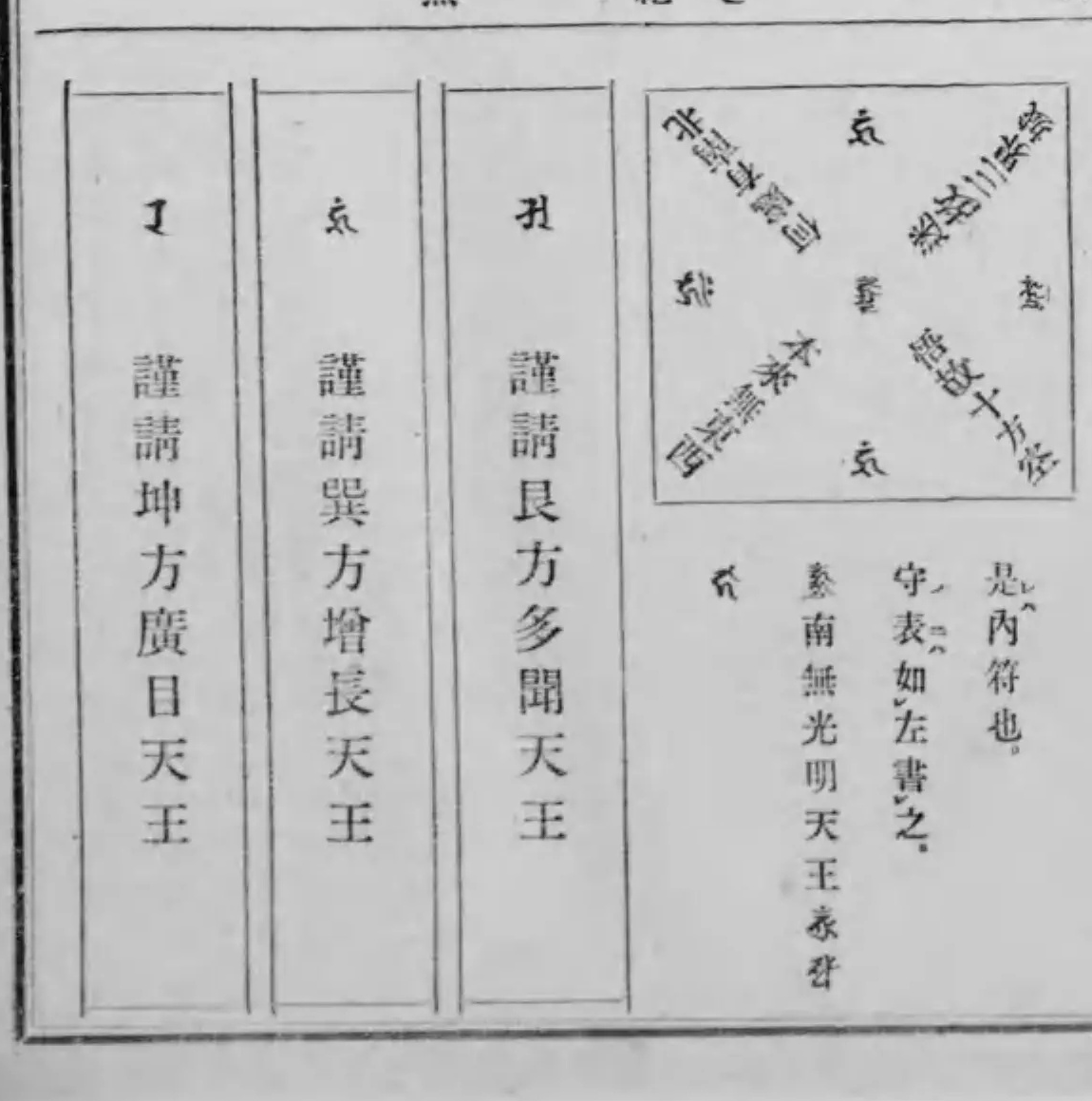
The directional-avoidance amulet (二百二十 方違守): the inner talisman (內符) drawn as a crossed square, and the outer face with the kings of the quarters, each column headed by its seed-syllable in Siddham and reading 謹請. Shugendō shōsho, Vol II, koma 123 (NDL 952662).
Two things depart from the schemes above, and the amulet’s purpose accounts for both. The Kings stand at the intercardinal points rather than the cardinal ones, and the quarters are named by trigram — 艮・巽・坤・乾. That is not decoration: hōtagae is the Onmyōdō practice of evading an inauspicious direction, so the divinatory idiom is the operative content, and the Buddhist guardians are set into a diviner’s frame rather than the reverse. And the center is not Fudō. Where the 續集’s nine-point scheme and the Godai Myōō arrangement both pivot on the immovable wisdom-king, this one pivots on the immovable ground: 堅牢地神, the Firm Earth Deity, who in the Konkōmyō-kyō rises to pledge that wherever the sūtra is expounded she will make the soil beneath it rich and firm. A Fudō center projects subjugating power outward; an Earth-deity center holds a place — which is what is wanted of an amulet that will be buried at the foot of the four corner-posts, cut from nurude wood (白膠木) to eight sun, with its own rules for what the traveler carries in which quarter: fire going by 卯, water by 午, earth by 亥.12
The chant then undoes the problem it addresses. The officiant stands, and after 南無光明天王 recites two verses. The first is a truth-act against the calendar:
Every day is good, every lunar mansion wise, every Buddha majestic, every arhat free of outflows; by these words of truth, may I be ever auspicious.13
The second is Chan:
Deluded, the three realms are a walled city; awakened, the ten directions are empty; originally there is no east or west — where then is south or north?14
A direction-taboo amulet, having named four quarters by their trigrams and staked a deity at each, closes by denying that directions exist at all. The Onmyōdō problem is not solved on its own terms but dissolved, and the practitioner is left holding both frames at once — which is the ordinary condition of this material rather than an anomaly in it. We draw attention to this ritual for its blend of Daoist, Chan and mikkyō elements. It is a good example from the long compendium of the three different philosophical traditions merging in a specific practice.
The technique carries over from the military scroll intact: the Konjin amulet on the same leaf is inscribed 「表〔種子〕字上書四竪五横也」, the four-vertical-five-horizontal grid cut over the kuji.
The 垂迹 assignment is astrological, and Daoist in technique. 九字垂迹 maps the nine onto the 九曜 (nine luminaries) — 羅睺 (Rāhu), 計都 (Ketu), and the seven planetary days — keyed to one’s year-star. The method is as follows:15
Face south, recite nine times, grinding the teeth nine times as though crushing — crushing the year-star’s calamity so it becomes auspicious; contemplate crushing demons, plague-gods, evil spirits, and strong enemies.
Tooth-clacking (叩歯) is a Daoist technique, which sits precisely with the corpus’s own attribution of the kuji to 抱朴子. Both textual forms survive here:
- Shugendō shogaku bendan (修驗道初學辯談; “Discourse for Beginners in Shugendō”; SGD, Vol III, koma 60): 「臨兵鬪者皆陣列前行」 — Gě Hóng’s original wording.
- 符咒集: 「臨兵鬪者皆陳烈在前」 — the Japanese standard.
The three-volume corpus preserves the Chinese original and the Japanese altered form side by side, with one of its compilers noting the Daoist provenance explicitly. This demonstrates that the 在前 form was already the working liturgical text in Japan while the 前行 form remained known to the learned.
Weapon Empowerment
Weapon-empowerment (武具加持) is likewise a titled practice: 「二百七 具足加持、武具加持 — 先護身法。次甲冑印…」 and 「二百八 武具加持 — 先護身法。次摩利支天寶瓶印…」, with 具足加持・弓箭加持 as siblings. And the Shugen jūni-kajō (修驗十二箇條; SGD, Vol III, koma 68, 加持祈禱修行方之事; printed p. 120) lists 武具加持 among the secret methods handed down in the 聖門流 (「玉體加持高加持武具加持病者加持其餘諸加持等傳來之祕法」).
Marīcī’s hōbyō-in is also the mudra used to empower arms (二百八 武具加持; the bow rite 二百九 弓箭加持 that follows is under Aizen’s seal) — one reason she stands first among the three war-deities (軍神三天) of the Shugen koji benran classification quoted below.
Koma 121 gives these rites in working detail. 二百六 兵具加持大事 keys its mudra sequence syllable by syllable to 臨兵鬪者皆陳烈在前, seals the four directions and the center with Gōzanze, and closes on the wisdom-fist with a verse of protection and increase: blade and soldier cannot harm, water and fire cannot burn or drown; a hundred years of life, a thousand autumns of flourishing, peace, wealth and rank, the house prospering, horses and retainers, freedom — svāhā.16 The opening clause is the 刀兵不能害 formula the corpus uses elsewhere in its kuji invocations, here turned from a ward into a blessing pronounced over the weapons themselves.
二百七 具足加持 is the most concrete of them. After the self-protection method and the helmet-mudra, nine places on the body are sealed — brow, both shoulders, heart, both thighs, navel, both armpits. Then the helmet-binding proper: the two hands in vajra fists, the index fingers interlaced three times at each point, a seed syllable visualized at each fingertip, and from those two syllables blue plaited cords stream out and bind the armor fast at twelve places — heart, back, both knees, navel, waist, brow in front, crown behind, both shoulders, throat, nape. The sash is let fall once, the dance-form performed three times, and the palms joined above the crown. Five syllables are written on the breast of the armor and three behind it; a 卍 on its face and a seed syllable within.17 A boxed aside on the same leaf gives the war-fan: on the 軍團扇, write the graph 專.
二百八 武具加持 then opens, as noted above, with Marishiten’s treasure-vase mudra — so the run that arms the body ends in her hands.
Mahākāla
Mahākāla is abundantly present. The transformation formula (SGD, Vol II, koma 94, printed p. 177; 大黑天一時千座頓成法) in the 道場觀 of the Mahākāla thousand-seat rite:18
“Visualize on the altar the syllable a, which becomes Dainichi Nyorai; Dainichi Nyorai transforms into Fudō Myōō; Fudō Myōō transforms into Mahākāla-ten. Wishes are fulfilled; the myriad dharmas are brought forth.”
Fudō is a semi-wrathful manifestation of Dainichi while Mahākāla adopts the fully wrathful depiction. A swordsman invoking the pair shows that he moved in the ordinary esoteric circles of his time. Mahākāla has a substantial presence in Shugendō:
- 七十五(通三)大黑天一時千座頓成法 — the thousand-seat instant-attainment rite: a thousand unblemished rice-grains washed, dried, wrapped in pure paper, empowered with the kiri-kiri mantra twenty-one times, then offered grain by grain; in its one-night form (同一夜千座法), 尊勝陀羅尼 7×, 光明眞言 300×,19 the honzon mantra 1000×, 「南無大黑天神」 100×, closing 「願滿世福、行於此道、願求佛法、廣作佛事」.20
- 七十六 大黑天大事 — 金剛合掌 with 「護持佛法」, 智拳印 for 七難卽滅, 外五貼印 for 七福卽生 (the Ninnō-kyō seven-calamities/seven-fortunes formula).21
- 七十七 大黑天鎚袋大事 — the mallet and bag as mudras: 智拳印 = the mallet (鎚習), 外五貼印 = the bag (袋習), 塔印 = 「令法久住、利益人天」. Closing: 「右祕印、唯授一人、輙不可示人」 — transmitted to one person only.21
- 續集 二十一 大黑天祕印 — under the outer five-pronged mudra the two nails are rubbed on the backs of the middle fingers (以二爪磨二火背) and flicked outward three times, then under the inner five-pronged mudra drawn inward three times; called 轉貧印 (the poverty-turning seal), also 決定.22
- 三十七 大黑天法, and the mantra 「唵、摩訶迦羅耶、娑婆賀」 (oṃ mahākālāya svāhā).
The kuji also travels outside the military scroll. On the same leaf as the Mahākāla rites, the article that follows them, 七十八 十二天法 (the rite of the Twelve Devas), lists the devas with their seed-syllables, then the local gods 丹生大明神・鶴河稚明神・高野大明神・嚴島辯財天 and a one-syllable amulet (一種字守), and closes with the nine syllables themselves — 「臨兵鬪者皆陳烈在前」 — followed by a lattice mark and a five-pointed star.23 The kuji practice is not compartmentalized to the military scroll; it is a general-purpose operator that attaches to deity rites throughout. Koma 88 has 「寶瓶之內、南無九萬八千之軍神、來臨影向… 此三遍吹入、卽切九字」 — invoking ninety-eight thousand war-deities into the treasure-vase, then cutting the nine. And from the 修驗故事便覽 卷四 (SGD, Vol III, koma 310), the classification: 「故ニ世ニ摩利支天。辨財天。大黑天ヲ軍神三天ト稱シテ崇敬スル士アリ」 — Marīcī, Benzaiten, and Mahākāla as the Three War-Deity Heavens. That is the frame in which a warrior tradition would naturally hold all three.
The Zokushū Contents Leaf
The 目次 and opening of vol. 1 of the Shugen jinpi gyōhō fuju zokushū (修驗深祕行法符咒續集; SGD, Vol II, koma 156); what the index shows is set out in Nine Syllables.
The contents list, in order, rites including:
- Fudō secret-mudra (不動尊祕印);
- Fudō “cutting-the-marman” method; the sevenfold mudra;
- the military nine-syllable great matter (兵法九字大事), and, two items on, the secret mudra for removing the calamity of violent death (除橫死難祕印);
- Marishiten’s sun-rite (摩利支天日所作);
- the fire-flame restraining mudra-mantra;
- Bishamon’s root-mudra (毘沙門天根本印);
- Thousand-Armed Kannon’s root-mudra;
- Dakiniten (吒枳尼天);
- Mahākāla’s secret-mudra (大黑天祕印);
- the Ninnō-kyō secret matters;
- the four dignified postures (行住坐臥);
- the general-permission eight-syllable Monju mudra (總許可八字文殊印);
- Fugen-Enmei
- Yakushi’s disease-curing mantra
- Aizen Myōō’s secret-mudra
- Bishamon’s root-mudra
- Eleven-Faced Kannon
- Benzaiten
- the “Lotus great matter” and the “fire-suppression great matter”
- the Daishō-Otsu-gohō secret method.
The body opens with the ācārya-rank mudra (阿闍梨行位印), citing the Abhiṣeka Sūtra (灌頂經): “with both hands, press the nails of the middle and ring fingers with the thumbnails…” Then comes the general-permission eight-syllable Monju mudra of the three and five families, “like the great wisdom-sword mudra; transmitted face-to-face (面授).”
On speaking during a rite: “The sūtra says — if you must speak to someone, visualize the syllable raṃ on your tongue, then recite the mantra.”
The military kuji, with its deity-grid (五 兵法九字大事, with the small note 胎立; 先護身法, “first the self-protection method”): the guardians are the Four Heavenly Kings — Tamonten 多門天 (=Bishamon), Jikokuten 持國天, Zōchōten 增長天, Kōmokuten 廣目天 — with Gundari 軍荼利, Gōzanze 降三世, Kongōyasha 金剛夜叉, Daiitoku (printed 金剛德, side-glossed 大威), and Fudō 不動 at the center; the mudras named are the needle-mudra, vajra-wheel, outer/inner lion, outer/inner bind, wisdom-fist, sun-disc, and treasure-vase.
Ichiji-Kinrin all-time-and-place abbreviated method (一字金輪一切時處成就略法): one-syllable heart-mudra; wisdom-fist mudra and its mantra; the “victory-body mudra” (勝身印) — “the two middle fingers like blue-lotus leaves, the forefingers touching the backs of their upper joints…”; visualization: “the thumbs are the lotus-seat posture; the middle and forefingers, the Buddha-body; the middle and ring fingers, the light-flames; both wrists, the great-awakening lion-throne. Recite 108 times.”
Weapon and Armor “Great Matters”
From 神社印信 (Jinja inshin; “Shrine Certificates”), SGD, Vol I, koma 180, comes a numbered series of martial secret transmissions (大事), each a mudra, a mantra and a waka — the yamabushi’s weapon-consecrations:
-
No. 15, Side-sword (脇刀大事). “First the self-protection method; join palms — ‘may all difficulties be wholly removed by the Buddha’; next expel the evil demons, day-and-night protection; single-pronged-vajra mudra.” Waka, followed by Monju’s mantra: “Chihaya-furu — the divine vow being deep, at the word ‘sword’ the evil demons retreat.”
(千刄破神誓深ケレハ刀トイヘハ惡魔シリソク 文殊眞言) Chihayaburu kami no chikai fukakereba, katana to ieba akuma shirizoku
-
No. 16, Long-sword (太刀大事). Outer five-pronged mudra; mantra [oṃ ro-kei-shim-hara-ki-riku-sowaka]; join palms — “all divine-power spirits, my sword’s efficacy in use: annihilation of the enemy” (怨敵消滅, onteki shōmetsu).
-
No. 17, Arrow-warding (矢違大事). Write the graph of the day’s quarter (其日方字書, by oral transmission). Waka: “The storm blows — this wind sweeps away the enemy that faces me.”
(嵐吹此間風シコリナリ向フ敵吹拂ナリ) Arashi fuku … mukau teki fukiharau nari
-
No. 18, Suwa great matter (諏訪大事). A method to erase the sin of taking life beforehand. Waka on birth-death and “on this very day, then, the body becomes Buddha.”
-
No. 19, Military armor (兵法甲冑大事). “First the self-protection method; next the outer-bind [mudra] deeply crossed and set on the crown of the head — this is the armor-mudra (甲印); next the nine syllables (九字), recited three times; next join palms — ken gen kō ri tei (乾元享利貞, so printed for 亨; ‘primal, penetrating, beneficial, firm’)” — the Yijing’s formula for the first hexagram, 乾 (qián).
-
No. 20, Sword-dressing (繕刀太大事, so printed). Join palms; next Fudō-mudra — “complete with all merits, therefore one should bow.” Waka: “…annihilation of the evil demons; come in prayer, and set at ease the thoughts within the heart” — closing with the Kannon-gyō line jigen ji shujō, fukuju kai muryō (慈眼視衆生、福壽海無量; “with eyes of compassion he beholds all beings; the ocean of his blessings and long life is boundless”).
-
No. 21, Bow-dressing (繕弓大事). Outer five-pronged mudra; Aizen mantra ×7. Waka: “…it was the bow-and-arrow that sweeps the evil demons away.”
(惡魔ヲ拂弓箭ナリケリ) akuma o harau kyūsen narikeri
-
No. 22, Horse (馬大事). [Siddham] stūpa-mudra — “this horse is Batō Kannon (馬頭觀音); by his deep compassion he takes on beings’ suffering and lets us ride.” Waka on the “Kai black-colt” (甲斐黑駒, Prince Shōtoku’s legendary steed).
The Two Ten-Character Articles
Two articles on the ten-character method stand together at SGD, Vol II, koma 120.
二百三 兵法十字之事. A menu, not a list. The heading article sets the pattern with 勝: on going out to the battle-array, or in any matter of victory and defeat, this graph may be cut and added; written and carried in the left palm it secures the victory — and, the text notes, everything below follows the same procedure. Then the graphs and their occasions:
| Graph | Occasion | Effect |
|---|---|---|
| 勝 | going out to the array; any contest of victory and defeat | secures the victory |
| 鬼 | facing a sick person | one does not take the illness |
| 龍 | crossing seas and rivers | no obstruction |
| 一 | traveling moor and mountain | one does not lose the way |
| 角 | going toward a blocked quarter | no difficulty |
| 行 | any setting-out whatever | no difficulty |
| 命 | wine, and eating generally | long life and ease |
| 水 | heavy drinking, or poisoning | dispels every poison |
| 天 | before Buddhas and kami, and men of high rank and office | one will surely accord with them |
| 虎 | facing beasts | one escapes calamity from the side |
| 太 | facing an enemy | body and mind made firm |
| 合 | entrusting a great matter to another | one will surely accord |
Then the rule that makes it a menu: from these, as use requires, one graph is added to the end of the nine syllables, and that is called the ten-character great matter; and whichever graph is written and carried in the left palm, the procedure is as for 勝 at the head.7
二百四 十字大事. A closed set of ten, each against a named hazard — and the tone shifts from the battlefield to the road:
| Graph | Occasion |
|---|---|
| 吉 | boarding a boat |
| 大 | a contest of victory and defeat |
| 一 | crossing river and sea |
| 惡 | that one not fall in with robbers |
| 鬼 | that plague not pass to one |
| 識 | that one not lose the road |
| 會 | meeting a madman on the way |
| 水 | that wine not intoxicate |
| 食 | that food give no trouble |
| 敵 | escape from the myriad difficulties |
The article closes with the practice rather than the theory. The shapes of these talismans carry an oral transmission; on leaving the house, within three paces, one writes the graph three times with the tip of a willow twig and licks it three times, and in general writes and licks it each morning. Before and after come three fascicles of the Heart Sūtra and a thousand recitations of the One-Syllable Golden Wheel mantra — or the honzon’s own mantra, at will. It ends where these things usually end: on no account let another see it; not to be transmitted for a thousand pieces of gold.24
The 目錄 labels the article 十字大事(通二), two transmissions, and the scroll delivers exactly that: the set above closes on koma 120, and a second 十字大事 — headed 祕術也 — opens at the foot of koma 120 and runs onto koma 121. The second set, as printed, is 天・龍・虎・王・命・勝・唵・水・大 — nine graphs under a rubric that says ten — and its occasions are the hazards of a man moving about the country: 天 before daimyō, great houses and high officials; 龍 sea, river, boat and bridge; 虎 broad moors and deep mountains; 王 bow and blade, army camp, mountain bandits, sea pirates, traveling by night; 命 unease about a person, or suspicion of poison in tea or wine; 勝 lawsuits and market dealing; 唵 avoiding plague, or entering a plague house; 水 dark places, cavernous unfamiliar houses, heavy drinking; 大 falling in with bad men, bad karmic ties, madmen.25
That set is the Yokoi 1675 Goshinhō set: the Waseda scroll too writes nine graphs under the ten-character title, sets 水 before 大, and gives the same occasions. The Waseda scroll and SGD are not two traditions that happen to overlap; they are two witnesses to one transmission, and the canon supplies the frame the densho leaves implicit. The overlap with the military article (six graphs of twelve) is the family resemblance between the two ten-character traditions, not the relation of witness to witness.
The rubric raises the stakes. The ten are written in the left palm with the right hand’s sword-mudra; the nine syllables are then added in recitation to make nineteen graphs (十九字), chanted nine times, the breath blown across the palm, the hand closed firmly on them. Then the seal — 「許九字不可許十字」: the nine may be permitted; the ten may not.26 The ten are held more secret than the nine. This is worth setting beside the Tsuki no Shō’s 九字・護身法・十字 order, where the ten stand last: in the canon that final position is not an appendix but the deepest term of the series.
Contents of the Secret-Ritual Collection
A 目錄 (contents) page of the fujushū covering vols 5–7 (SGD, Vol II, koma 79). Volume 6 is, in effect, a military ritual index.
Vol. 5 lists the moon-vigil rites (三日月待, the 17th/20th/23rd/26th-night vigils, the kōshin 庚申 vigil), sun-worship and sun-visualization (日天拜見/日想觀), setsubun and year-end rites, and a long run of implement-consecrations (incense, offerings, the aka-water, tea, homa-firewood, kāṣāya and robe empowerment, eye-opening, ablutions).
Vol. 6 is the military run inventoried above, interleaved in the 目錄 with non-military items — direction-taboo, Kōjin, fox and fire rites.
Vol. 7 continues with direction-taboo and Kōjin material.
Contents: Shugendō and Heihō · ← Nine Syllables · Gogyō and Godai →
-
「眞言宗四箇處本寺」, listed in the 目錄 under 卷第五 (SGD, Vol II, koma 79) and set out in the body of 卷五 as 百九十二 (koma 117, printed p. 223). ↩
-
「今擧其一傳、餘略之也。年號月日、授、傳授大事。切九字、今入一字爲十字樣有。通用時入吉也。切時堅切入也」 — SGD, Vol II, koma 120. ↩
-
Ichiji-kinrin’s mantra: oṃ bhrūṃ (唵部林) — the mantra of the One-Syllable Golden-Wheel Buddha-crown (一字金輪佛頂). ↩
-
天文三曆七月廿五日 授與賴〔…〕雄、傳授大阿闍梨權少僧都左學頭忠雅 / 天文廿二年閏正月三日 授與性盛、傳授大阿闍梨權大僧都法印賴雄 / 天正十六年五月廿一日 授與堅瑜、傳授性盛 — SGD, Vol II, koma 148. Between 賴 and 雄 in the first entry the leaf prints a small Siddham-like mark and a graph resembling 全; left unread. ↩
-
A 相承次第 closes the lower register with 快善法印・快成・憲海・政實, and the upper register opens with 教任・性盛・堅瑜, completing the chain from the preceding leaf — SGD, Vol II, koma 84. ↩
-
抑此習ハ、亡父、初瀬寺ニ祈請シケルニ…つく〴〵とミて得心シテ、今此捧心習トス。偏ニ観音ノ誓也 — Tsuki no Shō, p. 33. ↩
-
ノゾメルツハモノ、タタカウモノ、ミナヂンヤブレテ、マヘニアリ — SGD, Vol II, koma 120. ↩
-
「此クジニひとつ入テ十字也。ヨコ五ツ・タテ五ツ」 — Tsuki no Shō. ↩
-
「切樣…始ソト、一三五七九、終リソトナヘ切ル」 — SGD, Vol II, koma 120, 二百一 九字印大事, the labels of the printed grid; ソト is read as 外. The grid’s vertical strokes are numbered 二四六八. ↩
-
SGD, Vol II, koma 123 (符咒集 卷第七, printed pp. 234–235), 二百二十 方違守. Each column carries a bīja above the invocation; the conventional Japanese esoteric forms for these five would be dhṛ (धृ) for Dhṛtarāṣṭra, vi (वि) for Virūḍhaka, vi likewise for Virūpākṣa — the two middle kings share the syllable, and lineages distinguish them by position rather than by graph — vai (वै) for Vaiśravaṇa, and pṛ (पृ) for Pṛthivī. These are the standard assignments, given for orientation; they are not a reading of the leaf, whose Siddham has not been collated at full resolution. ↩
-
「右札ヌルデ木切八寸書之。四角柱根埋之也。越卯方時持火可越。越午方時持水可越。丑未方辰戌方時皆持水可越。越亥方時持土可越…」 — SGD, Vol II, koma 123 (printed p. 235). ↩
-
「一切日皆善、一切宿皆賢、諸佛皆威德、羅漢皆斷漏、以此誠實言、願我常吉祥」 — SGD, Vol II, koma 123. ↩
-
「迷故三界城、悟故十方空、本來無東西、何處有南北」 — SGD, Vol II, koma 123; a widely circulated Chan quatrain. ↩
-
南方ノ天ニ向テ九遍誦〆。齒ヲ九遍嚙ミクタクヤウニカミ合。其年ノ星ノ役難ヲカミクタキ失故ニ、忽ニ吉星ト成ル也。惡魔外道・疫神・惡靈・强敵等ヲカミ失ソト可觀。深祕也。 — SGD, Vol II, koma 118 (百九十七 九字垂迹; printed p. 225). 〆 is the シテ ligature as printed. ↩
-
「刀兵不能害、水火不焚漂、得長壽百歲、得榮華千秋、安穩富貴人、家門繁昌樂…自在娑婆賀」 — SGD, Vol II, koma 121, 二百六 兵具加持大事 (printed p. 230). ↩
-
SGD, Vol II, koma 121 (printed pp. 230–231), 二百七 具足加持・武具加持; the nine points (額・右肩・左肩・心・右股・左股・臍・右腋・左腋), the twelve binding-points (心・背・右膝・左膝・臍・腰・額前・頂後・右肩・左肩・喉・項後), the boxed 專 with 軍團扇書專字, and the 「具足胸書左五字、具足後書左三字」 instruction. The five-syllable breast inscription is treated as godai in Gogyō and Godai. ↩
-
次道場觀。法界定印。想壇上有𑖀字、遍成大日如來。大日如來變成不動明王。不動明王變成摩訶迦羅天。所願成就、萬法出生給。 — SGD, Vol II, koma 94, in 同七日千座法 (the last of the thousand-seat rites under 七十五 大黑天一時千座頓成法). The seed-syllable is printed in Siddham, not as the kanji 阿; a is the reading the Dainichi sequence implies. ↩
-
The Light Mantra (光明眞言, kōmyō shingon), Vairocana’s: oṃ amogha-vairocana mahāmudrā maṇi-padma jvāla pravarttaya hūṃ (唵阿謨伽尾盧左曩摩訶母捺囉摩尼鉢納摩入嚩攞鉢囉韈哆野吽). (The kiri-kiri mantra of the same rite is a form of Mahākāla’s — see Daikoku (Mahākāla).) ↩
-
SGD, Vol II, koma 94 (符咒集 卷二, 七十五 大黑天一時千座頓成法, headed 通三有之, with 同一時千座法 on printed p. 176 and 同一夜千座法 and 同七日千座法 on p. 177): 無疵白米一千粒取之、以淨水洗之而乾、淸淨白紙包之…誦枳里枳里明二十一遍加持之 / 次心經三卷。次尊勝陀羅尼七遍。次光明眞言三百遍。次本尊眞言千遍。次南無大黑天神百遍。次經文偈 願滿世福 行於此道 願求佛法 廣作佛事. Koma 93 carries nos. 六十七–七十二 and none of the Mahākāla rites. ↩
-
SGD, Vol II, koma 95 (符咒集 卷二; printed p. 178): 七十六 大黑天大事 (金剛合掌唱曰。護持佛法…智拳印 七難卽滅 / 外五貼印 七福卽生) and 七十七 大黑天鎚袋大事 (塔印 令法久住利益人天 / 右祕印唯授一人。輙不可示人). ↩ ↩2
-
先外五鈷印。以二爪磨二火背。卽以二爪外三度撥遣。次內五鈷印。上印同斷。內三度招入 — SGD, Vol II, koma 158 (修驗深祕行法符咒續集, 二十一 大黑天祕印; printed p. 305). ↩
-
七十八 十二天法 … 一種字守 … 臨兵鬪者皆陳烈在前 — SGD, Vol II, koma 95 (printed p. 178). The kuji line closes the Twelve-Deva article, not 七十六 大黑天大事. ↩
-
SGD, Vol II, koma 120, 二百四 十字大事 (printed p. 229); the ten are 吉・大・一・惡・鬼・識・會・水・食・敵. Closing rubric 「右此符形有口傳…努々不可他見。云々。千金莫傳」. ↩
-
SGD, Vol II, koma 120–121 (printed pp. 229–230), the second 十字大事 (headed 祕術也): 天・龍・虎・王・命 close p. 229 and 勝・唵・水・大 open p. 230. The leaves print these nine and no 鬼, as does the Yokoi scroll (Waseda ke05 01033). ↩
-
「右此十字任其用、左手內右手釼印書上九字加誦成十九字、九遍唱其息氣吹懸手內字確握可持…可祕可祕。千金莫傳。許九字不可許十字。深祕深祕」 — SGD, Vol II, koma 121 (printed p. 230). ↩