This piece is a companion to A-Un, Gogyō, Godai and Beyond, which set out the distinction between the five phases (gogyō 五行) and the great elements (godai 五大) as they bear on the Jikishinkage-ryū Shunkashūtō (春夏秋冬; four-seasons) curriculum. That essay made the phase/element distinction doctrinally. Here I want to ground it in a primary specimen — a diagram I came across while searching the esoteric stratum behind Yagyū Jūbei Mitsuyoshi’s Tsuki no Shō (月之抄, 1642) — and to add a third frame that is easily conflated with the first two.
How this surfaced
The Tsuki no Shō’s closing pages carry an oath-text (kishōmon 起請文) naming, among its deities, Marishiten (摩利支尊天; Mārīcī) and — in its Edo redaction — Atago Gongen (愛宕権現), together with a short esoteric passage on the “nine syllables, the body-protecting rite, and the great matter of the ten graphs” (真言ノ九字・護身法・十字ノ大事). Chasing that vocabulary through a Shugendō ritual corpus turned up a directional chart embedded in an unrelated-looking place, and the chart is a clean example of the five-phase seasonal scheme the parent essay describes only in words.
The source is the Shugen jōyō hihō-shū (修験常用秘法集; “Collection of Secret Methods in Common Shugen Use”), a section beginning around p. 116 of one volume of the early-Shōwa Shugendō canon (NDL digital collection 952642). The transmission line is dated in a colophon a few leaves on: 「文政五壬午閏正月授與」 — Bunsei 5 (1822), intercalary first month — with a further note naming a 自性観音 (Jishō Kannon) lineage. The compilation is later, but this stratum of it is an early-19th-century esoteric-warrior practice text.
The chart
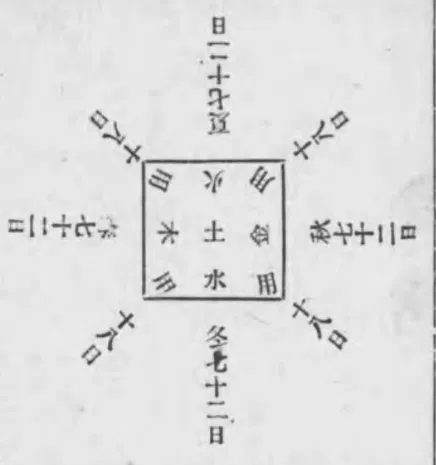
Five-phase directional chart, Shugen jōyō hihō-shū, p. 125 (NDL 952642)
The central square is the ordinary five-phase directional grid, in the traditional south-up orientation: fire (火) at top/south, water (水) at bottom/north, wood (木) at left/east, metal (金) at right/west, and earth (土) at the center. That much is unambiguous. (Two cells appear to carry a faint second graph — I read them provisionally as 用 / 合 but cannot confirm them at this resolution; they need a cleaner raster before transcription.)
The outer ring is the part that matters for a seasons discussion. Its eight positions carry day-count labels, of which the bottom is legible as 「冬七十二日」 — winter, seventy-two days. Read with the square, this is the familiar apportionment in which each of the four seasonal phases governs 72 days (4 × 72 = 288) and the earth phase (土) is allotted the remaining 72, distributed as four ~18-day interstices (doyō 土用) at the season-junctions — the eight ring positions being the four seasons plus the four doyō. The full ring wants a higher-resolution scan before I fix each label, but the 「冬七十二日」 anchor and the central 土 together make the 72-day doyō apportionment the natural reading.
What kind of object this is. A grep of the surrounding OCR’d prose (pp. 116–160) returns no doyō (土用), no generation/overcoming (相生・相剋), no 立春 — the technical vocabulary a calendrical treatise would use. In other words, the text does not expound the scheme; it deploys it. The diagram is a ritual object — a directional talisman — not the exposition of a theory. This is worth keeping distinct from the way Shunkashūtō uses the same cosmology in the parent essay: there, the five-phase seasonal cycle is a doctrinal organizing principle for a curriculum (with earth/Hōjō “encompassing the seasons” and governing their transitions); here, the identical apportionment is drawn as an operative diagram inside a protection rite. Same cosmology, two registers — expounded vs. wielded.
Three frames that are easily conflated
The parent essay distinguished two systems. This material makes it three, and they converge in exactly the Shinkage-derived milieu that produced both the JSKR Shunkashūtō and the Yagyū Tsuki no Shō:
- Five phases — gogyō (五行; wǔxíng): wood, fire, earth, metal, water (木火土金水). Modes of process in cyclical generation and overcoming, each mapped to a season and a direction. Daoist and onmyōdō (陰陽道) in provenance. This chart.
- Great elements — shidai (四大) / godai (五大): earth, water, fire, wind (地水火風), plus space (空) for the pentad; the mahābhūta, substantial constituents in Buddhist cosmology. The Tsuki no Shō anchors this side: its Ryōi Shintō wa colophon (良移心当和, p. 65) speaks of 「土水火風ノ得理、此中ニ籠ル」 — the attained principle of earth-water-fire-wind — which is the four great elements (shidai), not the five phases. A reader who sees 火 and 水 in both systems and assumes they are the same scheme will misread the passage.
- Directional-body / four gods — shishin (四神) and gotai (五体). On p. 123 of the same Shugendō section, a passage maps 「四節四季ノ形體」 onto the five body-parts (五体) guarded by the four directional gods — 「玄武神…白虎神…朱雀神…」 (Genbu/north, Byakko/west, Suzaku/south, and the implied Seiryū/east) — each with an enumerated host of deities. This is neither phase-process nor material-element; it is a directional-body cosmology laid over the same compass, and it is the frame most often silently merged with the other two because it shares their directions and their 火/水.
The three share graphs and directions, which is precisely why they blur. The Tsuki no Shō itself straddles them within a few leaves: 四大 in the Ryōi Shintō wa colophon (element), 「四季ノ心」 in the adjacent wa no koto (和之事) entry (season → phase), and the Marishiten/kuji stratum (esoteric-directional) at pp. 69–70. The Shugendō chart is a useful visual anchor for holding the phase frame apart from the other two.
The ritual matrix around the chart
The chart does not stand alone; it sits inside a Marishiten–Bishamon–Fudō protection rite. On the same opening (p. 125) the text gives Mārīcī’s jewel-vase mudrā and mantra — 「摩利支天寶瓶印…唵アニチヤマリシヱイ …兵杖利劒他方我身福德卽得圓滿」 — followed directly by the nine syllables in their Buddhist recension, 「南無臨兵鬪者〔皆陳列〕在前行、刀兵不能害、一切不能害、水火不能害」: blades cannot harm, nothing can harm. The apparatus around it is the standard esoteric warrior set — 火界咒・慈救咒 (Fudō), 毗沙門咒 (Bishamon/Vaiśravaṇa with 吉祥天女・善賦師童子・雨寶童子), 佛眼, 愛染 — the same complex whose scriptural basis (Mārīcī → Fó shuō Mólìzhī tiān jīng T21n1255 and family; Fudō → the Trisamaya 底哩三昧耶 group T21n1200–1201) I set out in the Tsuki no Shō corpus notes.
Two small findings fall out that bear on the Tsuki no Shō reading, and I record them because they qualify earlier claims of mine rather than confirm them:
- The kuji appears here in the 在前 form, not the Daoist 前行 form found elsewhere in the same corpus (the Baopuzi 抱朴子 original reads 「臨兵鬥者皆陣列前行」). So both recensions are preserved side by side in this Shugendō material — the Daoist-substrate 前行 and the Mikkyō-adapted 在前 — which is the kind of stratum marker worth tracking when asking which line the Tsuki no Shō’s 「十字ノ大事」 came through.
- Marishiten is the overlay, not a paired protector. In the canonical nine-graph deity-pairing (four Deva-kings + five Wisdom-kings, with 前 = Fudō Myōō), Mārīcī does not appear; she is the separate invisibility (隱形) cult on which the whole kuji-goshinbō rides. The Tsuki no Shō kishōmon’s Marishiten therefore connects to the overlay, while its 神妙劔/不動 register connects to the in-pairing Fudō — two different esoteric functions, not one.
Relation to the parent essay, and a note on it
The parent essay’s account stands; this is an extension, not a correction of it. The Tsuki no Shō’s 土水火風 (p. 65) is a shidai (element) usage, in contrast to the Shunkashūtō 五行 (phase) usage, i.e. two Shinkage-milieu texts using the two systems the essay contrasts.
In the Shunkashūtō description I wrote about the earth phase as being “associated with the transitional phases between seasons”, this chart is a period illustration of exactly that (土 at center, the four doyō interstices on the ring).
Caveats
- The ring labels beyond 「冬七十二日」 are at the edge of legibility; the 72-day doyō reading is well-motivated but not yet transcribed position-by-position. A cleaner raster is needed before the ring is reproduced in full, and before the two faint in-cell second graphs (用/合?) are asserted.
- p. 125 is heavily OCR-degraded (stray latin, gaiji gaps, phonetic mangling of mantras); only the phrases quoted above are given as read, and the rest of the page is not relied on here.
- This is a single Shugendō specimen of the seasonal apportionment in ritual use, from one transmission line. It illustrates a deployment; it is not evidence of how widespread the diagrammatic form was, nor of any direct line between this manual and either the Tsuki no Shō or Jikishinkage-ryū. The connection argued here is conceptual (the same cosmologies, held apart), not genealogical.
References
@misc{shugenjoyohiho1822,
  title     = {Shugen jōyō hihō-shū 修験常用秘法集},
  keywords  = {primary},
  reliability = {Shugendō ritual compilation; the section carries a Bunsei 5 (1822) transmission colophon. Cited here from the early-Shōwa Shugendō canon, NDL digital collection 952642. Diagram at p.125; season passage p.123; god-counts p.117. CONFIRM containing-volume printed title/editor/date.},
  archive   = {National Diet Library Digital Collections},
  access    = {NDL 952642}
}

@book{imamura1995yagyu,
  author    = {Imamura, Yoshio},
  title     = {Shiryō Yagyū Shinkage-ryū 史料柳生新陰流},
  edition   = {revised},
  publisher = {Shinjinbutsu Ōraisha},
  year      = {1995},
  keywords  = {primary},
  reliability = {Standard purchasable transcription corpus for Yagyū densho; Tsuki no Shō 月之抄 (Yagyū Mitsuyoshi, 1642) transcribed in vol. 2.}
}

@book{gehong-baopuzi,
  author    = {{Ge Hong}},
  title     = {Baopuzi neipian 抱朴子内篇},
  keywords  = {secondary},
  reliability = {Locus classicus of the six-jia incantation 臨兵鬥者皆陣列前行 (登渉 chapter), the pre-Buddhist source of the kuji. Cite a specific edition/translation.}
}