Mountain, Sword, and Mind is a two-volume work on the influence of Japanese mountain-centered religion on early martial traditions. This is the second volume. The first, Shugendō and Heihō, is described with the other writing on Shugendō; related essays are gathered under Shinkage heihō.
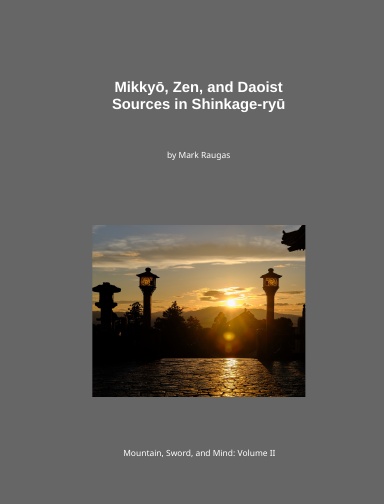
Mikkyō, Zen, and Daoist Sources in Shinkage-ryū: Reading the Heihō Kadensho, Tsuki no Shō, Honshiki Sanmondō, and Shinpishō, Mountain, Sword, and Mind, Volume II (opens in a new tab). Inner Dharma, 2026. 437 pages.
In Volume II we examine core Yagyū writings from the 17th century, including the Heihō Kadensho of Yagyū Munenori and the Tsuki no Shō of Yagyū Mitsuyoshi, which records oral teachings (kuden) of Munenori and writings of Sekishūsai. For completeness, we provide new translations of several works by Takuan, including the Taiaki, Fudōchi Shinmyōroku, and a short folded paper (kirigami) poem likely by the famous priest. The gokui of Yagyū Shinkage-ryū at the time are examined in relation to Zen and Mikkyō concepts.1
We then provide an overview of early Owari Shinkage Yagyū-ryū and the changes introduced into its curriculum, examine the gokui concept of seikōsui in the Honshiki Sanmondō of Kimura Kyūho (senior student of Yagyū Munenori who was given the name Unchū-ryū). Then we read the Edo Yagyū-ryū Shinpishō of Sano Yojizaemon, examine Kyushu area Shinkage-ryū densho, and close with an analysis of how the Shinkage-ryū philosophical concepts are found in the Jikishinkage-ryū (opens in a new tab) of Yamada Ippūsai.
End Notes
-
These volumes attempt to be precise but are not academic histories. Instead they are close readings of historical sources. In doing so, we relate the statements made about many older martial traditions by their witnesses and practitioners, but each surviving faction or group will have their own in-tradition orthodoxy. ↩