The introduction to the section on Takuan’s writing in my book Mikkyō, Zen, and Daoist Sources in Shinkage-ryū.
While reading through the front matter of the Meiji collected works of Takuan — Takuan Oshō Zenshū (沢菴和尚全集), ed. Ashin’an Setsujin, 1898 (NDL 1088656) — I came across a kirigami (切紙; a brushed slip) bound in at page 3, before the prose works begin. It is a small occasional poem, a jiin (次韻; matching-rhyme) quatrain, and it turns on a phrase that recurs around the Takuan material, so I set it down here as a diversion, in the same spirit as the verse by Fù Dàshì (傅大士; 497–569) that opens Mikkyō, Zen, and Daoist Sources in Shinkage-ryū:
有物先天地
無形本寂寥
能為萬象主
不逐四時凋
There is a thing prior to Heaven and Earth
Formless, originally Still and Void
It can be master of the myriad images
It does not wither with the four seasons
The slip sits in the front-matter verse zone (pp. 001–004), distinct from the Reirōshū body (pp. 001–077) in the same digitization.1 It is a matching-rhyme (次韻) quatrain, signed 京軒 (Kyōken) and written on the rhymes of 俊矩公; the identities of 俊矩公 and 京軒, and whether Takuan himself authored it, remain open. For the 東漂西泊 tag elsewhere in the same corpus, see the Tsuki no Shō corpus addendum §2.
Header and signature: kōi (叩依) — “humbly relying on / following” — then Shunku-kō no hōin (俊矩公之芳韻), “the elegant rhymes of Lord Toshinori (俊矩),” and the composer’s studio-name Kyōken (京軒). The quatrain is a matching-rhyme response, written to the same rhyme-words as a (now-unlocated) poem by a Lord Toshinori:
- 東漂西泊只随縁 (tōhyō seihaku, tada en ni shitagau) — “drifting east, mooring west, only following conditions (en 縁; pratyaya).” Tōhyō seihaku is a self-characterization associated with Takuan — the wandering monk with no fixed abode — and tada en ni shitagau is the plainest statement of the zuien (随縁) attitude: accepting whatever conditions bring.
- 撲面風塵猶未觸 (men wo utsu fūjin, nao imada furezu) — “the wind-and-dust that strikes the face has yet to touch [me].” Fūjin (風塵; wind and dust) is the stock figure for the grimy world of affairs; the line is a fudō / non-attachment image — buffeted, but inwardly untouched.
- 江上眺望詩思温 (kōjō no chōbō, shishi atatakanari) — “gazing out over the river, poetic thought turns warm.” A turn from the abrasive world of the second line to the ease of the riverbank; shishi (詩思; poetic thought/feeling) warming is a quiet, contented note.
- 一篇應評許渾 (ippen, Kyokon no hyō ni ōzu) — “a single piece, fit to be judged by Xu Hun.” Xu Hun (許渾; Xǔ Hún, c. 791–858) is the late-Tang poet famous for his polished regulated verse and river- and-rain imagery; invoking him as arbiter is a conventional modest flourish — “such as it is, submit it to a master’s eye.”
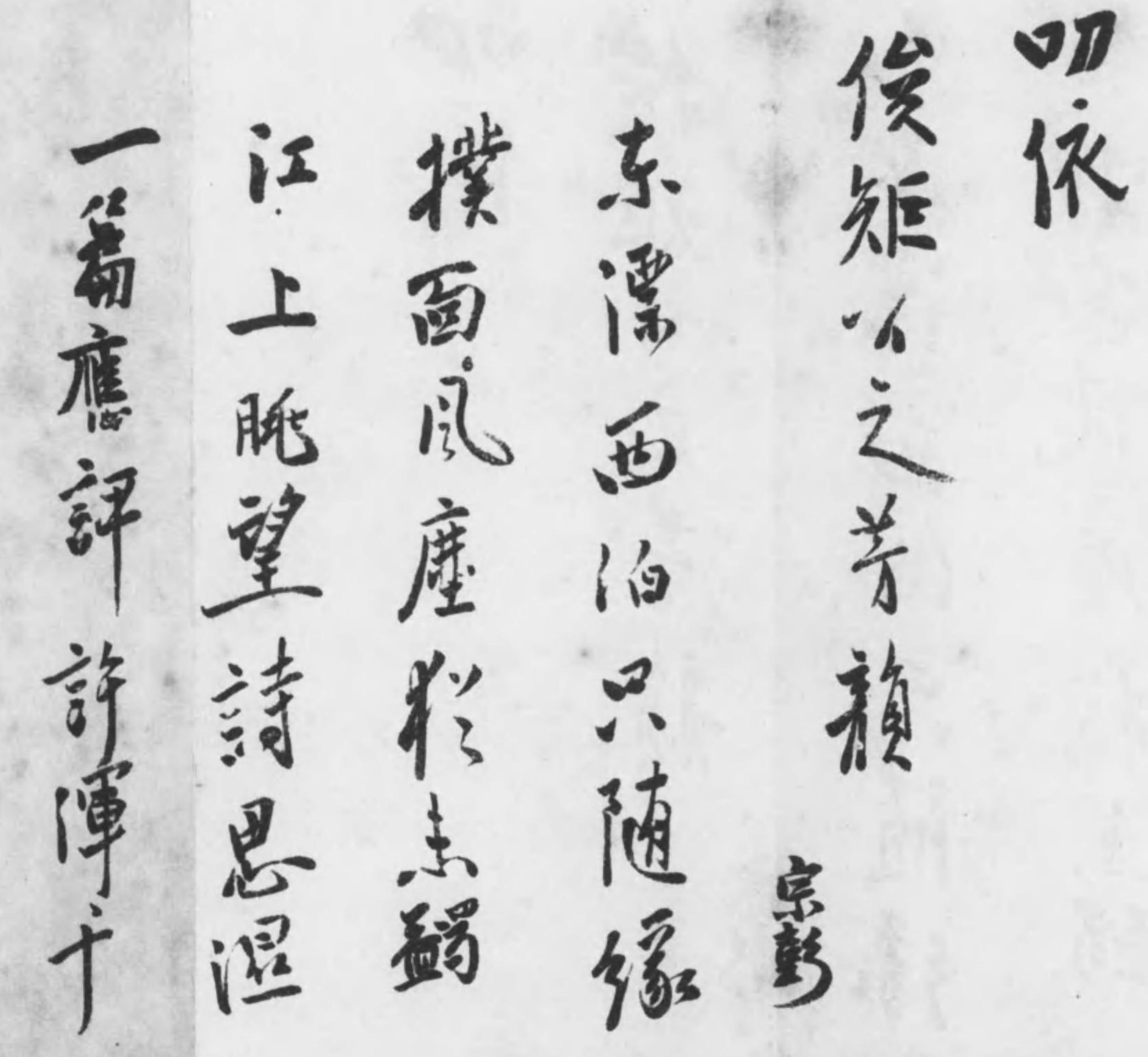
Kirigami slip, Takuan Zenshū (NDL 1088656) p. 3
The sensibility — drifting with conditions, dust that does not touch, closing on a poet’s ease — is thoroughly Chan, and consonant with the Takuan frame of the volume it prefaces.
The opening phrase repays a closer look. 東漂西泊 (tōhyō seihaku, also written 東飄西泊) is a Chan set phrase for the unanchored life, but in its recorded-sayings usage it usually carries a negative charge — the image of being helplessly tossed by circumstance. The Chánlín bǎoxùn 禪林寶訓 has it so: where the wind of circumstance stirs, unawares one’s whole body tumbles into the sea of karma and goes drifting east and mooring west — would a truly authentic follower of the Way be like that?2 The Tiānrú Wéizé chánshī yǔlù 天如惟則禪師語錄 uses it both ways: the same karma-sea image, and the scattering of dead and surviving fellow-monks, “the survivors drift east and moor west, sparse as morning stars.”3
The kirigami inverts the charge. 「東漂西泊只随縁」 reads the wandering not as helpless drift but as serene zuien (随縁), the free acceptance of conditions — the homeless monk’s freedom, the positive Takuan self-image — which is exactly what lets the next line claim that the world’s wind-and-dust “has yet to touch” him.
The quatrain is signed 京軒 (Kyōken) and matches the rhymes of 俊矩公, who is very plausibly Yagyū Tomonori / Toshinori (柳生友矩/俊矩, 1613–1639) — Munenori’s son (通称 左門/刑部; 従五位下刑部少輔) and the younger half-brother of Jūbei (三厳), buried at 芳徳寺 (Hōtoku-ji), the Yagyū temple Takuan founded with Munenori and the source of the 芳徳寺蔵本 Tsuki no Shō. The Yagyū house record Gyokuei shūi (玉栄拾遺) praises him as of peerless nature, rich in literary talent, and skilled in the Shinkage art,4 which describes precisely the sort of man whose 芳韻 (“elegant verse”) a poet in Takuan’s own circle would humbly match.
Note that the mainstream record reads his name 友矩 = Tomonori (左門/刑部). The 俊矩 (Toshinori) form — the one that matches the kirigami’s 「俊矩公」 — comes from the Yagyū genealogy in the 本朝武林傳 (武術叢書), which is imperfect here: it also gives him the titles 主膳正/飛驒守 that actually belong to his brother 宗冬 (Munefuyu). The identification therefore rests on the kirigami’s 俊矩 aligning with the 本朝武林傳’s variant 俊矩 against the standard 友矩. That is a strong match — same person, same name-graph slot, the right rank and literary reputation, Takuan’s own temple — but it comes via a variant form in an imperfect genealogy, not via the standard record. The earlier guesses of Kitanokōji Toshinori (1768–1832) and the Azuchi-Momoyama 青木俊矩 are rejected in favour of it.
That would make this a genuine Takuan–Yagyū-circle exchange preserved in the front matter, and raises — without settling — the possibility that 京軒 is a Yagyū-circle figure or a Takuan gō; he remains unidentified, and if he could be placed, that would close the question. The poem does not appear in the anthologized Takuan verse, but the 御物語-adjacent 東漂西泊 topos plus a Yagyū addressee place it firmly in that world rather than in a later, unrelated one.
That a slip like this survives in the front matter, distinct from the prose works, is a small reminder of how these Meiji collected editions were assembled: not just the treatises, but the loose verse and occasional pieces that had gathered around a teacher’s name, bound in at the threshold.
End Notes
-
Kirigami, Takuan Oshō Zenshū (沢菴和尚全集), Ashin’an Setsujin ed., 1898, NDL 1088656, p. 3. ↩
-
「境風扇動處、不覺和身輥入業海中、東飄西泊去。真正道流、豈肯恁麼」 — Chánlín bǎoxùn 禪林寶訓, CBETA, T48n2024. ↩
-
「存者東飄西泊、落落晨星」 — Tiānrú Wéizé chánshī yǔlù 天如惟則禪師語錄, CBETA, X70n1403. ↩
-
「性質無双、文才に富み、又新陰の術に長じ」 — Gyokuei shūi 玉栄拾遺 (Yagyū house record). ↩