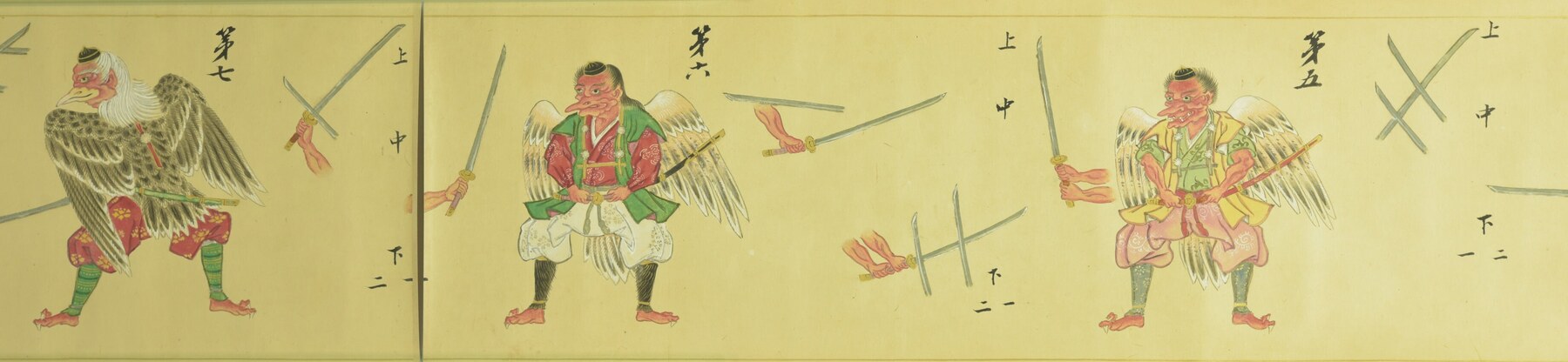
An excerpt from my book Mikkyō, Zen, and Daoist Sources in Shinkage-ryū (Mountain, Sword, and Mind, Volume II). The image above is from the Tengushō scroll of the Shinkage-ryū densho set (新影流, 8 scrolls); the owner of the original materials is the Historical Records Section, Manuscript Library, Kyushu University (九州大学附属図書館付設記録資料館九州文化史資料部門), which makes them available for public access and download (opens in a new tab).
Kyushu area Shinkage-ryū densho and the Tsuki no Shō of Yagyū Mitsuyoshi both provide descriptions of gokui and kuden level Shinkage-ryū teachings, the first in the form of makimono that list topics and the second in commentary by Mitsuyoshi. In our analysis, we examine hidden kata in Shinkage-ryū and how they evolve over time.
The 集字手利劔大事 phrase in the Kyushu densho contains the nine kuji mantra syllables, then shurimi (手裏見; seeing the shuri), then the Manura gāthā as one entry. Comparing with the Tsuki no Shō, p. 21, Jūji shurimi no koto (十字手裏見之事), we see the same three elements are present in the same entry:
“The mind of the study called ‘seed-graph’ (種字) is ‘the great matter of the nine syllables’ (九字ノ大事), in the secret method of Shingon (真言ノ秘法): putting one into these nine syllables makes ten. … ‘Seeing-the-back’ (手裏見) is the hand’s inside.”1
- the 手利劔 gokui
- the kuji
- 手裏見.
This Kyushu line was passed down from Ōno Matsuemon (大野松右衛門), a prominent early Edo-period swordsman, a senior disciple of Yagyū Sekishūsai Muneyoshi, and later granted the prestigious Yagyū family surname, becoming Yagyū Matsuemon-no-jō (柳生松右衛門尉). Matsuemon-no-jō taught the Arichi family, who passed their teachings down to the Miyake.
It is interesting to compare both documents, as the example from Kyushu diverged at the generation of Yagyū Munenori so provides an example of Yagyū teachings present at the time of Sekishūsai, but before Munenori wrote the Heihō Kadensho or Mitsuyoshi wrote the Tsuki no Shō.
Both the Tsuki no Shō and the Kyushu densho utilize the same character variants: 亦, 无 for 無, and the conjunction 亦 — 无喜亦无憂 (“neither joy nor sorrow”). The Kyushu document and the Tsuki no Shō both agree against the earlier standard use of 復 from Zǔtáng jí.
The identification of 種字 with 九字 appeared idiosyncratic at first because Shugendō corpora do not make that identification. The identification is now attested to in two Shinkage branches, which makes it a Shinkage-internal convention rather than an idiosyncrasy.
In the Tsuki no Shō, 集字 (the collected graphs) becomes 手字 (hand-graph, pulled toward 手裏見/手の内) and then 種字 (seed-graph, pulled toward bīja and 真言ノ秘法). Tsuki no Shō shows both later readings live at once and adds 裏 as 衣+里 wordplay.
Importantly, the nine syllables are not a late Yagyū borrowing but part of the founder-level 手利劔 teaching. In fact, 集字 may be an older orthography. The term ‘collected graphs’ then refers to the ten (9+1) and sets up the pattern of one set of teachings with a hidden oku appendix.
Common to multiple kata teachings and the mikkyō anointment ceremony we find a public set and a concealed increment that completes it. The mudra sequence itself encodes it — 前 is 遠行印, glossed 隱形 (ongyō; concealment). This theme is carried in both the original Enpi (6+2) and Tengushō (8+1) sets of Kamiizumi:
- Enpi 6+2 — six omote, with two oku no fuzui-dachi (獅子奮迅・山霞) appended.
- Tengushō 8+1 — eight named kata, with the ninth ninin kata (二人懸) withheld.
Meanwhile, kuji (9) is nine syllables, plus a silent or unvoiced (invisible) tenth that completes the 5x5 grid written onto the palm for protection — “putting one into these nine syllables makes ten”2 — and the Shugendō corpus’s parallel, “cut the nine, now insert one graph and it becomes the ten.”3
The Tsuki no Shō’s wordplay makes the concealment explicit at the graph level: 裏 = 衣 + 里, the village wrapped inside the garment — 里 being 中墨・高上・神妙剣, i.e. the concealed increment is the school’s core teaching, hidden inside the outer form. 手裏見 is then literally “seeing what is wrapped.”
Thus, the Shūji Shuriken Daiji (集字手利劔大事) is not a list of separate items. It is one teaching stated in three registers — the count (ten), the operation (concealment), and the perception (seeing the concealed) — with the Manura gāthā as its doctrinal ground: the mind turning through all objects, the turning-place 實能幽, truly able to be hidden. Even the gāthā is about the concealed increment.
If the increment is transmitted separately from the named set, then the same set will appear with different counts in different witnesses depending on whether the recipient had the oku. That is a mechanism, not a copying error — and it predicts exactly the pattern of the Ogasawara/Takahashi shedding, where 圓飛 disappears entirely rather than being reduced; what this implies for the Jikishinkage-ryū curriculum is taken up in the following chapter.
Regarding Tengushō, the Tsuki no Shō commentary (translated in the chapter Curriculum and Transmission) says: “beyond these, two swords used with the uncuttable stance as essential”4 — which is an appended-pair formula sitting right after the Tengushō list.
The Tengushō oku is not merely withheld but categorically different: it addresses how to engage two opponents instead of one. The Enpi oku also – it introduces teachings against uchitachi who holds two swords instead of one; as do the last two omote kata of Tengushō. The two sets relate to one another in this specific manner.
After the Tengushō list, Mitsuyoshi records: “striking with two implements, the mind of winning against two opponents: this is made the hidden matter within these.”5 That is 二人懸 and 二具足, named as the concealed item, in the Yagyū text, at the right place in the list.
The Hikita entry has 集字手利劔大事 — the completed form of the kuji teaching, ten not nine. So that line presents the increment explicitly in its densho. It is not a witness that lost the oku; it held it at the most restricted tier (一國一人傳授之; “transmission to one person in the realm”) in the same entry with 手裏見 and the Manura gāthā. This is in lieu of the commentary of Munenori and Mitsuyoshi in the Edo line of practice.
However, the line of Yagyū in Kyushu lacks the seikōsui gokui (西江水) placed above shinmyōken in Edo Yagyū, even though it explicitly lists the oku Tengushō and juji gokui of kuji having an oku tenth cut. This is in alignment with the analysis that places seikōsui as a Yagyū Sekishūsai invention that was made at the end of his life, after Matsuemon-no-jō graduated from his studies, and passed down to Munenori and then Mitsuyoshi.
It then likely entered Jikishinkage-ryū practice with Yamada Ippūsai.
Kuroda-han Shinkage-ryū Densho
The Shūyūkan (修猷館) of Kuroda Han Shinkage-ryū (黒田藩傳柳生新陰流兵法) provided in 2025 a complete set of seven Shinkage-ryū densho from 1766 to Kyushu University Library. The Shūyūkan is a martial arts school that teaches Kuroda Han (Kuroda Province) Yagyū Shinkage-ryū (opens in a new tab) Heihō and Hikita Kage-ryū (opens in a new tab) from the famed swordsman Kamiizumino Kami Fujiwara no Nobutsuna, and Niten Ichi-ryū of Miyamoto Musashi Harunobu.
NOTE: The owner of the original materials is Historical Records Section, Manuscript Library, Kyushu University. The materials are available for public access and download (opens in a new tab).
We turn towards an analysis of the densho, with an eye on capturing detail that relates back to Kashima Shinden Jikishinkage-ryū, as these densho are written within 2 years of the Naganuma Kunisato mokuroku at Waseda University.
Seven densho scrolls were transmitted in Meiwa 3 (1766), 5th month, from the Fukuoka-han Shinkage-ryū instructor Miyake San’emon Einori (三宅三右衛門栄範, d. 1774) to the karō Kuroda Genzaemon Takatsune (黒田源左衛門隆庸, 1744–1800). The scrolls include color-illustrated mokuroku. The eighth item is an Ansei 6 (1859) accompanying letter from Miyake Tasaemon Eigon (三宅太三右衛門栄権) to Kuroda Yamato Kazumi (黒田大和一美, 1830–1897), explaining that the seven scrolls, which had been returned to the Miyake family after the original transmission, were being re-delivered to the Minagi Kuroda house (三奈木黒田家; the Minagi-Kuroda house) upon a new transmission.
The scrolls use the school name 新影流 (Shinkage-ryū), with the character 影 (kage; shadow/reflection) rather than 陰 (in/kage; yin). Image order was arranged by catalogers based on Yagyū Genchō’s Seiden Shinkage-ryū (島津書房, 1989) and Imamura Yoshio’s Shiryō Yagyū Shinkage-ryū (人物往来社, 1967), as the original scroll order was not specified.
Ansei: Transmittal
The lineage is consistent across all scrolls in the collection:
- Kamiizumi Musashi-no-kami Fujiwara Nobutsuna (上泉武蔵守 藤原信綱)
- Yagyū Tajima-no-kami Taira Muneyoshi (柳生但馬守 平宗厳)
- Yagyū Matsuemon-no-jō (柳生松右衛門尉)
- Arichi Kuranosuke Ienobu (有地内蔵允 家信)
- Arichi Heiemon-no-jō Fujiwara Mitsuzane (有地平右衛門尉 藤原光真)
- Arichi Shirōemon-no-jō Fujiwara Narinobu (有地四郎右衛門尉 藤原就信)
- Miyake Genhachirō Shigenari (三宅源八郎 重業)
- Miyake San’emon Einori (三宅三右衛門 栄範) — the transmitter
The Arichi family (有地; Arichi family) were the initial Shinkage-ryū recipients in the Kuroda domain, with the Miyake family (三宅; Miyake family) succeeding them as domain instructors. The lineage runs entirely within the Yagyū mainline: from Kamiizumi, to Yagyū, to Arichi, then Miyake.
The Ansei letter states that the mokuroku (興儀之目録; ceremonial procedures catalog) were originally transmitted (御傳授中有之; transmitted/included in transmission) and that from this point forward (自今以後; henceforth/from now forward) the transmission is formalized. It references the 目録数巻 (“several scrolls of mokuroku”) and the 七巻 (“seven scrolls”) — matching the seven densho in the collection.
The letter explains that the seven mokuroku scrolls had been originally transmitted from Miyake Einori to Kuroda Takatsune, were later returned to the Miyake family, and are now re-delivered to the Minagi Kuroda house. The letter references the 七巻 (seven scrolls) as a unified set and includes language about exclusive practice of the school (為流専用; exclusively for the school) and prohibition on unauthorized transmission. Higher-level teachings are to be shared with only “one person in the realm” (一國一人).
The colophon date reads 安政六未 (Ansei 6, Year of the Sheep, 1859), signed by 栄権 (Eigon) with vermilion seal, addressed with 状如件 (“as stated above”), and 三宅三右衛門 (Miyake San’emon) appears as the formal signatory.
Dated Ansei 6, 12th month (1859), an accompanying letter from Miyake Eigon to Kuroda Yamato, certifying the transmission.
The seven densho are a complete Yagyū Shinkage-ryū transmission set:
- Enpi (燕飛) — the foundational kata
- Sangaku Entachi-bun (三学円太刀分) — analysis of the Three Learnings Round Sword
- Sangaku (三学) — Three Learnings
- Kūka (九箇) — Nine Pieces
- Tengushō (天狗抄) — the Tengu Writings
- Kiri-ai Gokai (截合五箇位) — Five Positions of Engagement
- Soto-mono Taryū (外物他流) — External Matters / Other Schools
Below we examine several that are relevant to our cross-lineage analysis of the composition of 18th century Jikishinkage-ryū.
Enpi
The Enpi (燕飛) scroll is stunning, with color illustrations exceptional for a 1766 document. It contains introductory philosophical preamble discussing the relationship between martial arts and Buddhist wisdom, with references to the Seven Buddhas (七佛), Sanskrit and Chinese bonkan (梵漢; Sanskrit-Chinese traditions), Mañjuśrī (文殊; Skt. Mañjuśrī), Prajñā (般若; Skt. Prajñā), chie (智慧; wisdom) and Arhats (羅漢). The text positions the art within a Buddhist framework and discusses the concept of ken-tai (懸待; suspension and waiting).
This is followed by color illustrations of the kata, each labeled, showing paired figures (shidachi in blue/grey, uchitachi in yellow/green):
- Enpi (燕飛; “Swallow Flight”)
- Enkai (猿廻; “Monkey Turning”)
- Yamakage (山陰; “Mountain Shadow”)
- Tsukikage (月影; “Moon Shadow”)
- Uranami (浦波; “Shore Waves”)
- Ukifune (浮舟; “Floating Boat”)
- Shishi Funjin (獅子奮迅; “Lion’s Fierce Rush”)
- Yamagasumi (山霞; “Mountain Mist”)
This maintains the early Sarutahiko inspired monkey imagery (Volume I, Udo Shugendō and the Aisu Kage-ryū) in its choice of kanji for the second kata instead of 燕 (swallow). The last two kata are the Enpi Oku — in other densho arrangements they sometimes are omitted.
The scroll concludes with homage to Nichirin Marishiten (日輪摩利支天; “Sun Disc of Mārīcī Deva”), a lineage chart (as above) and colophon. This is the standard Yagyū Shinkage-ryū Enpi set. The final section invoking Marishiten (摩利支天; Skt. Mārīcī) — the Buddhist deity of light and invisibility, patron of warriors — is worth noting. Her scripture, the Fó shuō Mólìzhītiān jīng 佛說摩利支天經, is the warrant for the set’s closing 日輪摩利支天 (“Sun-Disc Marīcī”) invocation: Marīcī goes ever before the sun, so that the sun cannot see her though she sees the sun, and no one can see her, know her, seize her, or bind her.6 The expanded Song recension is the Dà Mólìzhī púsà jīng 大摩里支菩薩經.7 The passage closes the set with an explicitly devotional frame.
The illustrations themselves show specific moments within each kata — sword positions, body angles and spatial relationships are clearly rendered, making these potentially useful as technical references.
The Enpi set has no direct equivalent in the Jikishinkage-ryū curriculum — this is part of the “middle layer” that Jikishinkage-ryū does not transmit, having substituted the Tō no Kata (韜之形) tactical forms instead. However, several points of connection exist:
- The Buddhist preamble’s emphasis on Prajñā and the relationship between martial technique and spiritual wisdom parallels the philosophical framework of Jikishinkage-ryū mokuroku gokui sections, particularly Nenshi (念思; “Thought and Contemplation”) and Furyū no Katsu (不立之勝; “Victory of Non-Reliance”), which reference Buddhist concepts of munen musō (無念無想; no-thought, no-conception).
- The concept of ken-tai (懸待; suspension and waiting) appears in the Jikishinkage-ryū gokui as Ken Tai Yū (権躰勇; “Authority, Body, Valor”), where the ancient writing is explicitly noted as 懸待遊 (Ken-Tai-Yū; Suspension, Waiting, Play). The Jikishinkage-ryū mokuroku acknowledges this older orthography.
- The Nichirin Marishiten (日輪摩利支天) invokes the Buddhist warrior deity Mārīcī (Skt. Mārīcī), connecting to the broader spiritual dimension shared by both traditions. Mārīcī as patron deity of warriors provides religious context for concepts like Shinmyōken. In contrast, Jikishinkage-ryū densho typically are adorned with bonji (梵字; Siddhaṃ characters) representing the celestial guardian Fudō or the A-Un philosophical concept at the same time (circa 1768 and onward).
Sangakuen (no) tachi-bun
The Sangakuen (no) tachi-bun (三學圓太刀分; “Three Learnings, Round Sword Division”) is the master index for the entire curriculum. First, core kata (entachi) are listed:
- Ittō Ryōdan (一刀兩段; “One Sword, Two Halves”)
- Zantei-settetsu (斬釘截鐡; “Cutting Nails, Breaking Iron”)
- Hankai Hankō (半開半向; “Half Open, Half Facing”)
- Usen Saten (右旋左轉; “Right Rotation, Left Turning”)
- Chōtan Ichimi (長短一味; “Long and Short are One Flavor”)
Three of these — Ittō Ryōdan, Usen Saten (= Uten Saten) and Chōtan Ichimi — are identical to Jikishinkage-ryū Hōjō kata names. That’s three out of four Hōjō sharing names directly with the Yagyū Entachi curriculum.
Only Hassō Happa (八相発破; Hōjō #1, spring) has no direct equivalent in this list, replaced by Zantei-settetsu and Hankai Hankō. This three-of-four correspondence strongly suggests the Hōjō were inherited from the common Shinkage-ryū of Kamiizumi and represent the same foundational training layer.
Kūka
Then the full curriculum is listed, including the individual kata in Kūka (九箇; nine places):
- Hisshō (必勝; “Certain Victory”)
- Gyakufū (逆風; “Reverse Wind”)
- Tō-dachi (十太刀; “Ten Swords”)
- Kaboku (和卜)
- Koshiboku (腰卜)
- Kozume (小詰; “Small Entrapment”)
- Ōzume (大詰; “Great Entrapment”)
- Yaegaki (八重垣; “Eight-Layered Fence”)
- Murakumo (村雲; “Gathering Clouds”)
Hisshō (必勝; “Certain Victory”) also appears in Jikishinkage-ryū gokui sections as scribal notes under the gokui called Ikki-tō (一氣當), where hisshō nari (必勝也; “this is Certain Victory”) is the culminating declaration.
Tengushō
Tengushō (天狗抄) is listed in summary, not providing kata names but simply the summary description Tachi-kazu yattsu (太刀数八ツ; “sword count: eight”) denoting eight kata for the set. The preamble establishes the Tengushō as the highest-level transmission document. Key phrases include: “This must not be transmitted to more than one person in the realm”8 and “This is written, but the oral transmissions are many.”9
Keeping with this, the kata are not named, but simply enumerated. Also absent are the tengu names found in the Edo line of practice (see the chapter Curriculum and Transmission and, for the tengu themselves, Volume I, Tengu, Gongen and their Sacred Mountains), likely dating from at least Yagyū Munenori’s emokuroku.
The Shūyūkan lineage records the set’s origin directly: the Aisu Kage-ryū oku techniques transmitted by Yagyū Ienobu include the Enpi of the catalogue that Kamiizumi Nobutsuna issued to Yagyū Muneyoshi in 1566 (Eiroku 9), the Enpi-oku pair Shishi Funjin and Yamagasumi, and the Tengushō tachi-kazu kamae hachi, which is said to be of Kage-ryū origin (陰流由来). So the Tengushō name and the eight-kata structure predate Sekishūsai by a generation: he inherited the set wholesale from Kamiizumi, who inherited it from the Aisu house.
The catalog lists the Soto-mono Taryū (外物他流) as a separate scroll specifically for “other school” material, but if Hikita content had already been integrated into the core transmission sets — including the Tengushō — it might not appear separately in the Soto-mono scroll at all.
The close-quarters/grappling techniques in the Soto-mono would then represent only the Hikita material that couldn’t be absorbed into existing Yagyū kata structures, while Hikita sword techniques compatible with the Tengushō framework were more likely folded directly into the set as four additional positions.
Typically, there are eight kata in Tengushō practice, including a hidden oku (奥; inner, deep) kata called Ninin-kakari (二人掛かり; two-attacker practice), for nine total. In the densho, twelve tengu are depicted and numbered — there are three known Tengushō kata from Hikita Kage-ryū, using the suffix -sho (書; writing) instead of 抄 (excerpt), which then make twelve (including the oku kata). Their names are:
- Ranshō (乱勝)
- Chōgoku (釣極)
- Unsetsu (雲截)
The Kuroda-han Miyake transmission appears to have followed a consistent documentary principle of listing everything — oku and Hikita material alike — rather than omitting some of the kata. This makes sense in context: these scrolls were being transmitted to a karō, a chief retainer of the domain. The Miyake family may have chosen completeness over concealment precisely because the scrolls were going to the highest level of their domain authority.
Following the preamble is a set of twelve illustrated positions with Tengu. Each of the twelve positions shows a tengu figure with:
- A position number (第一 through 第十二)
- Grey sword-trajectory lines indicating cutting paths
- Level notations: jō (上; upper), chū (中; middle), ge (下; lower) with associated numbers
The numbers after each level appear to indicate the count of cuts directed at that level. The grey lines drawn around each figure correspond to these counts, showing the angle and direction of each cut.
Dai-ichi (第一; First)
Figure: Tengu in pink-purple and blue-green clothing, crouching with sword held close. Level notation: 上中 / 下一 Sword lines: Crossed lines visible (partially obscured by image transition). Interpretation: Upper and middle cuts; 1 lower cut.
Dai-ni (第二; Second)
Figure: Larger tengu in green-yellow clothing, sword extended low and forward. Level notation: 上中 / 下一 Sword lines: Multiple crossing lines — X pattern with additional trajectories. Interpretation: Upper and middle cuts; 1 lower cut. Note: The pattern of grey lines is more complex than 第一 despite the same notation, suggesting the notation records targets struck rather than total number of movements.
Dai-san (第三; Third)
Figure: Tengu in brown-gold and green clothing, standing wide. Level notation: 上 / 中 / 下 一二 Sword lines: X pattern (two crossing diagonal lines). Interpretation: Upper; middle; lower with 1 and 2 (uncertain — could be “lower: 1–2 cuts” or a combined notation).
Dai-shi (第四; Fourth)
Figure: Tengu in pink-purple clothing, crouching with sword thrust forward, multi-directional sword lines. Level notation: 上 / 中 / 下 一二 Sword lines: Multiple lines radiating in several directions (more than a simple X). Interpretation: Same notation as 第三.
Dai-go (第五; Fifth)
Figure: Tengu in yellow-pink and green clothing. Level notation: 上 / 中 / 下 一二 Sword lines: X pattern. Interpretation: Same notation as 第三 and 第四.
Dai-roku (第六; Sixth)
Figure: Tengu in red-green clothing, mid-level guard. Level notation: 上 / 中 / 下 二一 Sword lines: Distinctive parallel horizontal lines (notably different from crossing patterns — possibly representing thrusts or horizontal sweeps rather than diagonal cuts). Interpretation: Upper; middle; lower 2 and 1. Note reversed order from 第三–第五 (二一 vs 一二).
Dai-shichi (第七; Seventh)
Figure: DISTINCTIVE — elder tengu with white hair/beard (daitengu type), dark feathered wings, in red and green clothing. Holds sword in both hands. Level notation: 上 / 中 / 下 二一 [reading from Image 5, right edge] Sword lines: Crossing lines plus additional trajectories. Interpretation: Same reversed notation as 第六. Note: The elder/white-haired appearance distinguishes this tengu from all others and may indicate a senior or master-level technique.
Dai-hachi (第八; Eighth)
Figure: Tengu in yellow-orange and green, seated in wide stance. Level notation: 此手多正傳 (Kono te ōku shōden) Sword lines: THE MOST COMPLEX — many lines radiating in multiple directions, significantly more than any other position. Also includes what appears to be a single horizontal line at the bottom (a thrust or sweep?). Interpretation: “These techniques are numerous — true/principal transmission.” This position is explicitly marked as the core or principal transmission of the set. The absence of standard 上/中/下 notation and the annotation 此手多正傳 suggests this is the summary or master technique that encompasses all levels. Note: The word 正傳 (shōden, true/correct transmission) marks this as having special doctrinal weight.
Dai-kyū (第九; Ninth)
Figure: Distinctive Tengu with dark brown/olive feathers (more eagle-like, different from the lighter-feathered tengu). Prominent beak-nose, in pink clothing. Level notation: 上 / 中 / 下 二一 Sword lines: Three parallel diagonal lines (distinctive pattern — all going in the same direction, upper-right to lower-left). Interpretation: Upper; middle; lower 2 and 1. Same reversed notation as 第六 and 第七.
Dai-jū (第十; Tenth)
Figure: Tengu in green clothing with dark wing feathers, crouching/striding. Level notation: 上 / 中 / 下 一二 Sword lines: X pattern with additional lines. Interpretation: Same notation as 第三–第五.
Dai-jūichi (第十一; Eleventh)
Figure: Tengu in red and green-yellow clothing, standing with sword drawn. Level notation: 上 / 中 / 下 一二一 Sword lines: Crossing X pattern. Interpretation: Upper; middle; lower 1, 2, 1. This is the first position with THREE numbers in the lower notation, indicating a more complex technique. The palindromic structure (1-2-1) may encode a specific rhythmic pattern.
Dai-jūni (第十二; Twelfth)
Figure: Elaborate Tengu in multi-colored pink/green/red clothing, in a dynamic lunging pose with sword raised high (jōdan). This is the final and culminating position. Level notation: 上 / 中 / 下 四三二 Sword lines: [partially visible due to proximity to text section] Interpretation: Upper; middle; lower 4, 3, 2. This is the most complex notation in the entire set — three numbers in a descending sequence (4, 3, 2). The total of 9 lower-level actions dwarfs every other position. The descending pattern may encode a progressive narrowing or refinement within the technique.
Following the blood oath and purification clauses, there are statements that “In ancient times, this was transmitted with sincere and pure devotion.”10 and Nichirin Marishiten (日輪摩利支天; “Sun Disc of Marīcī Deva”), an invocation of the warrior deity, closing the set.
Summary of Cut Notations
Read across the twelve positions, the notation is regular in its upper two registers and varies almost entirely in the lower. Every position carries both an upper (上) and a middle (中) cut except the eighth (第八), which abandons the standard 上/中/下 scheme and is marked 此手多正傳 (“these techniques are numerous — the principal transmission”), singling it out as the doctrinal core of the set.
The lower (下) notation moves through a clear progression. The first and second positions take a single cut, 一. The third through fifth — and the tenth — expand to 一二, the fourth distinguished only by its multi-directional lines. The sixth, seventh, and ninth reverse the order to 二一: the sixth with distinctive parallel lines, the seventh the white-haired elder (daitengu), the ninth dark-feathered with parallel diagonals. The last two positions extend to three numbers — the eleventh a palindromic 一二一, and the twelfth, the most elaborate and culminating figure, a descending 四三二 whose nine lower actions exceed every other position.
Notation
- The 上 and 中 notations never carry explicit numbers in this copy — only 下 receives numerical counts. This may indicate that upper and middle cuts are standard (one each?), with the variation encoded in the lower-level attacks.
- Positions 第六, 第七, and 第九 reverse the lower count from 一二 to 二一. This creates a pattern where a cluster of three positions in the middle of the set use reversed notation — whether this indicates a different sequence of execution, a different spatial arrangement, or marks a distinct sub-group of techniques is unclear without oral transmission.
- 第八 breaks the pattern entirely with the annotation 此手多正傳 (“these techniques are numerous — the principal transmission”), marking it as the principal/true transmission. The dense cluster of sword lines around this figure suggests it is the “master key” technique.
- 第七 and 第九 have visually distinctive tengu — the elder (white-haired) and the eagle-feathered respectively — which may indicate techniques of a different character or origin than the standard set.
- 第十二 has the highest lower-count numbers (四三二), with a total of 9 lower-level actions and a descending sequence. The progression from two-number notation (positions 1–10) to three-number notation (positions 11–12) suggests a structural escalation toward the climax of the set.
- The notation expands at the end of the set: Positions 第一–第十 use two numbers for 下, while 第十一 uses three (一二一) and 第十二 uses three (四三二). This expansion may indicate that the final positions encode more complex multi-stage techniques, or that the third number represents an additional dimension (e.g., a third direction or phase of attack).
- 第十一’s palindromic 一二一 (1-2-1) is structurally distinct from 第十二’s descending 四三二 (4-3-2), suggesting different organizing principles for the two culminating techniques. The grey sword-line patterns vary systematically: some show X-crosses (diagonal cuts), some show parallel lines (repeated cuts in one direction or thrusts), and some show radial patterns (multi-directional attacks). These patterns carry information beyond what the 上/中/下 notation alone records. 第八’s 此手多正傳 could be read as “these techniques are numerous — true transmission” or “this hand [position] has many true transmissions [variants].” Several positions in the middle of the set (第三–第五) share identical notation (上 / 中 / 下 一二), raising the question of whether the figures and sword-line patterns — rather than the text notation — carry the differentiating information. A clause follows the illustrations: “A blood oath [keppan] must be made at the time of transmission.”11 It is preceded by a seven-day purification requirement — this practice of having a separate keppan at a high-level of initiation is still maintained by contemporary ryūha (流派; school, tradition) influenced by Shinkage-ryū.
Okugi
Next we see listed six teachings that are similar to other Yagyū examples (the six gokui no tachi discussed in the chapter Curriculum and Transmission, where the first is Tensetsu Ransetsu, 添截乱截):
- Metsusai Ransetsu (滅載乱截; “Extinguishing Chaos, Cutting Disorder”)
- Muniken (無二劔; “Peerless Sword”)
- Rojin-ken (路人劔; “Sword of the Wayfarer”)
- Kōjō (高上; “Highest Level”)
- Gokui (極意; “Deepest Teaching”)
- Shinmyōken (神妙劔; “Mysterious Sword of the Mind”)
Notice, katsujinken (活人剣; life-giving sword) is replaced with Rojin-ken in this list. Shinmyōken appears here as the pinnacle of the Yagyū curriculum — the same term, same kanji (though 劔 rather than 剱), same position at the apex. Shinmyōken is the first gokui of Jikishinkage-ryū, which notes it as a teaching shared across the Kashima-area traditions. This scroll places Shinmyōken in a similar stature as the culmination of the Okugi.
Kōjō (高上) as a designation corresponds to Kōjō Gokui (口上極意) in the Jikishinkage-ryū mokuroku — the “beyond words” oral teachings. The character differs (高上 “highest” vs. 口上 “oral/spoken”) but the functional position is the same: the layer of teaching that transcends written transmission. Jikishinkage-ryū mokuroku list Kōjō, Gokui and Shinmyōken; but Metsusai Ransetsu, Muniken and Katsujinken are Yagyū Sekishūsai developed kata or concepts – this seems to indicate that Yamada Ippūsai did not import the Yagyū Okugi-no-tachi into his Jikishinkage-ryū.
Kiri-ai Gokai
The Kiri-ai Gokai (截合五箇位; “Five Positions of Engagement”) scroll lists five numbered positions (第一 through 第五), each followed by descriptive text in cursive text.
Preface
The Jo (序; “preface”) lists several topics, some of which we see in contemporary Jikishinkage-ryū densho and others we see in the Tsuki no Shō:
- Jōdan, mittsu (上段 三ツ; “Upper level, three [techniques]”)
- Chūdan, mittsu (中段 三ツ; “Middle level, three”)
- Gedan, mittsu (下段 三ツ; “Lower level, three”)
- Ha (破; “Break/Destroy”)
- 弁合結太刀 三ツ (Combination binding sword, three)
- Tōbō (刀棒; “Sword and staff”)
- Sekkō/Orikabuto, futatsu (折甲 二ツ; “Breaking armor, two”)
- 上段… 左 右 — Directional variants
- Metsuke no Daiji (目付之大事; “Important Matter of the Gaze”)
- Enzan (遠山; “Far Mountain”)
- Nijō (二畳; “Two tatami”)
- Irotsuki (色付; “Color Sensing”)
- 伍陰微味方三寸之事 — Complex entry, possibly “Matter of the Five Shadows, Subtle, Ally’s Three Sun”
- Sanchōshi no Koto (三調子…事; “Matter of Three Rhythms”)
In particular, tōbō (6) and gokage (13) seem unique to this line.
Philosophical Content
- Shin-omote no Koto (真表之事; “Matter of True Surface”)
- Taikyoku no Koto (待曲事; “Matter of Waiting/Curving”)
- Kodachi issaku rokusun (小太刀一尺六寸; “Short sword, one shaku six sun [~48cm]”) — with associated oral transmission notes
- Shūji Shuriken Daiji (集字手利劔大事; “Important Matter of Collected Characters, Shuriken”)
- Kuji (臨兵鬪者皆陣烈在前)
- Shurimi (手裏見; “Seeing the Hidden Hand”)
- Shin-hen Bankyō (心遍萬境; “The Mind Pervades All Realms”),〔轉〕處實能幽 (“True accomplishment following the flow”)、隨流認得性、无喜亦无憂
- Ikkoku Ichinin Denju (一國一人傳授之; “Transmission to one person in the realm”)
- Gokui nari (極意也; “This is the deepest teaching”)
We also see the important Shūji Shuriken, Kuji, and Shurimi sections common to the family line of Yagyū Shinkage-ryū being listed.
Metsuke no Daiji (目付之大事) and Enzan (遠山) align with Metsuke no Katsu in Jikishinkage-ryū mokuroku, which discuss Enzan no Metsuke as daiji (an important matter), and the Edo Yagyū Tsuki no Shō. Irotsuki (色付; “Color Sensing”) is similar to the discussion of iro (色; sensing the opponent’s intention) in the Jikishinkage-ryū Metsuke no Katsu as “sensing the opponent’s intention.” Here it appears as a named teaching within the Kiri-ai framework.
Ha (破; “Break”) may relate to the Jikishinkage-ryū concept of Hatetsu (破鉄; “Breaking Iron”).
Included is the complete Manura gāthā, written continuously with a repetition mark on 轉: 心隨萬境轉/轉處實能幽/隨流認得性/无喜亦无憂12 (“The mind turns following the myriad objects; the turning-place is truly able to be hidden/profound; following the flow one recognizes [one’s] nature; neither joy nor sorrow.”). Shin-hen Bankyō (心遍萬境; xīn biàn wàn jìng; “The Mind Pervades All Realms”) is not attested in the transmitted Chinese Buddhist canon, nor in searchable Japanese Buddhist or Edo-period printed corpora. It is most economically read as a recasting of the ubiquitous Chan gāthā shin zui bankyō ten (心隨萬境轉; xīn suí wàn jìng zhuǎn; “the mind turns following the myriad realms”) attributed to Manura (摩拏羅), substituting 遍 (“pervade”) for the passive 隨…轉 (“be turned by”) and drawing conceptually on Huáyán mind-only doctrine (三界唯心, “the three realms are mind-only” / 一切唯心造, “all is made by mind alone”) without quoting any single sūtra.
Manura gāthā
The verse included is the fugeju (付偈; transmission gāthā) of Manura (摩拏羅), the 22nd Indian patriarch, spoken to his successor Haklenayaśas (鶴勒那; Ch. Hèlènà; J. Kakurokuna). In the corpus its earliest extant occurrence is the Zǔtáng jí (祖 堂集; Sodōshū, 952; CBETA B25n0144), whose Manura chapter opens with “as fully given in the Bǎolín zhuàn”13, crediting the now largely-lost Bǎolín zhuàn (寶林傳, 801) as its source. (靜筠二禪師 (Jing and Yun, comp.) 952 AD)
The most-diffused version is the Jǐngdé chuándēng lù (景德傳 燈錄, 1004; T2076); across the corpus the gāthā recurs in ~90 works (lamp records, Dàhuì yǔlù T1998A, Bìyán lù T2003, and much of the Zokuzōkyō / Jiaxing Chan literature). (道原 (Daoyuan) 1004)
Text (earliest witnesses agree): 心隨萬境轉/轉處實能幽/隨流認得 性/無喜復無憂 — the earliest reading is 無喜復無憂 (fù), not the later-circulating 無喜亦無憂 (yì).
Manura entrusts Haklenayaśas with the shōbōgenzō (正法眼藏; treasury of the true dharma eye) — “guard it, let it not be cut off” — and speaks the verse; the Jǐngdé chuándēng lù recension ties it to liberating a flock of cranes (鶴眾, former disciples reborn in avian form), after which Manura enters final quiescence.
The verse is therefore a transmission teaching on the mind–object relation: the mind is carried through the myriad realms (境), yet one who recognises [self-]nature within the flux is beyond joy and sorrow — the passive “turned by” polarity that the densho phrase 心遍萬境 (“the mind pervades all realms”) inverts. In the Xù chuándēng lù (續傳燈錄, T2077) a Song-court speaker even cites the verse and misattributes it to the third patriarch’s Xìnxīn míng (信心銘) — evidence it circulated detached from its Manura source.
The Avataṃsaka-sūtra (大方廣佛華嚴經; Daihōkō butsu Kegon-kyō; “Flower-Ornament Sūtra”) is a large composite Mahāyāna scripture assembled in Central Asia by c. the 4th century from originally independent texts. Three Chinese recensions are standard: the 60-fascicle (T278, trans. Buddhabhadra, 418–420), the 80-fascicle (T279, trans. Śikṣānanda, 695–699), and the 40-fascicle (T293, the Gaṇḍavyūha alone).
Its cosmology centres on Vairocana (毘盧遮那) and the mutual interpenetration of all phenomena — ichi-soku-issai (一即 一切; “one is all”) and hokkai engi (法界縁起; dharmadhātu dependent-arising). Its two oldest and most influential chapters are the Jūji-hon (十地品; Daśabhūmika, the ten bodhisattva grounds, source of 三界唯心 “the three realms are mind-only”) and the Nyū-hokkai-hon (入法界品; Gaṇḍavyūha, the pilgrim Sudhana / 善財童子 visiting fifty-three teachers).
It is the doctrinal basis of the Huáyán (華厳宗) / Kegon school (historically at Tōdai-ji). The mind-only line “all is made by mind alone” (一切唯心造)14 belongs to the Yuishin-ge (唯心偈) of the Kakurin Bosatsu ge (覚林菩薩偈), 80-fascicle, fasc. 19 (Taishō vol. 10, 102a) but the phrase 心遍萬境 (“the mind pervades all realms”) does not occur in it. (實叉難陀 (Śikṣānanda, trans.) 699 AD)
Soto-mono Taryū
The Soto-mono Taryū (外物他流; “External Matters, Other Schools”) is a catalogue of techniques from outside this lineage of Yagyū Shinkage-ryū — techniques from other schools or “external matters” that were incorporated into or are discussed in the Kuroda-han practice. This is an extensive list, which contains several items of relevance to the comparison of Jikishinkage-ryū with other lines of Shinkage-ryū:
Kiri-otoshi (切落) appears as the first entry. In the Jikishinkage-ryū mokuroku, Kiri Otoshi no Katsu (切落之克; “Victory of Cutting Down”) is the fourteenth Katsu and one of the entries Karukome identified as a Naganuma Kunisato addition (Karukome Yoshitaka 2015). Its placement in the Yagyū “Other Schools” section raises the question of whether this concept was recognized as originating outside the Yagyū mainline — possibly representing a shared Kage-ryū teaching that the Yagyū classified as “external” and that Naganuma later incorporated into the Jikishinkage-ryū Katsu progression.
Hitotachi (一太刀; “One Sword”) relates to the Jikishinkage-ryū teaching of Hitotsu no Tachi (一ノ太刀; “First or Singular Sword”), discussed in the Shinmyōken gokui section as one of the highest-level teachings associated with Kashima no Tachi (鹿島之太刀) and Katori no Ken (香取之剱). This is typically regarded as being a Shintō-ryū gokui.
Mu’iken (無一劔; “No-Sword”) connects to the broader Shinkage-ryū tradition of mutō-dori (無刀取; sword-taking without a sword), which has conceptual parallels in the Jikishinkage-ryū teaching of abandoning attachment to technique in Furyū no Katsu (不立之勝).
Ichimonji (一文字; “Horizontal Line”) parallels Yoko Ichimonji no Katsu (横一文字之克; “Victory of the Horizontal Line”) in the Jikishinkage-ryū Katsu. Its placement in the “Other Schools” section suggests this may have been recognized as a technique shared across other Shinkage-ryū lineages.
Techniques possibly referring to other traditions or viewed as side-matters (auxiliary) imported from them include:
- Kiri-otoshi (切落; “Cutting Down”)
- Ichimonji (一文字; “Horizontal Line”)
- Kanetsumi or Kinzumi (金積; “Gold Accumulation” — unusual name)
- Eiketsu (英傑; “Hero/Outstanding”)
- Hitotachi (一太刀; “One Sword”)
- Sanmi (三位; “Three Ranks/Positions”)
- Mu-ikken (無一劔; “No-Sword” or “Without a Single Sword”)
- Sanshin no Tachi (三身之太刀; “Sword of Three Bodies”)
- Shuriken (手裏劔; “Hidden-Hand Sword”)
- 折截身曲身面影 — This appears to be compound, possibly parsing as 折截 (Sessetsu; “Breaking Cut”) + 身曲 (Mimagari; “Body Curve”) + 身面影 (Mi-menkage; “Body’s Reflection/Shadow”). Or these may be three separate entries written continuously.
- 爐子三人截事 — Difficult reading. Possibly “The Matter of Three-Person Cutting” with 爐子 being a name or term.
- Jigusoku no Koto (自具足事; “The Matter of Self-Armor/Self-Equipment”)
- Surite Daiji (摺手大事; “Important Matter of the Sliding/Rubbing Hand”)
- Shiri-kashiwa no Koto (尻柏之事; “Matter of the Rear Oak” — possibly a body-contact technique)
- 脇指ヨキテ事 — Wakizashi-related technique (reading uncertain — possibly Wakizashi yokite, “using the wakizashi effectively”)
- Ryūshuken or Nagashite-ken (流手劔; “Flowing Hand Sword”)
- Asete/Kante Tachi (汗手太刀 上下右左; “Sweating Hand Sword — Upper, Lower, Right, Left”)
- Uchigusoku Kakemono no Koto (打具足懸物事; “Matter of Striking Armor / Hanging Things”)
- Hatori Tedome no Koto (羽取手留之事; “Matter of Feather-Catching, Hand-Stopping”)
- Ennin Hachimonji no Koto (遠任八文字事; “Matter of the Distant Eight-Character”)
Some of the entries are found in the Heihō Kadensho and Tsuki no Shō, so side matters may refer to teachings from the parallel lines of Yagyū, rather than other ryū.
It seems as though the entries from (12) onward — Jigusoku (self-armor), Surite (sliding hand), Uchigusoku (striking armor), Hatori (feather-catching) — could be grappling or close-quarters techniques.
Hikita Shinkage-ryū, which reached Higo (Kumamoto) through Ueno Sōma-no-suke, was not a sword-plus-jūjutsu package the way Owari Yagyū carried Seigō-ryū: Kumamoto’s grappling was a separate cluster of dedicated houses — the “three jūjutsu dōjō of Higo,” consolidated with other surviving lines into Higo-ryū taijutsu (肥後流体術) by Hoshino Kumon in 1902 — whose roots lay outside Shinkage swordsmanship: Shiten-ryū’s founder Narita Seibei, for one, came out of Toda-ryū iai and kenjutsu.15 In the Hosokawa domain the Hikita line was simply called “Shinkage-ryū”, “Yagyū-ryū” being reserved for the Yagyū-derived line; it split into the five instructor houses of Wada, Yokota, Hayami, Tonami and Hayashi, of which the Wada line survives.
Taisha-ryū, Marume Nagayoshi’s school in the Sagara domain of Hitoyoshi, is the one Kyūshū Shinkage line that carries its grappling inside the sword school (Volume I, Taisha-ryū and Denrinbō Raikei). It spread across Hizen: in Bakumatsu Saga the Taisha-ryū Kawara-kōji dōjō and the Jikishinkage-ryū Mizugae dōjō split the field so evenly that people spoke of “Jikishinkage-ryū in the east, Taisha-ryū in the west”, and the tenth lord Nabeshima Naomasa himself enrolled. It also fed Satsuma: Tōgō Chūi, founder of Jigen-ryū, was a Taisha-ryū adept first.
In Kurume, Katōda Shinsaku, invited to the domain in 1716, named his line “Shinkage-ryū” (Kurume Shishi Hensan Iinkai 1981/1999); the Katōda became a hereditary instructor house, and their auxiliary arts were Yōshin-ryū naginata and kusarigama rather than grappling.
End Notes
-
種字ト云習之心持、九字ノ大事トテ、真言ノ秘法ニアリ。此クジニひとつ入テ十字也。…「手裏見」ハ手の内也。 ↩
-
「此クジニひとつ入テ十字也」 ↩
-
「切九字、今入一字爲十字樣有」 ↩
-
「此ノ余ニ、キラレヌ構を専トシテつかふ太刀二つアリ」 ↩
-
「ふたつクソク打もの、二人あひてにして勝心持ヲ、此内ニテ秘事とするなり」 ↩
-
「(日)不能見彼、彼能見日」; 「無人能見、無人能知、無人能捉」 — Fó shuō Mólìzhītiān jīng 佛說摩利支天經, CBETA, T21n1255b. ↩
-
Dà Mólìzhī púsà jīng 大摩里支菩薩經, CBETA, T21n1257. ↩
-
不可傳之一國一人之 ↩
-
書也口傳多 ↩
-
古者直實穀之仁粹之相傳 ↩
-
血判可有相傳之節 ↩
-
Zǔtáng jí 祖堂集, Mónáluó 摩拏羅章 — CBETA B25n0144: 「心隨萬境轉,轉處實能幽。隨流認得性,無喜復無憂」 (xīn suí wàn jìng zhuǎn, zhuǎn chù shí néng yōu, suí liú rèn dé xìng, wú xǐ fù wú yōu). Manura’s transmission gāthā (付偈) to Haklenayaśas 鶴勒那; the most-diffused recension is Jǐngdé chuándēng lù 景德傳燈錄 T2076 (earliest reading 無喜復無憂, not the later 無喜亦無憂). ↩
-
Zǔtáng jí 祖堂集, Mónáluó 摩拏羅章 — CBETA B25n0144: 「具如寶林傳也」 (jù rú Bǎolín zhuàn yě); the cross-referenced Bǎolín zhuàn 寶林傳 (801) survives only as a fragment — CBETA B14n0081 (雙峰山曹侯溪寶林傳殘卷): 「…正名得勝,具如寶林傳也」. ↩
-
Dàfāngguǎng fó huáyán jīng 大方廣佛華嚴經 (80-fasc., trans. Śikṣānanda), Yèmó gōng zhōng jié zàn pǐn 夜摩宮中偈讚品, fasc. 19 — CBETA T279 (Taishō vol. 10, 102a), the 覺林菩薩 wéixīn gāthā 唯心偈: 「若人欲了知,三世一切佛,應觀法界性,一切唯心造」 (ruò rén yù liǎo zhī, sān shì yīqiè fó, yīng guān fǎjiè xìng, yīqiè wéi xīn zào). ↩
-
The “three jūjutsu dōjō of Higo” (四天流組討・星野道場, 竹内三統流・矢野道場, 扱心流体術・江口道場) and Hoshino Kumon’s 1902 consolidation of the surviving domain lines into Higo-ryū taijutsu (肥後流体術) are documented in Higo budō-shi (肥後武道史), the standard Kumamoto martial-history compilation. Its full bibliographic details remain to be confirmed. ↩