From Shugendō and Heihō, the first volume of Mountain, Sword, and Mind.
In outline, Zaō Gongen is the wrathful, single-figure avatar of the three-times buddhas (Śākyamuni, Kannon, Miroku), a Japanese-original protector with no Indian ancestor, generated by En no Gyōja’s vision on Kinpusen. The canon’s own Kinpusen himitsu-den (金峰山祕密傳; Kinpusen hidden transmissions) treats him at far greater length, and one liturgical text serves him directly — the Kongō Zaō-hō (金剛藏王法), set out in the last section below. We begin by exploring his identity as the Kongō Dōji, his welling-up from rock, the emergence-peak vision, and his kinship with Kōjin.
Kongō Dōji, and the body of three colors
The canon associates Zaō with the Kongō Dōji (金剛童子), youthful, divine attendant deities in Japanese Esoteric Buddhism, often associated with protection, wisdom kings like Fudō Myōō, or manifestations of higher buddhas, and grades the two by register: 「金剛童子卽ち藏王權現なり。當山に出現して極惡の濁世を化度する形相なり。……悉く藏王權現と稱す、外は金剛童子と稱し、內は藏王大權現と曰ふ」 — the Kongō Dōji is Zaō Gongen, manifesting on this mountain to save the utterly evil, defiled age; all are called Zaō Gongen, outwardly styled Kongō Dōji, inwardly Zaō Daigongen.1 His visualization is a generation-sequence in two syllables: 「藏王權現之觀、上有𑖀𑖾字變成磐石、上有𑖮𑖳𑖽字變成一古杵、杵變成藏王權現」 — the syllable aḥ becomes the boulder, the syllable hūṃ becomes a single-pronged vajra (一古杵), and the vajra becomes Zaō Gongen. The form is then specified in detail: 「其身靑赤黑三身悉忿怒形。頭髮逆立。右手持一古杵如打。左手勢舒五指、以大指押小无名、安左脇。身形如飛。火焰遍身。上右足、左足踏大盤石」 — his body blue, red, and black, three bodies all in wrathful form; the hair standing on end; the right hand holding a single-pronged vajra as if to strike; the left hand with the five fingers extended, thumb pressing the little and ring fingers, resting at the left flank; the body’s posture as if in flight; flames covering him; the right foot raised, the left treading the great boulder. He is 「三目六臂を具す、是れ三身攝集之身なり」 — possessed of three eyes and six arms, “the body that gathers in the three [buddha-]bodies.”
That identification is not only doctrinal: with no Indian mantra of his own, Zaō is addressed with Kongō Dōji’s, on a transmission the rite records and the last section of this chapter takes up. The Kongō Dōji equation is what licenses a practitioner to address him at all.
The three colors are not decorative. Each represents a direction, a wisdom, and a buddha in wrathful aspect:
Black is the north, the wisdom of accomplishing what is to be done (成所作智) — Śākyamuni’s wrathful body, the form of the uttermost. Blue is the east, the mirror-like wisdom (大圓鏡智) — Akṣobhya’s wrathful body, the form from which all things arise. Red is the south, the wisdom of equality (平等性智) — Ratnasambhava’s wrathful body, the form of perfect completeness. … The center is the wisdom of the dharma-realm’s own nature (法界體性智); the west is white, because it is where Fudō dwells, and white is the color that takes no stain. Because these three bodies fulfill the work of conversion, the three bodies appear.2
So Zaō’s tricolor body is the five-wisdom scheme worn as skin: three of the five directions, each with its buddha turned wrathful, compressed into one figure. A marginal note asks why the north should be black when the water-element is white and round, and answers that in the mandala the north is black, “because the north is the uttermost of things.”3
Here, the Kushō-jin (倶生神), the “co-born deity” who keeps the clear mirror of one’s sins (罪障明鑑之主神) and by whom “one first purifies sin and hindrance,” is not Zaō. That office instead belongs to Shinsha Daiō (深砂大王), whose entry stands immediately above the Kongō Dōji entry in the same register of deities.4
The entry then closes with three bonji (梵字; Siddham letters), 𑖀 𑖓 𑖨 — a, ca, ra — followed by 「王同一」: 「可見𑖀𑖓𑖨王同一」, “he is to be seen as one and the same as the A-ca-ra King.”5 The three letters are not seed-syllables but a name spelled in Siddham: Acala (阿遮羅; Fudō). Having gathered the three bodies into one figure, the entry ends by identifying that figure with the wisdom-king whose seat, a few lines earlier, it had placed in the white west.
The welling-up from the rock
Zaō’s defining act in the canon is not arrival but eruption, and the Kinpusen hidden-transmission dates it: 「卽宣化天王卽位三年八月中旬」 — the middle decade of the eighth month of the third year of Senka, that is 538, with a marginal note fixing the day more precisely.6 The year is worth pausing on: 538 is the year traditionally given for the official transmission of Buddhism to Japan. The canon thus has the mountain’s wrathful gongen well up in the very year the religion arrives — Zaō is not a later Japanese accretion onto an imported faith but, on this telling, identified with it. The text then narrates the eruption as a physical event at a physical stone7:
En no Gyōja is the manifestation of the Hōki Bodhisattva on this Kongō-san. … Having made his vow and prayer, he dwelt at the south face of the jewel-rock. Then the treasure-rock trembled and gave off light illuminating the world, and above it the blue-black wrathful Kongō Zaō welled up of itself and stood upon the jewel-stone; on the rock’s west face the eastern Garbhadhātu mandala appeared, on its south face the Eight Great Kongō Dōji — all self-manifesting. This is now the dragon-cave pond beneath the screen-Buddha altar within the Zaō hall on the mountain. One account: the emergence-boulder of Zaō stands beside the Sword-Peak on the south face of the Zaō hall, a stone of over one jō.
Two things follow. The rock is itself a natural mandala — its faces bear the two-world mandalas and the eight Dōji unbidden — so Zaō’s welling-up is the rock revealing what it always was. And the mountain is placed on the highest cosmic register: 「當山は是れ鷲峰の分、吾が國の勝地なり」, Kinpusen is a portion of Vulture Peak (Gṛdhrakūṭa), the finest ground in the land, with “Kongō Zaō dwelling on the golden mountain’s high peak to express the loftiness of the honji, and Kumano Gongen in the deepest valley to reveal the depth of compassion” — Zaō high, Kumano low, the two poles of the Yoshino–Kumano axis.
The emergence-peak vision
The fullest account8 makes the welling-up the climax of a thrice-seven-day austerity at the Yūshutsu-dake (涌出嶽, “emergence-peak”), and it delivers three deities in turn:
He prayed at this peak thrice-seven days. On the seventh day the Benzaiten (弁財天; Skt. Sarasvatī) of the Heavenly River came forth, and became the Ama-no-kawa Benzaiten. On the fourteenth day Jizō Bodhisattva (地藏; Skt. Kṣitigarbha) appeared in a gentle, forbearing, compassionate form; [judged too mild to guard the mountain] he was sent down the Yoshino River, climbed seven ri up it, and is called the Up-river Jizō — and this Jizō is Shōgun Jizō (勝軍地蔵), and so to the end of ages he manifests as the god of the bow and arrow (弓矢の神). On the twenty-first day the three-in-one — Dainichi, Śākyamuni, and Amida as one body — appeared truly in the form of a Kōjin, like a Daikōjin; and Zaō Gongen, saying “We too are displeased, and shall ascend to heaven,” raised his right foot … [and, held back,] is revered as Kongō Zaō Gongen.
This one page ties together threads that run across the whole book. The gentle Jizō rejected as the mountain’s guardian becomes Shōgun Jizō, the war-Jizō — the same martial bodhisattva the Atago chapter finds at that mountain’s origin. The three-Buddha composite manifests as a Kōjin, confirming the Zaō/Sanbō-Kōjin kinship from the inside. And Zaō’s iconic raised right foot is explained not as a dance-pose but as the arrested instant of his departure — the god caught in the act of leaving, and so fixed forever over the mountain.
The Kongō Zaō rite
The emergence-peak vision narrates the composite; the Kongō Zaō-hō has the practitioner construct it.
Zaō has no fascicle of his own in the canon. The mountain’s own deity is served instead by a rite embedded in Shokugu sahō-shū (諸供作法集; Collection of Ritual Procedures for Various Offerings), where it stands last in a short series of abbreviated offering-services — one for En no Gyōja, one for Shōbō, one for Kūkai, and then 金剛藏王法, the Kongō Zaō method.9 It is short, it is unannounced in the table of contents, and it does something none of the doctrinal expositions of Zaō can do: it puts the three-buddha composite in the practitioner’s hands as a thing to be assembled.
The rite in outline
Invitation — the principal deity, Kongō Zaō-son, with the eight great youths and their retinues. The making of the vow — the principal holy one, Kongō Zaō, the eight great youths, the classes and retinues. The contemplation of the ritual arena. The seven-point empowerment. The calling-down, with the great hook-summons (or the vajra-division heart-mantra). The boundary, with Fudō. The hymn — the four wisdoms, and the principal deity’s. Homage to the Buddhas. Empowerment of the principal deity. The primary recitation, the three-in-one mantra. The syllable-wheel contemplation in the five elements. The scattered recitation. Dismissal.10
The visualization follows:
Contemplate: before you is a seed-syllable, which becomes Mount Kinpusen. On its summit is the syllable aḥ, which becomes a jeweled vajra palace. Within it is a subtle and marvelous great altar. On the altar is the syllable a, which becomes a moon-disc; within it a lotus; and on the lotus three syllables — bhaḥ, hrīḥ, yu — which become in turn a begging-bowl, a lotus, and a stūpa. These become the three venerables — Śākyamuni, Senju Kannon, and Miroku. Then, further, for the benefit of the beings of this defiled age and its border-lands, and to subdue the obstinate and hard-to-convert: the one body possesses the three mysteries, the three venerables are gathered into one body, and it becomes Kongō Zaō-son, appearing in blue-black wrathful form. The left hand forms the sword-seal, the right grasps a three-pronged vajra; the left foot treads the boulder, the right foot is raised into space. He subdues the demon-hosts, holds beings in compassion, guards the Dharma, and benefits the realm; the kami and the unseen host (神祇冥衆), with the classes and retinues, encircle him before and behind.1112
This is the emergence-peak narrative turned into a procedure. Where the canon’s account of the apparition at the rock has the three buddhas erupt and resolve into a wrathful form as something that happened, the rite has the practitioner build it: the mountain first, then the palace on the mountain, then the altar, the moon, the lotus, and on the lotus the three attributes that unfold into three buddhas before collapsing into one body.
The phrase 一體具三密、三尊攝一身 — “one body possessing the three mysteries, three venerables gathered into one body” — is the doctrine of the composite stated as the central pillar of a meditation.
The reason the rite gives for folding three buddhas into one is the same one the Kongō Dōji passage gives for the manifestation, and it is both pastoral and martial: the beings of this defiled age and its border-lands are “obstinate and hard to convert,”13 and require a form that subdues.
The iconography the rite specifies is the standard one — blue-black, sword-seal, three-pronged vajra, one foot on the rock and one raised — so what the text adds is not a new Zaō but the sequence by which he is summoned.
Set against the doctrinal gloss above, the rite also shows how loosely the triad’s membership is fixed. The standard reckoning makes Zaō the three-times buddhas — Śākyamuni, Kannon, Miroku — as Vol III has it, in one sentence that gives the eruption and the composite together: 「又時天地震動、金剛藏王從地湧出、其相忿怒…卽釋迦・觀音・彌勒三佛之所合體也」.14 The rite writes the second as Senju Kannon specifically and empowers each member with its own seal before the unified form. The emergence-peak page gives a third set again: Dainichi, Śākyamuni, and Amida as one body, appearing in Kōjin’s shape. What stays constant is the arithmetic — three gathered into one wrathful figure — and what varies is which three, which suggests the composite is a structural claim about Zaō rather than a fixed identification of him.
The empowerment sequence
The honzon kaji runs the composite backwards, empowering each member before the unified form:
First Dainichi, seal and mantra. Śākyamuni, seal and mantra: the bowl-seal. Senju, seal and mantra: the eight-petal seal. Miroku, seal and mantra: the all-pervading seal. The three-in-one Kongō Zaō, seal and mantra: the inner-bound three-pronged seal.15
Each of the three honji is touched in its own right, with its own seal and a mantra printed in Siddham, and only then is the composite empowered as 三世一體金剛藏王 — “Kongō Zaō, one body of the three ages.”
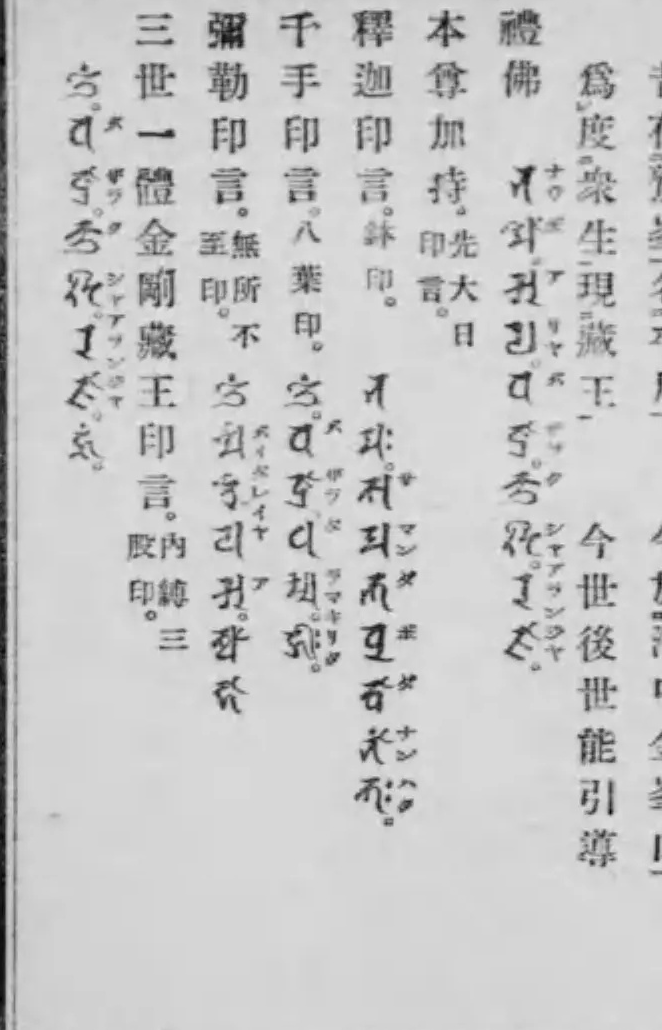
The empowerment of the principal deity (本尊加持): the seals of Śākyamuni, Senju and Miroku, each with its mantra printed in Siddham and glossed in katakana, then the composite 三世一體金剛藏王. Shugendō shōsho, Vol II, koma 62 (NDL 952662).
The hymn
昔在鷲峯名牟尼 今於海中金峯山 爲度衆生現藏王 今世後世能引導
Long ago on Vulture Peak he was named Muni; now on Kinpusen amid the sea. To save beings he manifests as Zaō; in this world and the next he is able to lead them.16
The second couplet states the whole rationale of the composite in fourteen kanji: manifestation is for the sake of guidance, in this life and the next. The first makes the identification geographically rather than doctrinally, and in doing so fixes the mountain’s rank: the Śākyamuni of Gṛdhrakūṭa and the gongen of Kinpusen are one figure who has changed mountains. It is the claim the honji-suijaku makes in the abstract, and the one the hidden transmission makes in prose when it calls Kinpusen 鷲峰の分, a portion of Vulture Peak; here it is a line the practitioner sings while facing the deity he has just assembled — and it places Japan’s peak in the same register as the Indian one, which is exactly the warrant the yamabushi’s own mountain needs.
The rite then records a named transmission on a point that evidently remained open:
Some say: the Kongō Zaō mantra [given in Siddham]. Another spell [given]. Ono Hanshun sōjō transmitted, saying: for the Zaō Gongen of Kinpusen one may use the Kongō Dōji mantra [given].17
This is worth weighing. Zaō being a Japanese-original deity, no Indian mantra is his by inheritance, and the canon here preserves the working solution and the dissent side by side: borrow Kongō Dōji’s, or use one framed for Zaō himself. The borrowing is not arbitrary — the identification of Zaō with Kongō Dōji (金剛童子) is the one the Kinpusen himitsu-den argues at length, and the rite shows that identification doing liturgical work rather than only doctrinal work: it is what licenses a mantra. That the compiler records the variants under 或云, “some say,” and then names his authority for the borrowing — Hanshun (小野範俊), the Ono-branch Shingon prelate — is the same evidentiary posture the canon shows elsewhere when a practice is contested.
The recitations
Primary recitation: the three-in-one mantra. The syllable-wheel contemplation, in the five elements. Scattered recitation: Butsugen, Dainichi, Śākyamuni, Senju, Miroku, the principal deity, Monju, Jizō, Tamonten, the great vajra-wheel, the one-syllable golden wheel.18
The scattered recitation is a good index of the company Zaō keeps in practice: the three honji of the composite are all there, and around them Monju and Jizō — the two figures the martial chapters lean on hardest — with Tamonten, the north-guarding war-king, closing the set.
The paradigm deity
Zaō is, in short, the paradigm Shugendō deity, and every feature that makes him one is a feature the canon states outright: Japanese-born and wrathful; welling up from a rock that is already a mandala; the three times gathered into one body; kin to Kōjin; and the source, by way of the rejected gentle Jizō, of the war-Jizō himself. Where the imported pantheon offers deities who arrive, Kinpusen’s central figure is one who erupts — and stays only because he was stopped, one foot already raised, on his way back to heaven.
End Notes
-
SGD, Vol I, koma 66. ↩
-
身黑色北方。成所作智。釋迦如來忿怒身至極形。靑色東方。大圓鏡智。阿閦如來忿怒身諸物發生形。赤色南方。平等性智。寶生如來忿怒身所具圓滿形。如是中西二方闕。然中央法界體性智故。西方白色卽不動尊所居故。白色染不垢。以上三身化度滿足故三身出現。 — SGD, Vol I, koma 66. ↩
-
水大白色。北圓形故可成北方白色。何云黑色乎。答曰。北方物至極也。故曼茶羅北方黑色也。無變故。五色北黑西白也。是今所用也。 — SGD, Vol I, koma 66 (interlinear note). ↩
-
在娑婆稱深砂大王。都率內院荷負引導之本尊。在未世曰倶生神。罪障明鑑之主神也。故先以此尊淨除罪障。 — SGD, Vol I, koma 66, in the 深砂王 entry that precedes 金剛童子 in the same register. ↩
-
又金子具三目六臂。是三身攝集之身也。可見𑖀𑖓𑖨王同一。 — SGD, Vol I, koma 66. 金子 is the leaf’s own abbreviation for 金剛童子 (cf. 金子愛不之三尊 on the facing page). The first letter, at the foot of the column after 可見, is the same a glyph the edition uses for 𑖀字本不生 (koma 98); the second is ca; the third is read as ra (𑖨), though la (𑖩) cannot be excluded at this size. The kaeriten (可ㇾ見二…同一一) make 𑖀𑖓𑖨王 the object: “one should see that he is one with the A-ca-ra (Acala) King.” ↩
-
卽宣化天王卽位三年八月中旬、雲上有聲。其韻數萬音也。〈裏云。宣化天皇御宇〔…〕三年戊午八月十九日。〉 — SGD, Vol I, koma 233 (金峰山祕密傳卷中, printed p. 448). The two-line interlinear note (a reading from the verso, 裏云) gives the day as the nineteenth of the eighth month and the cyclical year as 戊午 (538); both confirmed. The two graphs after 御宇 in the note’s first line are not legible with confidence. ↩
-
役優婆塞、此金剛山法基菩薩の應現なり。……發願祈誓して、卽ち玉石の南面に住す。時に寶石振動し放光して世界を照らし、卽ち寶石の上方に靑黑忿怒の金剛藏王自然に涌出し、卽ち玉石の上に立つ。亦寶石の西面には胎藏界東曼陀羅、南面には八大金剛童子、自然に化現す。此則ち今、山上藏王堂の內、障佛壇の下、此の龍穴池なり。或說、藏王涌出の盤石、藏王堂の南面、劒峰の傍に在り、卽ち丈餘の石なり。 — SGD, Vol I, koma 233. ↩
-
此嶽を三七日祈り玉ふ。一七日目には天の河の辨財天出で玉ふ、天の河辨財天と成り給ふ。二七日目には地藏菩薩、柔和忍辱・慈悲の姿を顯し出で玉ふ……吉野河へ流し玉へば、河の上へ七里登り玉ふに依て、河上の地藏と申すなり。さて此地藏は勝軍地蔵にて御座す、故に末代まで弓矢の神と顯れ給ふなり。三七日行ひ給へば、三尊一體の大日・釋迦・彌陀一體にして、實に荒神の御姿、大荒神の如く顯れ玉ふ。……藏王權現は「我等も氣に入らず、天に上る」と有て、右の御足を上げ……金剛藏王權現と申し奉るなり。 — SGD, Vol I, koma 286. ↩
-
SGD, Vol II, koma 61–62. The series runs 神變大士本地供 (En no Gyōja), 理源大師片供作法 (Shōbō), 弘法大師片供作法 (Kūkai), 金剛藏王法. ↩
-
勸請〈本尊金剛藏王尊。八大童子諸眷屬。〉發願〈本尊聖者。金剛藏王。八大童子。部類眷屬。〉道場觀。…七處加持。召請〈大鈎召。或金剛部心。〉結界〈不動。〉讚〈四智。本尊。〉…禮佛。本尊加持。…正念誦〈三世一體咒。〉字輪觀〈五大。〉散念誦。撥遣。 — SGD, Vol II, koma 61–62. ↩
-
SGD, Vol II, koma 61–62 (printed pp. 111–112). ↩
-
觀想。前有〔種子〕字變成金峯山。其頂上有𑖀𑖾字變成金剛寶宮殿。其內有微妙大壇。壇上有𑖀字變成月輪。中有蓮華。蓮華上有𑖥𑖾𑖮𑖿𑖨𑖱𑖾𑖧𑖲三字如次變成寶鉢・蓮華・塔婆。變成釋迦・千手・彌勒三尊。更爲利益濁世邊土衆生、降伏强剛難化有情、一體具三密、三尊攝一身、爲金剛藏王尊、現靑黑忿怒形。左手作劒印、右手執三股、左足踏盤石、右足上虛空。調伏魔黨、愍念衆生、護持佛法、利益國土。神祇冥衆部類眷屬前後圍繞。 (SGD, Vol II, koma 61–62) ↩
-
强剛難化 (in 降伏强剛難化有情) — SGD, Vol II, koma 61–62. ↩
-
又時天地震動、金剛藏王從地湧出、其相忿怒、其勢如大嶽巍不可動也。卽釋迦・觀音・彌勒三佛之所合體也。 — SGD, Vol III, koma 157 (役君徵業錄). ↩
-
本尊加持〈先大日印言。〉釋迦印言〈鉢印。〉〔梵字〕千手印言〈八葉印。〉〔梵字〕彌勒印言〈無所不至印。〉〔梵字〕三世一體金剛藏王印言〈內縛三股印。〉〔梵字〕 — SGD, Vol II, koma 62 (the mantras are printed in Siddham, not transcribed here). The Siddham mantras (shown in the figure) read, from their katakana glosses: Śākyamuni namaḥ samanta-buddhānāṃ bhaḥ; Senju oṃ vajra-dharma hrīḥ; Miroku oṃ maitreya svāhā; the composite Zaō mantra is only partly legible. ↩
-
讚〈四智。本尊。〉昔在鷲峯名牟尼。今於海中金峯山。爲度衆生現藏王。今世後世能引導。 — SGD, Vol II, koma 62. ↩
-
撥遣。〔梵字〕或云。金剛藏王眞言。〔梵字〕又咒。〔梵字〕小野範俊僧正傳曰。金峯山藏王現權咒可用金剛童子眞言。〔梵字〕 — SGD, Vol II, koma 62 (現權 as printed, for 權現). ↩
-
正念誦〈三世一體咒。〉字輪觀〈五大。〉散念誦〈佛眼。大日。釋迦。千手。彌勒。本尊。文殊。地藏。多聞天。大金剛輪。一字金輪。〉 — SGD, Vol II, koma 62 (the small-type list is read right line, then left line). ↩
