From Shugendō and Heihō, the first volume of Mountain, Sword, and Mind.
The emptiness teaching of the Heart Sūtra and the precepts that follow from it both find a figure in Monju (文殊; Mañjuśrī), who has two faces in this material. He is the bodhisattva who holds the sword — the wisdom that severs delusion, the figure at whom the sword-arts’ esoteric register meets the mountain — and he is the object of formless homage, the dharmakāya one bows to under the sign of emptiness. This chapter takes him in both: first the wisdom-sword and the warrant he gives for dwelling in the peaks, then the two homage-liturgies the tradition addresses to him — a Dunhuang office preserved in the Taishō, and the Shugendō canon’s own daily rite.
In the Yaku-gyōja hongi (役行者本記; Original Record of En no Gyōja), the most secret image of En no Gyōja is Mañjuśrī’s:
「最深之形像者、中央小角形如文殊師利。右手持利劍、左手持獨股金剛杵。頭着華冠、坐玉蓮華」
in the deepest image, Ozunu at the center takes the form of Mañjuśrī: the sharp sword (利劍) in his right hand, the single-pronged vajra in his left, a flower-crown on his head, seated on a jeweled lotus,
with his disciples Gikaku and Gigen as Fudō’s two boy-attendants, Kiṃkara and Ceṭaka.1
That sword is prajñā, the wisdom that severs delusion; Monju is the shichibutsu-shi (七佛師), “teacher of the seven Buddhas,” and this is where the esoteric register meets the sword-arts: in the weapon-rites his mantra turns a blade apotropaic — the 脇刀大事 verse runs 「刀トイヘバ惡魔シリゾク、文殊眞言」, “at the word ‘sword’ the evil demons retreat: Monju’s mantra”.2
Behind it stand his five-syllable arapacana rite (文殊五字, 阿囉跛左曩 = a-ra-pa-ca-na) — reciting it but once, the scripture promises, one “enters the equality of all dharmas and of all letters, and swiftly attains the Great Prajñā”3 — and his five-topknot form (文殊五髻).
That same five-syllable logic yields a second, independent Mañjuśrī channel: the corpus systematizes the 五字文殊咒 as one of his syllable-forms among several — 「此菩薩有八字・六字・五字・一字等不同、今文殊五字」 (“this bodhisattva has eight-, six-, five-, one-syllable forms and the rest that differ; here it is Mañjuśrī’s five”).4
The running Yagyū example meets the same figure at its head: the Tsuki no Shō (月之抄; Notes at the Moon, 1642) opens its Rakusaku (落索) with Monju as the teacher of the seven Buddhas (七仏師), wielding the wisdom-sword.
Monju’s other relevant role is doctrinal geography, the warrant for the mountain — he authorizes the very act of dwelling in the peaks. The Shugen hiō-shō (修驗祕奧鈔; Notes on the Secret Depths of Shugen) §27, “On mountains and forests” (山林抖藪之事),5 grounds the practice on dhūta (頭陀) / araṇya, the secluded austerity that “sweeps away” (打拂) the defilements, and justifies it by a parallel of exemplars — Śākyamuni on Vulture Peak, Monju on Mt. Qingliang [= Wutai], and so the practitioner of the latter age in the mountains and forests — sealed with Shōbō’s dictum 「聚落ニハ妙行ヲ修シ難ク、山林ニハ淨業ヲ起シ易シ」 (the section is translated in full under The Warrant for the Mountain below).
Monju’s Qingliang (清涼山), the Chinese Wutai, is thus the archetype of the sacred mountain the yamabushi then occupies as his own.
On the suijaku side the corpus, citing the Dai-engi (大緣起), makes Monju the honji of Katte Myōjin (勝手大明神), the Yoshino / Kinpusen deity6 — so the wisdom-sword bodhisattva stands, in the Japanese landscape, at the very gate of the Ōmine range, and the mountain-warrant and the sword meet in one figure.
The Ten Formless Prostrations
The Ten Formless Prostrations to Mañjuśrī (文殊師利菩薩無相十禮) is a short homage-liturgy of the Qingliang (Wutai) Mañjuśrī cult, preserved in the Taishō canon from a Dunhuang manuscript (T85 no. 2844). It is a daily office — its closing verses are divided by the hours, dawn (寅朝), noon (午時), and dusk (黃昏) — and its homage is “formless” (無相) throughout: each of its ten ritual acts is offered to the dharmakāya under the sign of emptiness, so that 「無禮無不禮、一禮遍含識」, “there is no bowing, yet no lack of bowing; one bow encompasses all that is conscious.”
Its Mañjuśrī is expressly the Great Sage of Mount Qingliang (「清涼山中大聖文殊師利菩薩」) — the same 清涼山 mountain-warrant just named, now approached not as the authority over the peaks but as the dharmakāya one bows to formlessly. Read beside Kūkai’s Heart-Sūtra commentary that opens this Part, the wisdom-sword bodhisattva supplies here, in a liturgical register, the same compassion-and-emptiness ground.
From the Taishō text (T2844, 文殊師利菩薩無相十禮):7
“The Great Sage Mañjuśrī Bodhisattva of Mount Qingliang, seated in meditation, contemplates the mind. Even the mind is unattainable. With utmost sincerity, I take refuge and pay homage to the True Suchness Dharmakāya Buddha.”8
Without color, form, or image, without root or abiding place, because it is neither born nor dies, I pay homage to countless contemplations. It neither comes nor goes, neither grasps nor relinquishes. Because it is far removed from the six senses, it transcends the three realms, equal to empty space. Because it is undefiled by desires, in all conduct — coming or going, asleep or awake — it is always in samādhi.
Coming and going are all equal. Abiding in equality, because it does not destroy equality, it enters all formless samādhis, seeing all dharmas as tranquil and pure. Because it is free from tranquility and purity, the Buddhas are like empty space; empty space too is without form. Because it is free from cause and effect, empty space has no middle or edge. The bodies of the Buddhas are also like this. Because the mind is like empty space, the Buddha is always in the world, yet undefiled by worldly affairs. Because it does not discriminate among worldly things, all dharmas are like illusions — like an illusion, unattainable. Because we are free from all illusory phenomena, we bow equally to all. There is no bowing, yet no lack of bowing; one bow encompasses all consciousness, leading all to the true nature of reality. For the sake of all beings in the four realms of grace and the three realms of existence, we are all thus.
I take refuge and repent. I seek the nature of my sins at the three times. The mind is truly nonexistent — inside, outside, and in between. Because there is no mind, all phenomena are still; the three poisons and four inversions are all as they are. Having repented, I take refuge and bow to the Dharmakāya Tathāgata.
I entreat. All phenomena are fundamentally unborn; since there is no birth, how can there be death? The nature of non-birth and non-death is eternal. I only wish that all Buddhas would not enter Nirvāṇa, so that all beings may illuminate their true nature and freely roam the city of Nirvāṇa. The practitioner need only illuminate the five aggregates — no self, no others, both sides empty. Having entreated, I take refuge and bow to the Dharmakāya Tathāgata.
I rejoice. The Dharma is fundamentally neither craved nor feared; it is neither one nor different. We contemplate the one reality and realize the unborn; we rejoice in the complete and unconditioned contemplation. Contemplating emptiness, illuminating being, the nature of suchness — may all beings diligently illuminate the mind, whose essence is inherently pure, where illusory form and empty space are the same as true wisdom. Having rejoiced, I take refuge in the Dharmakāya Tathāgata.
I dedicate this merit. Lost in the illusion of light, clinging to that illusion, I give rise to the dust of self; now, illuminating the non-self-nature of that dust, I dedicate the merit to the unabiding city of Nirvāṇa. The five dharmas are encompassed within correct wisdom (正智); the eight consciousnesses are the pure mind-king. May this shadow-body be turned to the Buddha-path, the four postures ever manifest in practice. Having dedicated, I take refuge in the Dharmakāya Tathāgata.
I make my vow. May all beings ward off the six thieves, compassion and wisdom manifest together; unending yet not permanent, beyond the immeasurable, neither empty nor existent — practicing in perfect clarity. May the four wisdoms and three bodies arise from that essence, the five eyes ever illumine the three knowledges, the minds of the three assemblies arise unhindered, and all beings be liberated beneath the Bodhi-tree. Having vowed, I take refuge in the Dharmakāya Tathāgata and revere all.
I take refuge in the Buddha’s virtue and awakening; may resolve on the path never waver; may all beings together enter the true nature of reality. I take refuge in the Dharma-Prajñā; having gained the Great Dhāraṇī-gate, may we with all beings enter the ocean of True Suchness. I take refuge in the Sangha, ceasing disputes, entering the ocean of Harmony. May all beings awaken the bodhi-mind, their three karmas ever pure, in accord with the Dharmakāya Buddha.
The office then closes with its hour-verses: the Dawn Purity Verse (寅朝清淨偈) — “you who desire the bliss of quiescence, learn the śramaṇa’s Dharma… each of you, in the morning purity, keep the six recollections”; the Noon Impermanence Verse (午時無常偈) — “human life without diligent effort is a rootless tree… life is a fleeting instant, hard to repay”; and the Dusk Impermanence Verse (黃昏無常偈) — “this day already passed, life diminishes with it.”
The Daily Homage (文殊日禮)
The martial cluster of the Shugen jōyō hihō-shū (修驗常用祕法集; Collection of Secret Methods in Common Shugen Use) names, beside the Marishiten whip and the Fudō gold-binding, a daily-homage cycle (文殊日禮) involving Kannon and Mañjuśrī. It is not the Dunhuang Ten Formless Prostrations (無相十禮) given above, but a distinct, ritual-programmatic text of the esoteric-Shugendō daily office; the two share the premise of a formless bow to the wisdom-bodhisattva.9
The office opens with three prostrations (先禮拜三反) and the goshinhō (護身法) and then runs a graded mudra sequence, each with its seed-syllable:
- the inner- and outer-bound mudras (内縛・外縛印)
- the inner and outer lion mudras (獅子印)
- the inner and outer five-pronged-vajra mudras (五鈷印)
- the principle- and wisdom-fist mudras (理拳印・智拳印)
The latter are the Womb- and Diamond-world pair that seals the whole as a sadhana to Mañjuśrī. Two scriptures are then read entire, the Kannon-gyō and the Heart Sūtra (觀音經一卷・心經一卷).
Here the text inserts its 血脈 (blood-lineage). The transmission runs from Mañjuśrī himself directly to the “Eight-Syllable Lodge” (八字坊), and from that lodge to Retired Emperor Go-Shirakawa (printed 御白河), Kōbō Daishi, and Hachiman Tarō (八幡太郎, the warrior Minamoto no Yoshiie), and thence over generations — 忠順・覺潭・亮寛・慈俊・覺心・寛山 — down to the compiler.
The esoteric patriarch Jikaku Daishi (Ennin) is named as the source of the body-protection goshinhō that opens the next section, and the whole is styled a great secret method (大祕法) of the forty-nine-night vigil (七七夜待).
The 八字 of the pedigree points to the eight-syllable Mañjuśrī (Hachiji Monju) cult, the protective form of the bodhisattva. With a famous warrior standing in the line of transmission, the pedigree itself shows the register the martial cluster is drawing on.
A gachirin (moon-disc) contemplation follows:
- Facing the disc, the officiant empowers it three times with the three-pronged-vajra mudra and its mantra, then with the forefinger “writes” the syllable hūṃ within it seven times.
- Three scriptural verses are then recited, each under a joined-palm mudra and each assigned to one of three grades of “Lotus” teaching — the root Lotus (根本法華), the hidden Lotus (printed 陰密法華), and the explicit Lotus (顯說法華).
They are as follows:
- Root Lotus: the Heart Sūtra’s 「能除一切苦、眞實不虛故」 (“able to remove all suffering, for it is true and not false”), with a mantra printed in Siddham and glossed センタラヤアモキヤヒロシヤナ (oṃ candrāya amogha-vairocana).
- Hidden Lotus: the Amida Sūtra’s 「從是西方過十萬億佛土世界、名曰極樂」 (“westward past ten myriad koṭi of buddha-lands, a world named Sukhāvatī”).
- Explicit Lotus: the Lotus’s own 「須臾聞之、卽得究竟阿耨菩提」 (“hearing it but a moment, one gains ultimate supreme awakening”).
The last two carry the same moon-mantra in katakana.
The godai syllable (アビラウンケン, a-vi-ra-hūṃ-khaṃ) is recited seven times over the outer five-pronged mudra.
The wisdom-fist mudra follows with 「七難卽滅」 (“the seven calamities at once extinguished”) and a Siddham mantra ending 「七福卽生」 (“the seven fortunes at once arise”) — the Ninnō-kyō’s formula made gesture.
Then, palms joined with the thumbs raised, comes the Lotus verse 「皆令離苦、得安穩樂、世間之樂、及涅槃樂」 (“causing all to leave suffering and win peace and joy, the joy of the world and the joy of nirvāṇa,” from the Parable of the Herbs, 藥草喩品).
Under the heading 「華嚴經文曰」 comes a homage to the Moon-deva whose honji is Mahāsthāmaprāpta:「歸命月天子、本地大勢至、爲度衆生故、普照四天下、一稱一禮者、滅盡諸苦惱、現世安穩樂、臨終住正念」.
The rite’s distinctive heart is a calendar, a dated Kannon cycle. Each night from the seventeenth to the twenty-third of the month is given to one figure, with its proper mudra and a Siddham mantra recited three hundred times, and on each day the honzon’s mantra is to be recited as well. These are the nights of the moon-waiting vigils (月待), to which the pedigree’s 七七夜待, the moon-mantras, and the Moon-deva homage all point:
- 17th — Senju (thousand-armed) Kannon, Butsugen mudra
- 18th — Shō (holy) Kannon, Amida-samādhi mudra
- 19th — Batō (horse-headed) Kannon, outer five-pronged mudra
- 20th — Jūichimen (eleven-headed) Kannon, eight-petal mudra
- 21st — Nyoirin Kannon, single-pronged-vajra mudra
- 22nd — Juntei (Cundī), wisdom-fist mudra; mantra glossed シャレイシュレイシュンテイ (cale cule cunde svāhā)
- 23rd — Seishi (Mahāsthāmaprāpta), noose-mudra; mantra opening saṃ (glossed サン) and closing saḥ svāhā
The homage is rounded out by Nikkō, the Sun-radiance bodhisattva (ヲンロボシッタヤタヤソワカ, twenty-one times), and Gakkō, the Moon-radiance bodhisattva (oṃ センタラハラハヤソワカ, twenty-one times).
Then come the Twelve-Spirits general-mantra (十二神總咒) recited twelve times, the syllable hūṃ a thousand times, and a closing finger-snap (彈指) with the dismissal mantra ヲンハサラモキシャモク (oṃ vajra-mokṣa muḥ).
The six nights from the seventeenth run through the six Kannon of the Japanese set, with Juntei among them, and the seventh closes on Seishi, the honzon of the twenty-third-night vigil. The “daily homage” is thus a rotation through the moon-vigil deities, sealed under the eight-syllable Mañjuśrī: the wisdom-sword bodhisattva as the master-key to a month of Kannon devotion.
The Warrant for the Mountain
In SGD, Vol I, koma 222, the second fascicle of the Shugen hiō-shō gives the warrant for mountain practice. There we find a dense doctrinal build-up — stūpa-mudra, eight-consciousness ālaya, and the wish-jewel-as-Buddha-body — culminating in §27, “On mountains and forests,” the classic Shugendō rationale for dwelling in the peaks.
In the stūpa-mudra passage: the [vaṃ] syllable is the water-wheel, hence “round”; two waters combine into one stūpa, hence “double-round nature-ocean” (雙圓性海); the stūpa embodies the four maṇḍalas; per the Dainichi-kyō, “truly knowing one’s own mind” (如實知自心), the non-dual one-mind.
There follows a long exposition of the ālaya-vijñāna (阿賴耶識) as “the non-arising-non-ceasing true-mind united with arising-ceasing false-thought, neither one nor different,” running through its ten names (store-consciousness, ādāna, seed-consciousness, retribution-consciousness, etc.) via the Shakusen, Sōkyōroku, Shōron, and Kenshū-ron.
The image: “the ālaya, colorless and formless, motionless, yet storing the seeds of all phenomena… as the eye, seeing no colors, still contains all things — consciousness is nature, nature is consciousness; not-changing is dependent-arising, dependent-arising is not-changing; no waves outside water, no water outside waves.”
On the wish-fulfilling jewel (如意寶珠) we find:
not the worldly jewel of dragon-liver and phoenix-brain, but the Buddha-body — the [vaṃ]-syllable dharma-body. Those who know this principle, without transmuting the flesh-body born of father and mother, dwell in the diamond-bone rank… Is this not the very-body-is-Buddha (卽身卽佛) direct path? To be believed and kept secret… Toward one who has not practiced, dare not grant sight or hearing — the high patriarch’s injunction is to be feared.
§27 “On mountains and forests” (山林抖藪之事). “‘抖藪’ is a Chinese term; the Sanskrit is dhūta (頭陀), translated 抖藪, and 抖藪 is read ‘strike-and-sweep’ (打拂) — dwelling secluded in mountains and forests, sweeping off (抖擻) the defilements, undefiled by the five dusts: the principle of no-defilement, no-attachment, suchness ever-abiding.”
Therefore, the volume writes, En no Gyōja took dhūta as his practice and no-thought (無念) as his mind.
Question: Why must the body dwell in mountains and forests?
Answer: Śākyamuni dwelt on Vulture Peak (靈山); Monju dwells on Mt. Qingliang (清涼山) — how should the practitioner of the latter age not dwell in the mountains and forests?10
Hence the sūtra: “dwelling amid mountains and forests, diligently keeping the pure precepts.”
“Mountain-forest sleep — the Buddha rejoices; village-hamlet diligence — the Buddha grieves. Ponder it. Thus Master Shōbō (聖寶) said: ‘In the hamlet, wondrous practice is hard; in mountains and forests, pure karma easily arises.’”
The section closes on two waka, each cited from an earlier manual. The first, from the Shikaku-shō (私覺鈔), is given as Kōbō Daishi’s:
Horanu i ni / tamaranu mizu ni / kage sashite / kage mo katachi mo / naki hito zo kumu (掘らぬ井に溜まらぬ水に影さして影も形もなき人ぞ汲む)
In a well no one dug, on water that never collects, a reflection falls — and the one who draws it up has neither reflection nor form.11
The second, from the Shuyō-shō (修要抄; “Notes on the Essentials of Practice”), is given as Shōbō’s, though the print adds in small type that a later hand may have inserted it:
Kumo harete / nochi no hikari to / omou na yo / moto yori sora ni / ariake no tsuki (雲晴れて後の光と思ふなよもとより空に有明の月)
Do not think it a light that comes once the clouds have cleared: it was in the sky from the first — the moon at dawn.12
Both turn §27’s argument inward. The mountain is where defilements are swept away, but what is uncovered there was never produced: the water no one gathered, the moon that was always in the sky.
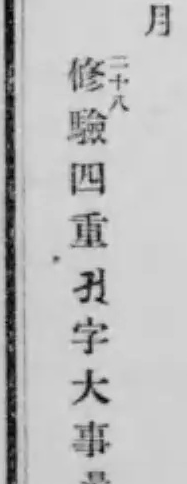
Section heading 二十八 修驗四重𑖀字大事, "the Shugen fourfold great matter of the letter A," with the seed-syllable a printed in Siddham. Shugendō shōsho, Vol I, koma 222 (NDL 952642).
§28, the Shugen fourfold great matter of the letter A (修驗四重𑖀字大事), is marked “most secret” (最極祕). The syllable a is taken through four levels, each with what it “shows”:
- First, the level of teaching (教重): the a that expresses (能詮). Shown: a — letters, words and speech. The print adds that this one level is plain.
- Second, the level of practice (行重): the a that is expressed (所詮). Shown: the very substance of the life-breath (命息當體) — the primal qi, continuing from the origin, before yin and yang divide. From this level on, all three are “full wisdom.”
- [Third,] the level of practice: the a of birth-and-death. Shown: the two kinds of birth-and-death — the momentary and unbroken kind, which is the out-breath and in-breath, and the kind that ends a lifetime, which has an oral transmission.
- Fourth, the level of realization (證重): the a of nirvāṇa — nir as unborn, vāṇa as unceasing. Shown: the six great elements of self-nature (自性六大), inherent in one’s own mind.
The realization is then put as a four-line verse, each word glossed in small type:
Constantly, within one’s own mind, contemplate the sound of the one syllable hūṃ; going out and coming in, follow the life-breath, and see neither body nor mind.
The glosses make the verse a map of the body. “Constantly” is the dharmadhātu-nature abiding through the three times, abiding nirvāṇa; “one’s own” is the life-breath; “within the mind” is the six elements of the intermediate existence (中有); “contemplate” is to know one’s own body as it truly is. The “one” is the six elements with form and mind non-dual; hūṃ is the breath; its sound is the true mark of sound and letter. The life-breath is the qi that carries a lifetime; “not seeing” is not seeking elsewhere; the body is the five elements, the Womb-realm, form; the mind is the consciousness-element, the Diamond-realm.13
The fourfold a has now been shown.
The master’s oral teaching follows, and it names breath as the border between life and death:
The one great matter of birth-and-death is wind, one of the six great elements. When this one element is whole, the six elements combine: this is called birth. When this one element fails, the six elements separate: this is called death. So the two dharmas of birth and death are the wondrous function of the one mind, and the two ways of being and non-being are the true virtue of original awakening.
The one mind is the breath-wind; original awakening is the six elements of self-nature. While the six elements are combined, the text goes on, one is provisionally called sentient — the cultivated state Dainichi attained by practice, in which the six elements are in transformation (are in motion).
When they separate, one is called insentient in the original sense — the originally existent state, Dainichi possessed by nature, the five elements that do not transform (are inert). That insentient, originally existent dharma-body forgets being and non-being, forgets the two realms of buddhas and beings, and cuts off the discrimination of good and evil; it is called Dainichi, the dharmadhātu-nature abiding through the three times.
In the peak-entry it is enacted as the tokogatame and the hashiramoto (床堅・柱源床定). As the most secret of all, not a sheet of it is written down during practice: “even to a legitimate heir of the transmission, if he lacks the wisdom, it must not be shown in the least.”14
End Notes
-
密之三尊者、小角如常、左義覺、右義元是也。最深之形像者、中央小角形如文殊師利。右手持利劍、左手持獨股金剛杵。頭着華冠、坐玉蓮華、身白肉色、微笑形也。是卽因地向上之形。義覺・義元、矜羯羅・制吒迦二童子也。 — SGD, Vol III, koma 133 (役行者本記, printed p. 250). ↩
-
SGD, Vol I, koma 180. ↩
-
The “Mañjuśrī five-syllable” (文殊五字) is the arapacana mantra 阿囉跛左曩 (a ra pa ca na). Scripture: CBETA, T20n1172, Jīngāngdǐng chāoshèng sānjiè jīng shuō Wénshū wǔzì zhēnyán shèngxiàng (金剛頂超勝三界經説文殊五字真言勝相, tr. Amoghavajra 不空): 「即説五字真言曰、阿囉跛左曩。若善男子善女人、有能持此真言、纔誦一遍、即入如來一切法平等、一切文字亦皆平等、速得成就摩訶般若」. ↩
-
此菩薩有八字六字五字一字等不同。今文殊五字 — SGD, Vol I, koma 331 (修驗祕要義 卷五; printed p. 658). ↩
-
「釋尊ハ靈山ニ住シ、文殊ハ清涼山ニ居ス。末代ノ行者、豈ニ山林ニ居ラザランヤ。」 — SGD, Vol I, koma 222. ↩
-
勝手大明神 大緣起云。靈鷲山辰巳。…大聖文殊垂跡云云。或說得大勢。或云不動。或云毗沙門 — SGD, Vol III, koma 189 (金峰山創草記, 諸神本地等). The same entry records Mahāsthāmaprāpta, Fudō and Bishamon as other identifications. ↩
-
CBETA 2026.R1, T85, no. 2844, Monju shiri bosatsu musō jūrai (文殊師利菩薩無相十禮), p. 1296b7–c24 — a Dunhuang text. ↩
-
《文殊師利菩薩無相十禮》卷1:「文殊師利菩薩無相十禮清涼山中大聖文殊師利菩薩。端坐政看心。心亦不可得。至心歸命敬禮。真如法身佛。無色無形像。無根無住處。不生不滅故。敬禮無數觀。不來亦不去。不取亦不捨。遠離六入故。出過於三界。等如虛空。諸慾不染故。於諸威儀中。去來及睡悟。常在三昧故。去來悉平等。已住於平等。不壞平等故。入諸無相定。見諸法寂淨。離諸寂淨故。諸佛虛空相。虛空亦無相。離諸因果故。虛空無中邊。諸佛身亦然。心同虛空故。佛常在世間。而不染勢法。不分別世間故。諸法由如幻。如幻不可得。離諸幻法故。一切平等禮。無禮無不禮。一禮遍含識。同歸實相體。普為四恩三有及法界眾生同如如。歸命懺悔至心懺悔。我於三時求罪性。內外中間心實無。已無心故諸法寂。三毒四倒悉皆如。懺悔已歸命禮法身如來至心勸請。一切諸法本不生。已無生故何有滅。不生不滅性常住。唯願諸佛莫涅槃。令諸眾生照本性。自然遊戲涅槃城。行者但能照五蘊。無我無人兩邊空。勸請已歸命禮法身如來。至心隨喜。法本不貪亦不畏。勿我不一亦不異。同觀一實證無生。無緣等觀盡隨喜。觀空照有如如性。唯願眾生勤照心。心體由來性清淨。妄色虛空同智真。隨喜已歸命禮法身如來至心迴向。迷於一室隨明想。執明想故我塵生。今照我塵無自性。迴向無住涅槃城。五法包含於政智。八識清淨淨心王。迴此蔭身成佛道。四儀一向現前行。迴向已歸命禮法身如來至心發願。令諸眾生妨六賊。悲智二照現前行。不斷不常離無量。非空非有惶了行。四智三身緣彼體。五眼常照浪三明。三眾意生無障礙。菩提樹下度群萠。發願已歸命禮法身如來一切恭敬。歸佛德菩提。道心恒不退。願共諸眾生。同入真如體。歸法薩般若。得大總持門。願共諸眾生。同入真如海。歸僧息諍論。同入和合海。願諸眾生等。悉發菩提心。三業恒清淨。和南眾法身佛。諸眾等聽說寅朝清淨偈。欲求寂滅樂。當學沙門法。衣食之身命。精麁隨眾等。諸眾等今日寅朝清淨上中下坐各記六念。諸眾等聽說午時無常偈。人生不精進。□若樹無根。葉花至日終。能得已時新。花亦不久鮮。色亦非常好。人命如剎那。須臾難可報。今勸諸眾等。懃修無上道。諸眾等聽說黃昏無常偈。此日已過命。即隨減如少」(CBETA 2026.R1, T85, no. 2844, p. 1296b7-c24) ↩
-
Seed-syllables are given below in Siddham where a printed kana gloss or a recurring formula settles them; the rest are marked provisional〔種子〕. ↩
-
末代行者、豈に山林に居らざらんや ↩
-
私覺鈔 弘法大師歌 保良怒井爾多萬羅怒水爾影差底影毛形毛奈幾人曾久武 — SGD, Vol I, koma 222 (修驗祕奧鈔 卷下; printed p. 427). ↩
-
修要抄 聖寶尊師歌〈已後人補入乎〉 雲波禮亭後之光止思奈與本與利空爾有明之月 — SGD, Vol I, koma 222 (printed p. 427). The small-type note 已後人補入乎 stands beside the attribution. ↩
-
二十八 修驗四重𑖀字大事〈最極祕〉 — SGD, Vol I, koma 222 (heading; printed p. 427). 初重 教重 能詮𑖀字〈此一重分明也〉 示曰𑖀〈文字言說等也〉 第二 行重 所詮𑖀字〈以下三重共滿智也〉 示曰 命息當體〈陰未分本有相續元氣也〉 第二 行重 生死𑖀字 示曰 二種生死〈一刹那無間生死出息入息・一期終命生死有口傳〉 第四 證重 涅槃𑖀字〈涅不生槃不滅也〉 示曰 自性六大〈自心本具六大〉 常〈三世常住法界體性也。常住涅槃義也〉於自〈命息也〉心中〈中有六大也〉觀〈如實知自身也〉一〈色心不二性六大也〉吽〈息也〉字聲〈字實相也・字意可思也〉出入隨〈住也〉命息〈一期運氣也〉不見〈異求也〉身〈五大胎藏色法也〉與心〈識大金剛也〉 — koma 223 (修驗祕奧鈔 卷下; printed p. 428, upper register). The third level is printed 第二. ↩
-
已上四重𑖀字示之訖。師口云。生死一大事者六大中風一大也。此一大全則六大和合。是曰生。此一大闕則六大分離。是曰死。依之生死二法一心妙用、有無二道本覺眞德也 文。釋之、一心者息風也。本覺者自性六大也。息字可思之。故六大和合時假名有情、是修生〈修得大日也〉轉變六大也。六大分離時本號非情、是本有〈性得大日也〉不轉五大也。非情本有法體者、亡有無、亡生佛二界、絕善惡分別。是處名三世常住法界體性大日也。峰中形儀床堅柱源床定是也。爲最極深祕、修行之間一紙不載之。誠是諸宗修學所期、顯密兩家詮要也。甚深甚深。縱雖爲付法嫡家、非其智者聊不可示之 云云 — SGD, Vol I, koma 223 (printed p. 428). ↩
