From Shugendō and Heihō, the first volume of Mountain, Sword, and Mind.
Takenouchi-ryū (竹内流) and Araki-ryū (荒木流) are each treated in three of the five treatises of the 1915 Bujutsu sōsho (武術叢書) volume, and in all of them they are classed not as sword schools but under kogusoku (小具足) and torite (捕縛/取手) — close-quarters grappling with the short blade. Both are tied to Atago. The printed record, however, treats them very differently; the entries are read in turn below and compared under “Araki-ryū and Atago”.
Takenouchi-ryū: the founder
The Honchō bugei shōden (1716) entry reads:
“Takenouchi Nakatsukasa-dayū (竹内中務大夫) was a man of Haga village below Tsuyama castle in Sakushū (Mimasaka), and a master of kogusoku. What is now called Takenouchi-ryū koshimawari (竹内流腰廻) is his. Downstream branches exist in the provinces.”1
The Bujutsu ryūso-roku gives the same, with the title as 中務大輔 and the personal name Hisamori (久盛), and names the succession: his son Hitachi-no-suke Hisakatsu (常陸助久勝), then Kaga-no-suke Hisayoshi (加賀助久吉), who carried on the transmission without letting the house name fall, 其名徧日域 — its fame spread throughout the realm.
The Tenbun 1 visitation
Both the Honchō bugei shōden and the Ryūso-roku give the founding itself as a quotation from the school’s own densho (傳書曰):
“The transmission document says: on the twenty-fourth day of the sixth month of Tenbun 1 (mizunoe-tatsu, 1532), a shugenja (修驗者) came suddenly to Takenouchi’s residence, taught [him] five [items of] capture-and-binding (敎捕縛五), and departed; where he went is not known. Takenouchi had always prayed devoutly to the deity Atago (阿太古神); reflecting on it, [he thought] perhaps that shugenja was the Atago deity — and revered and trusted in him all the more.”2
Later, the Honchō nendai jinbutsu tenohira mi kōhen (本朝年代人物掌覽後編; chronological handbook of Japanese figures, later part) of 1800 gives an abbreviated entry:
“Takenouchi Nakatsukasa-no-taifu, a man of Haga village, Tsuyama, in Mimasaka. In the first year of Tenbun (1532) a shugenja (修験者) happened to come to his house, transmitted to him the tradition of hobaku (捕縛; binding and arresting), and departed. Takenouchi thereafter made kogusoku (小具足) and hobaku his specialty; this is now called Takenouchi-ryū koshimawari (腰廻). His son Hitachi-no-suke and his grandson Kaga-no-suke both continued the calling and did not let the family’s name fall.”3
This is evidently abridged from Hinatsu Shigetaka’s entry. The shugenja remains, but the Atago surmise has gone.
Takenouchi-ryū’s founding narrative is the clearest instance in the collectanea of a divine attribution being made by the recipient, retrospectively, and marked as conjecture in the school’s own transmission document. Three features distinguish it from the tengu attributions elsewhere in the volume:
The visitor is a human category. 修驗者 — a shugenja, a mountain ascetic. Not a tengu, not an ijin (異人), not a deity. The text names an ordinary if unexpected class of person.
The divine identification is the recipient’s inference, not the narrative’s assertion. 憶…乎 — “reflecting on it, [was it] perhaps…?” The densho itself frames the identification as Takenouchi’s own retrospective surmise, hedged with 乎, and grounds it in a stated prior disposition (常祈阿太古神篤 — he had always prayed devoutly to Atago). The logic is explicit and psychological: a man who prays constantly to a deity receives an unlooked-for gift and wonders whether the giver was the deity.
The hedge survives into print. Hinatsu (1716) carries 憶…乎; the Ryūso-roku has 惟に…乎 — the same conjecture, differently worded — and drops 篤 and 不知其所歸. Both close with 云々, marking the whole as quoted matter. Neither compiler hardens it.4
Mikami Genryū (三上元龍), in the Gekiken Sōdan (撃剣叢談; collected tales of fencing; Bujutsu sōsho, koma 110; kan 4, p. 200), treats the school under kenjutsu only with an explicit apology, since its root is elsewhere:
“Item. Takenouchi-ryū swordsmanship originally issued from koshimawari (腰廻); its founder (small-type note in the print: the founder of Takenouchi-ryū is called Takenouchi Nakatsukasa-tayū; after him Hitachi-no-suke, Kaga-no-suke, Tōichirō and others became known to the world — though from when the sword was transmitted is not clear).”5
He closes the entry with a genuine structural hypothesis rather than an assertion:
“As for the koshimawari gokui called Shinshō (心勝) in the Takenouchi Iori line current in Bizen, it has postures usable with the sword — and one cannot rule out that the school arose from just such [grappling] postures and only then became a sword lineage.”6
Mikami also names the teachers current in his day (c. 1790), Takenouchi Kanenosuke (竹内包之介) and Ikeda Yozaemon (池田與左衞門) in Edo, and reports the school’s sword at Chikuzen-Fukuoka as well.
Araki-ryū in the Edo sources
Araki-ryū appears briefly in the same three treatises. The Honchō bugei shōden entry is three clauses long:
“Araki Mujinsai. What province he was from is not known, nor are the events of his life clear. He was a master of torite, and his methods still survive in the world; it is called Mujinsai-ryū (無人齋流).”7
The Bujutsu ryūso-roku reproduces this almost verbatim — 不知謂何國の人、亦不詳其事跡、捕縛の達人而其法猶存于世 — with one substantive difference: it closes 曰荒木流, giving the school-name as Araki-ryū rather than Mujinsai-ryū.
The Gekiken Sōdan entry (Bujutsu sōsho, koma 109; kan 4, p. 199) adds the school’s technical placement and then does the disambiguation work:
“Item. Araki-ryū swordsmanship originally issued from torite (small-type note in the print: also called kogusoku). It is a downstream branch of Araki Mujinsai (荒木無人齋). There is also, someone told me, an Araki-ryū that takes Araki Matauemon (荒木又右衞門) as founder; if so, that one must be a branch of Yagyū-ryū (柳生流).”8
Araki Matauemon Shigekatsu (荒木又右衞門) was the swordsman of the famous Kagiya-no-tsuji vendetta and a Yagyū disciple. Here two Araki have already been merged in circulation (“someone told me”), and an Edo compiler separates them again by reasoning from lineage incompatibility. The case is similar to that of Yoshioka Kenpō (one hereditary name, several men; see Kuramadera) and of the Hōzan-ryū Tōyama/Okuyama (one man, two surnames that the compiler declines to merge; see Hōzan-ryū).
The two schools are not in a parent–child relation in these sources. They are set side by side as parallel members of the same grappling family, each with its own root. Araki-ryū names its approach a torite and kogusoku (取手・小具足) tradition, while Takenouchi-ryū calls its methods koshimawari (腰廻). Torite, kogusoku, and koshimawari are near-synonyms for close-quarters short-blade grappling, so the grouping is by kind, not by implicit transmission.
The printed record treats them very differently. Takenouchi-ryū receives a province, a date, named successors and a founding narrative, and that narrative carries the Atago attribution into print as the school’s densho framed it: the visitor is a shugenja, and his identification with the Atago deity is Takenouchi’s own surmise. Against this, the Araki-ryū entries has only a name, an art (torite), and a school-name that is itself unstable between two witnesses.
Araki-ryū and Atago
There no Atago (愛宕/阿太古) or Tarō-bō (太郞坊) attribution for Araki-ryū in any of the three works. The Atago association in the printed sources attaches to Takenouchi-ryū and to the Mijin-ryū line of Negishi Tokaku (see the preceding section), which can be easily confused with Araki-ryū at a glance, since both are torite-adjacent grappling traditions of the same period, and Hinatsu treats them within pages of one another.
Araki-ryū’s Atago connection appears instead in the school’s own documents.
The tradition-internal Araki-ryū torite saitan no jo (荒木流捕手再誕之序) written by Mujinsai states that Fujiwara no Katsumi (藤原勝真) was the tradition’s founder, who prayed at Atago shrine for one hundred days before founding his approach. Some suggest he may have been a student of Takenouchi-ryū, while the 18th-century work we are drawing from lists Mujinsai explicitly as the art’s founder.9
The two densho taken up below show the same devotion, written from inside the school.
Concealed Invocations
A Genroku 12 (1699) Araki-ryū torite densho — Araki-ryū menjō (荒木流免状; “Araki-ryū Certificate”) (“Araki-ryū menjō 荒木流免状” 1699), one scroll (一軸), 18 cm, 15 frames, manuscript (写); Nippon Sport Science University Library, Minwa Bunko (日本体育大学図書館・民和文庫), digital call no. DIG-NSSU-00004; National Institute of Japanese Literature, Kokusho Database bibl. ID 100344490, https://doi.org/10.20730/100344490 (opens in a new tab) — carries two devotional texts embedded in its structure, neither of them visible to a reader who takes the documents as bare technique-lists. Both were absent from every printed compilation surveyed above.
The catalogue classifies the work under jūjutsu (柔術), not swordsmanship — independently corroborating the placement of Araki-ryū in the torite/kogusoku sections of the Honchō bugei shōden and Bujutsu ryūso-roku, and against any reading of it as primarily a sword school. The recorded title 「1.荒木流免状、外」 — “Araki-ryū certificate, and others” — refers to the several separately headed documents mounted on the one scroll: 荒木流捕手 (with the 三曲之傳, 八方之傳, and 五方之傳), 荒木流小具足 (人質捕之傳, 両具之傳), 荒木流縄 (早縛之段), 荒木流捕手極意之巻, and the 到位教傳 leaf with the lineage and colophon.
The scroll signs 荒木夢仁齋源秀縄 — Mujinsai written 夢仁 (“dream-benevolence”), not the 無人 (“no-man”) of the Honchō bugei shōden and Bujutsu ryūso-roku, nor the 無人斎 of the modern reference literature. This is a third orthography, and it is the school’s own.
The Ryōgu no den Acrostic
The 両具之傳 (Ryōgu no den) comprises seven articles. Read down, the head character of each spells a votive invocation: 愛〔宕〕山大〔権〕現守護 — Atago-san Daigongen shugo, “Atago-san Daigongen, protect [us].” Five of the seven heads are the standard graphs. Two are substitutions, and they substitute by different mechanisms:
- 岩 for 宕 — a graphic near-substitution: both are 石 beneath a differing upper element (山 vs. 宀). Not homophonous (gan vs. tō).
- 捲 for 権 — a phonetic substitution: both read ken. Not graphically similar (扌+卷 vs. 木+雚).
That the two operate by different mechanisms argues against simple scribal error and for deliberate veiling: the invocation is legible to a holder who knows it is there and opaque to one who does not. The article that completes the acrostic, 守護, also completes the sentence — the seventh technique-name is the verb of the prayer. And the list’s closing rubric supports a votive reading of the whole:
右七ヶ條は老中口論の時先勝や、堅可禄々
“these seven articles are for prevailing when a dispute arises; to be strictly kept.”
The acrostic is specific to the Ryōgu no den, and not found in other technical sections such as the Happō no den (八方之傳) and Gohō no den (五方之傳).
The gokui Marishiten diagram
The 荒木流捕手極意之巻 opens with a five-panel diagram. Two vertical texts run across the panels, black above and red below, and the red text names the deity, Marishiten:
| Panel | Black | Red | Disc | Correspondences |
|---|---|---|---|---|
| 1 | 是 | 摩 | black | 黒・地・小 |
| 2 | 極 | 利 | pale | 青・水・中 |
| 3 | 一 | 支 | red, vajra-form cross | 赤・火・離 |
| 4 | 手 | 尊 | yellow | 黄・風・刀 |
| 5 | 心 | 天 | white | 自・空・心 |
Red: 摩利支尊天 (Marishi-son-ten).
Black: 是極一手心 — “this is the ultimate: the mind of a single hand,” where 一手 is a reference to the torite art itself.
The discs give the five phases in the standard gorin sequence 地・水・火・風・空 with colored discs, the third panel’s disc drawn as a vajra-form cross. Panel 5’s 自空心 recurs on the tōi kyōden (到位教傳) leaf beside an ensō, above the transmission line.
The school’s innermost transmission is structured as an esoteric five-phase mandala with Marishiten as its through-line, and its curriculum list encodes an Atago invocation. This is a substantially more mikkyō-inflected document than the three-clause notice in the Bugei shōden would suggest. Neither deity appears in Hinatsu’s notice; unlike Takenouchi-ryū’s Atago attribution (see “Araki-ryū and Atago” above), this devotion did not reach print.
Colophon and transmission
Dated 元禄十二己卯 六月吉日 (Genroku 12 / 1699, sixth month, auspicious day), with kaō and a red seal. The lineage is given in red-ruled boxes:
from 荒木夢仁齋源秀縄, to 春〔…〕震之助 Katsushige (勝重), to 山中加助 Katsuhisa (勝久), to 小林源右衞門 Shigeyuki (重之), then 常田三右衞門 〔Katsufusa 勝房〕
The catalogue records the certificate as issued 常田三右衛門勝房より牛越太郎左衛門ヘ — from Tsuneda San’emon Katsufusa (常田三右衛門勝房) to Ushikoshi Tarōzaemon (牛越太郎左衛門). The last name in the red-boxed chain is the grantor: the scroll is his license to a named recipient, and the boxed sequence is the pedigree he cites to warrant issuing it.10
A second witness: the Araki Shin-ryū mokuroku denju of 1767
The 1699 scroll conceals its deities. A second document, from a branch line seventy years later, declares them — and in doing so supplies what the Bugei shōden said was not known (不詳其事跡): a founding narrative.
The 荒木新流目録傳受 (Araki Shin-ryū mokuroku denju, “conferral of the Araki Shin-ryū catalogue”) is a paper scroll dated 明和四丁亥年十二月吉日 — an auspicious day of the twelfth month of Meiwa 4, 1767, the sexagenary pair internally correct. It was conferred by 賀藤八右衛門 (Katō Hachiemon), with kaō and a red relief seal, on 圀松要助殿 (Kunimatsu Yōsuke).11
Photograph, author's collection: the 1767 scroll's colophon and seal
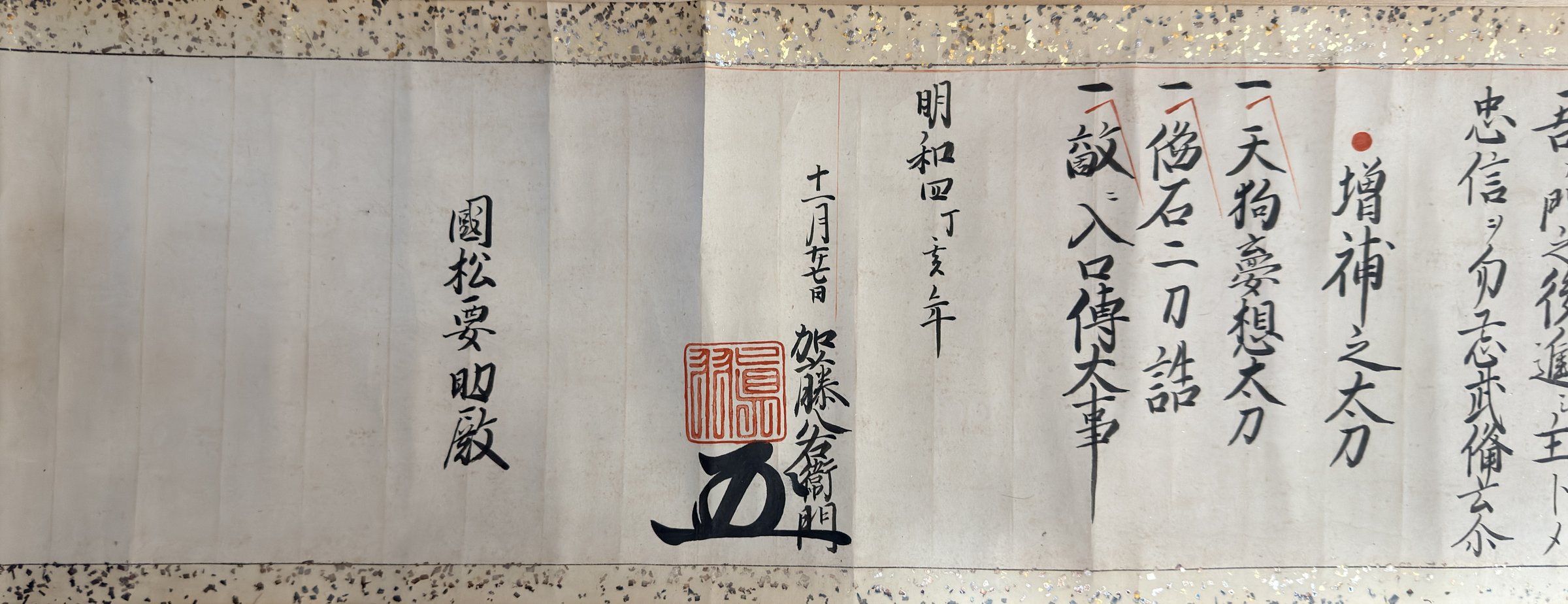
荒木新流目録傳受 (*Araki Shin-ryū mokuroku denju*, 1767): the 増補之太刀, the colophon (明和四丁亥年十二月吉日), and Katō Hachiemon's seal and *kaō*, to 圀松要助.
The scroll’s order matters. The devotional material is not an appendix: it stands between the origin narrative and the technique list, because the narrative explains why the techniques take the shape they do.
A dream, a formula, a curriculum
Photograph, author's collection: the 1767 scroll's founding narrative
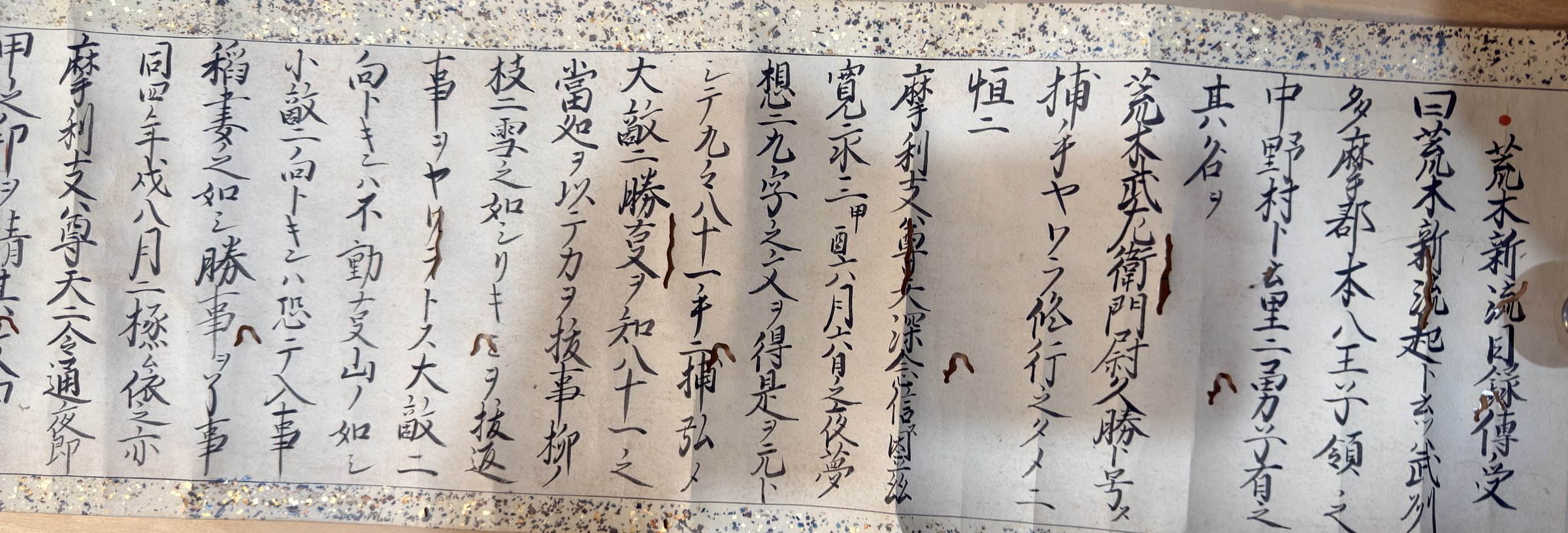
荒木新流目録傳受 (*Araki Shin-ryū mokuroku denju*, 1767): the title and the founding narrative, on the opening leaf.
“In Musashi, Tama district, in the village of Nakano, there was a man of valor named Araki Buzaemon-no-jō Hisakatsu (荒木武左衛門尉久勝). Training in torite and yawara, he constantly and deeply revered Marishi-son-ten. On the night of the sixth day of the sixth month of Kan’ei 3 he obtained in a dream the text of the nine graphs (九字之文); taking this as the root, he spread it out into nine-times-nine, eighty-one techniques. […] In the eighth month of the following year he brought it to completion; for this he again kept an all-night vigil before Marishiten, and thereupon received the seal of kō (甲之印) and asked for its text, which reads:”12
Unlike the colophon, whose sexagenary pair is correct, the founding narrative carries two internal chronological faults — 寛永三 paired with 甲寅 (Kan’ei 3 is 丙寅) and 同四年 with 戌 (Kan’ei 4 is 丁卯). The compiler dated his own act accurately and the tradition’s origin inaccurately, which is what one expects of a founding narrative received rather than witnessed. Nothing in the scroll is contemporaneous with the events it reports; it is a 1767 witness to a claim about 1626.
Two things place that narrative in Shugendō rather than in general esoteric piety. The first is orthography: the kuji is written 臨兵闘者皆陳烈在前, and that spelling occurs six times in the Shugendō corpus and nowhere in the Buddhist canon or the Chinese collections, where the ordinary form is 陳列 and the Bàopǔzǐ’s is 陣列前行. The second is the 甲之印. The canon’s shrine-certificate series (神社印信) sets out a 兵法甲冑大事 — a “great matter of heihō and armor” — running 先護身法。次外縛深交置頂上。是甲印也。次九字: the protection rite, then the outer-bound mudrā placed on the crown of the head, which is the kō seal, then the nine graphs.13 The founder’s dream and vigil, dated a year apart, are the two components of one rite, in the order the manual provides. The narrative distributes across the dream and the vigil what the ritual literature transmits as a single sequence; the founder may, of course, have learned its two parts on separate retreats or pilgrimages.
Photograph, author's collection: the 1767 scroll's kuji array
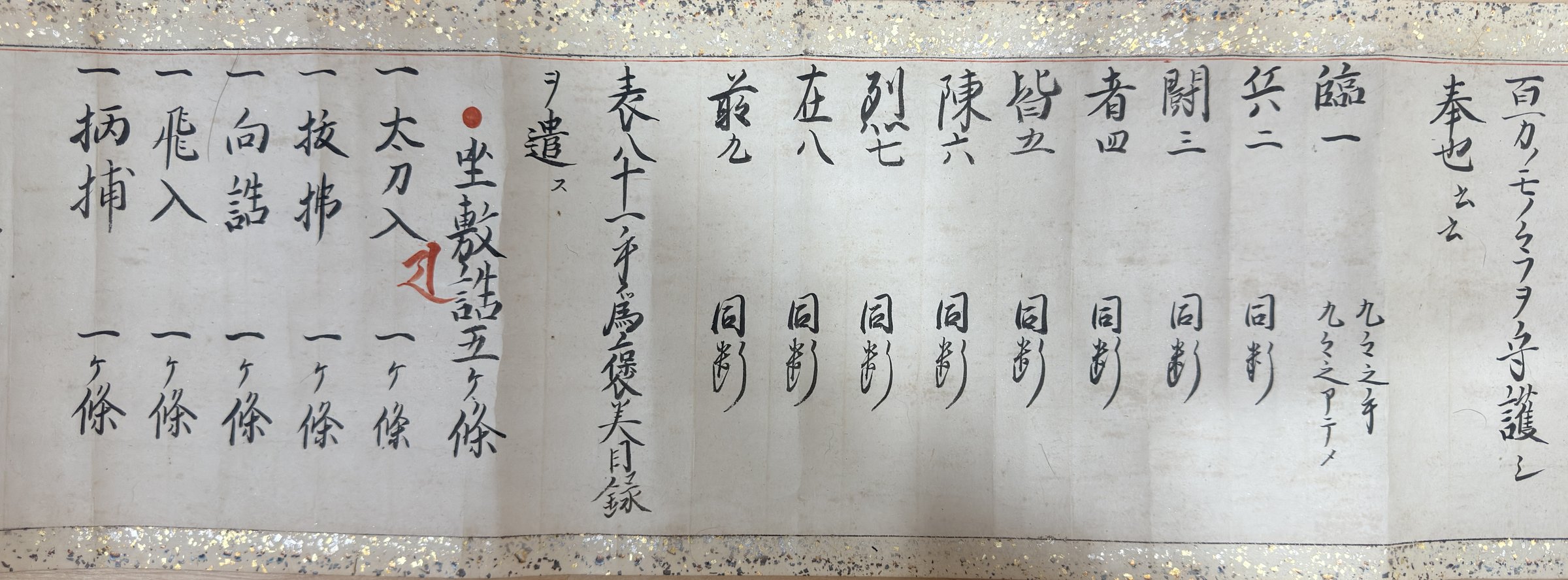
荒木新流目録傳受 (*Araki Shin-ryū mokuroku denju*, 1767): the *kuji* array, written 臨兵闘者皆陳烈在前, and the 坐敷詰 five articles.
The sword that is the Name
Between the narrative and the invocation stand two Pure Land quatrains — the only scriptural citations in the scroll, and it copies both entire.14 The scroll does not set them apart from the narrative: the founder receives the seal of kō and asks for its text (請其文曰), and the first quatrain follows as that text, the second added with 亦曰.
Photograph, author's collection: the 1767 scroll's Pure Land quatrains
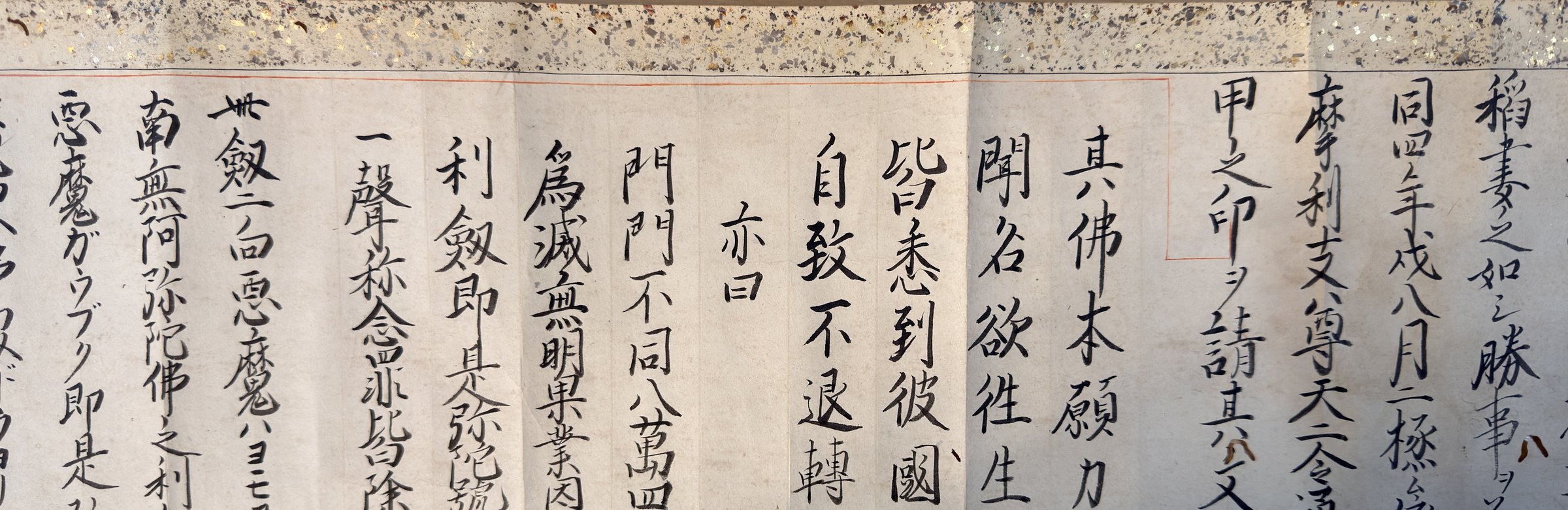
荒木新流目録傳受 (*Araki Shin-ryū mokuroku denju*, 1767): the end of the founding narrative and the two Pure Land quatrains.
The first is from the Larger Sukhāvatīvyūha:
其佛本願力/聞名欲往生/皆悉到彼國/自致不退轉
Through that Buddha’s original vow, those who hear the Name and desire birth all reach that land, and of themselves attain non-retrogression.
The second is Shandao’s, introduced by 亦曰, “it is also said”:
門門不同八萬四/爲滅無明果業因/利劔即是彌陀號/一聲稱念罪皆除
The gates are eighty-four thousand and none alike; all serve to extinguish the karmic cause that is the fruit of ignorance. The sharp sword is none other than Amida’s Name — one utterance in mindful recitation and all offenses are swept away.
The third line is why the pair is here. 利劔即是彌陀號 — the sharp sword is none other than Amida’s Name. A compiler assembling a martial document has reached past the sūtra for a hymn selected on its sword metaphor, and set both immediately after a Marishiten vision. The scroll’s Japanese gloss then presses the point in the vernacular: no demon could stand against the sharp sword that is Namu Amida Butsu; the subjugation of demons is itself Amida.
Around that gloss the scribe has written out, phonetically in kana, a four-line Buddhist 頌 that the same Shugendō collection prescribes in its demon-expelling rite, the joma daiji (除魔大事), used against fox-possession and epidemic:15
天魔外道皆佛性/四魔三障成道來/魔界佛界同如理/一相平等無差別
Heavenly demons and heterodox paths are alike Buddha-nature; the four Māras and the three hindrances come as the very attaining of the Way; demon-realm and Buddha-realm are one in the principle of suchness — a single mark, equal, without distinction.
The four Māras (四魔) are the aggregates, the afflictions, death, and the deva Māra; the three hindrances (三障) are karma, affliction and retribution. The verse takes the whole apparatus of obstruction and identifies it with what it obstructs. Set beside the sword that is the Name, and beside the five-direction invocation that follows, it gives the scroll’s devotional core a single shape: what the practitioner faces and what protects him are not two things.
Marishiten in all five directions
The scroll then gives a five-direction invocation, setting the deity at east, south, west, north and center, closing with “Marishiten and I are one body” (摩利支天トハ我一躰ニシテ — ) — with a doubled 急々如律令 and a clause of protection.
The same Shugendō canon carries Marishiten, then the Four Heavenly Kings distributed around the quarters as directional guardians.16
This scroll keeps the directional organization and makes a substitution, putting Marishiten herself in every position. The guardian scheme collapses into a single deity the school actually petitions.
Set beside the 1699 gokui diagram, where 摩利支尊天 is written vertically in red across five panels of the gorin sequence, the two documents are doing the same thing by different means. The earlier scroll distributes the deity’s name across the five phases and says nothing; the later one distributes the deity across the five directions and explains itself at length.
Supplements and lineage
The supplementary items appended at the end include a 天狗夢想太刀 — a “sword of the tengu dream-vision” — repeating the founding narrative’s mechanism with a tengu in place of Marishiten. The compound is unattested in the Buddhist, Daoist and Shugendō corpora searched: it appears to be the school’s own coinage rather than a borrowing, which makes it the more telling.
The lineage divides into two groups, each under its own 元祖 rubric: Araki Buzaemon-no-jō Hisakatsu with three transmitters, then 辻上左衛門尉是忠 as 荒木新流元祖 with five more, ending at Katō, the man who signs. The branch names its own founder and keeps the parent line above him.
Photograph, author's collection: the 1767 scroll's lineage
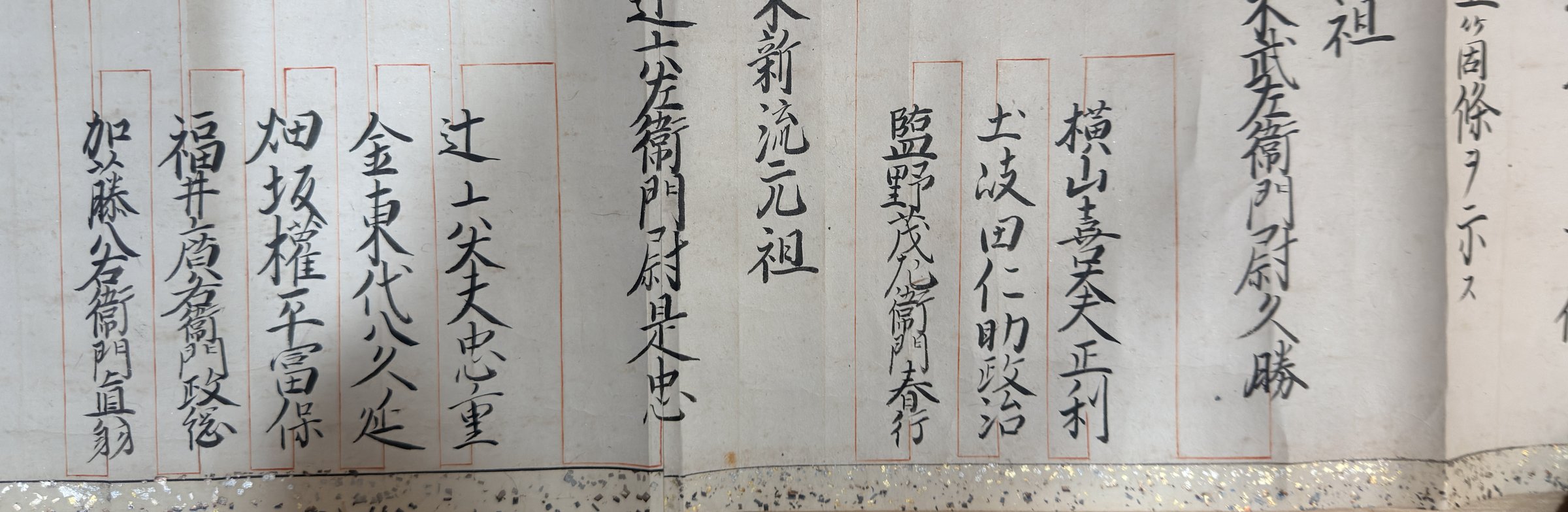
荒木新流目録傳受 (*Araki Shin-ryū mokuroku denju*, 1767): the lineage under its two 元祖 rubrics, ending with Katō, who signs.
What the second witness shows
The 1699 and 1767 scrolls are separate witnesses from separate lines, and neither corroborates the other’s particulars. What they establish jointly is narrower and firmer than either alone: that across seventy years and a branch division, Araki tradition documents carried Marishiten at their center, in a Shugendō ritual idiom, while the printed compendia of the same period recorded a founder of whom nothing was known. The concealment in the earlier scroll and the declaration in the later one are two solutions to the same problem, which is that this material was meant to be held in confidence.
End Notes
-
○竹内中務大夫 竹内中務大夫者、作州津山城下波賀村人而小具足之達人也。今謂之竹内流腰廻。其末流在諸州。 ↩
-
傳書曰、天文元壬辰年六月廿四日、修驗者忽然而來竹内之館、敎捕縛五而去、不知其所歸。竹内常祈阿太古神篤、憶彼修驗者阿太古之神乎、彌敬之信之云々。 ↩
-
竹内中務大夫 (タケノウチナカツカサノタイフ) 美作津山波賀村人。 天文元年、偶〔たまたま〕有二修験者一来レ家、授二捕縛之伝一而去。 竹内遂以二小具足捕縛一専門、今謂レ之竹内流腰廻。子常陸助、孫加賀助、皆継レ業、不レ墜二家声一。 ↩
-
The deity is written 阿太古, phonetically, rather than the standard 愛宕, which appears in its normal form elsewhere in this volume (in the Negishi Tokaku material). The spelling may reproduce the densho’s own orthography, which would count in the passage’s favor as a quotation; but Hinatsu’s Katayama entry, which is not a densho quotation, also prints 詣阿太古社 (see the preceding section), so it may instead be the compiler’s habit. ↩
-
一、竹内流劔術は、もと腰廻より出で、其祖(竹内流元祖は竹内中務大輔と云。夫より常陸介・加賀介・藤一郞など云人、世に名をしられたり。但し劔術は何時より傳ふると云事詳ならず)。 ↩
-
今備前に行るゝ竹内伊織傳の腰廻り極意心勝と云に至ては、太刀に用べき態有り。もとはけ樣の態より起て太刀の一流と成りしもしるべからず。 ↩
-
○ 荒木無人齋 荒木無人齋者、不知謂何國人、亦不詳其事跡。捕縛之達人而其法猶存于世、曰無人齋流。 ↩
-
一、荒木流劔術は、もと取手(小具足共稱す)に出たり。荒木無人齋が末流也。又、荒木又右衞門を祖とする荒木流も有る由、云ひし人有り。さあらば、是は柳生流の一派成べし。 ↩
-
cf. EN and JA Araki-ryū Wikipedia entries; further confirmation desired. ↩
-
The name 常田 is romanized consistently with the Japanese catalogue record; it can be read variously as Tsuneda / Tokita / Tsunoda / Jōda — the catalogue supplies no furigana for the surname, so the reading remains open. ↩
-
(“Araki Shin-ryū mokuroku denju 荒木新流目録傳受” 1767). The scroll is in the author’s own collection and was photographed directly, in two sessions; dimensions, the seal legend and any external title slip remain unrecorded. ↩
-
曰荒木新流ノ起トハ武州多摩ノ郡本ハ王子ノ領之中野村ト云里ニ勇士有之其名ヲ荒木武左衛門尉久勝ト号ス捕手ヤワラヲ修行スルニ恒ニ摩利支尊天ヲ深ク信仰ス〔因〕玆寛永三〔甲〕〔寅〕六月六日之夜夢想ニ九字之文ヲ得是ヲ元トシテ九々八十一ヶ手ニ捕弘メ大敵ニ勝〔事〕ヲ知……同四年戌八月ニ極ム依之亦摩利支尊天ニ令通夜即甲之印ヲ請其文曰 ↩
-
兵法甲冑大事, no. 19 of the 神社印信 — SGD, Vol I, koma 180. The canon also carries a 摩利支天九字法 — a “Marishiten nine-graph method” — as a rite in its own right (SGD, Vol II, koma 79, 120), together with consecrations for weapons, armor and arrows (SGD, Vol II, koma 121–122), which is the repertoire this scroll’s contents presuppose. ↩
-
佛説無量壽經, Taishō XII no. 360, from the verse 其佛本願力/聞名欲往生/ 皆悉到彼國/自致不退轉, which the 無量壽經起信論 (Zokuzōkyō XXII no. 400) also quotes entire; and Shandao, 依觀經等明般舟三昧行道往生讚 (Banzhou zan), Taishō XLVII no. 1981, where the four lines stand as a contiguous block. Shandao’s quatrain also circulated detached from its hymn — 華嚴通關 quotes all four lines, and Dīng Fúbǎo’s annotated Platform Sūtra cites the first by name — which is how it reaches a document like this one. ↩
-
天魔外道皆佛性 四魔三障成道來 魔界佛界同如理 一相平等無差別 — SGD, Vol II, koma 127 (修驗深祕行法符咒集 卷七, 二百卅三 除魔大事; printed p. 242). The rite (此法狐放又行疫病加持時自身堅也。諸事通用) opens with the protection rite and the wisdom-fist mudrā, then prescribes this verse after the kongō gasshō (次金剛合掌。頌曰), closing with a seed-syllable mantra recited three times. The scroll renders the verse phonetically and not in the source’s line order, with two departures: イツリウ where the verse reads 一相, and an added ケンゲン (顕現). The identification rests on four of four lines matching. The verse has no match in CBETA or Kanripo and appears to be a Japanese composition on Tendai vocabulary: 四魔三障 is Zhanran’s (止觀義例, T46n1913, 449c20), and the third line restates the formula 魔界如佛界如、一如無二如 (維摩經略疏, T38n1778, 644a12; 止觀輔行傳弘決, T46n1912, 406b22; 起信論疏筆削記, T44n1848, 402a26). ↩
-
唵摩利支天 持國 廣目 增長 多聞 皆乘守護 四魔怨敵 噫急如律令 — SGD, Vol I, koma 122 (修驗常用祕法集, printed p. 237): the text of the charm headed 得浴愛咒 (so printed), which follows the monthly charms of the sun-talisman (日符) rite. ↩
