Transcription
第一 (Dai-ichi / First)
Figure: Tengu in pink-purple and blue-green clothing, crouching with sword held close. Level notation: 上中 / 下一 Sword lines: Crossed lines visible (partially obscured by image transition). Interpretation: Upper and middle cuts; 1 lower cut.
第二 (Dai-ni / Second)
Figure: Larger tengu in green-yellow clothing, sword extended low and forward. Level notation: 上中 / 下一 Sword lines: Multiple crossing lines — X pattern with additional trajectories. Interpretation: Upper and middle cuts; 1 lower cut. Note: The pattern of grey lines is more complex than 第一 despite the same notation, suggesting the notation records targets struck rather than total number of movements.
第三 (Dai-san / Third)
Figure: Tengu in brown-gold and green clothing, standing wide. Level notation: 上 / 中 / 下 一二 Sword lines: X pattern (two crossing diagonal lines). Interpretation: Upper; middle; lower with 1 and 2 (uncertain — could be “lower: 1–2 cuts” or a combined notation).
第四 (Dai-shi / Fourth)
Figure: Tengu in pink-purple clothing, crouching with sword thrust forward, multi-directional sword lines. Level notation: 上 / 中 / 下 一二 Sword lines: Multiple lines radiating in several directions (more than a simple X). Interpretation: Same notation as 第三.
第五 (Dai-go / Fifth)
Figure: Tengu in yellow-pink and green clothing. Level notation: 上 / 中 / 下 一二 Sword lines: X pattern. Interpretation: Same notation as 第三 and 第四.
第六 (Dai-roku / Sixth)
Figure: Tengu in red-green clothing, mid-level guard. Level notation: 上 / 中 / 下 二一 Sword lines: Distinctive parallel horizontal lines (notably different from crossing patterns — possibly representing thrusts or horizontal sweeps rather than diagonal cuts). Interpretation: Upper; middle; lower 2 and 1. Note reversed order from 第三–第五 (二一 vs 一二).
第七 (Dai-shichi / Seventh)
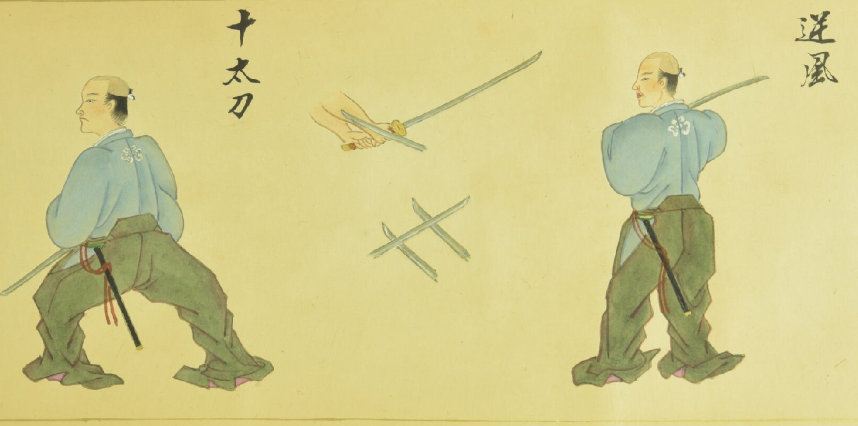
Figure: DISTINCTIVE — elder tengu with white hair/beard (daitengu type), dark feathered wings, in red and green clothing. Holds sword in both hands. Level notation: 上 / 中 / 下 二一 [reading from Image 5, right edge] Sword lines: Crossing lines plus additional trajectories. Interpretation: Same reversed notation as 第六. Note: The elder/white-haired appearance distinguishes this tengu from all others and may indicate a senior or master-level technique.
第八 (Dai-hachi / Eighth)
Figure: Tengu in yellow-orange and green, seated in wide stance. Level notation: 此手多正傳 (Kono te ōku shōden) Sword lines: THE MOST COMPLEX — many lines radiating in multiple directions, significantly more than any other position. Also includes what appears to be a single horizontal line at the bottom (a thrust or sweep?). Interpretation: “These techniques are numerous — true/principal transmission.” This position is explicitly marked as the core or principal transmission of the set. The absence of standard 上/中/下 notation and the annotation 此手多正傳 suggests this is the summary or master technique that encompasses all levels. Note: The word 正傳 (shōden, true/correct transmission) marks this as having special doctrinal weight.
第九 (Dai-kyū / Ninth)
Figure: DISTINCTIVE — tengu with dark brown/olive feathers (more eagle-like, different from the lighter-feathered tengu). Prominent beak-nose, in pink clothing. Level notation: 上 / 中 / 下 二一 Sword lines: Three parallel diagonal lines (distinctive pattern — all going in the same direction, upper-right to lower-left). Interpretation: Upper; middle; lower 2 and 1. Same reversed notation as 第六 and 第七.
第十 (Dai-jū / Tenth)
Figure: Tengu in green clothing with dark wing feathers, crouching/striding. Level notation: 上 / 中 / 下 一二 Sword lines: X pattern with additional lines. Interpretation: Same notation as 第三–第五.
第十一 (Dai-jūichi / Eleventh)
Figure: Tengu in red and green-yellow clothing, standing with sword drawn. Level notation: 上 / 中 / 下 一二一 Sword lines: Crossing X pattern. Interpretation: Upper; middle; lower 1, 2, 1. This is the first position with THREE numbers in the lower notation, indicating a more complex technique. The palindromic structure (1-2-1) may encode a specific rhythmic pattern.
第十二 (Dai-jūni / Twelfth)
Figure: THE MOST ELABORATE — tengu in multi-colored pink/green/red clothing, in a dynamic lunging pose with sword raised high (jōdan). This is the final and culminating position. Level notation: 上 / 中 / 下 四三二 Sword lines: [partially visible due to proximity to text section] Interpretation: Upper; middle; lower 4, 3, 2. This is the most complex notation in the entire set — three numbers in a descending sequence (4→3→2). The total of 9 lower-level actions dwarfs every other position. The descending pattern may encode a progressive narrowing or refinement within the technique.
Closing Text
Following the blood oath and purification clauses, there are statements that "In ancient times, this was transmitted with sincere and pure devotion." (古者直實穀之仁粹之相傳) and Nichirin Marishiten (日輪摩利支天; "Sun Disc of Marīcī Deva") an invocation of the warrior deity, closing the set. ## Summary Table of Cut Notations | Position | 上 (Upper) | 中 (Middle) | 下 (Lower) | Notes | |----------|-----------|------------|-----------|-------| | 第一 | ✓ | ✓ | 一 | | | 第二 | ✓ | ✓ | 一 | | | 第三 | ✓ | ✓ | 一二 | | | 第四 | ✓ | ✓ | 一二 | Multi-directional lines | | 第五 | ✓ | ✓ | 一二 | | | 第六 | ✓ | ✓ | 二一 | Reversed; parallel lines | | 第七 | ✓ | ✓ | 二一 | Elder/daitengu figure | | 第八 | — | — | — | 此手多正傳; most complex | | 第九 | ✓ | ✓ | 二一 | Dark-feathered; parallel lines | | 第十 | ✓ | ✓ | 一二 | | | 第十一 | ✓ | ✓ | 一二一 | THREE numbers — expanded notation | | 第十二 | ✓ | ✓ | 四三二 | THREE numbers — descending sequence; culminating |
Notation
1. The 上 and 中 notations never carry explicit numbers in this copy — only 下 receives numerical counts. This may indicate that upper and middle cuts are standard (one each?), with the variation encoded in the lower-level attacks.
2. Positions 第六, 第七, and 第九 reverse the lower count from 一二 to 二一. This creates a pattern where a cluster of three positions in the middle of the set use reversed notation — whether this indicates a different sequence of execution, a different spatial arrangement, or marks a distinct sub-group of techniques is unclear without oral transmission.
3. 第八 breaks the pattern entirely with the annotation 此手多正傳, marking it as the principal/true transmission. The dense cluster of sword lines around this figure suggests it is the "master key" technique.
4. 第七 and 第九 have visually distinctive tengu — the elder (white-haired) and the eagle-feathered respectively — which may indicate techniques of a different character or origin than the standard set.
5. 第十二 has the highest lower-count numbers (四三二), with a total of 9 lower-level actions and a descending sequence. The progression from two-number notation (positions 1–10) to three-number notation (positions 11–12) suggests a structural escalation toward the climax of the set.
6. The notation expands at the end of the set: Positions 第一–第十 use two numbers for 下, while 第十一 uses three (一二一) and 第十二 uses three (四三二). This expansion may indicate that the final positions encode more complex multi-stage techniques, or that the third number represents an additional dimension (e.g., a third direction or phase of attack).
7. 第十一's palindromic 一二一 (1-2-1) is structurally distinct from 第十二's descending 四三二 (4-3-2), suggesting different organizing principles for the two culminating techniques.
The grey sword-line patterns vary systematically: some show X-crosses (diagonal cuts), some show parallel lines (repeated cuts in one direction or thrusts), and some show radial patterns (multi-directional attacks). These patterns carry information beyond what the 上/中/下 notation alone records.
第八's 此手多正傳 could be read as "these techniques are numerous — true transmission" or "this hand [position] has many true transmissions [variants]."
Several positions in the middle of the set (第三–第五) share identical notation (上 / 中 / 下 一二), raising the question of whether the figures and sword-line patterns — rather than the text notation — carry the differentiating information.