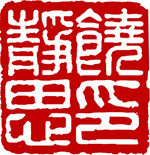
Details on the Chan (Zen) phrase 一口吸盡西江水, which is carried in the Jikishinkage-ryū Heihō zakki (兵法雑記) of Yamada Ippūsai — composed 1686, surviving in his own 1708 copy — and later mokuroku from 1764 and 1800 Jikishinkage-ryū mokuroku (opens in a new tab) as the gokui seikō-sui (西江水).
Origin
It originates in 17th-century Yagyū Shinkage-ryū writings as a capstone gokui of Yagyū Shinkage-ryū developed by Yagyū Sekishūsai and was very likely imported into Jikishinkage-ryū from the Edo line of Yagyū Shinkage-ryū by Yamada Ippūsai. Unlike shin hen bankyo (心遍萬境) found in Hikita Kage-ryū densho, this phrase has a firm, attested Chan locus.
The toponym 西江 is generally taken as “the great western river” — an image of vastness, not a gazetteer identification of a specific body of water (Mazu taught in Jiangxi, 江西).
Seikō-sui becomes a swordsmanship gokui across the Shinkage-derived schools.
The Honshiki san-mondō (本識三問答), a Yagyū-method text bound in the Bujutsu sōsho (武術叢書, 1915), expounds 西江水 as the apex secret of Yagyū Shinkage-ryū — the teaching “above” the entire mokuroku, to which all techniques reduce.
The phrase (「西江水一つにて濟む」, “it is settled by the one West River water alone”) is attributed in that work explicitly to Yagyū Munenori, named there as 柳生但馬守. The school’s own account glosses the 一口: “he named it out of the mind of ‘one gulp’ (一口の心).”
It ties 西江水 to the core Yagyū concept of no-sword as well — Munenori is reported to have said he would have called the school 無刀流 (Mutō-ryū; the No-Sword school). The Tsuki no Shō carries the same credo attributed one generation up: 亡父ハ「無刀流、我カ法ナリ」といはれしと、老父かたりたまへし也 (p. 49) — the saying is the late father’s (bōfu 亡父), relayed by the aged father (rōfu 老父). If the deixis identification below holds (亡父 = Sekishūsai), the Honshiki’s Munenori attribution looks like a relay collapse — a dictum voiced by Munenori in transmission hardening into Munenori’s own — a small, documentable instance of the generational-name conflation mechanism. And it versifies the phrase as waka:
兵法は懸待表裏みつなれど、つゞめてみれば西江水
In swordsmanship there are the three — engaging, waiting, and the front-and-back of deception — but gathered up and seen whole, it is the West River water.
兵法の敷〔數?〕の習を打ちすてゝ、西江水を一口に呑む
Casting off the manifold trainings of swordsmanship, swallow the West River water in one gulp.
The second waka is the Chan 一口吸盡西江水 turned directly into a sword gokui.
A syncretic passage in the text’s Unchū-ryū (運籌流) appendix equates the same principle across traditions, where 西江水 is identified with 空理/天理 (the empty/heavenly principle), 本來の面目 (Chan, “Original Face”), 明德 (Confucian Daxue, “illustrious virtue”), 內外清淨 (Shintō) and finally the concept of mastery (meijin 名人): one principle under many names. This is quite poetic, but indicates some sword lineages read 西江水 as a high-level concept associated to attainment, not merely as a Chan citation.
The Yagyū inka episode
In the Yagyū transmission tradition, the phrase sits at the very center of Yagyū Jūbei Mitsuyoshi’s (柳生三厳) 1637 licensing. When Jūbei submitted his densho, his father Munenori ordered it burned (一炬焼却). Jūbei consulted Takuan Sōhō (沢庵宗彭), then lodging with Munenori, who explained that Munenori’s real meaning was「西江水を一口に吸尽して、徹底乾者乎、是乎為汝之印可也」 (“[are you not] one who has swallowed the West River water in one gulp and drained it dry to the very bottom? — this is your inka”).
Takuan emended the text and Jūbei was then granted his license.1 On this account, 一口吸盡西江水 is the specific kōan at the heart of the Jūbei–Takuan transmission.
The phrase 西江水 does not appear in Takuan’s own martial-arts prose: a full-text check of his Taiaki (太阿記), Reirōshū (玲瓏集), and Fudōchi Shinmyōroku (不動智神妙録), as digitized, finds no mention of it — while their signature vocabulary (殺人刀・活人剣, 拈華微笑, 真我/人我, 石火の機) is all present.
It appears Sekishūsai did not acquire the phrase by quoting Takuan’s writings; they drew it from the Chan stratum directly — where it saturates hundreds of works. On the Yagyū side, the Tsuki no Shō’s own deixis (see below) now indicates the term was in the house before the 1637 licensing: Takuan’s role at the inka is best read as re-explication — re-pointing an inherited house term in its original Chan idiom — rather than as the term’s source.
Its route into swordsmanship is Chan-canonical, and we know the Yagyū Sekishūsai-era mokuroku was already naming articles in Chan vocabulary a generation before Takuan-specific material enters the house.
In Jikishinkage-ryū
The fact that it is present in the Jikishinkage-ryū mokuroku of the 18th century points to it being an earlier teaching in that line and evidence seems to indicate it was added by Yamada Ippūsai from his study under the Edo line of Yagyū (founded by Mitsuyoshi and continued through Munefuyu). The earliest Jikishinkage-ryū witnesses for 西江水 are the Heihō zakki (composed 1686; the surviving witness is Ippūsai’s own 1708 copy) and densho whose colophons claim derivation from Kamiya Denshinsai’s mokuroku but were likely ammended by Ippūsai. Seikō-sui appears in the 1708 Heihō zakki of Yamada Ippūsai but not in the 1670 mokuroku Ogasawara awarded to Kobayashi Ichirōemon. Nor, as we saw above, do early students of Sekishūsai carry the concept.
Evidence
The Yagyū tradition’s own testimony makes 西江水 a Yagyū-generation coinage, not a Kamiizumi inheritance. This is the strongest single datum, and it comes from the Seikōsui no koto itself. The origin anecdote from the Tsuki no Sho says the aged 亡父, after the privy realization, 「此心持ヲ得道シテ、今此ヲ西江水ト秘シテ、無上至極ノ極意ト号ス」 — he attained the mind-set and then named it 西江水, keeping it secret. That naming is decades after Kamiizumi (d. c. 1577).
The gokui shows transmission depth inside the house: the Seikōsui no koto records two named applications — 亡父ノ用 (base contracted) against 老父ノ用 (base extended), with Mitsuyoshi preferring the latter.
In addition, aside from received kata, the Kamiizumi naming legend contained in the Tsuki no Sho attributes exactly three teachings to the founder:
- tejikari-ken (手字手利剣; the hand-graph sharp-sword)
- suigetsu (水月; the water-moon)
- shinmyōken (神妙剣; the divine-subtle sword)
Seikōsui (西江水) is conspicuously not among them, having been developed by Sekishūsai late in his life..
Ippūsai is known to have imported the kodachi and habiki material from Edo Yagyū training — so a transmission conduit from exactly the line that held the Tsuki no Shō gokui. Mitsuyoshi was the Edo heir; the kuden would run through Munefuyu’s line, which is the Edo Yagyū Ippūsai later encountered.
The Jikishinkage-ryū densho’s own commentary on the kata omokage (面影; the reflected image) explicitly names the Yagyū house (柳生公) and positions Jikishinkage-ryū against it — direct evidence that this recension family was formed in conscious contact with Yagyū doctrine.
The Waseda University KE05 1032 black-ink gloss reads 西江水 as the boundless world-water and a somatic instruction: settle it into the kikai-tanden (気海丹田; qìhǎi dāntián; the lower dantian).
On the Yagyū side, the Seikōsui no koto places the mind below the waist (腰より下), and kokoro no oku tokoro) — 「心を置くとは西江水なり、置所なり」: “to place the mind is 西江水, the placing-place.” Seikōsui directly involves mind-placement (置所).
The Jikishinkage-ryū ke05 mokuroku’s 面影 kata names the Yagyū house and glosses its own method as 「柳生公にては…水に月の移る心也」 (attaching 影無/kage-nashi and striking).
The Tsuki no Shō omokage entry uses the same water-reflection figure — 「敵の面影を水へうつして、下の水にうつりたる面影をみて」 — and closes 「西江水に知るべし」.
So the 面影 ↔ water-reflection ↔ 西江水/水月 nexus is attested in both schools’ densho. The Jiki entry frames it as a contrast with 柳生 (影 vs 影無): differentiation within a shared frame, not verbatim copying — consistent with adaptation during Ippūsai’s dual training.
The kōan seikōsui is drawn from by Sekishūsai is ubiquitous (CBETA corpus of the Buddhist canon has 463 occurrences across 247 works) and it is reasonable to imagine a Zen-practicing swordsman adopted its use.
Shinmyōken and Variants
On the graphs 功妙剣 / 切妙剣 / 心妙剣, The entry belongs to a fixed two-member pair, written beneath the a-un bonji and marked 口伝 in every witness: Kōmyōken (功妙剣; 功 = merit, efficacy) followed by Shinmyōken (心妙剣; 心 = heart-mind). The pair is stable across the Heihō zakki (1708), the Mokuroku kudensho (1764) and the 1800 copy — so 心妙剣 is a line-level convention from the founding stratum, not a late scribal substitution for 神妙剣. Whether it stands in any genealogical relation to the Yagyū founder-set’s shinmyōken (神妙剣; 神 = divine) is a separate question, and one these witnesses cannot settle: the two are homophonous, but the Jikishinkage-ryū tradition writes 心 consistently and pairs it with 功妙剣, which the Yagyū set does not have.
The graph that does drift is the first member. The 1800 witness (ke05_01032_0003) writes
切妙劔 — Setsumyōken (切 = cutting) — where the 1708 zakki and the 1764 kudensho both write
功妙剣. This is image-verified (2026-07-19): the head graph’s left element is the crossing 七, not
功’s 工, and the single-graph siglum beside the second bonji independently writes 切 in clearer
semi-cursive. A fresh ndlkotenocr-lite pass on the same leaf also returns 切妙剣, so model, eye
and siglum concur for this witness; the divergence is between witnesses rather than between machine
and reader.
The two variants in this one gokui list therefore illustrate different mechanisms. 功 → 切 is graphically motivated — 工 and 七 converge in cursive — and is confined to a single copy. Any 神 → 心 drift, by contrast, would be phonically motivated; but on present evidence no such drift occurred inside the Jikishinkage-ryū witness tradition, which is uniform on 心. The stability of the surrounding block is itself worth noting for the argument above: the gokui list carrying 西江水 transmits from 1708 to 1800 with a single graph altered, which is a high-fidelity chain.
The 抜目 correspondence should be emphasized. Takuan’s argument is that localizing the mind makes every other function 缺ける — deficient, gapped. 抜目なく is precisely the negation of that: no place where it lapses. The densho isn’t echoing a mood; it’s stating Takuan’s conclusion in Takuan’s terms, with 惣身/總身 as shared vocabulary.
On マシ: Takuan’s verbs here are 行きわたり, 廣ごり, のびひろがり, 満ち — none of them マシ. So the graph stays unresolved; what’s now corroborated is the sense (distribution, not localization). 増し remains the least strained of the candidates. The 惣-body idiom itself has a further JSKR attestation at the founding stratum: the Heihō zakki’s 惣体之〆 teaching (惣体ヲ満ル・惣体ハシマルモノ也, 1686/1708, quoted in Karukome) — the same vocabulary family as the densho’s 惣身, forty years after Takuan’s death.
What’s still not established is directionality. The channel is plausible — the Fudōchi Shinmyōroku was addressed to Munenori, and JSKR descends from Shinkage-ryū — so influence has a route. But this vocabulary may simply be common Edo sword-mind currency that both drew on, and a single entry can’t distinguish those. The mokuroku’s date does bear on it (Takuan d. 1645), as does whether 惣身 appears in Shinkage-ryū material independent of Takuan. On the latter: 惣身 is now attested inside the Yagyū corpus itself — 惣身ニテ取 (Tsuki no Shō p. 30, in the Munenori oral stratum) — but that stratum is Takuan-adjacent by date (1637), so it attests circulation, not independence; a clean test would need pre-1632 Shinkage material.
In Takuan’s Zenshu we find:
由なる位に行く事にて候、右の應無所住の位は向上至極の位にて候、敬 つ居ても捕へぬやうにするが、應無所住而生其心の文の心に
The scriptural genealogy connects Takuan’s philosophical framework directly to Diamond Sutra doctrine:
應無所住而生其心 (ō mu shojū ni shō go shin; “give rise to the mind that abides nowhere”) is from the 莊嚴淨土分 chapter of the 金剛般若波羅蜜經, in Kumārajīva’s translation — and it’s the line that, in the Platform Sutra narrative, awakens Huineng. It’s the canonical root of the entire 心の置所 argument. Takuan’s chain of 敵の太刀に心を置けば…心をとらるる is a vernacular unpacking of no-abiding, and his gloss here says so outright — 捕へぬやうにするが、應無所住而生其心の文の心に.
The mind that isn’t caught is the mind that doesn’t abide. He calls it 向上至極の位, placing it at the top of the scheme.
Yagyū reaches the delusion-cutting sword “via Takuan’s Zen adaptation of Fudō” but more specifically what the Fudōchi Shinmyōroku actually delivers under Fudō’s name is Prajñāpāramitā no-abiding plus Chan no-mind (總身に廣ごりて全體に行渡る心を無心と申す也).
Fudō supplies the title, the fudō immovability figure, and the martial-devotional authority; the doctrinal content is 般若. So the appropriation is strong in that Takuan is not transmitting mikkyō content to Munenori but instead is using a mikkyō deity’s name as a vehicle for sutra doctrine. The Shugendō proclamation and the Yagyū line diverge by the time of Takuan.
Original context — Layman Pang and Mazu
The exchange is between Layman Pang (龐蘊, Páng Yùn; also 龐居士, J. Hōkoji; c. 740–808), the paradigmatic lay Chan adept, and Mazu Daoyi (馬祖道一; J. Baso Dōitsu; 709–788), founder of the Hongzhou school.
Zutang ji (952), earliest form:
龐居士…因問馬大師:「不與萬法為侶者,是什摩人?」馬師云:「待居士一口吸盡西江水,我則為你說。」居士便大悟。
“Layman Pang asked Master Ma, ‘What sort of person is the one who is not a companion to the ten thousand dharmas (不與萬法為侶)?’ Ma said, ‘Wait until you have swallowed all the water of the West River in one gulp — then I will tell you.’ At this the Layman had a great awakening.”
Jingde chuandeng lu (1004) gives 待汝一口吸盡西江水即向汝道 and adds 居士言下頓領玄要 (“at these words he suddenly grasped the essential mystery”).
Shitou precursor. Per the Biyan lu commentary, Pang first put the identical question to Shitou Xiqian (石頭希遷; J. Sekitō Kisen), who covered the layman’s mouth (掩却口) — occasioning Pang’s first verse, 日用事無別…神通并妙用,運水及搬柴 (“my daily affairs are nothing special… supernatural power and wondrous function: hauling water and carrying firewood”). Only then did he ask Mazu.
Pang’s awakening verse (after the West River reply):
十方同聚會,箇箇學無為。此是選佛場,心空及第歸。
“From the ten directions we gather in one assembly; each studies non-doing (mui 無為; wúwéi). This is the hall where Buddhas are selected; mind emptied, one passes the exam and returns home.” (senbutsujō 選佛場 casts the training hall as the imperial-examination hall — one “passes” by emptying the mind.) Zutang ji variants: 同一會 / 各各 / 選佛處.
Commentary
The question 不與萬法為侶 asks after the absolute subject — the “one” that keeps company with nothing, unconditioned by any of the myriad dharmas; it is itself a stock huatou. Mazu declines to answer it as a proposition: such a “one” cannot be pointed at as an object among objects without contradicting the question. He substitutes an impossible physical demand. Swallowing an entire great river in one mouthful cannot be parsed into a subject performing an act on an object — the image forces a totality taken whole, non-dually; one does not drink the river cup by cup. The impossibility is the teaching: it jams conceptual grasping (a “live word,” katsugo 活句), and in the collapse of the subject/object frame Pang awakens. Read positively, to “swallow the West River” is to be non-separate from the whole, so there is no longer a “one” standing over against “the ten thousand” — which is exactly what “not companioned by the myriad dharmas” names.
Biyan lu Case 42 — 碧巖錄・第四十二則「龐居士好雪片片」
Yuanwu Keqin (圜悟克勤; J. Engo Kokugon; 1063–1135), with verse by Xuedou Chongxian (雪竇重顯; J. Setchō Jūken; 980–1052). Text: Taishō vol. 48, no. 2003. Translations below are working translations.
垂示 (Pointer)
垂示云。單提獨弄,帶水拕泥,敲唱俱行。銀山鐵壁。擬議則髑髏前見鬼,尋思則黑山下打坐。明明杲日麗天,颯颯清風匝地。且道古人還有誵訛處麼。試舉看。
“Holding it up alone, playing it solo; or else trailing through water, dragging through mud, striking and singing at once. A silver mountain, an iron wall. Hesitate and deliberate — you see ghosts before the skull; ponder and reflect — you sit under the black mountain. Bright, bright, the blazing sun rides the sky; rushing, rushing, the pure wind circles the earth. But say: did the ancients have any slippery point (誵訛)? Try looking at the case raised here.”
本則 (Main case)
舉。龐居士辭藥山,山命十人禪客相送至門首。居士指空中雪云:「好雪片片,不落別處。」時有全禪客云:「落在什麼處?」士打一掌。全云:「居士也不得草草。」士云:「汝恁麼稱禪客,閻老子未放汝在。」全云:「居士作麼生?」士又打一掌,云:「眼見如盲,口說如啞。」
“Raised: Layman Pang, taking leave of Yaoshan (藥山; J. Yakusan [Weiyan 惟儼]), was seen off to the gate by ten Chan monks Yaoshan had ordered to escort him. Pointing at the snow in the air, the Layman said, ‘Good snow — flake after flake, it falls in no other place.’ A monk named Quan (全禪客) said, ‘Where does it fall, then?’ The Layman gave him a slap. Quan said, ‘Layman, don’t be so careless.’ The Layman said, ‘Calling yourself a Chan monk like that — Old Yama (閻老子; King of Death) won’t let you off.’ Quan said, ‘And what about you, Layman?’ The Layman slapped him again and said, ‘Your eyes see as if blind, your mouth speaks as if mute.’”
Xuedou’s alternate word (別語): 初問處,但握雪團便打。 — “At the first question, I’d just have grabbed a snowball and hit him.” (In the Taishō text, Yuanwu’s capping phrases, jakugo 著語, are interlined throughout the case; they are omitted from the clean transcription above.)
評唱 (Yuanwu’s commentary) — the West River passage
龐居士參馬祖、石頭,兩處有頌。初見石頭,便問:「不與萬法為侶,是什麼人?」聲未斷,被石頭掩却口,有箇省處,作頌道:「日用事無別,唯吾自偶諧。頭頭非取捨,處處沒張乖。朱紫誰為號,青山絕點埃。神通并妙用,運水及搬柴。」後參馬祖,又問:「不與萬法為侶,是什麼人?」祖云:「待爾一口吸盡西江水,即向汝道。」士豁然大悟,作頌云:「十方同聚會,箇箇學無為。此是選佛場,心空及第歸。」…到藥山盤桓既久,遂辭藥山。山至重他,命十人禪客相送。是時值雪下,居士指雪云:「好雪片片不落別處。」
“Layman Pang studied under both Mazu and Shitou, and has verses from both. First, meeting Shitou, he asked, ‘What sort of person is the one not a companion to the myriad dharmas?’ Before the words were out, Shitou covered the layman’s mouth — and he had an insight, making the verse, ‘My daily affairs are nothing special… supernatural power and wondrous function: hauling water and carrying firewood.’ Later, with Mazu, he asked again, ‘What sort of person is the one not a companion to the myriad dharmas?’ Mazu said, ‘Wait until you swallow all the water of the West River in one gulp — then I’ll tell you.’ The Layman was thoroughly, greatly awakened (豁然大悟), and made the verse, ‘From the ten directions we gather in one assembly… mind emptied, one passes the exam and returns home.’… Having lingered long at Yaoshan’s, he took his leave; Yaoshan, esteeming him greatly, ordered ten monks to see him off. Snow was then falling, and the Layman, pointing at it, said, ‘Good snow — flake after flake, it falls in no other place.’”
The remainder of the pingchang (評唱) glosses the snow exchange: Quan’s “Where does it fall?” takes the bait; Pang’s two slaps enact what cannot be said; Xuedou’s “just grab a snowball and hit him” is judged apt but a half-beat slow (機遲) — the reply should meet the sound as it sounds (和聲便應、和聲便打). Yuanwu then reads the whole as “one-color” (一色) ground — the Samantabhadra (普賢) realm, “made into one seamless piece” (打成一片) — cautioning that resting in uniform whiteness is only “half-raising” (半提); full-raising (全提) requires the upward road (向上一路), where great function appears and no needle enters. He closes: even Bodhidharma could scarcely tell it apart.
Iro (one color) is found in Jikishinkage-ryū mokuroku commentary as well, for Metsuke no Koto (目付之事; “Matter of the Gaze”) in the phrase Gan nari. Metsuke no Shiyō, Iro o Miru, Kokoro no Kagami (眼ナリ 目付ノ仕用 色ヲ見ル 心ノ鏡).
頌 (Xuedou’s verse)
雪團打,雪團打,龐老機關沒可把。天上人間不自知,眼裏耳裏絕瀟灑。瀟灑絕,碧眼胡僧難辨別。
“Snowball smack! Snowball smack! — Old Pang’s device, there’s no grabbing hold of it. Gods above and humans below don’t know it themselves; in the eye, in the ear, utterly unfettered (瀟灑). Utterly unfettered! — even the blue-eyed foreign monk (碧眼胡僧; Bodhidharma, 達磨) could hardly tell it apart.”
Corpus findings
Full-text search of the CBETA P5 corpus (tags stripped, CJK-only stream):
- 一口吸盡西江水 (full form): 463 occurrences; 吸盡西江水: 509; 吸盡西江 (broad): 653; the paired question 不與萬法為侶 (“not a companion to the myriad dharmas”): 632. Present in 247 works — one of the most-diffused kōan tags in the canon.
- A bare-string census of 西江水 alone (a broader net that also catches non-kōan and toponym uses) returns ~238 works and ~572 raw occurrences — a partly-overlapping but distinct set from the 吸盡-based counts above, not directly comparable to them. The bare string additionally picks up unrelated fragments to be filtered: 一口吸盡西江月 (moon, not water) and 吸盡西江難下口 (a separate dhāraṇī-offering verse, 「吸盡西江難下口,遍為甘露潤群生」).
- Earliest extant occurrence: Zutang ji (祖堂集; Sodōshū, 952; CBETA B25n0144), in the Layman Pang entry.
- Source-specific records: Mazu Daoyi chanshi guanglu (馬祖道一禪師廣錄, X69n1321, in the Sike yulu 四家語錄) and Pang jushi yulu (龐居士語錄, X69n1336).
- Canonical transmission: Jingde chuandeng lu (景德傳燈錄, 1004; T2076).
- Most influential later vehicle: Biyan lu (碧巖錄, 1128; T2003), Case 42.
- Datable textual signal. The 祖堂集 wording — 待居士…我則為你說 — differs from the standardized transmission-lamp form 待汝…即向汝道 that dominates the later census (X80n1565, T51n2077, the J-works, etc.).
- Tsuki no Shō p. 71’s 一口吸盡西江水 is unambiguously the Mazu–Pang locus — a single, highly recognizable Chan set-piece — with its earliest form in 祖堂集 exactly as placed. This is the positive counterpart to the Takuan null below.
End Notes