The Kōbusho (講武所), the shogunate’s martial academy, opened in 1856 and was absorbed into the Rikugunsho (陸軍所) ten years later. Its instructors were bakufu officials, so they were printed, year by year, in the commercial registers of office-holders called bukan (武鑑). Those registers are now online. This note shows three documents for two Jikishinkage-ryū men, then follows four names through the registers as an example of what such a search looks like, and ends with the commands used, so that readers can repeat it or search for someone else that may be of interest.
The four names are Odani Seiichirō (opens in a new tab) (男谷精一郎), Sakakibara Kenkichi (opens in a new tab) (榊原鍵吉), Amano Shōshō (opens in a new tab) (天野将曹) and Shimada Toranosuke (opens in a new tab) (島田虎之助). Each links to his record on jikishinkageryu.org.
Three documents
Odani Seiichirō in the register of 1860
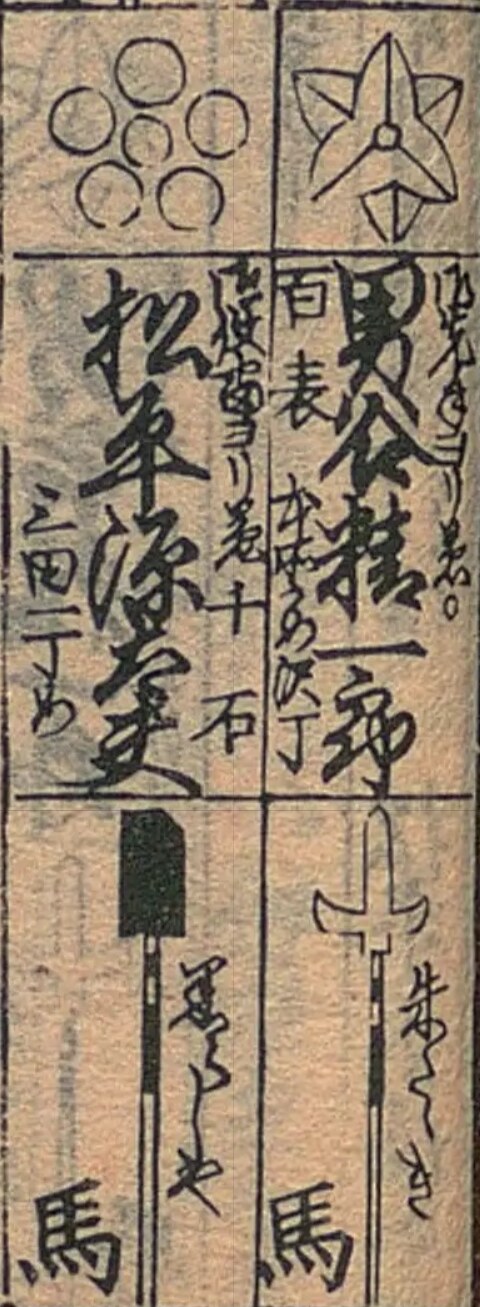
Odani Seiichirō among the Kōbusho directors, 1860
This is one cell of a printed page. The upper name, in the large hand used for the holder of a post, is 男谷精一郎. Above it is his crest; beside it in small type are his stipend and residence; below it are the spear and the 馬 (horse) mark that show the regalia his rank allowed in procession. The second name in the cell belongs to the next director. The page it comes from is shown further down.
Amano Shōshō’s appointment card, 1863
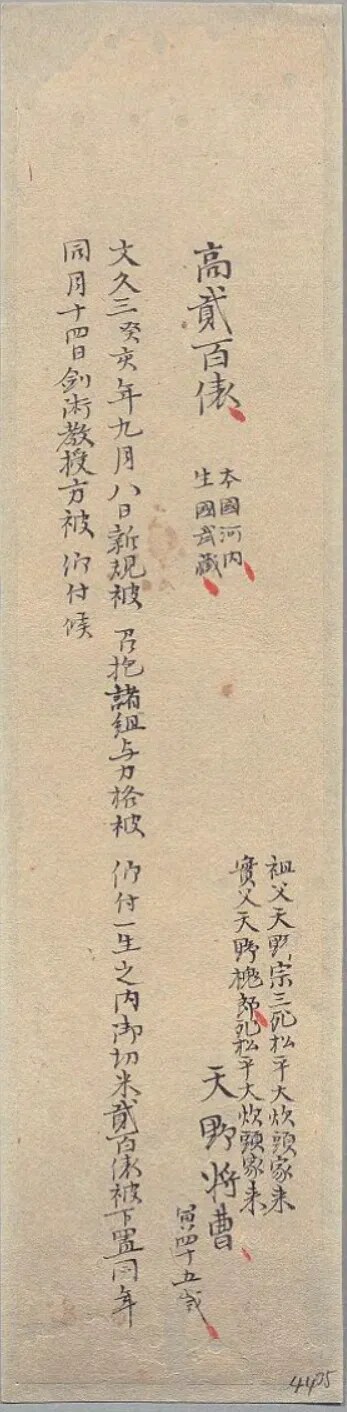
Appointment card of Amano Shōshō, Bunkyū 3 (1863)
A handwritten slip of the kind the bakufu kept for each retainer. It is headed 高貳百俵 (a stipend of two hundred hyō), is dated 文久三亥年九月 (the ninth month of 1863), records his appointment as kenjutsu kyōju-kata (剣術教授方; sword instructor) and is signed 天野將曹. It gives his age as forty-five, which puts his birth about 1819, and names his grandfather and father as retainers of a daimyō house, so that he entered direct shogunal service in his own generation. Amano’s record discusses it further.
A match ledger of 1851
The third document records gekiken bouts headed Yorihito kazu shiai shōbu-tsuki (寄人数試合勝負附), dated to the fifth month of Kaei 4 (1851), listing pairs of fencers by school — Odani, Chiba, Saitō, Momonoi, Ōishi — with the points each took.
Amano Shōshō appears in it, among other bouts against the second Ōishi Susumu, seven points to five with one simultaneous strike. It is printed in Uryū Tōkatsu (瓜生等勝), ed., Shin shiryō Kijima Matabē monjo (新資料 来嶋又兵衛文書), which the National Diet Library holds as pid 12230039 (opens in a new tab). The page was photographed and posted by a Japanese researcher (opens in a new tab) online.
The sources
| Year | Source | Where | Kōbusho section |
|---|---|---|---|
| 1856, 1860 | Rikugun rekishi (陸軍歴史), vol. 2, 1889: rosters copied from bakufu records | NDL 988906 (opens in a new tab) | koma 96–108 (the review of 1856), 125–132 (night duty, 1860), 147–152 (appointments) |
| 1860 | Ansei bukan (安政武鑑), officials | NDL 14950262 (opens in a new tab) | koma 68–72 |
| 1861 | Taisei bukan (大成武鑑), vol. 3, part 1 | NDL 2547105 (opens in a new tab) | koma 73–77 |
| 1862 | Taisei bukan, officials | NDL 2547098 (opens in a new tab) | koma 76–80 |
| 1863 | Shūchin bukan (袖珍武鑑), a pocket edition | Waseda University Library (opens in a new tab) | not yet located |
| 1864 | Taisei bukan, officials | NDL 2547156 (opens in a new tab) | koma 81–84 |
| 1865 | Taisei bukan, vol. 3, part 1 | NDL 2547163 (opens in a new tab) | koma 23–28 |
| 1866 | Taisei bukan, officials | NDL 2602907 (opens in a new tab) | koma 21–26 |
| 1867 | Taisei bukan, officials | NDL 2547111 (opens in a new tab) | koma 26–31 |
A koma (コマ) is one camera frame, normally an opening of two pages, and it is the unit the library’s viewer counts in. https://dl.ndl.go.jp/pid/2547156/1/82 opens frame 82 of that volume. The right-hand page is the earlier one.
The bukan were commercial publications, revised and reissued every year from the same blocks. A name that left office was cut out and a new one let in, which is why some cells are blank and why the lettering differs from cell to cell. The names are in a cursive hand. Rikugun rekishi is a Meiji compilation in movable type, far easier to read, but it reproduces only the rosters its editors chose.
The National Diet Library’s digitized run of the Taisei bukan has no edition for 1863, so that year has to come from another library. The pocket edition at Waseda is complete, but its pages are small and worn and I have not yet found the Kōbusho entry in it.
Searches
Odani Seiichirō
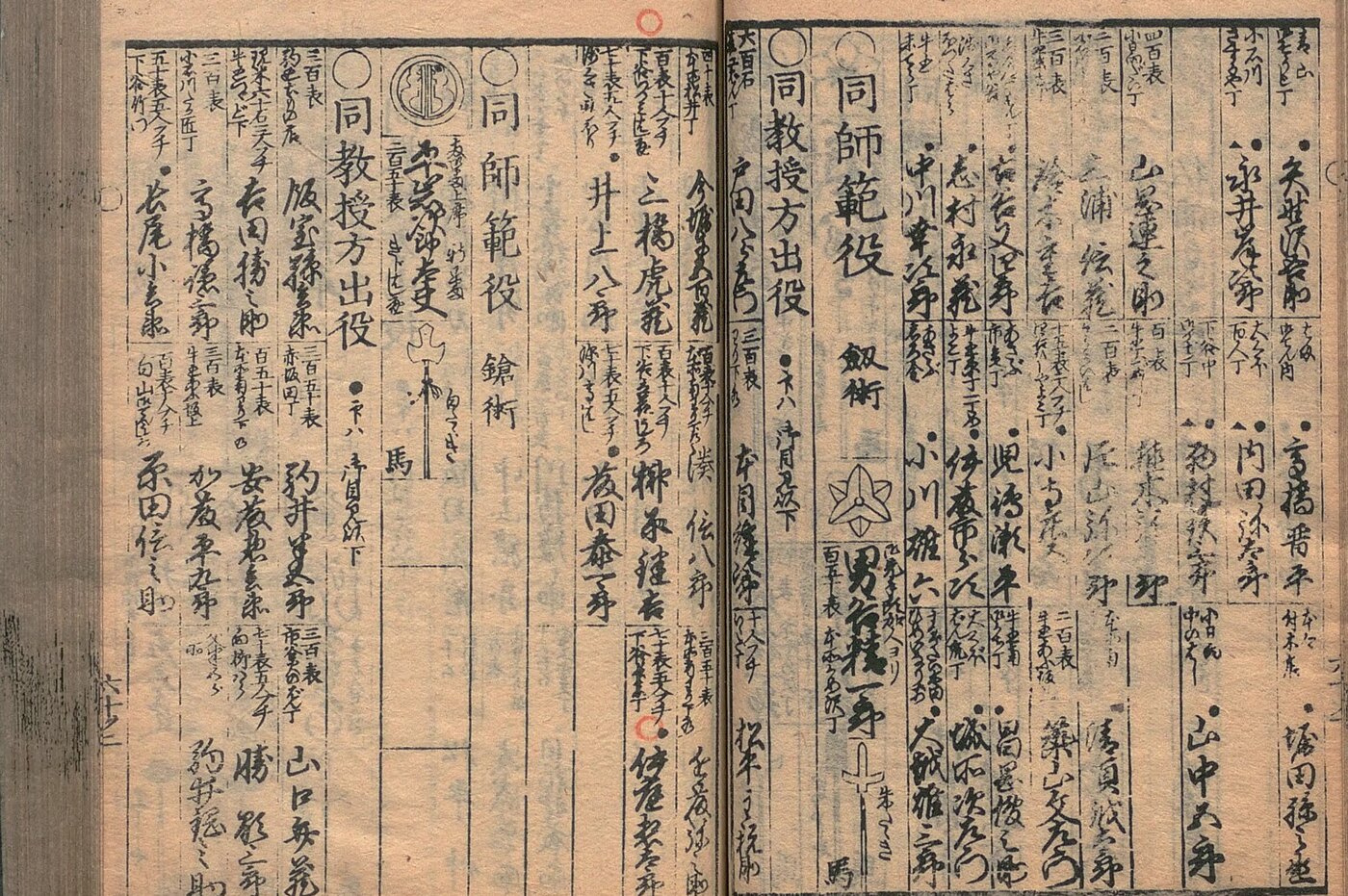
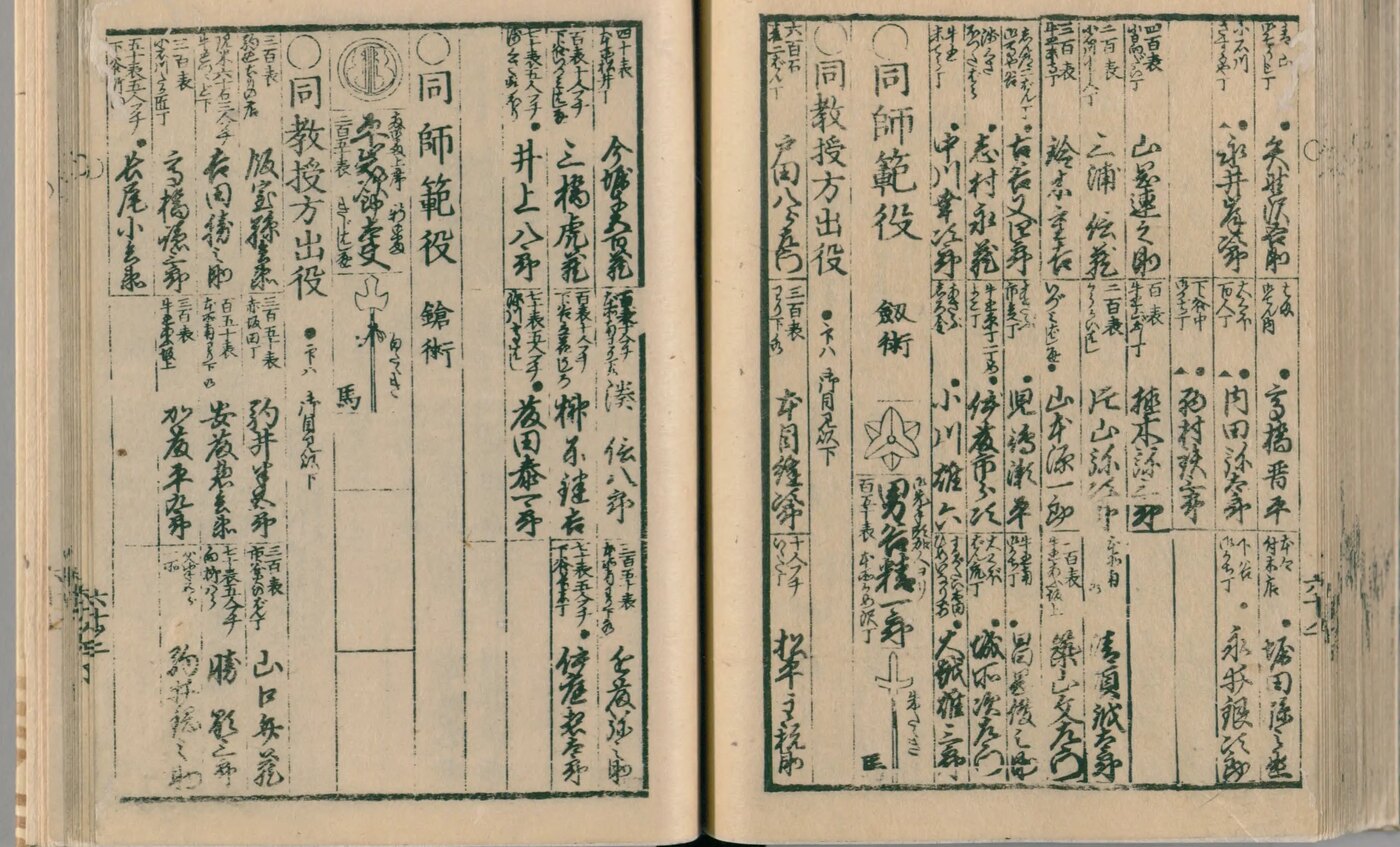
Odani appears twice in the register of 1860: among the directors (同頭取), and as the head instructor of swordsmanship (同師範役 劔術).
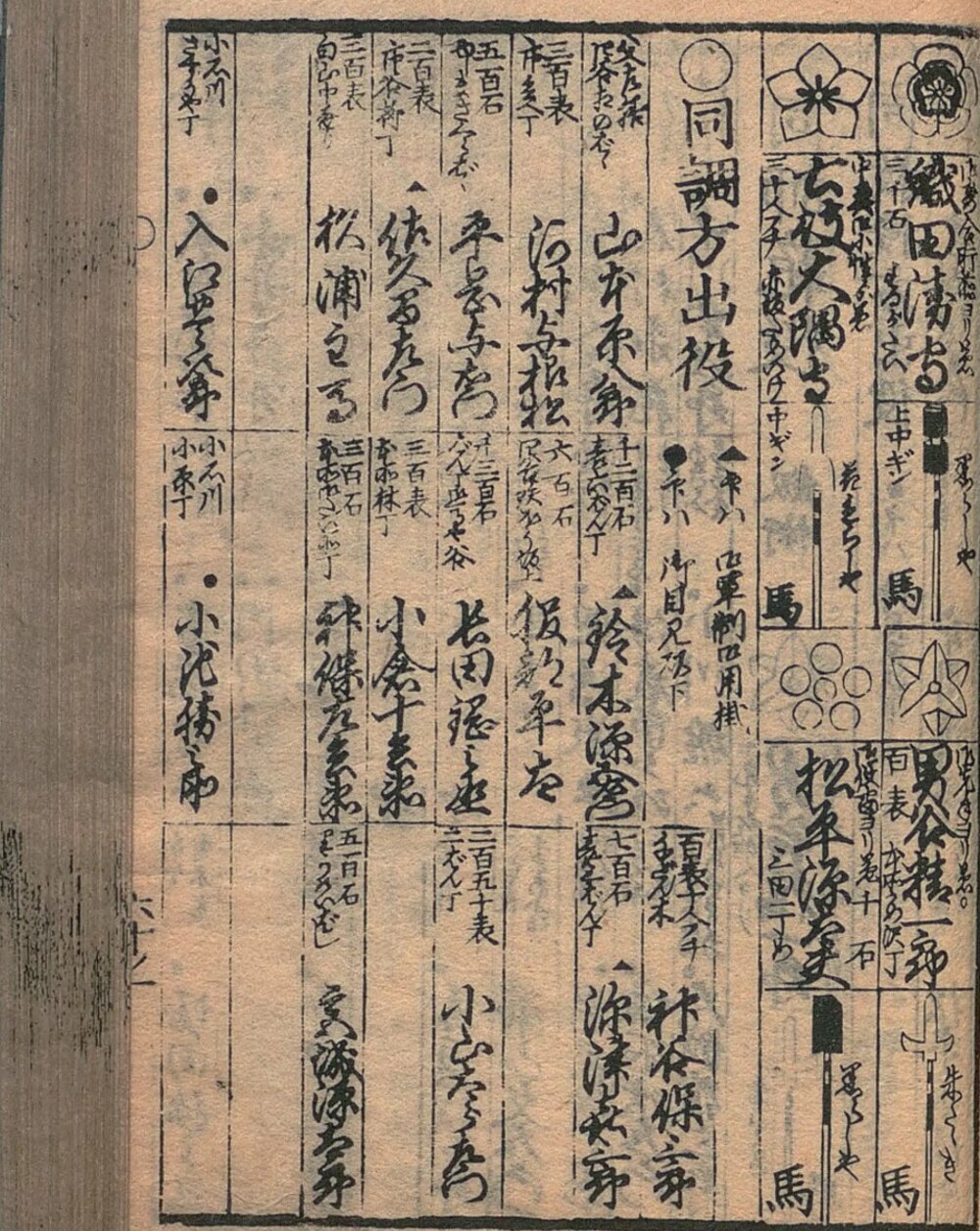 (opens in a new tab)
1860, koma 68, left page. Odani is in the lower half of the page, under the star-shaped crest; this is the cell shown above.
 (opens in a new tab)
1860, koma 69. Right page: 同師範役 劔術, with 男谷精一郎 beneath his crest. Left page: the sword instructors continue, then the spear.
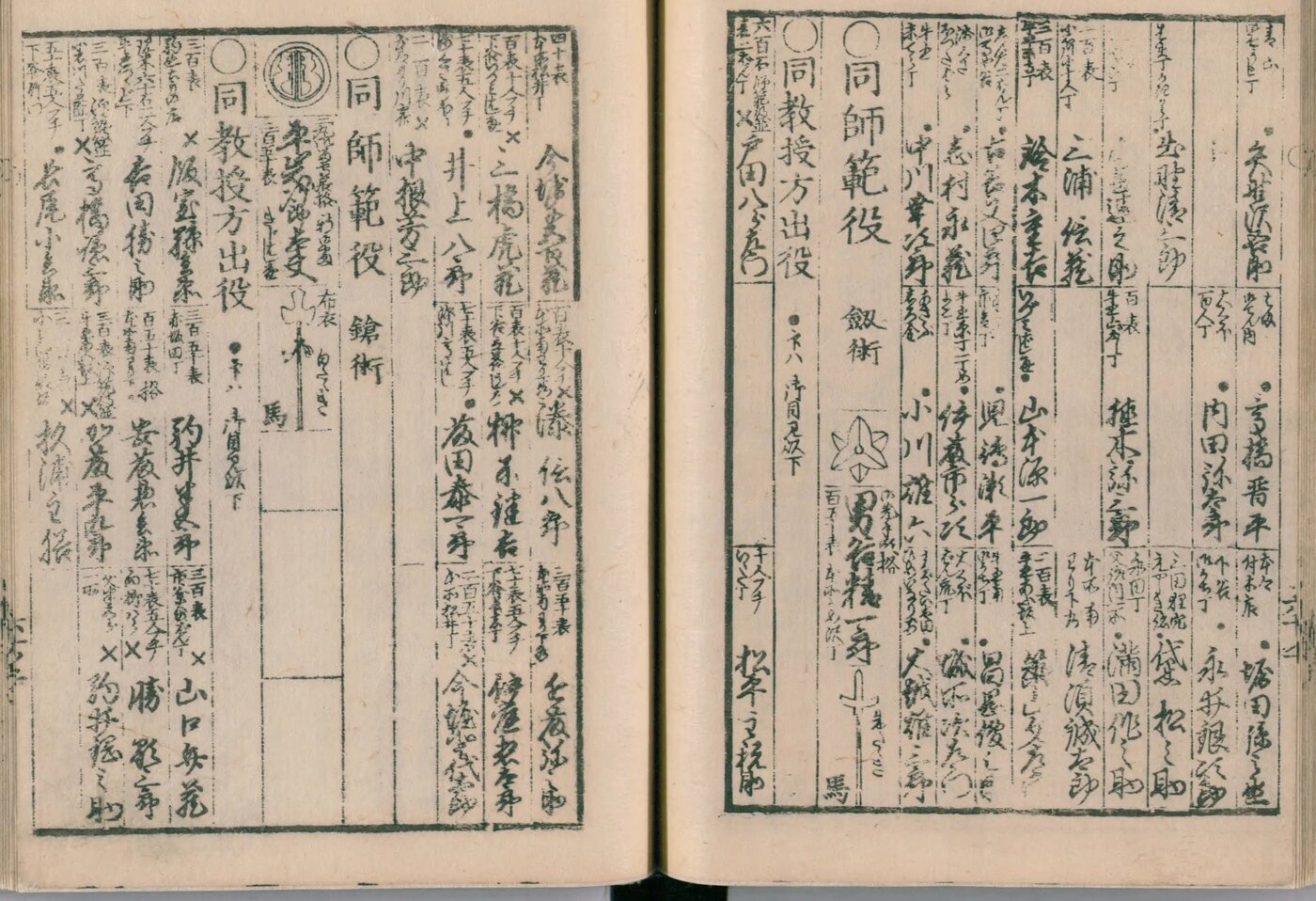
The same blocks serve in 1861 and 1862, with small changes.
 (opens in a new tab)
1861, koma 74.
 (opens in a new tab)
1862, koma 77. The small × marks beside some names are a feature of this edition.
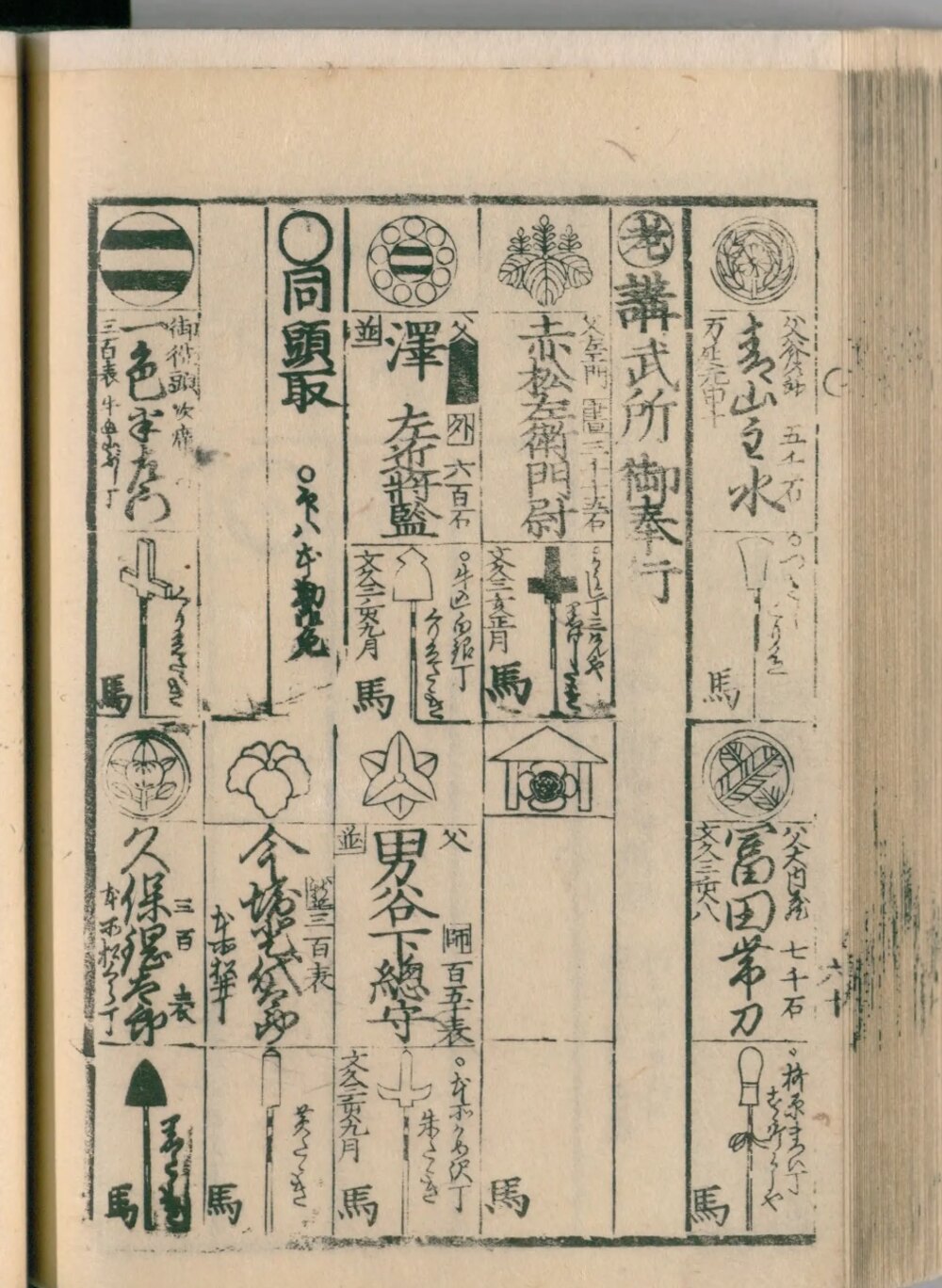
By 1864 he has been promoted. The sword instructors are now headed by Matsudaira Kazusa-no-suke (松平上總介) as associate, with Toda Saburōbei (戸田三郎兵衛) beside him — likely the Toda Hachirōzaemon (戸田八郎左衛門) of the earlier registers under a new name taken on his promotion, since the stipend of six hundred koku and the residence are the same, and the man whose diary Enomoto Shōji (榎本鐘司) used in his analysis of the Kōbusho personnel rosters; the register of 1865 gives him a court title — and Odani stands at the head of the academy’s section as 男谷下總守, with the mark 並 for associate magistrate (奉行並) and, as I read the small type beneath, the ninth month of Bunkyū 2 (1862).
 (opens in a new tab)
1864, koma 81, right page: 講武所御奉行. 男谷下總守 is in the lower row.
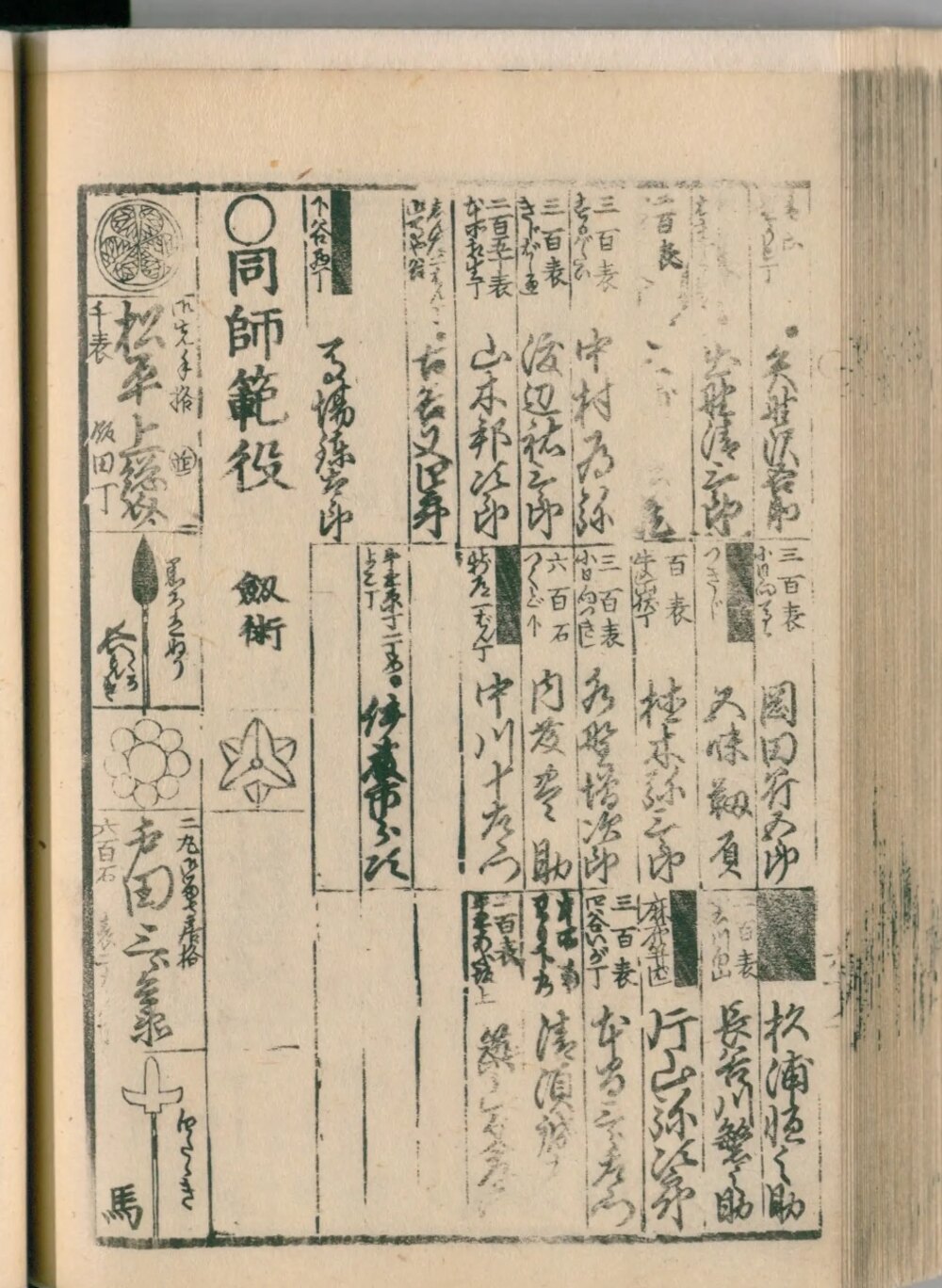 (opens in a new tab)
1864, koma 82, right page: 同師範役 劔術, with 松平上總介 (並) and 戸田三郎兵衛 (六百石) in the left-hand column.
The night-duty roster of 1860 in Rikugun rekishi, drawn up after the Sakuradamon incident, has him at the head of the first sword division.
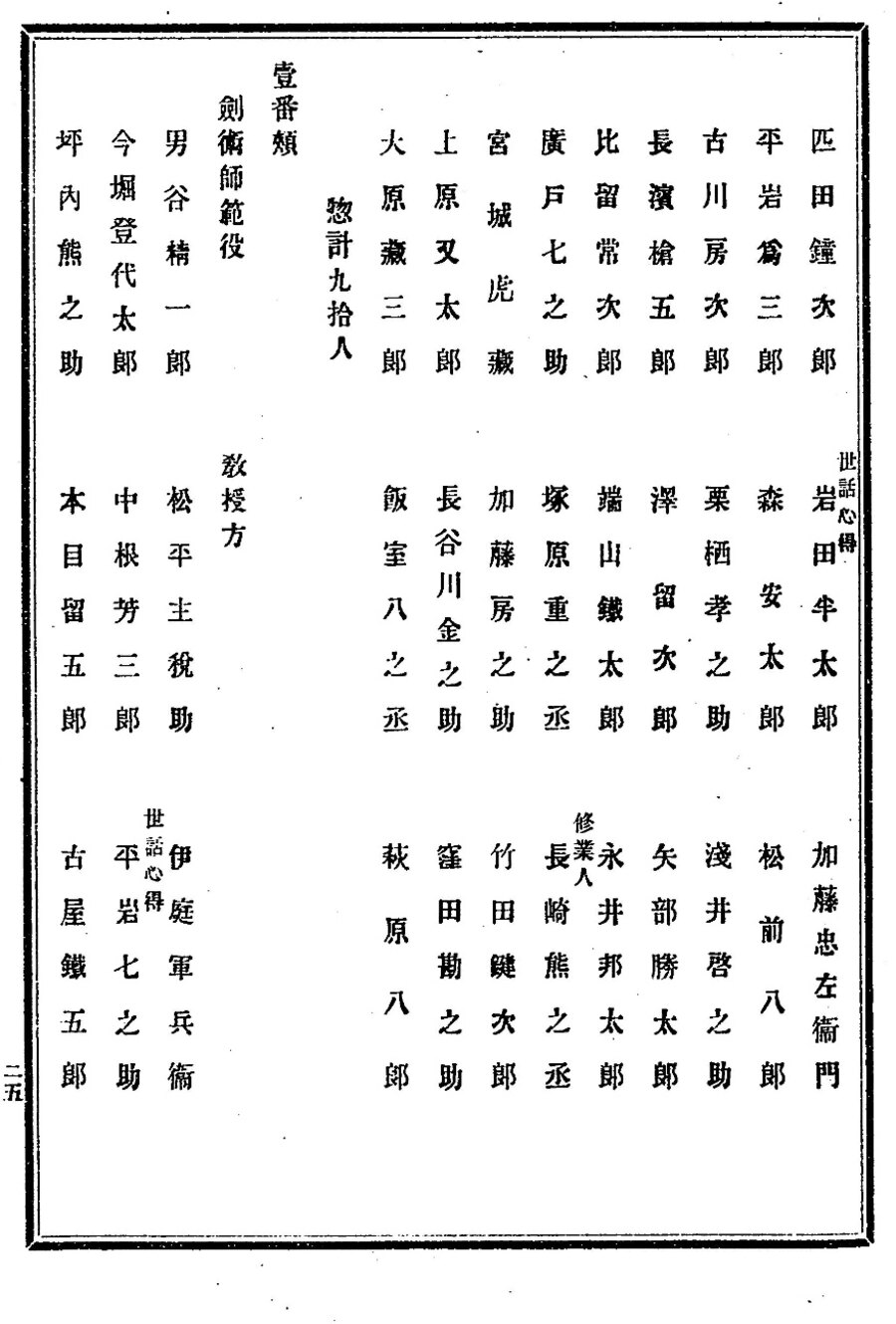 (opens in a new tab)
Rikugun rekishi, koma 127 (p. 25): 壹番類 劍術師範役 男谷精一郎.
Sakakibara Kenkichi
Sakakibara is among the sword instructors seconded to the academy (同教授方出役) in every edition from 1860 to 1864, and a head instructor from 1865. In the pages above he is on the left-hand page for 1860, 1861 and 1862, written 榊原鍵吉 in the cursive of the block. In 1864 he is still there:
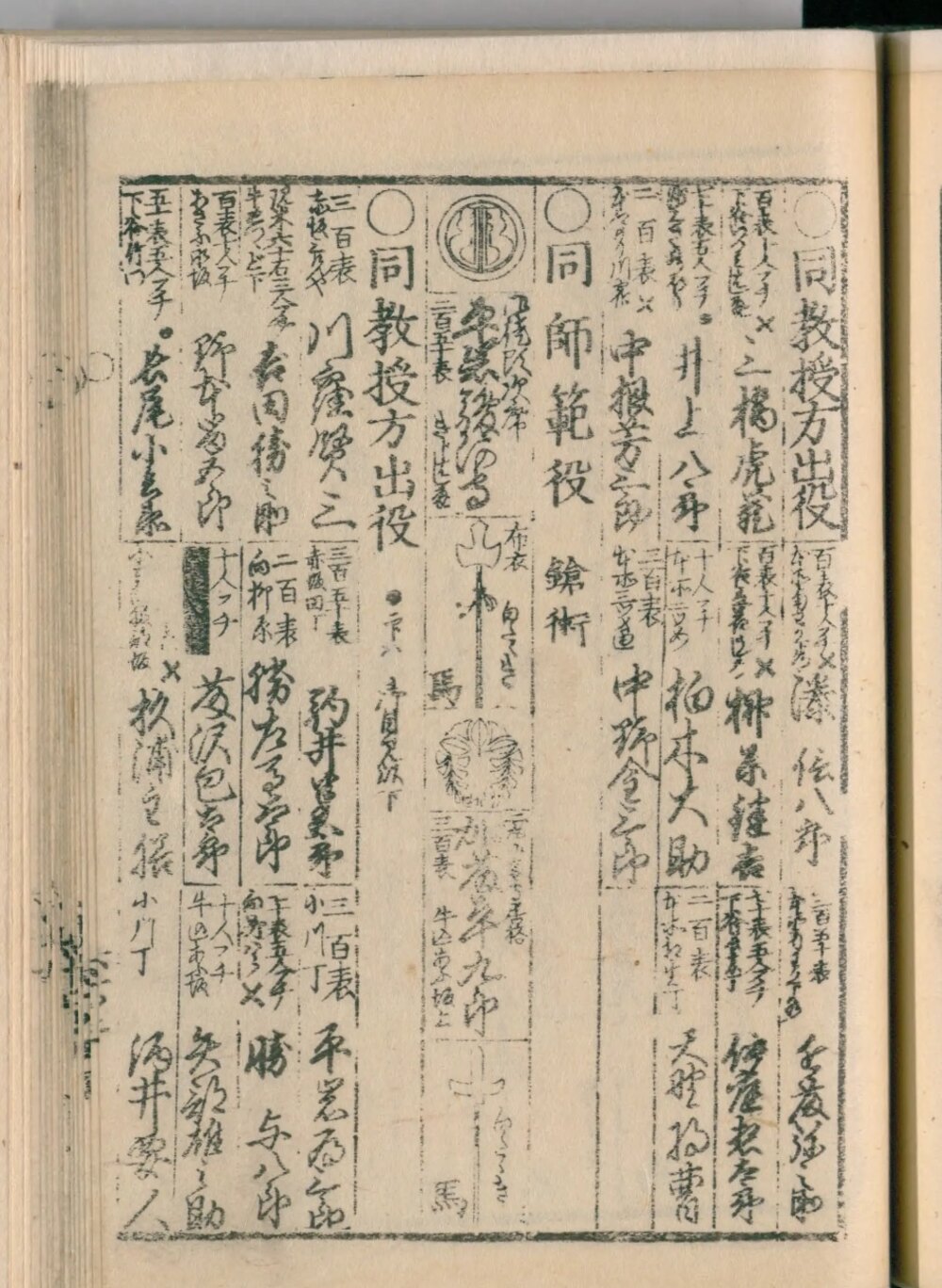 (opens in a new tab)
1864, koma 82, left page. The right-hand columns are the sword instructors (同教授方出役): 榊原鍵吉 is in the second column of names, and at the foot of the third I read 天野将曹. The spear instructors (鎗術) begin in the middle of the page.
From 1865 the section is printed near the front of the volume, among the new army offices, and no longer where it stood in 1860 to 1864; a search that looks only in the old place will conclude, wrongly, that the academy has gone. The register of 1867 shows it after its reorganization. It now reads: the Kōbusho magistrates (講武所御奉行), the head of the Yūgekitai (遊撃隊頭) and its officers, then the sword and spear instructors, then the instructors of the Rikugunsho (陸軍所教授方). The Yūgekitai was the guard corps formed from the academy’s instructors and men; its head in this edition is Imahori Toyotarō (今堀登代太郎), one of the sword instructors of the earlier registers.
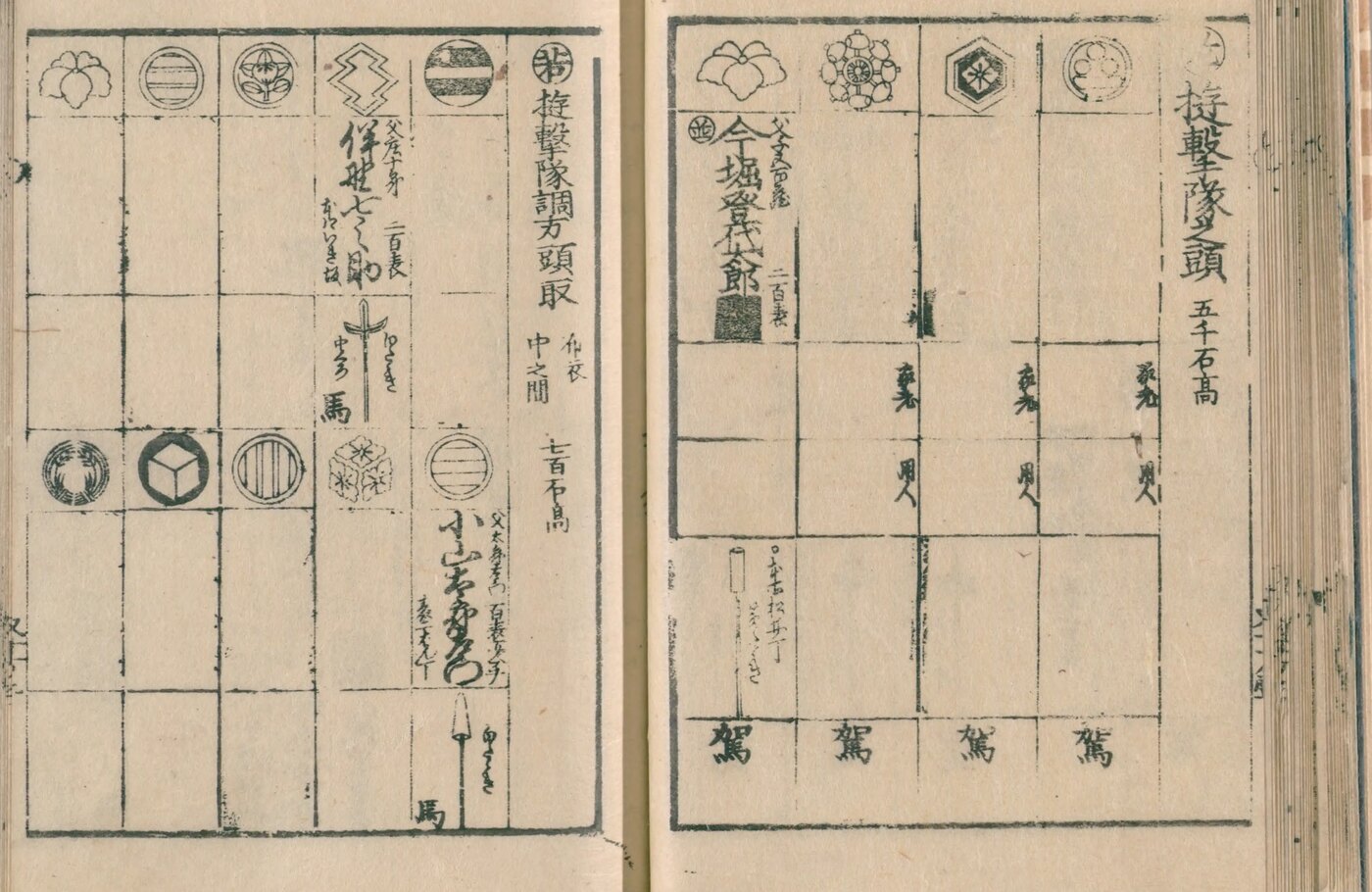 (opens in a new tab)
1867, koma 27. Right page: 遊撃隊頭, with 今堀登代太郎. Left page: 遊撃隊調方頭取. Most cells are empty: the office was new.
Sakakibara had by then risen. He is one of the head sword instructors (同劔術師範役) in the editions of 1865, 1866 and 1867, in the last of them with Inoue Hachirō, Mitsuhashi Torazō, Momonoi Shunzō, Iba Gunbei and Minato Shinpachirō.
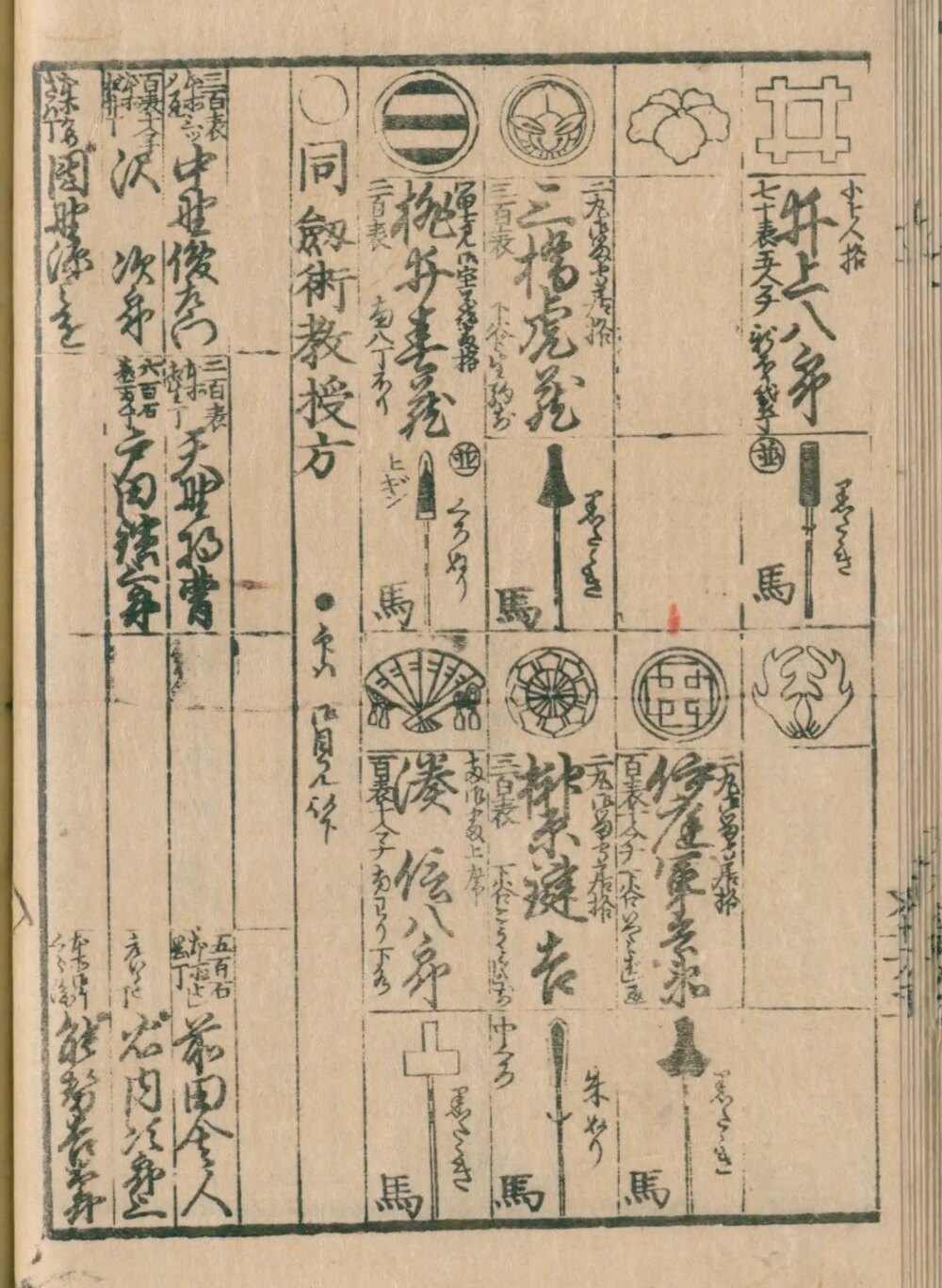 (opens in a new tab)
1867, koma 29, right page. Right half: the head sword instructors, with 榊原鍵吉 in the lower row. Left half: 同劔術教授方, where I read 天野将曹 in the second column.
In Rikugun rekishi he is in the roster presented at the shogunal review of 1856 (koma 96, the page shown at the head of the roster article) and in the night-duty roster of 1860:
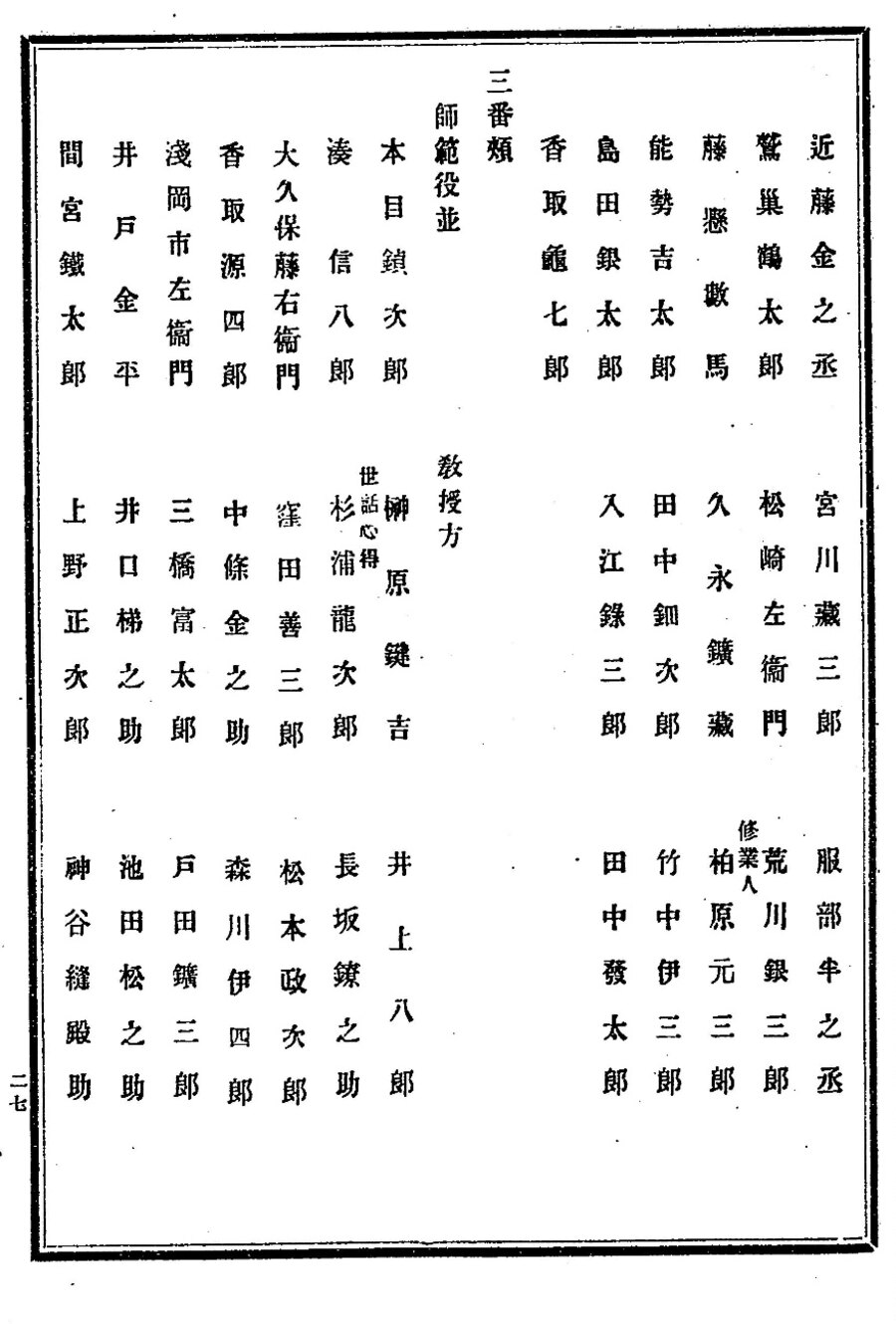 (opens in a new tab)
Rikugun rekishi, koma 128 (p. 27): 三番類, 教授方 榊原鍵吉.
Amano Shōshō
Amano’s card dates his appointment to the ninth month of 1863. He is accordingly absent from the registers of 1860 to 1862 and present in 1864, in the page shown above, with 二百表 beside his name: the two hundred hyō of the card. He is still a sword instructor in 1865, 1866 and 1867. Here a document from a private hand and a printed register agree on a man, a post, a stipend and a date, which is as much as one can ask of either.
How to repeat the search
Looking at a page
Every frame in the National Diet Library’s collection has a stable address and can be fetched as an image:
# frame 82 of pid 2547156, 2400 pixels wide
curl -o k0082.jpg \
  "https://dl.ndl.go.jp/api/iiif/2547156/R0000082/full/2400,/0/default.jpg"
If you fetch more than a page or two, wait several seconds between requests and run one job at a time. The pages used here were fetched five seconds apart.
Searching the library’s own text
For printed books in movable type, such as Rikugun rekishi, the library has machine-read text, and its site searches inside it. The text of a volume can be downloaded from the National Diet Library Digital Collections (opens in a new tab) as a zip archive holding one small text file per frame, named <pid>_<frame>.txt, alongside a .json file that gives the position of each line on the page.
# every line that contains the name, across the whole volume
unzip -p 988906.zip '*.txt' | grep '榊原鍵吉'

# which frames contain it
for f in $(unzip -Z1 988906.zip '*.txt'); do
  unzip -p 988906.zip "$f" | tr -d '\n' | grep -q '榊原鍵吉' && echo "$f"
done
Two habits matter more than the commands.
Join the lines first. The text follows the printed columns, and a name that runs over the end of a column is split across two lines. tr -d '\n' removes the breaks so that the name is whole again. In rosters such as these the characters of a name are also spaced out to fill the column, so allow for gaps:
unzip -p 988906.zip '*.txt' | tr -d '\n' \
  | grep -oP '.{0,15}男\s*谷\s*精\s*一\s*郎.{0,15}'
Search for the variants. Old and new character forms, and the machine’s misreadings, all have to be tried: 劍, 劔 and 剣; 將 and 将; 鍵 and 健; 總 and 総. A character class does this in one pass, and searching on the surname alone, then reading every hit, is slower but misses less.
unzip -p 988906.zip '*.txt' | tr -d '\n' \
  | grep -oP '.{0,10}天\s*野\s*[將将]\s*[曹曺].{0,10}'
The text is a finding aid. Every hit used above was then read on the page image, and several readings changed when it was.
Reading a page by machine
The woodblock registers have no text layer worth the name, and the pages have to be read by eye or by a model you run yourself. Two free ones are worth knowing.
The library’s own model for premodern books, NDL Koten OCR-Lite (opens in a new tab), runs on an ordinary computer:
git clone https://github.com/ndl-lab/ndlkotenocr-lite
cd ndlkotenocr-lite && python3 -m venv venv && source venv/bin/activate
pip install -r requirements.txt && cd src
python3 ocr.py --sourceimg k0082.jpg --output out    # or --sourcedir <folder>
It writes a .txt, a .json and an .xml for each image, which can be searched with the commands above. For printed Meiji and later books, Tesseract (opens in a new tab) with its vertical Japanese model does well:
mkdir tessdata && cd tessdata
curl -L -O https://github.com/tesseract-ocr/tessdata_best/raw/main/jpn.traineddata
curl -L -O https://github.com/tesseract-ocr/tessdata_best/raw/main/jpn_vert.traineddata
cd ..
TESSDATA_PREFIX=./tessdata tesseract k0127.jpg stdout -l jpn_vert --psm 5
How far to trust them: on the movable type of Rikugun rekishi either one gives text good enough to search. On the cursive of a bukan the results are poor. I ran the library’s model over all fifty-two openings of the 1863 pocket edition; it read the headings of the Gakumonjo and the Kaiseijo and little else, and it did not find the Kōbusho. The models are best used to decide which pages to read, and an AI assistant that can look at images is useful in the same way, to propose a reading that you then check against the page. Where a reading here is uncertain I have said so, and the links let you look for yourself.