A follow-up to my book From the Kōbusho to the Butokukai: Swordsmanship in Transition, and a companion to Finding Jikishinkage-ryū Swordsmen in the Bakufu Registers.
The Zoku Tokugawa jikki (続徳川実紀; “Veritable Records of the Tokugawa, Continued”) is the shogunate’s own chronicle of its last five reigns. It continues the Tokugawa jikki, which ends with the tenth shogun, and runs from Ienari to Yoshinobu. The bakufu’s compilers did not finish it. For the later reigns what survives is the working draft: the daily record of the castle, set down entry by entry with the appointments, rewards, audiences and orders of each day, and with the documents copied in. That makes it less a narrative than a register, and for anyone looking for a person it is the better for it.
It was printed in five volumes by the Keizai Zasshisha in 1905–1907. The volumes that cover the life of the Kōbusho are the fourth, the record of Iemochi (Shōtokuin-dono go-jikki 昭徳院殿御実紀), and the fifth, which carries Iemochi’s last years and the record of Yoshinobu (Yoshinobu-kō go-jikki 慶喜公御実紀). Both can be read at the National Diet Library: volume 4 (opens in a new tab) and volume 5 (opens in a new tab). The edition is in movable type, and the library’s machine-read text of it is good enough to search, provided one searches in the old character forms (奧詰, 遊擊隊, 劔術, 郞). How the text was fetched and searched is set out in a separate note on method.
An entry for an appointment has a fixed shape. Each man is listed with his existing post or company in small type above his name, the new post stands as a heading or in the closing formula, and the entry ends by saying in which room the order was read and by whom. A man who served a daimyō and not the shogun is entered as that lord’s retainer (家来).
The Kōbusho men made okuzume, 1861
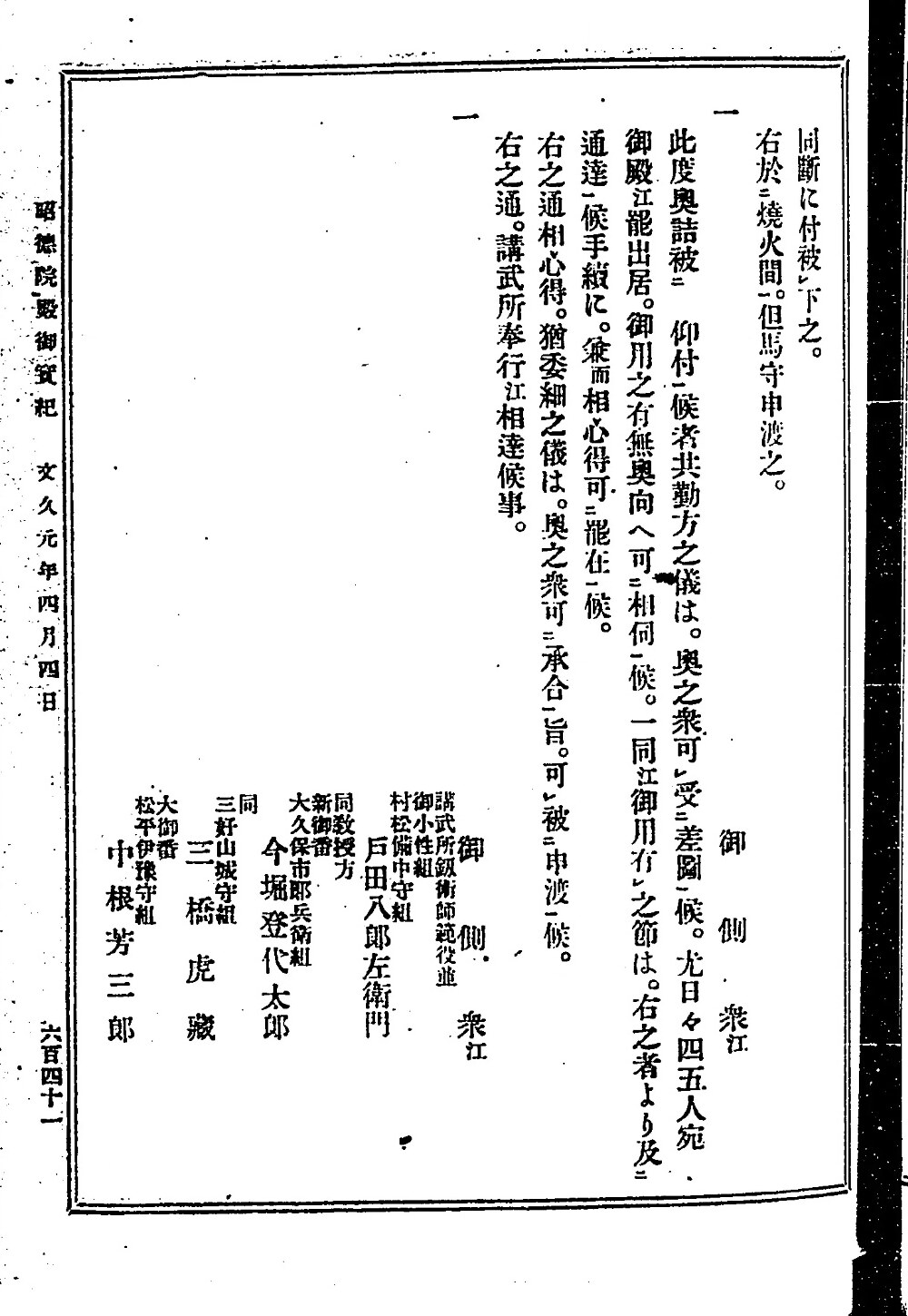
On the fourth day of the fourth month of Bunkyū 1 (13 May 1861) a body of Kōbusho men were appointed okuzume (奥詰; attendants on the inner side of the castle, in effect a personal guard). The order to the Kōbusho magistrates that goes with the list says that four or five of them are to be in attendance at the palace each day, taking their instructions from the men of the inner apartments.
 (opens in a new tab)
The order (此度奥詰被仰付候者共勤方之儀は…) and the head of the list. Volume 4, frame 327 (p. 641).
The list follows the arts in order, and within each art the grades: head instructor or associate (師範役並), instructor (教授方), assistant (世話心得) and trainee (修行人). The company each man belonged to is given here in parentheses.
Swordsmanship
- Associate head instructor (講武所劔術師範役並): Toda Hachirōzaemon Tadamichi (戸田八郎左衛門忠道; 御小性組 村松備中守組), a Tamiya-ryū man and a student of Kubota Sugane.
- Instructors (同教授方): Imahori Toyotarō (今堀登代太郎; 新御番 大久保市郎兵衛組), Mitsuhashi Torazō (三橋虎藏; 同 三好山城守組), Nakane Yoshisaburō (中根芳三郎; 大御番 松平伊豫守組), Minato Shinpachirō (湊信八郎; 小十人組 明樂八郎左衛門組), Sakakibara Kenkichi (opens in a new tab) (榊原鍵吉; 同 菅善右衛門組).
- Assistants (講武所世話心得): 小幡左衛門, 池田松之助 (御小性組 水野山城守組); 淺岡市右衛門, 坪內熊之助 (同 小笠原志摩守組); Mamiya Tetsujirō (間宮鐵次郎; 同 村松備中守組); 平岩七之助, 須藤兵庫, 神谷縫殿助 (同 平岡石見守組); 安部勝三郎 (御小性組 高井兵部少輔組); 近藤甚左衛門 (同 奥田下野守組); 鷲巢鶴太郎 (御書院番 德永伊豫守組); 前田主馬, 杉田勝太郎 (同 溝口讃岐守組); 大久保九郎兵衛, 金田英之助 (土屋備前守組); 榊原畝十郎 (新御番 松平織部組); 布施信三郎 (同 大久保市郎兵衛組); 大久保藤右衛門 (大御番 松平伊豫守組); 田代愛之助 (大御番 稻葉兵部少輔組); 三橋富三郎 (同 松平因幡守組); 戸田祐之丞 (同 近藤遠江守組); 澤隼之助 (小十人組 本田一學組); 速見三郎 (同 稻葉清次郎組).
- Trainee (講武所修行人): 加藤捨三郎 (御書院番 德永伊豫守組).
Spearmanship
- Associate head instructors (同鎗術師範役並): Takahashi Kenzaburō (高橋謙三郎; 御書院番 德永伊豫守組), the later Takahashi Deishū, Katō Heikurō (加藤平九郎; 新御番 松平織部組).
- Instructors (講武所教授方): 飯室孫兵衛 (御小性組 大久保甚右衛門組); 駒井鋼之助 (御書院番 曾我若狭守組); 山口辨藏 (同 溝口讃岐守組); 杉浦鐵太郎 (同 松平筑後守組); 勝顯三郎 (新御番 松下大學組).
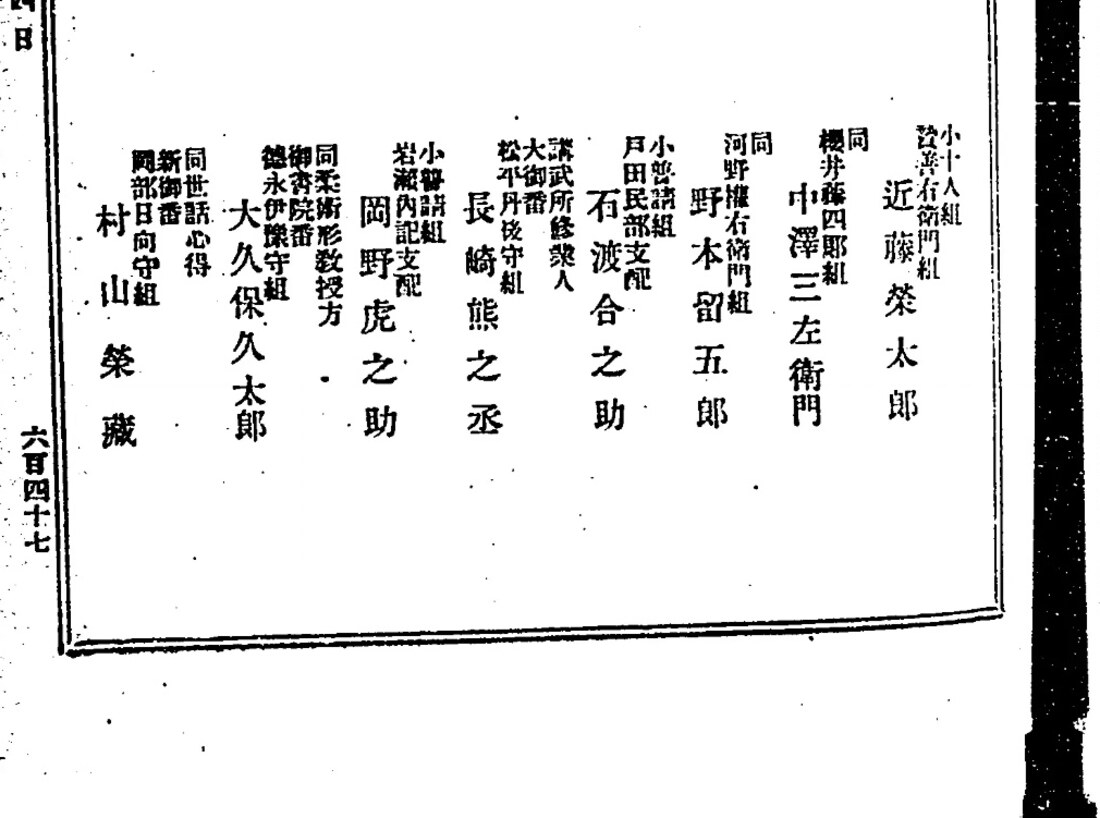
- Assistants (同世話心得): 川窪賢三 (御小性組 内藤肥後守組); 竹內新五郎 (同 齋藤攝津守組); 山本敬次郎 (同 平岡石見守組); 伴野金三郎 (御書院番 德永伊豫守組); 岩田半太郎, 木城安太郎 (同 久永石見守組); 加藤忠左衛門, 山崎健次郎 (同 高木伊勢守組); 內藤源助, 平岩爲三郎 (同 戸田隼人正組); 古川房次郎 (大御番 津田越前守組); 勝謙次郎 (同 近藤遠江守組); 矢部勝太郎 (小十人組 杉原平左衛門組); 近藤榮太郎 (小十人組 菅善右衛門組); 中澤三左衛門 (同 櫻井藤四郎組); 野本留五郎 (同 河野權右衛門組); 石渡合之助 (小普請組 戸田民部支配).
- Trainees (講武所修業人): 長崎熊之丞 (大御番 松平丹後守組); 岡野虎之助 (小普請組 岩瀨內記支配).
Jūjutsu
- Kata instructor (同柔術形教授方): Ōkubo Kyūtarō (大久保久太郎; 御書院番 德永伊豫守組).
- Assistant (同世話心得): Murayama Eizō (村山榮藏; 新御番 岡部日向守組).
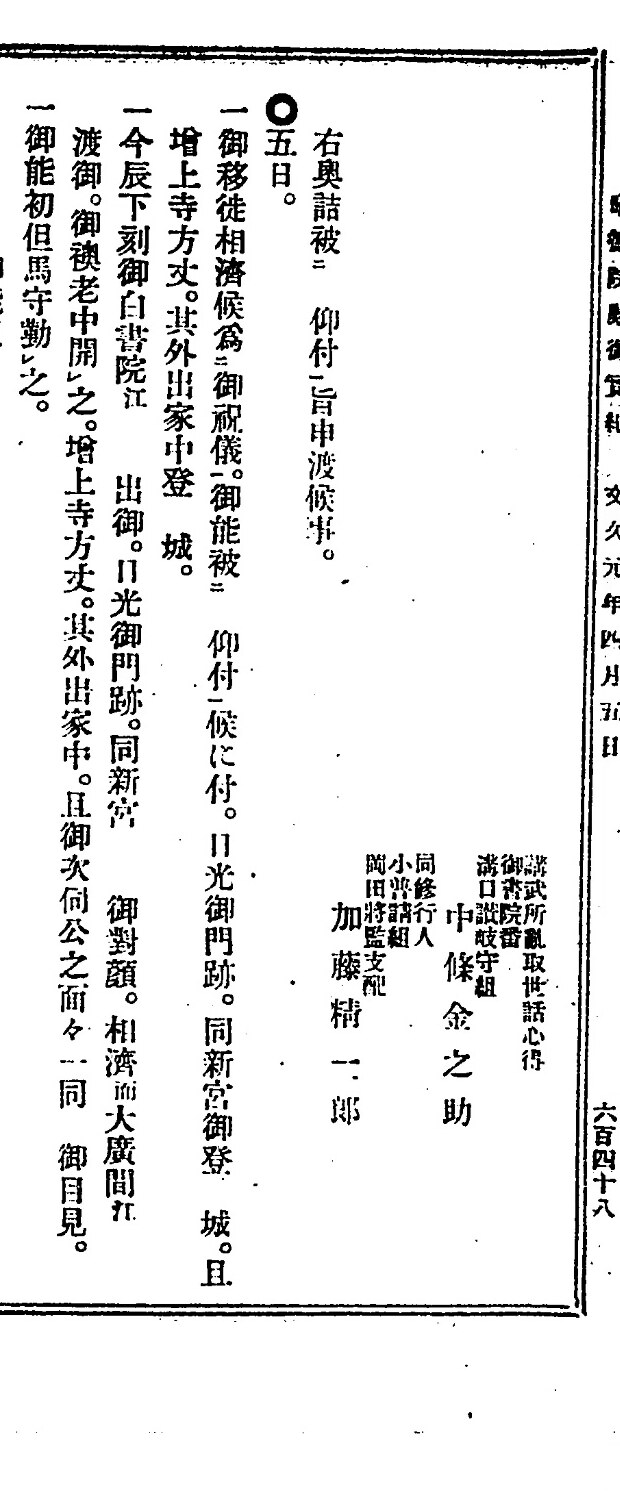
- Randori assistant (講武所亂取世話心得): Chūjō Kinnosuke (中條金之助; 御書院番 溝口讃岐守組).
- Trainee (同修行人): Katō Seiichirō (加藤精一郎; 小普請組 岡田將監支配).
The entry closes: 右奥詰被仰付旨申渡候事, “the above were informed that they are appointed okuzume.”
 (opens in a new tab)
Volume 4, frame 330 (p. 647). From the right: the last spear assistants, the two spear trainees, then 同柔術形教授方 大久保久太郎 and 同世話心得 村山榮藏.
 (opens in a new tab)
Volume 4, frame 331 (p. 648). 講武所亂取世話心得 中條金之助, 同修行人 加藤精一郎, and the closing formula.
Three things stand out. The jūjutsu division was a year old, and it is here as a complete small staff of four: an instructor of kata, his assistant, an assistant for free practice (randori), and one trainee. The trainee was made okuzume with his teachers, as the sword and spear trainees were. And every man in the list, the trainees included, is a direct retainer of the shogun, entered under the guard company or the reserve (小普請) he belonged to. The Kōbusho of this entry is an institution of the shogun’s own housemen.
The same four jūjutsu names stand in the roster of the Kōbusho printed in the Tōkyō shishi gaihen, which evidently drew on this entry or its source. The head instructors of jūjutsu, Suzuki Seibei (鈴木清兵衛) and Katayama Yajirō (片山彌次郎), appear in the chronicle the following year, and so does the end of the division: on the fifth of the ninth month of Bunkyū 2 jūjutsu practice at the academy was stopped along with archery and the dog-shooting, and on the sixth of the tenth month Totsuka Hikosuke (戸塚彦助), a retainer of Mizuno Dewa-no-kami who had served as chief of the instructors, was released with thirty pieces of silver and three robes for his trouble.
Men from the domains
Totsuka shows how the chronicle treats a man who was not a shogunal retainer. He is never given a guard company. He is “retainer of Mizuno Dewa-no-kami” (水野出羽守家来) each time he appears, from his audience in 1860 for skill in jūjutsu to his release in 1862.
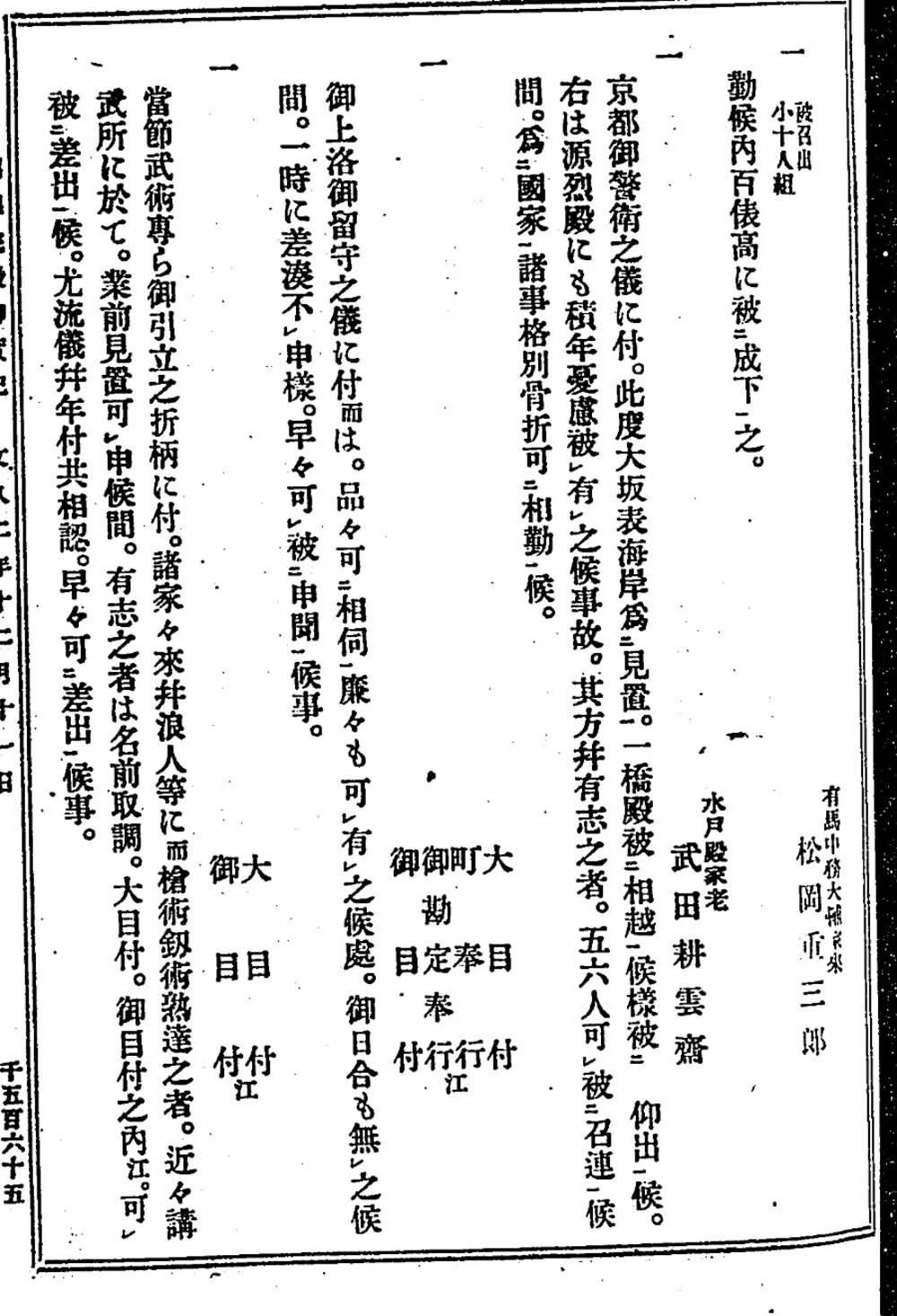
When such a man was taken into the shogun’s own service, that too was recorded, and the entry reads differently. A good example is Matsuoka Jūzaburō (松岡重三郎), a retainer of Arima Nakatsukasa-no-tayū of Kurume. He first appears on the last day of the eleventh month of Ansei 5 (1858), granted an audience because he and his father before him had studied and taught the proper wearing of court dress (衣紋). On the eleventh of the twelfth month of Bunkyū 2 (30 January 1863) he was called up:
 (opens in a new tab)
Volume 4, frame 795 (p. 1565). 有馬中務大輔家来 松岡重三郎: 被召出 小十人組, 勤候内百俵高に被成下之 ("called up into the kojūnin company; granted one hundred hyō for as long as he serves").
His name stands again, six weeks later, in the lists drawn up for the shogun’s journey to Kyoto. So the passage of a domain retainer into direct service left a dated entry with his lord’s name, the corps he entered and his stipend. The same page carries an order of some interest for the academy: at a time when the martial arts were being promoted, men of the daimyō houses and masterless men who were accomplished with the spear or the sword were shortly to be seen at the Kōbusho, and the names of those willing were to be collected.
Jūzaburō is one of several men of the surname Matsuoka in these volumes. The one who matters for the history of the academy’s circle is Matsuoka Yorozu (松岡萬), who appears on the fifth of the second month of Bunkyū 3 (1863) as a superintendent of the rōshi (浪士取締役) beside Yamaoka Tetsutarō, the two of them rewarded as the Rōshi-gumi set out for Kyoto.
The other Matsuoka listed are: Kazaemon (嘉左衛門), the head of a company of foot who retires in 1845; Tokutarō (徳太郎) of the Hakodate magistrate’s staff in 1861; Jūzaburō (重三郎; recorded here with 金, a common error) of kojūnin grade, sent ahead on the journey of 1863; Shōjirō (正次郎), a works official in 1866; and Bankichi (盤吉), a naval officer in 1868. Those are all the men of the name in volumes 3 to 5, which run from 1837 to 1868, with a gap in the later part of 1863. As but one example of how well attested figures can be, Jūzaburō was a court-dress officer (御衣紋方) who is found in 63 separate works, having served the Tokugawa until 1868. In later years he ran the affairs of the Wagaku Kōdansho and is found in diplomatic writings answering questions about dress and attire.