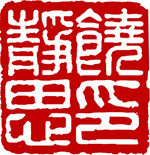
While reading through the front matter of the Meiji collected works of Takuan — Takuan Oshō Zenshū (沢菴和尚全集), ed. Ashin’an Setsujin, 1898 (NDL 1088656) — I came across a kirigami (切紙; a brushed slip) bound in at page 3, before the prose works begin. It is a small occasional poem, a jiin (次韻; matching-rhyme) quatrain, and it turns on a phrase that recurs around the Takuan material, so I set it down here as a diversion, in the same spirit as the Fu Dashi verse I noted earlier.1
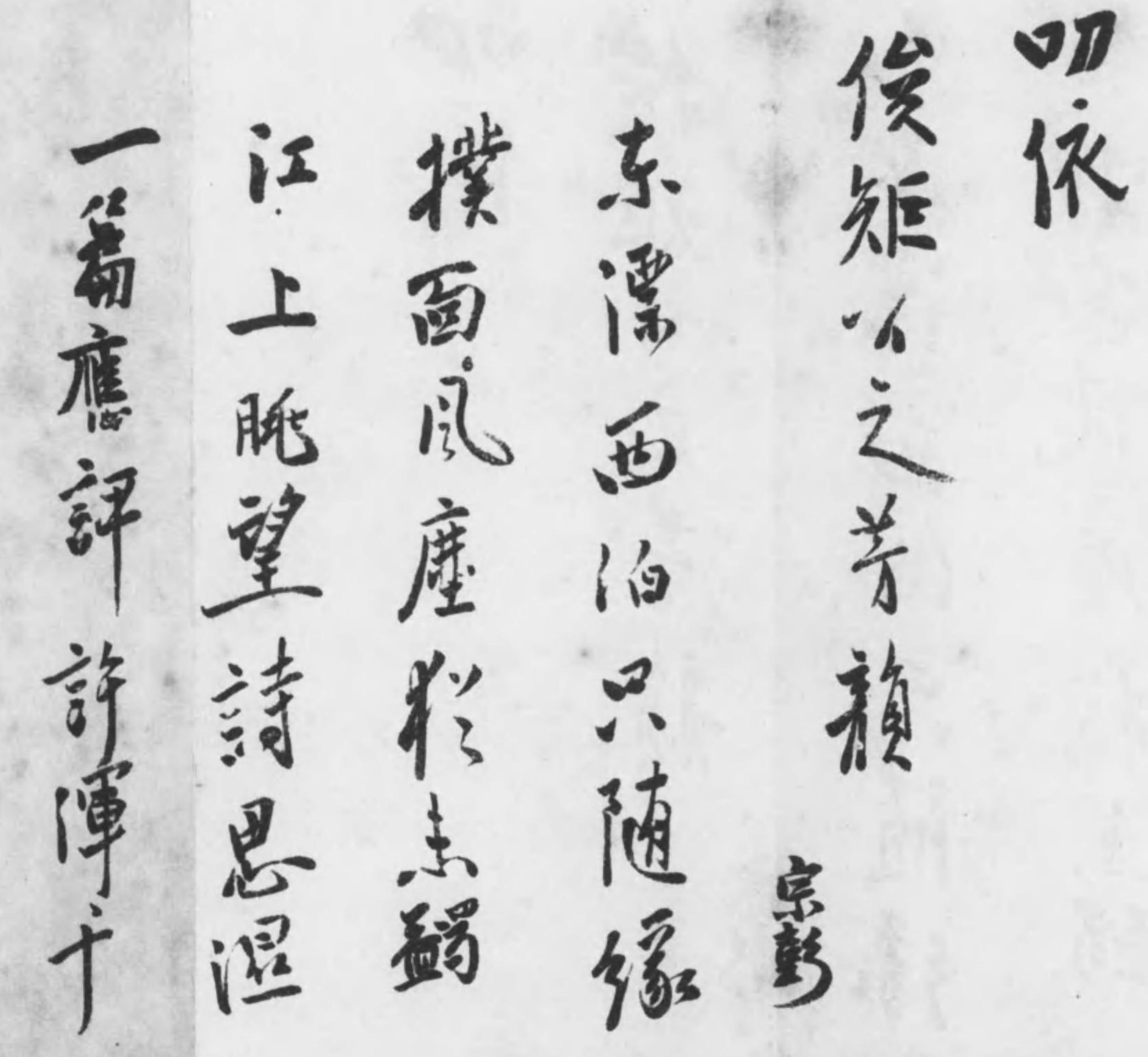
Kirigami slip, Takuan Zenshū (NDL 1088656) p. 3
The slip
東漂西泊只随縁
撲面風塵猶未觸
江上眺望詩思温
一篇應評許渾
Header and signature: kōi (叩依) — “humbly relying on / following” — then Shunku-kō no hōin (俊矩公之芳韻), “the elegant rhymes of Lord Toshinori (俊矩),” and the composer’s studio-name Kyōken (京軒). So the quatrain is a matching-rhyme response, written to the same rhyme-words as a (now-unlocated) poem by a Lord Toshinori.
A reading
Drifting east, mooring west — simply following conditions; the world’s wind and dust strike my face, yet never touch me; gazing out over the river, poetic thought turns warm; a single piece, fit for Xu Hun’s judgment.
Line by line:
- 東漂西泊只随縁 (tōhyō seihaku, tada en ni shitagau) — “drifting east, mooring west, only following conditions (en 縁; pratyaya).” Tōhyō seihaku is a self-characterization associated with Takuan — the wandering monk with no fixed abode — and tada en ni shitagau is the plainest statement of the zuien (随縁) attitude: accepting whatever conditions bring.
- 撲面風塵猶未觸 (men wo utsu fūjin, nao imada furezu) — “the wind-and-dust that strikes the face has yet to touch [me].” Fūjin (風塵; wind and dust) is the stock figure for the grimy world of affairs; the line is a fudō / non-attachment image — buffeted, but inwardly untouched.
- 江上眺望詩思温 (kōjō no chōbō, shishi atatakanari) — “gazing out over the river, poetic thought turns warm.” A turn from the abrasive world of the second line to the ease of the riverbank; shishi (詩思; poetic thought/feeling) warming is a quiet, contented note.
- 一篇應評許渾 (ippen, Kyokon no hyō ni ōzu) — “a single piece, fit to be judged by Xu Hun.” Xu Hun (許渾; Xǔ Hún, c. 791–858) is the late-Tang poet famous for his polished regulated verse and river- and-rain imagery; invoking him as arbiter is a conventional modest flourish — “such as it is, submit it to a master’s eye.”
The sensibility — drifting with conditions, dust that does not touch, closing on a poet’s ease — is thoroughly Chan, and consonant with the Takuan frame of the volume it prefaces.
Notes and open questions
This slip is a minor object and I read it as such, but a few points are worth recording:
- Reading corrections. The opening graph is kōi 叩依, not 以依 (the top character is 叩, “to knock / humbly,” not 以); the third line’s third graph is 塵 (dust), not 座; and the third line ends 詩思温 (warm), not 詩忠湿 — 思 for 忠, 温 for 湿, both confirmed on a higher-resolution scan.
- A trailing mark. Below 許渾 there is a small stroke (〔十/干?〕). Since 許渾 is complete as a name, I take this to be a colophon tick or the start of a signature rather than part of the poem, and leave it out of the text.
- Authorship is open — but the addressee now has a strong candidate. The quatrain is signed 京軒 (Kyōken) and matches the rhymes of 俊矩公, who is very plausibly Yagyū Tomonori/Toshinori (柳生友矩/俊矩, 1613–1639), Munenori’s son and Jūbei’s half-brother — buried at 芳徳寺, the Yagyū temple Takuan founded, and praised in the Yagyū house record as literarily gifted.2 That would make this a genuine Takuan–Yagyū-circle exchange preserved in the front matter, and raises (without settling) the possibility that 京軒 is a Yagyū-circle figure or a Takuan gō. The poem still does not appear in the anthologized Takuan verse I can find, so I stop short of asserting Takuan’s authorship; but the 御物語-adjacent 東漂西泊 topos plus a Yagyū addressee place it firmly in that world rather than in a later, unrelated one.
That a slip like this survives in the front matter, distinct from the prose works, is a small reminder of how these Meiji collected editions were assembled: not just the treatises, but the loose verse and occasional pieces that had gathered around a teacher’s name, bound in at the threshold.
End Notes
-
Provenance for the register: kirigami, Takuan Oshō Zenshū (沢菴和尚全集), Ashin’an Setsujin ed., 1898, NDL 1088656 p. 3. Front-matter verse zone (pp. 001–004, distinct from the Reirōshū body pp. 001–077 in the same digitization). Matching-rhyme (次韻) quatrain; signature 京軒; on the rhymes of 俊矩公. OPEN: identities of 俊矩公 and 京軒; whether Takuan-authored. See tsuki-no-sho corpus addendum §2 for the 東漂西泊 tag in the same corpus. ↩
-
Very probably Yagyū Tomonori / Toshinori (柳生友矩/俊矩, 1613–1639) — Munenori’s son (通称 左門/刑部; 従五位下刑部少輔) and Jūbei’s (三厳’s) younger half-brother, buried at 芳徳寺 — the Yagyū temple Takuan founded with Munenori, and the source of the 芳徳寺蔵本 Tsuki no Shō. The Yagyū house record Gyokuei shūi (玉栄拾遺) praises him as 「性質無双、文才に富み、又新陰の 術に長じ」 (of peerless nature, rich in literary talent, and skilled in the Shinkage art) — i.e. exactly someone whose 芳韻 (“elegant verse”) a poet would humbly match, in Takuan’s own circle. The reading wrinkle, stated plainly: the mainstream record reads his name 友矩 = Tomonori (左門/刑部). The 俊矩 (Toshinori) form — which matches the kirigami’s 「俊矩公」 — comes from the 本朝武林傳 (武術叢書) Yagyū genealogy, which is imperfect here (it also gives him the titles 主膳正/飛驒守 that actually belong to his brother 宗冬/Munefuyu). So the identification rests on the kirigami’s 俊矩 aligning with the 本朝武林傳’s variant 俊矩 against the standard 友矩 — a strong match (same person, same name-graph slot, right rank and literary reputation, Takuan’s temple) but via a variant form in an imperfect genealogy, not the standard record. 京軒 (who matched his rhymes) remains unidentified; if a Yagyū-circle figure or a Takuan gō, that closes it. — The earlier Kitanokōji Toshinori (1768–1832) and Azuchi-Momoyama 青木俊矩 guesses are rejected in favor of this. ↩