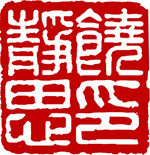
Kukishin-ryū is said to have been developed in Kumano Sanzan, but its history is wrapped up in well-researched forgery. There is a Taishō ultranationalist-spiritualist thread similar to others I have looked at. In this case, Deguchi Onisaburō of Ōmoto-kyo drew heavily on an apocryphal Kuki document, while the specific martial revival ran through Kuki Takaharu, descendant of the former Ayabe-domain Kuki lords. Kuki founded the Kōdō Sen’yō-kai (Imperial-Way Promotion Society) in 1921 and set up a budō section to spread what he called Kukishinden-ryū.
Kuki-family transmission presents itself as the martial art of the yamabushi of Nakatomi Shintō and Kumano Shugendō, founded by Kuki Yakushimaru Takazane, born a son of the Kumano Bettō house and a thirty-sixth-generation descendant of Fujiwara no Kamatari, who was granted the Kuki surname for rescuing Emperor Go-Daigo during the Nanbokuchō wars and wove the school from his house’s martial art, kami transmission, and esoteric-Buddhist mikkyō. The signature move — cutting the kuji and defending himself with the broken naginata shaft after its blade was struck off in 1336 — and its okuden forms are explicitly said to carry on the old mountain worship.
A related line even folds in the Kuramadera complex, fusing the Kuki naval heihō with the Tenshin Hyōhō transmitted at Kurama since Kiichi Hōgen. This is a common pattern of establishing pedigree.
In at least one line the bōjutsu’s technical roots are traced more prosaically not to mountains but to other warrior schools — Shintō-ryū long-sword and Araki-ryū. The Kuki family itself acknowledges this Ōkuni transmission as one of its recognized lines, noting that the twenty-fifth sōke learned the Ōkuni-den Kukishin-ryū and that the Edo transmission was not the only orthodoxy.
So, while inspired by Shugendō, Kukishin is an early Edo-period bōjutsu art attributed to Ōkuni Kihei Shigenobu and related to a line of Yōshin-ryū that became Hontai Yōshin-ryū. But it draws heavily on Shugendō in its own origin making and identity.
There has been a great deal of academic study, establishing its source documents as twentieth century forgeries.
The Kuki family’s ancient claims rest on the same textual corpus as the Kuki monjo — the Kukami monjo, one of the koshi-koden, a forgery asserting the legitimacy of an ancient Izumo dynasty, supposedly recorded in kami-yo script by the Kuki ancestor Ame-no-Koyane and rendered into kanji by Fujiwara no Fuhito.
Academia is uniform here: the koshi-koden are treated wholesale as forgeries with no source value, and the corpus including the Kuki document is regarded as recently created. The connection to the ryūha is not loose — the “Amatsu Tatara” is part of the Kuki document group, and the Kukishin jūjutsu system is itself said to be recorded in the thirty-four-scroll Amatsu Tatara compilation, so the martial densho and the forged ancient history share the same textual frame.
It is true, however, that the Kuki family is from Kumano, a Shugendō heartland. Sakamoto (in his work that won the 2007 Japan Society for the Study of Mountain Religion prize) establishes that the Kumano bettō house is solid, well-documented history, but his subject is the bettō organization and its political lineage, not a martial line, so it corroborates the setting of the Yakushimaru Takazane claim without corroborating the claim itself.
The unsupported step is from family to yamabushi ryūha. Shugendō complexes held militia but produced no codified ryūha, so a Kumano-yamabushi derivation functions as prestige attachment rather than institutional descent. Here the charter happens to rest on a forged document corpus and a Taishō nationalist revival.1
End Notes
-
This tradition insists the 鬼 in Kuki be written with a special glyph lacking the top stroke and read “Kukami” rather than “Kuki.” That variant-graph move to mark a more archaic, sacral reading is likely a prestige-borrowing device. ↩