An excerpt from my book Shugendō and Heihō (Mountain, Sword, and Mind Volume I).
Haguro (羽黒) means “black wing” — it alludes to the giant yatagarasu (八咫烏; eight-span crow), an important symbol in Japanese mythology. Yatagarasu is associated with divination and divine guidance, and is sometimes depicted with three legs; one common (and relatively late) interpretation reads the three legs as the ten-chi-jin (天地人; the three powers of heaven, earth and humanity). In Chinese mythology, the three-legged crow is said to dwell in the sun (日; sun).
Haguro Shugendō
Shugendō had a strong philosophical influence on many classical Japanese martial arts. Despite that fact, martial practice was generally the purview of the bushi and gōshi (郷士; rural samurai). There are very few yamabushi-related martial traditions surviving in Japan. Today, people will sometimes attempt to use mountain religion as a backstop for their practice because of its poetic allure (taking refuge in the mountains) and also because there is not as much public information available in English compared to other Japanese religions such as well-known Shintō shrines or Buddhist complexes.
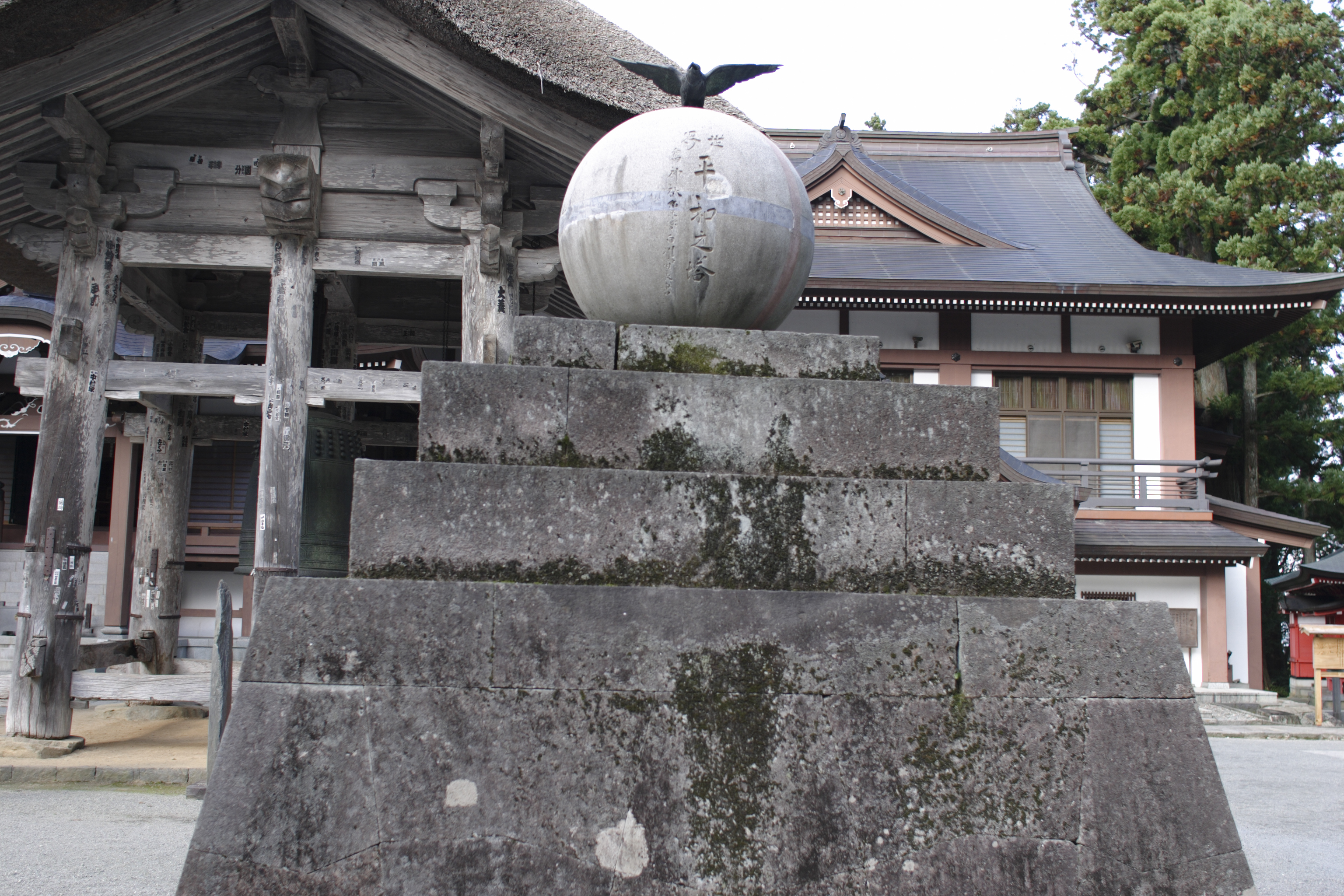
The Sanjin Gōsaiden (Dewa Jinja) on Mt. Haguro
In the case of Haguro Shugendō, Hagurosan Shugen Honshū (羽黒山修験本宗) is the postwar institutional continuation of Haguro Shugendō, whose head temple (honzan) is Kōtaku-ji (荒澤寺) in Tsuruoka, Yamagata Prefecture, with Shōzenin (正善院) as its administrative head temple (honbō). It was made independent in 1946 (Shōwa 21) by Shimazu Dendō, inheriting the tradition maintained at Shōzenin through the Meiji disruption.(Wikipedia contributors, n.d.) According to the Shōzenin temple’s website, the head temple of Haguro had been the Tendai Jakkō-ji (寂光寺; now part of Dewa Sanzan Jinja) until the end of the Edo period.(Hagurosan Kōtaku-ji Shōzenin, n.d.) After the Meiji shinbutsu bunri, the functions of the temple side passed to Kōtaku-ji (荒澤寺) and its administrative office Shōzenin (正善院). Much has been written about the Akinomine (秋の峰; autumn peak entry). It is a well-documented and important practice in Haguro Shugendō, and there are multiple retreats conducted by Buddhist-affiliated, Shintō-affiliated and independent revival groups today.
The bettō of Haguro during the Meiji transition is said to have been a man named Kanda (官田), who became the shrine priest (shashi, 社司) and took the name Haguro Uzen (羽黒羽前). The first gūji (宮司; head priest) installed at Dewa in 1873, when Buddhism and Shintō were split and Shugendō banned, was a young Hirata-school nativist scholar named Nishikawa Sugao (西川須賀雄), who drove what must have been a very disruptive radical de-Buddhicization of Haguro before leaving in 1876. (Gotō Takeshi 1999)(Wikipedia contributors, n.d.)
Haguro-ha Shugendō generally traces its founding to Nōjo Shōja (能除聖者), identified with Prince Hachiko (opens in a new tab) (蜂子皇子; traditionally c. 542–641), son of Emperor Sushun. After his father’s assassination by Soga no Umako in 592, the prince is said to have fled north and opened Mt. Haguro, Mt. Gassan, and Mt. Yudono as sacred sites for mountain practice.(Dewa Sanzan Jinja, n.d.) This identification is better treated as a later regularization than as an early datum: the early-Edo Hagurosan engi does not name Hachiko, and his role as founder was foregrounded only after the Meiji shinbutsu bunri replaced the gongen with a recorded human opener.(Wikipedia contributors, n.d.) Hachiko is figured prominently on Mt. Haguro, where the Hachiko Jinja (蜂子神社) stands beside the Gōsaiden.
The core source for the Shugendō ritual apparatus is the 1920 Nihon Daizōkyō, Shugendō shōsho (日本大蔵経 修験道章疏), the three-volume canon (hereafter SGD; Vol I = NDL 952642, Vol II = 952662, Vol III = 952663), cited by volume and koma (齣) — the NDL digitized-frame number, which is stable across the online scans and is what a reader needs to reach the leaf, though it differs from the printed folio the scan reproduces.(Nihon Daizōkyō Hensankai 1920)
Five separate sendatsu registers in the SGD that are Kumano-centric attribute Haguro’s founding not to Hachiko no Ōji but to a figure named Kokuchin, a Dewa man in the Ōmine transmission, who was said to be born in Tenpyō 13 (741), conducted Ōmine practice and received engi transmission in Enryaku 4 (785) at 45, Kumano Gongen enshrined in Dewa, died Kōnin 1 (810) at 70 — 「黑珍。出羽國人。羽黑山開基」. The five are 踏雲錄事 (SGD, Vol III, koma 125, pp. 234–235); a Hiko-related blood-lineage section (koma 164, pp. 312–313); a chronological sendatsu register (koma 174, pp. 332–333); the Genjōroku abstract (koma 176, pp. 336–337); and 證菩提山等緣起 (koma 192, pp. 368–369), which places 「出羽興黑珍持經者」 in a jikyōsha succession.
The two founder traditions never touch in the collated text. The Haguro-side documents (the kechimyaku, the Kojitsu shūranki) run a line through Hachiko (Nōjo Taishi) and the Sushun imperial line, while the Ōmine Honzan-side registers run it through Kokuchin, whose whole significance is that he received the Ōmine transmission and brought it north. Each corpus is internally consistent and neither acknowledges the other. Anyone reading only one half of the compendium would come away with a different story.
The Kojitsu shūranki (Haguro sanzan kojitsu shūranki 羽黑三山古實集覽記) is not a neutral record but a litigation brief. It is signed 酉八月 (the eighth month of a Rooster year) by the hōin of the Yakuju-in, Kezō-in and Kejō-in (藥樹院・華藏院・化城院法印) and a 北之在廳, its internal date computations resolve to Kansei 1 (1789), and it was prepared for renewed litigation some 120 years after the judgment it contests; what is drawn from it below is that party’s account.
The kechimyaku version (SGD, Vol III, koma 221, pp. 426–427) is careful in a way worth noticing. It relates that Hachiko no Ōji (蜂子皇子), son of Sushun, tonsured at Shōtoku Taishi’s urging in Bidatsu 14 (585), dharma name 弘海, gō Nōjo (能除); lands at Yura beach in Suiko 1 (593), is led east by a bird under five-coloured clouds, ascends the mountain on the eleventh day of the sixth month. Gassan appears in the same period, Yudono in Suiko 13 (605). But the text explicitly denies that he created anything, stating “the three gongen were enshrined in the age of the kami”1 and “what was lacking was recognition”2. The founder claim is thus a revelation claim, and immediately anchored to an external authority as “Listed in the Engishiki (ancient Japanese legal code). One of the nine shrines in Dewa Province. Dewa Shrine, Tagawa District.” 3 Hachiko is in that account said to have died in Jomei 13 (641), aged 90, after 49 years on the mountain.
The Kojitsu shūranki extends this in four directions, each doing institutional work:
- Naming (SGD, Vol III, koma 233, p. 444). The three peaks were anciently 皇納賀原 (Kōnōgahara), with imperial plaques granted at Keikō 21 and Bidatsu 4 — i.e. before Hachiko. Then 「其後開山能除太子八咫の烏を路しるへと成し。三山路踏分候故。烏の羽色を以て三山總而羽黑と名く」. The whole point is that “Haguro” is the collective name and Gassan and Yudono are 小名 (sub-names) within it.
- The name Nōjo (koma 237, p. 452), from nōjo issai ku (能除一切苦; “able to remove all suffering”) in the Heart Sūtra, tied to his own disfigurement and suffering — 「醜陋の御姿自を以て他を量り」 — and thence to the leprosy cures claimed at Haguro.
- Territory (koma 234, 239; pp. 446, 456). Twelve districts of Ōshū granted by Suiko; and the etymology 「羽黑より出る國と申事にて。出羽國と號之」. That is transparent back-formation and should be read as a rhetorical move, not evidence.
- Office (koma 234, p. 446). Since Suiko-era sōgō (僧綱; the official clerical hierarchy) ranks had no category for it, 弘俊 petitioned on the grounds of Sushun’s connection and was granted the 執行位 in Suiko 5 — the founding charter for the title actually at issue in 1789.
The cosmological layer (koma 237–238, pp. 453–455) is separate and likely a later grafting. Quoting the Taiseikyō (大成經), its Jinja hongi (神社本記), and the Wakan sansai zue (和漢三才圖會), book 65: Japan as a two-headed dragon-body, 「東頭名羽黑彥大神」 with 湯殿主大神 the western head and Tsukiyomi on the spine as Gassan; the three-legged crow crowns the eastern head and 「其三足卽ち三山にて。胎金合之三部」. An alternative Ōkuninushi / Sukunahikona / Kuebiko triad follows. Here also the aggressive move against Kumano: 「熊野權現異國より倭國へ光來の砌り。鎭の地無之。最初暫此羽黑彥神社へ致寄寓候」, whereupon Haguro assigned Kumano the western thirty-three provinces and handed over the crow goō seal — so Kumano’s talisman derives from Haguro, and its New Year’s fire rite is a copy of Haguro’s. Then: 「役の行者も熊野三山修行雖有之.爲本山間先此羽黑三山へ來被致修行候」.
The Ōmine-side registers (SGD, Vol III: 踏雲錄事, koma 125, pp. 234–235; koma 164, 174, 176, pp. 312–313, 332–333, 336–337; 證菩提山等緣起, koma 192, pp. 368–369) make Haguro’s founder Kokuchin (黑珍), a Dewa man whose significance is precisely that he received the Ōmine engi transmission and brought it north. Haguro’s own brief inverts the vector: it was Ōmine’s founder who instead came to Haguro first. Neither historical corpus acknowledges the other, and the 1920 volume prints both without comment.
Other important founding figures in Shugendō, like En no Gyōja and Shōbō (聖宝) – Rigen Daishi (理源大師 (opens in a new tab)) – lived near Nara and Kyoto and are not associated with Haguro-ha Shugendō, but remained venerated by Honzan-ha and Tōzan-ha practitioners who had a presence on the three mountains during the Edo period. For example, Ono-ryū (小野流) is the line of Shingon practice said to have been founded by Shōbō at Daigo-ji on Mt. Kasatori; it is not the family name of a line of Haguro-ha Shugendō practice in Dewa, but could plausibly have been represented as Shingon Shugendō on Mt. Yudono. Haguro Ichi-ryū is the name used to refer to Haguro practice during the Edo period – it was not a ryūha in the martial sense of the word. Instead, the term ichi-ryū is being used as an early-modern reference meaning “our tradition” or “this one lineage”. We also see reference in the SGD to Haguro ippa (羽黑一派; Haguro one branch) used interchangeably with Haguro Ichi-ryū.
Yudonosan was administered by four Shingon temples. In the Kan’ei era these “four Shingon temples” (Dainichibō/Ryūsuiji, Chūrenji, Hondōji, and Dainichi-ji) jointly erected the hōkyōintō (宝篋印塔; a stūpa-form reliquary) on Dainichibō’s grounds.(Dainichibō, n.d.) Which of them was the lead temple is contested among their individual narratives. The surimono’s colophon (analysed below) styles Dainichi-ji as shō-bettō (正別當; principal administrator), the standard account names Hondōji as principal, and Dainichibō styles itself Yudonosan sōhonji (湯殿山総本寺; head temple) and, with Chūrenji, credits Kūkai rather than Hachiko no Ōji as founder.(Wikipedia contributors, n.d.) So three of the four temples assert some form of primacy, and the foundation legend splits on sectarian lines.
The very notion of Dewa Sanzan as a group is itself in flux, in terms of the priority given to different mountains in the area. In the Edo period, Tendai groups headquartered on Mt. Haguro called the area Haguro Sanzan, and Shingon groups headquartered on Mt. Yudono called it Yudono Sanzan.
Dewa Area Tengu
Hagurosan Konkōbō (羽黒山金光坊) is the tengu assigned to Haguro in the Tengu-kyō (天狗経), the Edo-period esoteric (mikkyō) invocatory text that enumerates the so-called forty-eight tengu (四十八天狗). In the standard list it sits between Nikkōsan Tōkōbō (日光山東光坊) and Myōgisan Nikkōbō (妙義山日光坊).(Author unknown n.d.)(Wikipedia contributors, n.d.) A second, locally circulated figure is Hagurosan Sankōbō (羽黒山三光坊), described as the daitengu (大天狗; great tengu) governing the tengu who protect the three mountains and their practitioners, with an attendant (kenzoku, 眷属; familiar) named Enkōbō (円光坊), unusually classed as a “water tengu” (suitengu, 水天狗) said to guard the pilgrim boats on the Mogami River (最上川). The relationship between Konkōbō and Sankōbō is genuinely unresolved in available lore; they may be two aspects of a single figure or a true pair. There is also a folk identification of Sankōbō with Hachiko no Ōji (蜂子皇子), the legendary founder of Dewa Sanzan, holding that the founder became the mountain’s great tengu — though this rests on a single popular source and should be treated as devotional rather than documented.(Fushigi na Chikara 2015)
Akiha Sanjakubō (秋葉三尺坊) — the famous fire-prevention daitengu — is not a Haguro tengu, despite the near-homophony with Sankōbō. His tradition makes him a Shinano-born shugenja of the Tochio Zaōdō (栃尾蔵王堂) in Echigo (越後; present Niigata), where it places his ascetic transformation, with a later descent onto Akihasan in Tōtōmi, where he kept a thousand-day retreat and practised the fire-samādhi rite (火生三昧).(Ishida Tetsuya (石田哲弥) 2011)(Ishida Tetsuya (石田哲弥) 2016) He appears in the same Tengu-kyō list under his own mountain.(Wikipedia contributors, n.d.)
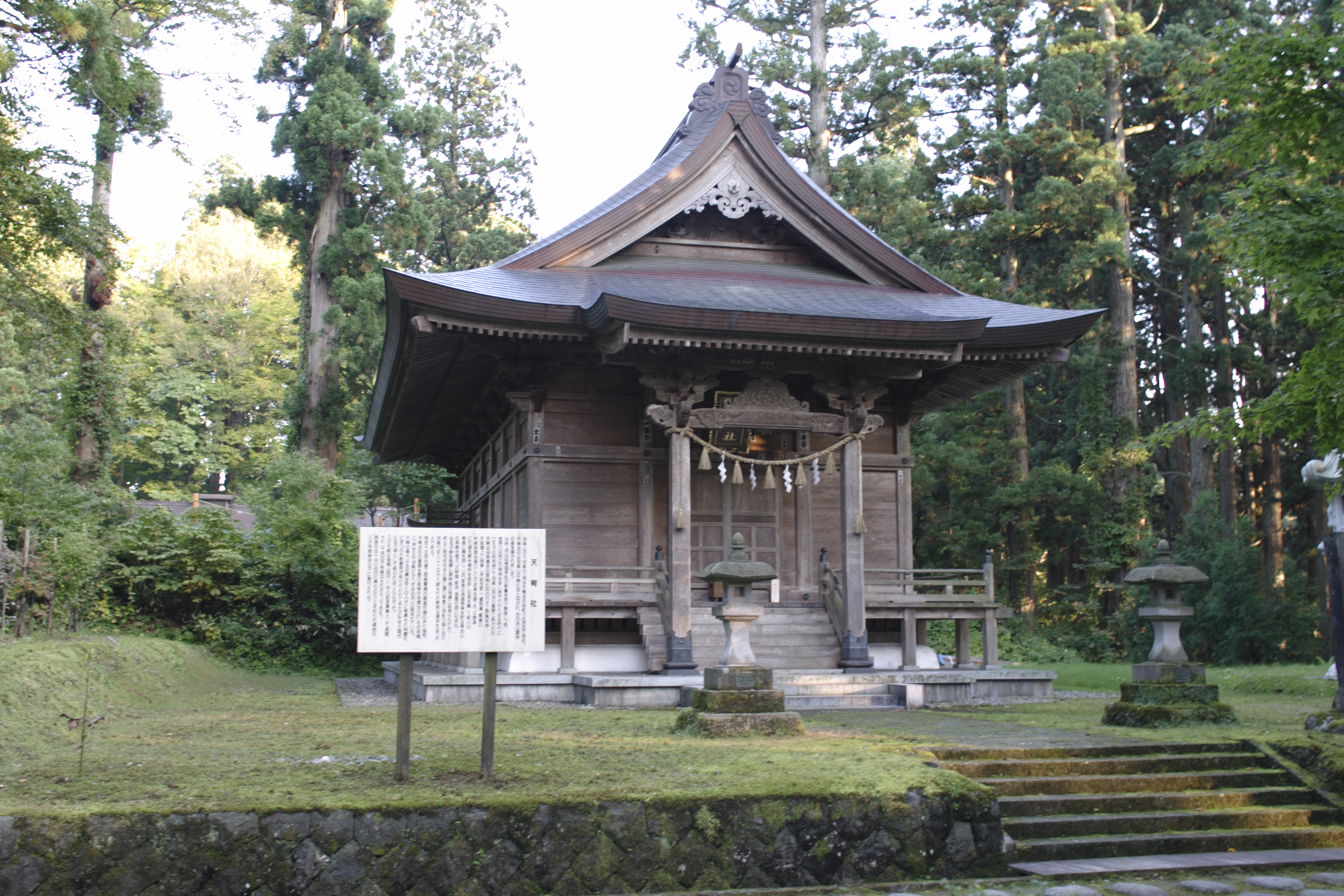
Tenyū-sha (天宥社) shrine on Mount Haguro (1992) dedicated to Tenyū Betto, a monk who played a crucial role in restoring Mount Haguro.
Comparatively-named tengu attached distinctly to Gassan (月山) or Yudonosan (湯殿山) are not as easily found. The Tengu-kyō (天狗経) itself is a late, apocryphal invocatory text (an Edo-period mikkyō-style kaji liturgy, not a canonical sūtra), and its transmission is correspondingly loose. It is not among the texts of the Shugendō canon (SGD) on which this book draws. That canon is most accessible in the Kokusho Kankōkai reprint: Shugendō shōsho in three volumes plus a separate kaidai (解題; bibliographic-commentary) volume edited by Miyake Hitoshi, published by Kokusho Kankōkai in 2000.(Nihon Daizōkyō Hensankai 1920)(Miyake Hitoshi 2001)
The gongen of the three mountains
The honji-suijaku (本地垂迹) structure has each mountain’s kami venerated as a gongen (権現; “provisional manifestation”), understood as the local trace (suijaku) of an “original-ground” buddha (honji-butsu, 本地仏).
Dewa Sanzan Jinja’s own account frames this through Sueki Fumihiko’s typology of kami–buddha subordination and cites Togawa Anshō’s Shinpan Dewa Sanzan Shugendō no kenkyū for the interpretive claim that the practitioner experiences the deities’ efficacy as ōgen (応現), formless and omnipresent yet visible only to the believer.(Dewa Sanzan Jinja, n.d.)(Sueki Fumihiko, n.d.)(Togawa Anshō 1973)
Work by Togawa Anshō (戸川安章) — the foundational scholar of Haguro Shugendō — specifically Dewa Sanzan Shugendō no kenkyū (Kōsei Shuppansha, 1973) and its revised edition, and Dewa Sanzan to Tōhoku Shugen no kenkyū, are sources with further information.(Togawa Anshō 1973)(Togawa Anshō 1978) Roughly:
-
Hagurosan (羽黒山) — honji Shō Kannon (聖観世音菩薩; Skt. Avalokiteśvara, the bodhisattva of compassion), assigned to the present (現世). The site’s deity is Ideha-no-kami, honji Shō Kannon; the institution was the Tendai temple Jakkō-ji, a branch of Rinnōji. After the Meiji separation of kami and buddhas the kami was reframed as Ukanomitama-no-Mikoto (identified with Ideha-no-kami).
-
Gassan (月山) — honji Amida Nyorai (阿弥陀如来; Skt. Amitābha), assigned to the past and to ancestral spirits. Its honji is Amida Nyorai; the mountain was held to be where ancestral souls gather, and its bettōji was the Tendai temple Nichigatsuji at Iwanesawa. The post-Meiji kami is Tsukuyomi-no-Mikoto.
-
Yudonosan (湯殿山) — honji Dainichi Nyorai (大日如来; Skt. Mahāvairocana), assigned to the future / rebirth. Its honji is Dainichi Nyorai, with the suijaku kami Ōyamatsumi-no-Mikoto, and the goshintai is a hot, reddish-brown spring-rock — the “speak not, hear not” object — making it the okunoin (innermost sanctuary) where yamabushi sought sokushinbutsu (即身仏; living buddhahood).
Unlike the two Tendai mountains, Yudonosan’s bettōji were four Shingon temples — Hondōji, Dainichibō, Chūrenji, and Dainichi-ji — with Hondōji as the principal administrator (shō-bettō). Its enshrined kami are given as Ōyamatsumi, Ōnamuchi, and Sukunahikona.(Dewa Sanzan Jinja, n.d.)(Haguro-machi Kankō Kyōkai, n.d.)
The traversal logic binding them is the sankan-sando (三関三渡): moving through Haguro (present), Gassan (past), and Yudono (future) as a passage through three “barriers,” conceived as a rebirth pilgrimage rather than mere geography. Yudono future/rebirth–Dainichi assignment is the doctrinal seat of the sokushinbutsu tradition at Dainichibō and Chūrenji — a thread that connects the gongen framework directly to material practice.
Membership of the triad is not however historically stable:
-
In the medieval reckoning Yudonosan was the sō-okunoin (総奥の院; overall inner sanctuary) and the “three mountains” were Gassan, Hagurosan, and Hayama — or alternatively Chōkaisan. In that older scheme the future/Yakushi position was held by Hayama or Yakushidake, with Hayama and Yakushidake assigned Yakushi Nyorai (薬師如来; Skt. Bhaiṣajyaguru) (future), while Yudono’s Dainichi was figured as transcending the three barriers altogether rather than occupying one of them. Yudonosan’s promotion into the modern triad, displacing Hayama/Chōkai, is itself a datable shift.(Haguro-machi Kankō Kyōkai, n.d.)
-
The gongen sit inside competing institutional claims. The Tendai-aligned mountains (Haguro, Gassan) were historically the “Haguro Sanzan,” and the Shingon side the “Yudono Sanzan,” reflected in the obsolete names Haguro-sanzan and Yudono-sanzan. Beyond the indigenous Haguro-ha — which fused Gassan ancestral-spirit belief — Tōzan-ha and Honzan-ha practitioners also operated at Dewa Sanzan, and these credited the founding to Kūkai or En no Gyōja rather than to Hachiko no Ōji; the Kūkai foundation (the shining leaf bearing the Dainichi mantra borne down the Bonjigawa) is the Shingon Yudono-ha’s account. So which founder, and by extension which honji emphasis, itself differs across sects.
Relationships among the three mountains
In doctrinal ranking (koma 233, 235; pp. 444, 449), Ōmine is Vajradhātu, 「始覺果滿の山」; the Haguro three are Garbhadhātu, 「本有法身の山」. Internally, Akuya/Akoya (阿久谷 — Haguro proper), Gassan and Yudono form the three stages of the sankan-sando (三關三渡) scheme, and therefore 「開山太子羽黑口より次第の修行被遊候に付。以來羽黑表口と定り來り候」.
In the division of practice (koma 231, p. 442), Haguro and Gassan are the mountains of fushaku shinmyō (不惜身命; not begrudging body or life) austerity; Yudono is where attainment is realised, hence its cave is 「自然本來の眞相好」 and 「人力人作手入等不相成是神都の制律に御座候」. This turns Hondōji and Dainichiji’s stone paving of the Jōdo-guchi approach into a violation of the mountain’s constitution rather than a mere trespass — 「右修驗山の制律を破り。我意不屆」.
Seasonally (koma 232, p. 443), because Gassan and Yudono are snowbound from the eighth month to late third, the spring, autumn and winter peaks are performed at the Haguro sōsha; only the summer peak traverses all three. Winter peak opens 9/20 with two matsuhijiri (松聖) dividing the sixty-six provinces (ijō 位上 for the upper thirty-three, sendo 先途 for the lower), and closes on New Year’s Eve with the great torch and the ijō/sendo contest. Kumano Sansha is enshrined inside the sōsha because Ōmine-line practitioners also enter here.
The seven gates (koma 229–230, pp. 440–441) are given foundation dates with a Haguro supervisor attached to each: Shimekake (注連掛) Tenchō 10/833 (under Satsuma-bō), Dainichibō (大日坊) Ninju 2/852 (under Kezō-bō), Ōisawa Daizōbō (大井澤大藏坊) Ōei 2/1395, 臂折阿呼院 Meitoku 1/1390, 岩根澤日月寺 Kakyō 1/1387, plus the Arasawa-guchi (荒澤口) and Haguro-guchi (羽黑口) — 「是と右五口井羽黑口是を古來の七口と申候」. Hondōji (本道寺; Daiei 5/1525) is excluded: 「本道寺口は往古七口の內には無御座候」, admitted only because pilgrims found it convenient, 「漸二百六十年來の寺院遂に七口の內に申習候事」.
The sectarian split (koma 231, p. 442) began with Tenyū’s Kan’ei conversion of the mountain to Tendai under Tenkai; Iwanesawa and Ahō-in complied, the four temples refused. So in this account the four temples’ Shingon identity is the residue of a refusal, not an ancient charter. And the Kanbun judgment is parsed narrowly (koma 235, pp. 448–449): 「寛文年中。御裁判狀は別當論には無之。只法流の御裁許に御座候」 — a ruling that Yudono’s hōryū be Shingon, silent on the bettō office, which the four temples have inflated into a claim of 正別當. The document then presses on the Hondōji goshuin: if the grant was to one temple only, the other three cannot derive 正別當 from it — 「本道寺のみ正別當と申事にして。餘三ヶ寺正別當所以無之候」 — and predicts Hondōji will eventually turn on its own allies.
Dewa Sanzan Museum Holdings
The Dewa Sanzan History Museum (出羽三山歴史博物館), which sits in the Hagurosan precinct, contains tengu carvings and calligraphy associated with the shrine. The two scrolls below function as a matched pair — the kami-side title and the Buddhist-side invocation, both from the Tendai-aligned (Haguro) pole at Dewa.
Both works are single vertical columns of large semi-cursive characters, and both are 御筆 (gohitsu; “from the brush”) of the Tendai zasu Jōshin hosshinnō (承真法親王, Kajii-no-miya, 1787–1841). The museum cards both read 天台座主梶井宮承真法親王御筆 — “by the brush of the Tendai zasu (座主; head abbot), the Kajii-no-miya Prince-Monk Jōshin.” Jōshin (承真法親王) served repeatedly as Tendai zasu (the 218th, 220th, 222nd, and 224th incumbencies) and was a son of Arisugawa-no-miya Orihito-shinnō. His dates are 1787–1841, and he carried the childhood names Kuni-no-miya and Naga-no-miya. That places both calligraphies in the late Edo period (Bunka–Tenpō, c. 1810s–1841).(Wikipedia contributors, n.d.)(Reichsarchiv, n.d.)
The reading “Jōshin” for 承真 follows the usual convention for 承- monastic names but is not furigana-confirmed here. For provenance: the Arisugawa house was the home of the Arisugawa-ryū (有栖川流) calligraphic school, so a brush-piece by an Arisugawa-born prince-monk sits inside a recognized court-calligraphy lineage.
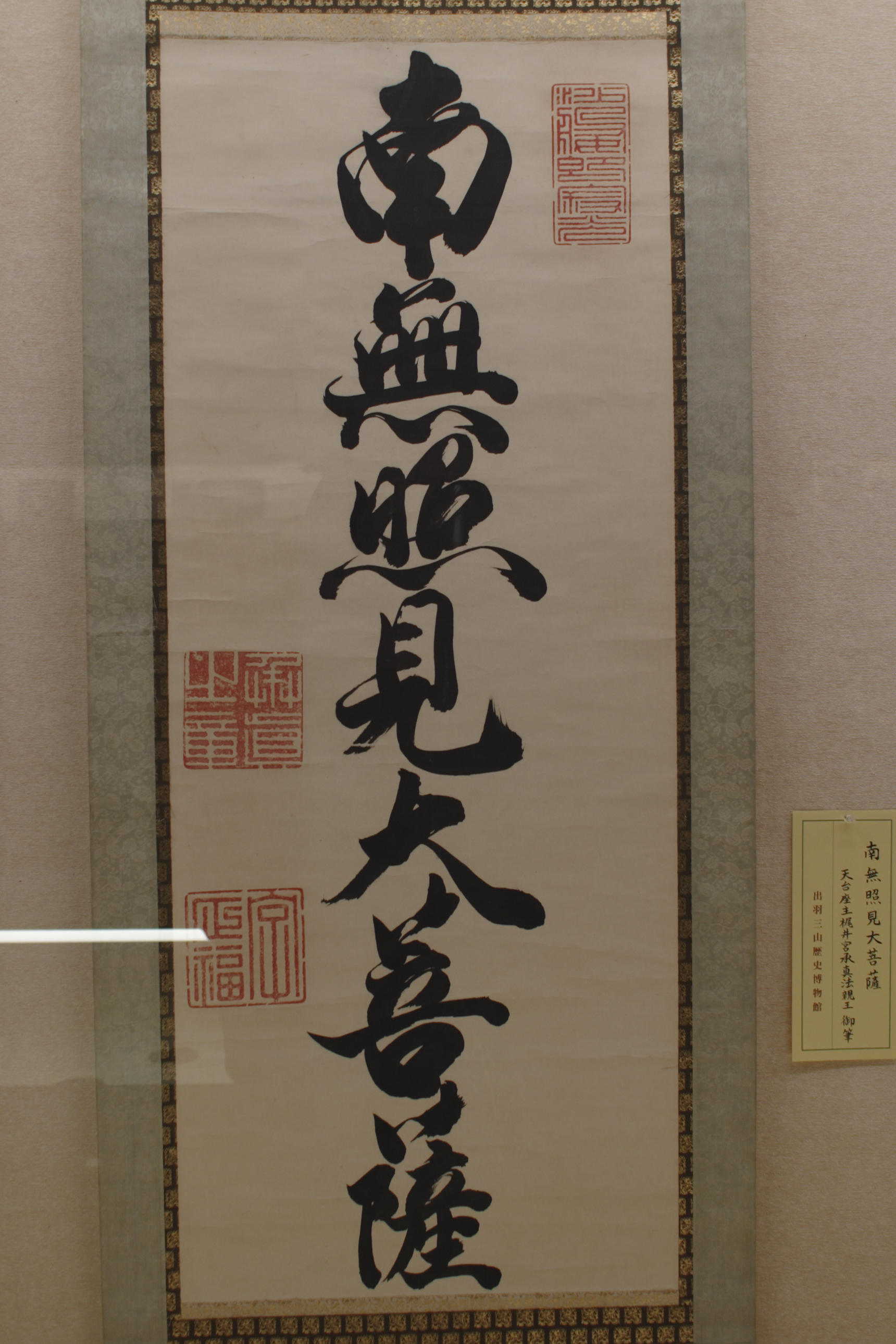
南無照見大菩薩 (Namu Shōken Daibosatsu)
The first scroll reads:
(Namu Shōken Daibosatsu): 南無 (Namu; homage, from namas) / 照見 (Shōken; “illumining insight / clear seeing,” carrying the Heart Sūtra resonance of shōken goun kaikū 照見五蘊皆空, “clearly saw that the five aggregates are all empty”) / 大菩薩 (Dai-bosatsu; Great Bodhisattva). In full: “Homage to the Great Bodhisattva Shōken.” The referent of 照見大菩薩 within the Dewa Sanzan pantheon is an unidentified divine title.(Jōshin hosshinnō n.d.)
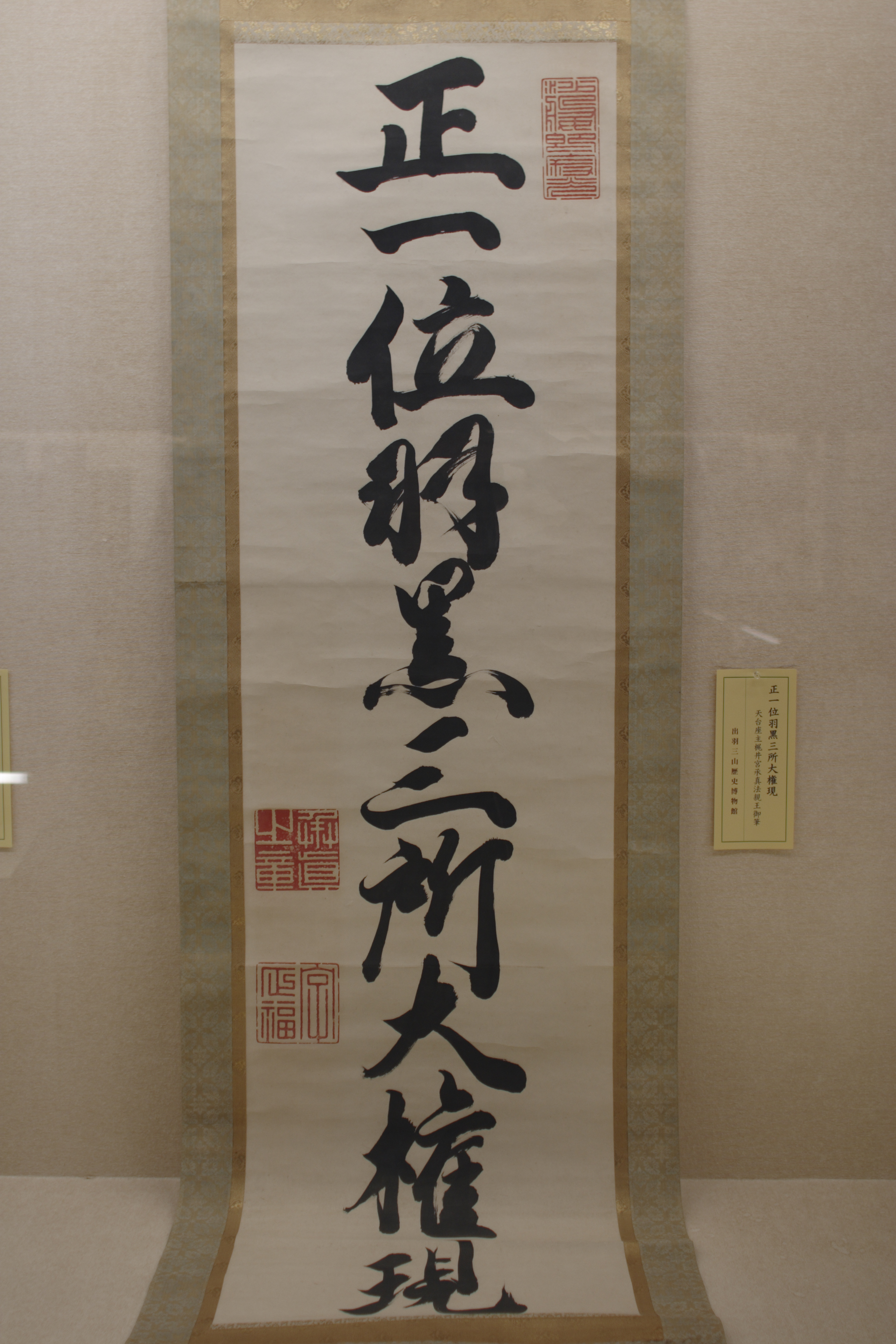
正一位羽黒三所大権現 (Shō-ichi-i Haguro Sansho Dai-gongen)
The second reads:
(Shō-ichi-i Haguro Sansho Dai-gongen): 正一位 (Shō-ichi-i; Senior First Rank — the apex of the ritsuryō court-rank system, here conferred on the deity) / 羽黒 (Haguro) / 三所 (sansho; “the three places,” i.e. the three mountains’ deities together) / 大権現 (Dai-gongen; Great Avatar). In full: “Senior First Rank, the Great Gongen of the Three Places of Haguro” — the title of the combined three-mountain deity as enshrined together at Haguro (the configuration of the Sanjin Gōsaiden). This very title, 羽黒三所大権現, was the deity venerated at the Haguro summit before the Meiji separation abolished the gongen.(Jōshin hosshinnō n.d.)(Wikipedia contributors, n.d.)
The pairing is the substantive point: one scroll gives the deity its Shintō court rank and gongen titulature, the other gives the Buddhist invocation (namu + bodhisattva) — the honji-suijaku duality rendered as two facing inscriptions, and pointedly in the hand of the Tendai head abbot, the Tendai-aligned (Haguro) pole rather than the Shingon (Yudono) one.
Next we find two Shingon-related scrolls:
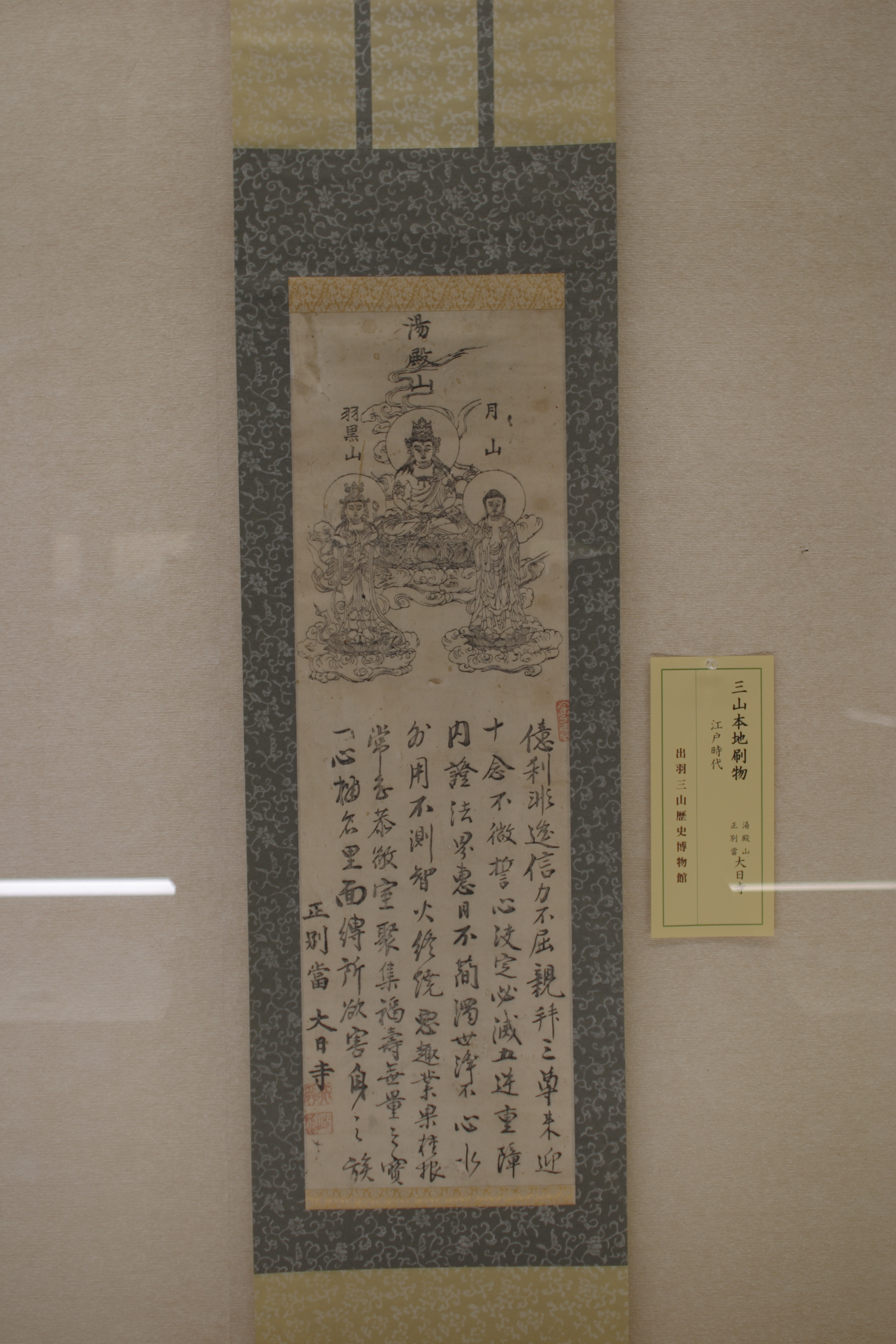
三山本地刷物 (Sanzan honji surimono; "printed icon of the honji-buddhas of the Three Mountains")
Card: Sanzan honji surimono (三山本地刷物; “printed honji-icon of the Three Mountains”) / 江戸時代 (Edo period) / 湯殿山 正別當 大日寺 (Yudonosan, Shō-bettō Dainichi-ji) / 出羽三山歴史博物館. The print shows the three honji-butsu, labeled in the image: 湯殿山 (Yudonosan; top center, the crowned, elevated central figure = Dainichi Nyorai), 月山 (Gassan; upper right, the standing buddha = Amida Nyorai), and 羽黒山 (Hagurosan; upper left, the standing bodhisattva with lotus = Shō Kannon). The composition is itself an argument: Yudono/Dainichi is enthroned at the apex over the other two — the Shingon Yudono-ha’s hierarchy made visible, which is a discrepancy with the Hondōji-as-principal account.(Dainichi-ji n.d.)
It is a votive geju (偈頌; verse-eulogy) in kanbun praising the three honji and their salvific power. Working transcription, right-to-left, with unresolved graphs in 〔…〕:
1 億利非遐 信力不屈 親拜三尊來迎 2 十念不微 誓心〔決〕定 必滅五逆重障 3 内證法界 惠日不簡濁世 澤不〔…〕 4 加用不測智火 〔燒盡〕惡趣業果振 5 常〔懷〕恭敬室 聚集福壽無量之〔寶〕 6 一心〔稱名/植名号〕里面縛 所欲害身之族
Signature: 正別當 大日寺 (Shō-bettō Dainichi-ji), followed by a seal.
The colophon at lower left is signed 正別當 大日寺 (“Shō-bettō [principal administrator] Dainichi-ji”). The scroll’s signature and the museum card style Dainichi-ji as 正別當, whereas the standard modern reference names Hondōji as the principal of Yudonosan’s four Shingon bettō-ji. The standard account lists four Shingon temples for Yudonosan — Hondōji, Dainichibō, Chūrenji, and Dainichi-ji — with Hondōji as the principal bettō. The artifact thus records a competing precedence claim among the four temples; that tension is itself of note.
The votive verse filling the lower register contains the phrases 親拜三尊來迎 (reverently worshipping the three honored ones who come in welcome — raigō), 十念 (the ten recitations), 必滅五逆重障 (surely extinguishing the grave hindrances of the five heinous sins), 福壽無量 (boundless merit and longevity), and 一心 (single-mindedly). The register is Pure Land / esoteric salvific language praising the three honji.
The verse reads as a coherent arc from salvation to protection, which is itself informative about the print’s function:
- Columns 1–2 are the welcoming-descent and sin-extinction movement: faith’s power is unbending, so one reverently worships the raigō (来迎) of the three honored ones; the ten recitations (jūnen, 十念) are not slight, and the resolved vow-mind surely extinguishes the grave hindrances of the five heinous sins (goku jūshō, 五逆重障).
- Columns 3–4 are the wisdom movement: the inner realization of the dharma-realm (naishō hokkai, 内證法界), whose sun of grace does not discriminate against the defiled world (jokuse, 濁世), and the immeasurable fire of wisdom that burns up — 振, i.e. shaking loose — the karmic fruits of the evil destinies (akushu gōka, 惡趣業果).
- Columns 5–6 then turn protective/apotropaic: 常〔懷〕恭敬室、聚集福壽無量之〔寶〕 — “constantly cherishing the hall of reverence, gathering the treasure of immeasurable merit and longevity”, closing on a subjugation clause — 面縛 (menbaku; bound hand-and-face) and 所欲害身之族 (“those whose desire is to harm the body”). That final turn toward 調伏 (chōbuku; subjugation of malevolent forces) is characteristically esoteric, and fits a Dainichi-ji surimono whose apex deity is Dainichi.
The translation above is incomplete: several graphs are unresolved, and the phrases are not standard formulae.
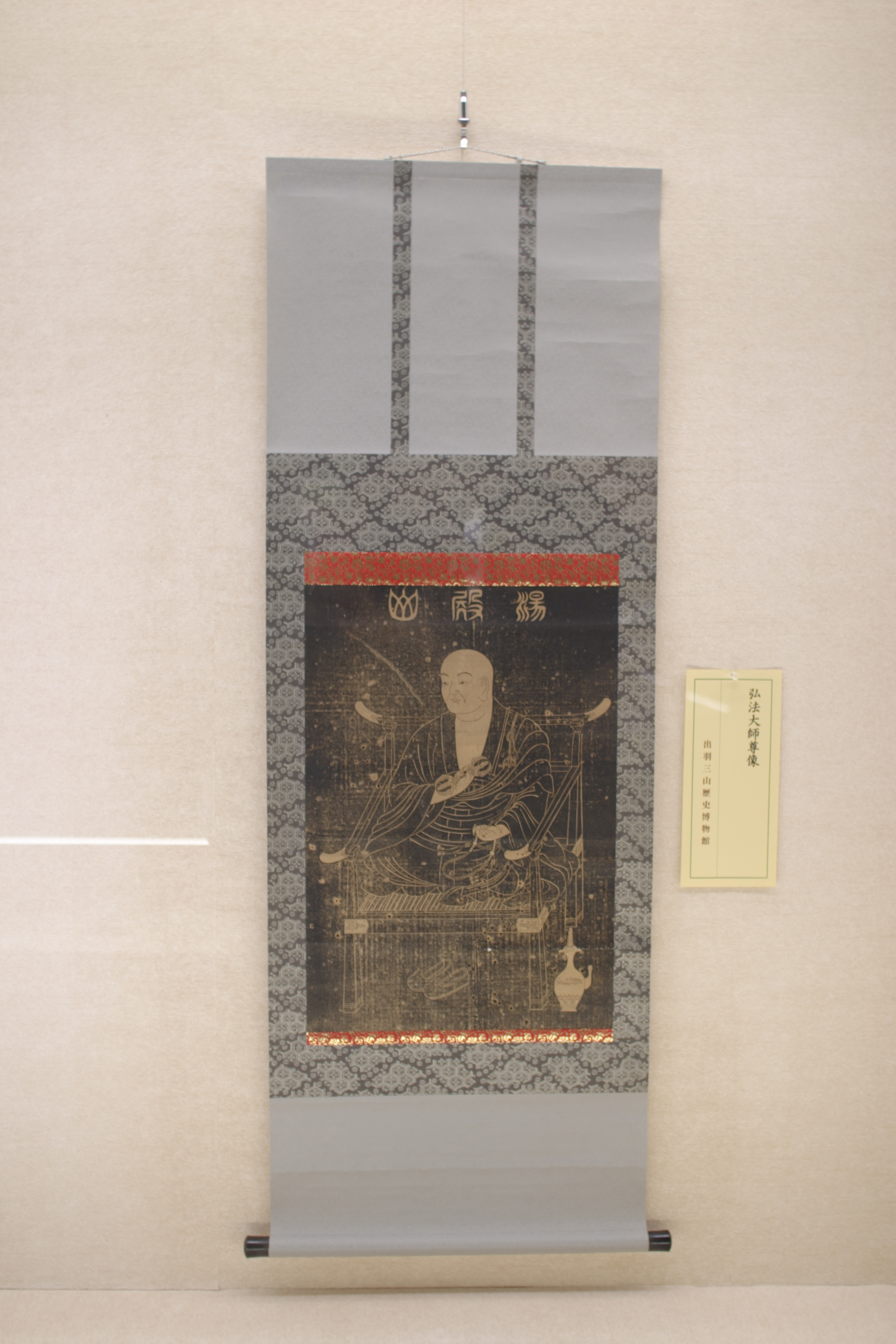
弘法大師尊像 (Kōbō Daishi sonzō; "venerable image of Kōbō Daishi")
Card: Kōbō Daishi sonzō (弘法大師尊像; portrait of Kōbō Daishi) / 出羽三山歴史博物館. The header cartouche reads 湯殿 (Yudono) beside a lotus-form crest. The icon is the standard seated Kōbō Daishi (Kūkai) type, rendered in gold line on a darkened ground: seated on a chair (kyokuroku, 曲彔), a five-pronged vajra (goko-sho, 五鈷杵) in the right hand and a rosary (nenju, 念珠) in the left, with a water vessel (suibyō, 水瓶) at lower right. This is the Shingon Yudono-ha’s founder-icon — the material counterpart to the Kūkai-foundation legend, set against the Hachiko-no-Ōji/Tendai-Haguro foundation.(Author unknown n.d.)
The first two scrolls are the Tendai/Haguro pole (the gongen title and bodhisattva invocation in a Tendai zasu’s hand) and the second two represent the Shingon/Yudono pole (the honji triad printed at Dainichi-ji; the Kūkai icon).
End Notes