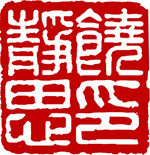
Jikishinkage-ryū is commemorated in stone at more than one place, and its memorial steles are not neutral lineage records so much as partisan monuments in a succession dispute. Three sites carry the relevant inscriptions.
At Kashima Jingū, by the Mitarashi pond (御手洗池), the Hyakuren-kai (百錬会) maintains a cluster of four monuments — the 1968 founder’s stele, a stele to the fifteenth-generation Yamada Jirōkichi, an ancestral-spirits shrine, and the “Hyakuren jitoku” motto stone — transcribed and translated below.
In Chiba, at Kitashimizu Fudō-in in Yokoshiba, a 1960 “Stele of the Martial Man” honours Kawashima Takashi as the sixteenth-generation orthodox successor; its full text and the twenty-three-name roster of those who raised it are given below under Chiba. A second stele at Kashima Jingū — by the Sakashita pond (坂下の池) — likewise names Kawashima sixteenth-generation, independently of the Yokoshiba stone.
These monuments bracket a quiet contest over the succession. The 1968 founder’s stele runs the line straight from the fifteenth-generation Yamada to the seventeenth-generation Ōnishi Hidetaka, with no sixteenth generation; the 1960 stelae name Kawashima to that seat. How the 1968 monument produces its seamless story — and writes Kawashima out — is examined below in Reading the 1968 Founder’s Stele.
Kashima
Within the precincts of Kashima Jingū (鹿島神宮), by the Mitarashi pond (御手洗池), stand a cluster of Kashima-shinden Jikishinkage-ryū monuments maintained by the Hyakuren-kai (百錬会). The texts and details below are drawn from the Hyakuren-kai’s own documentation of the site;1 only the founder’s stele carries an inscription transcribed online, so the remaining three are recorded here to the extent presently possible and await on-site transcription.
One point of method worth stating at the outset: the founder’s stele is not a neutral lineage record. It was raised in 1968 in the name of the seventeenth-generation Ōnishi Hidetaka, and its account of the succession runs directly from the fifteenth generation to the seventeenth, omitting the sixteenth — Kawashima Takashi, whom his own Yokoshiba memorial of 1960 names as sixteenth-generation orthodox.2 The monument is therefore best read as a partisan document of the post-Yamada schism rather than as a settled genealogy.
1. The Founder’s Stele (鹿島神傳直心影流流祖碑)
Frontispiece (daigaku, 題額) by Sasai Shintarō (佐々井信太郎), Doctor of Literature;3 text composed by Mizuma Shingo (三潴信吾), Professor of Takasaki City University of Economics;4 calligraphy by Ōmori Sōgen (大森曽玄).5 Dated kōki 2628 / May Shōwa 43 (1968).6
夫レ古来我ガ武道ハ剣道ニ由ツテ立ツ。
Sore korai waga budō wa kendō ni yotte tatsu.
From of old, our martial way has stood upon the way of the sword.
而シテ日本刀ノ真髄ハ實ニ皇国伝来ノ惟神之〔六〕道ヲ百錬自得、世々ニ継受シテ、生成化育創造ノ至妙ヲ發揚シ、以テ無窮ニ彌榮エ、至道一貫、唯天業ニ侍スル大和魂其ノ者ニ他ナラズ。
Shikashite Nihontō no shinzui wa jitsu ni kōkoku denrai no kannagara no 〔roku-?〕dō o hyakuren-jitoku, yoyo ni keiju shite, seisei kaiiku sōzō no shimyō o hatsuyō shi, motte mukyū ni iyasakae, shidō ikkan, tada tengyō ni jisuru Yamato-damashii sono mono ni hokanarazu.
And the true essence of the Japanese sword is nothing other than the Yamato spirit itself — that which, attaining through hundredfold tempering the imperially transmitted divine Way,7 inheriting it generation upon generation, manifests the supreme subtlety of generation, nurture and creation; flourishes endlessly without limit; runs unbroken through the ultimate Way; and serves the heavenly enterprise alone.
生ク足ルノ〔義〕亦正ニ此ニ在ラン。
Iku taru no 〔gi〕 mata masa ni koko ni aran.
The meaning of a life fully lived, too, lies precisely here.8
剣道ノ本ハ術ニ在ラズ、日本刀ノ質ハ具ニ在ラズ。
Kendō no moto wa jutsu ni arazu, Nihontō no shitsu wa gu ni arazu.
The root of the way of the sword does not lie in technique; the nature of the Japanese sword does not lie in the implement.
其ノ修得ニ志ス者、齊シク心ヲ清メ體ヲ〔持〕シ、専ラ神意ヲ畏ミテ、須臾モ油断アルベカラズ。
Sono shūtoku ni kokorozasu mono, hitoshiku kokoro o kiyome, karada o 〔ji〕shi, moppara shin’i o kashikomite, shuyu mo yudan aru bekarazu.
Those who aspire to master it must alike purify the heart and discipline the body, reverently heed the divine will and never relax their guard even for a moment.
謹ミテ想フニ、千早振ル神代ノ昔、建御雷之男神、智勇殊ニ勝レ、神命ヲ畏ミテ韴霊剣ヲ佩キ、高天原ヨリ降リテ出雲ニ使シ、大國主命ノ治メ給ヘル豊葦原ヲ獻リテ天孫ヲ迎フルノ神機ヲ成ス。
Tsutsushimite omou ni, chihayaburu kamiyo no mukashi, Takemikazuchi-no-o-no-kami, chiyū koto ni sugure, shinmei o kashikomite Futsu-no-mitama no tsurugi o haki, Takamagahara yori kudarite Izumo ni tsukai shi, Ōkuninushi-no-mikoto no osame-tamaeru Toyoashihara o tatematsurite tenson o mukauru no shinki o nasu.
Reverently I reflect: in the age of the gods of old, Takemikazuchi-no-o-no-kami, surpassing in wisdom and valor, in awe of the divine command girded the Futsu-no-mitama sword, descended from Takamagahara as envoy to Izumo and brought about the divine turning by which Ōkuninushi-no-mikoto offered up the Toyoashihara land he had ruled and welcomed the heavenly grandchild.
皇國ノ基茲ニ開ク。鹿島神宮創始ノ淵源ニシテ、武運發祥ノ所以也。
Kōkoku no moto koko ni hiraku. Kashima Jingū sōshi no engen ni shite, buun hasshō no yuen nari.
Thus the foundation of the imperial land was opened here — the very wellspring of Kashima Jingū’s founding, and the reason it is the birthplace of martial fortune.
史上、海邊防備ノ防人モ此地ニ武ヲ練リ、海外ニ使スル者亦當神宮ノ神佑ヲ祈リテ出デ立ツヲ習トシ、以テ「鹿島立チ」ノ名起ル。
Shijō, kaihen bōbi no sakimori mo kono chi ni bu o neri, kaigai ni tsukai suru mono mata tō-jingū no shin’yū o inorite idetatsu o narai to shi, motte “Kashima-dachi” no na okoru.
In history the frontier-guards (sakimori) of the coastal defenses honed their martial skill here; and those sent abroad likewise made it their custom to set out after praying for this shrine’s divine protection — whence arose the term “Kashima-dachi,” the setting-out from Kashima.
中葉、兵法者多ク此地ニ参集セル中ニ、當神宮ノ祝部松本備前守尚勝、〔神伝〕ヲ得テ鹿島神流ヲ起シ、門系上泉伊勢守信綱ニ至リテ新陰流ヲ開キ、七代山田平左衛門ニ及ビテ直心影流ノ稱ヲ定ム。
Chūyō, heihōsha ōku kono chi ni sanshū seru naka ni, tō-jingū no hafuri Matsumoto Bizen-no-kami Naokatsu, 〔shinden〕 o ete Kashima Shin-ryū o okoshi, monkei Kamiizumi Ise-no-kami Nobutsuna ni itarite Shinkage-ryū o hiraki, nana-dai Yamada Heizaemon ni oyobite Jikishinkage-ryū no shō o sadamu.
In a middle age, among the many martial men who gathered here, the shrine’s priest (hafuri) Matsumoto Bizen-no-kami Naokatsu9 received the divine transmission10 and founded Kashima Shin-ryū; the lineage reached Kamiizumi Ise-no-kami Nobutsuna, who opened Shinkage-ryū; and by the seventh generation, Yamada Heizaemon, the name Jikishinkage-ryū was fixed.
一切諸行ハ心ノ影也、氣ハ即チ影ニ應ズ、直キ心コソ大事ナレ、トノ意也。
Issai shogyō wa kokoro no kage nari, ki wa sunawachi kage ni ōzu, naoki kokoro koso daiji nare, to no i nari.
All actions are shadows of the heart; the spirit (ki) answers to that shadow; an upright heart is what truly matters — such is the meaning of the name.
流祖備前守出デテ、茲ニ五百年ヲ迎フ。
Ryūso Bizen-no-kami idete, koko ni gohyaku-nen o mukau.
Five hundred years have now passed since the founder Bizen-no-kami appeared.
此ノ時ニ當リ、且ハ邦家ノ現状ニ鑒ミ、十五代山田次朗吉門弟、十七代大西英隆ノ遺志ヲ継ギ、同志相譲リテ謹ミテ碑ヲ立テ、以テ皇國守護・斯道恢弘ノ微〔衷〕ヲ祈念セント欲ス。
Kono toki ni atari, katsu wa hōka no genjō ni kangami, jūgo-dai Yamada Jirōkichi montei, jūnana-dai Ōnishi Hidetaka no ishi o tsugi, dōshi ai-yuzurite tsutsushimite hi o tate, motte kōkoku shugo, shidō kaikō no bi〔chū〕 o kinen sen to hossu.
At this juncture, mindful too of the present state of the nation, carrying on the will of the seventeenth-generation Ōnishi Hidetaka — a disciple of the fifteenth-generation Yamada Jirōkichi — like-minded persons have together reverently raised this stele, wishing thereby to pray with humble sincerity11 for the protection of the imperial land and the broad propagation of this Way.2
神霊庶幾クハ受ケサセ給ヘ。
Shinrei koinegawakuwa ukesase-tamae.
May the divine spirits, we humbly pray, deign to receive this.
Attribution lines: Respectfully composed by Mizuma Shingo, Professor, Takasaki City University of Economics. Imperial Year 2628 / May Shōwa 43 (1968). Respectfully brushed by Ōmori Sōgen. (高崎經濟大学教授三潴信吾謹撰/皇紀二千六百二十八年 昭和四十三年五月/大森曽玄謹書)
2. The Yamada Jirōkichi Ittokusai Stele (霊剣位 山田次朗吉一徳斎碑)
A separate stele honoring the fifteenth-generation head, Yamada Jirōkichi Ittokusai (山田次朗吉一徳斎), prefaced by the title “Reiken-i” (霊剣位, “spirit-sword rank”).12 No body inscription is reproduced in the online source; the full text awaits on-site transcription.
3. The Ancestral-Spirits Shrine (祖霊社)
A small shrine (sorei-sha) in the precinct cluster; the Hyakuren-kai records that the seventeenth-generation Ōnishi Hidetaka is enshrined (gōshi, 合祀) there. No inscription is given online.
4. The “Hyakuren Jitoku” Stone (百錬自得)
A stone bearing the school’s motto Hyakuren jitoku (百錬自得, “through hundredfold tempering, self-attainment”). The characters were chosen by Katsu Kaishū (勝海舟) and brushed by Yamada Jirōkichi (山田次朗吉).13 No further text is recorded online.
Chiba
A memorial stele (武人ノ碑) to Kawashima Takashi stands in the precincts of Kitashimizu Fudō-in (北清水不動院), Yokoshiba (横芝), Chiba, the birthplace of Kawashima Takashi (川島堯), gō 〔Ryūun 龍雲〕, who is honoured on it as the sixteenth-generation orthodox successor (十六代正統者; sixteenth-generation legitimate successor) of Jikishinkage-ryū.
The text below is transcribed from the photographically reproduced inscription in the town newsletter Kōhō Yokoshiba (広報よこしば), No. 165, 1 June 1978 (Shōwa 53), p. 9 — column “Steles of Yokoshiba” (横芝の碑), installment 68, contributed by Ozawa Harumitsu (小沢春光) of the Cultural Properties Council.14
The inscription dates his birth to the fourth month of Meiji 16 (1883) and his death to the eighth month of Shōwa 33 (1958);15 the headline writes the school 真心影流 while the engraved text uses the standard 直心影流;16 and the stele’s own “seventy-three-year life” does not square with those dates.17
Title graphs on the stele face: 武人ノ碑 — Bujin no hi — “Stele of the Martial Man.”
The inscription (stele face / 表面)
郷土ノ偉人川島堯、明治十六年四月此ノ地ニ生レ、昭和三十三年八月此ノ地ニ没ス。
Kyōdo no ijin Kawashima Takashi, Meiji jūroku-nen shigatsu kono chi ni umare, Shōwa sanjūsan-nen hachigatsu kono chi ni bossu.
Kawashima Takashi, an eminent man of this district, was born at this place in the fourth month of Meiji 16 (1883) and died at this place in the eighth month of Shōwa 33 (1958).
幼少ヨリ文ニ志シ、〔海保漁村ニ比肩ス〕。
Yōshō yori bun ni kokorozashi, 〔Kaiho Gyoson ni hiken su〕.
From childhood he aspired to letters, 〔rivaling the Confucian scholar Kaiho Gyoson〕.
二十余歳ニシテ武人タラムト志シ、一刀流及ビ不二心流ノ免許ヲ得タリ。
Nijūyo-sai ni shite bujin taran to kokorozashi, Ittō-ryū oyobi Fujishin-ryū no menkyo o etari.
In his twenties he resolved to become a warrior and received the licenses of Ittō-ryū and Fujishin-ryū (不二心流).
二十九歳ノ春、台湾警察剣道師範トシテ赴任スルヤ、益々難業ヲ積ミ、弟子ヲ持ツ〔モ〕…
Nijūkyū-sai no haru, Taiwan keisatsu kendō shihan to shite funin suru ya, masumasu nangyō o tsumi, deshi o motsu 〔mo〕…
In the spring of his twenty-ninth year, on taking up the post of kendō instructor to the Taiwan police, he accumulated ever harder training and took on disciples, 〔yet〕…
自ラハ…道ニヨリ後進ヲ善導セムト、無一物ノ…
Mizukara wa … michi ni yori kōshin o zendō sen to, muichimotsu no …
…he himself sought only to guide his juniors through the Way, owning nothing…
心ハ赤誠至純、生来非凡ノ…
Kokoro wa sekisei shijun, seirai hibon no …
His heart was utterly sincere and pure, by nature extraordinary…
力量ハ連続七十人ノ門人ニ対シ、些カモ呼吸ヲ乱サズ。
Rikiryō wa renzoku shichijū-nin no monjin ni taishi, isasaka mo kokyū o midasazu.
In strength, facing seventy disciples in succession, he never once disturbed his breathing.
弓ハ〔寸弓〕ヲ引キ、今為朝ト称セラル。
Yumi wa 〔sun-yumi〕 o hiki, ima Tametomo to shōseraru.
In archery he drew the 〔sun-yumi〕 and was called a latter-day Tametomo.
既ニ台湾ニ比肩スル剣士無ク、弓亦武徳会範士トナルモ、己ヲ持スルニ最モ厳正、道ヲ学ムルニ最モ懸命ナリ。
Sude ni Taiwan ni hiken suru kenshi naku, yumi mata Butokukai hanshi to naru mo, onore o jisuru ni mottomo gensei, michi o manabu ni mottomo kenmei nari.
By then no swordsman in Taiwan could rival him, and in archery too he became a Butokukai hanshi; yet he held himself to the strictest discipline and studied the Way most earnestly.
直心影流十五代山田次郎吉ニ入門、遂ニ〔武道ノ真髄ヲ得〕、請ハレテ同流十六代ヲ継グ。
Jikishinkage-ryū jūgo-dai Yamada Jirōkichi ni nyūmon, tsui ni 〔budō no shinzui o e〕, kowarete dōryū jūroku-dai o tsugu.
He entered the school of Yamada Jirōkichi, fifteenth-generation head of Jikishinkage-ryū, at last 〔grasped the essence of the martial Way〕 and on being asked, succeeded as the sixteenth generation of that school.
文武両道ハ日本人ノ道也、武道ハ元ヨリ競技ニ非ズ。
Bunbu ryōdō wa Nihonjin no michi nari, budō wa moto yori kyōgi ni arazu.
The dual path of letters and arms is the Way of the Japanese; budō was never, from the first, a sport.
戦後道徳ノ混乱セル日本ノ将来ヲ思フトキ、…〔無〕刀ノ剣ヲ奮ヒ、無弓ノ弓ヲ引ク。
Sengo dōtoku no konran seru Nihon no shōrai o omou toki, … 〔mu〕tō no ken o furui, mukyū no yumi o hiku.
Thinking of the future of a Japan whose morals were thrown into confusion after the war, …he wielded the sword of no-sword and drew the bow of no-bow.
七十三年ノ生涯ハ真ノ武人也。此ノ道ノ蘊奥ニ果テハナキモノ〔ト…〕。
Shichijūsan-nen no shōgai wa shin no bujin nari. Kono michi no un’ō ni hate wa naki mono 〔to…〕.
His seventy-three-year life was that of a true martial man. 〔He held that〕 there is no end to the depths of this Way.
Reading notes for individual lines: the Fujishin-ryū reading,18 the term sun-yumi,19 and the Kaiho Gyoson comparison20 each carry caveats.
The uramen (裏面; reverse/hidden side): those who raised the stele
The article states that the reverse bears the names of “thirteen initiators, believed to be his disciples” (門弟と思われる発起人十三名) together with “ten supporters” (賛助者十名; ten supporting members), twenty-three in all. The stele was raised in the memorial month of Shōwa 35 (1960), two years after his death. Kanji are given as read from the reproduction; given-name rōmaji are tentative.21
Initiators — thirteen (発起人十三名; thirteen founding members)
| # | Name (kanji) | Rōmaji (tentative) | Note |
|---|---|---|---|
| 1 | 大西英隆 | Ōnishi Hidetaka | Later counted 17th generation; founder of the Hyakuren-kai |
| 2 | 伊藤竹松 | Itō Takematsu | |
| 3 | 川島栄太郎 | Kawashima Eitarō | Shares the Kawashima surname (kin?) |
| 4 | 斎藤要 | Saitō 〔Kaname〕 | Segmentation uncertain (whether 要 closes this name) |
| 5 | 林義郎 | Hayashi Yoshirō | |
| 6 | 井上新太郎 | Inoue Shintarō | |
| 7 | 並木靖 | Namiki Yasushi | Author of Katsu Kaishū no genten (勝海舟の原点), cited by the article |
| 8 | 大橋恒治 | Ōhashi 〔Tsuneji / Kōji〕 | |
| 9 | 石橋恒一 | Ishibashi 〔Kōichi / Tsuneichi〕 | |
| 10 | 安井正行 | Yasui 〔Masayuki〕 | |
| 11 | 作田守康 | Sakuta 〔Moriyasu〕 | Surname/reading tentative |
| 12 | 伊藤雅之 | Itō Masayuki | |
| 13 | 秋葉隆昌 | Akiba 〔Takamasa / Takaaki〕 |
Supporters — ten (賛助者十名)
| # | Name (kanji) | Rōmaji (tentative) | Note |
|---|---|---|---|
| 1 | 浅野清 | Asano Kiyoshi | |
| 2 | 伊藤馨 | Itō Kaoru | |
| 3 | 斎藤元一 | Saitō 〔Gen’ichi / Motoichi〕 | |
| 4 | 平山喜代治 | Hirayama 〔Kiyoji〕 | |
| 5 | 芹川昌栄 | Serikawa 〔Masae / Shōei〕 | |
| 6 | 伊藤孝 | Itō Takashi | |
| 7 | 秋葉堯 | Akiba Takashi | 堯 is the same character as Kawashima’s given name |
| 8 | 秋葉信夫 | Akiba Nobuo | |
| 9 | 伊藤一 | Itō Hajime | |
| 10 | 宇都木昭三 | Utsugi 〔Shōzō〕 | Surname reading Utsugi/Utsuki tentative |
A companion stele at Kashima Jingū
The article adds that within the precincts of Kashima Jingū (鹿島神宮) in Ibaraki — around the Sakashita pond (坂下の池; pond below the slope) — a stele likewise bears the name of Kawashima Takashi inscribed as “sixteenth-generation orthodox of Shinkage-ryū” (十六代正統). That a second inscription at the school’s spiritual home assigns him the sixteenth generation is independent corroboration of the designation on the Yokoshiba stone.
Reading the 1968 Founder’s Stele
A commentary on the Kashima Jingū Jikishinkage-ryū founder’s stele (鹿島神傳直心影流流祖碑). The full transcription and translation are in the Kashima transcription above; this piece reads that text rather than reproducing it.
The founder’s stele raised at Kashima Jingū in 1968 is not a neutral lineage record but a composed argument. It tells a single, smooth story that begins in the age of the gods and ends in a Zen reading of the school’s name, and it is worth seeing how that smoothness is produced — because the seam it hides is the omission of the sixteenth-generation head, Kawashima Takashi.
A line that is too straight
Read for proportion, the inscription spends almost all of its length on its two ends and almost none on its middle. The mythic opening is lavish: Takemikazuchi descending from Takamagahara with the Futsu-no-mitama sword, the cession of the land by Ōkuninushi, Kashima as the wellspring of both the imperial polity and “martial fortune,” the frontier-guards and the Kashima-dachi. The name-etymology, too, gets its own clause — all actions are shadows of the heart; the upright heart is what matters. But the actual human succession is dispatched in a single breath: founder, Kamiizumi, the seventh-generation Yamada, “five hundred years,” and then straight to the fifteenth-generation Yamada Jirōkichi and the seventeenth-generation Ōnishi Hidetaka. The eighth through fourteenth generations disappear; so does the sixteenth.22 The linearity is an effect of compression. The line looks unbroken because the contested human stretch has been reduced to two names, while the cosmological and interpretive bookends carry the authority a genealogy would normally carry. When a school’s legitimacy is made to flow from a sacred place and from an interior principle, a missing teacher does not disturb the story.
Two anchors outside history
Both bookends do the same work from opposite directions: they ground the school in something trans-historical. The Kashima myth roots it in sacred place and national origin; the name-gloss roots it in mind. Neither is incidental. The school’s full name, Kashima-shinden (“Kashima divine transmission”), already invites the first move, but the stele amplifies it to a cosmogonic scale. The second — “the root of the sword is not in technique… the upright heart is what matters” — is the kenzen-ichinyo (sword-and-Zen-as-one) reading that the tradition absorbed across the twentieth century, from Yamaoka Tesshū’s remark that the hōjō form makes Zen unnecessary, through Yamada Jirōkichi, to the stele’s own calligrapher, the Rinzai master and swordsman Ōmori Sōgen.23 That a Zen rōshi’s hand brushed the stone makes the interpretive register literal rather than figurative.
The idiom: prewar imperial-Shintō and kokutai
The frame in which both anchors sit is the idiom of prewar imperial-Shintō and kokutai ideology.24 From the Meiji Restoration to 1945 the Japanese state promoted a doctrine of national essence (kokutai, 国体) holding that Japan was a divinely founded polity ruled in unbroken succession by an imperial line descended from the sun-goddess Amaterasu, with the emperor as sacred sovereign; shrine ritual, emperor-veneration and national identity were fused under the principle of saisei-itchi, the unity of worship and government. In the 1930s and 1940s this complex supplied the vocabulary of expansion, condensed in slogans such as hakkō ichiu — “the eight corners of the world under one roof” — a phrase coined by the Nichirenist Tanaka Chigaku in 1903 from the Nihon Shoki’s account of Emperor Jinmu and taken up by the second Konoe cabinet in 1940 as the watchword of the “Greater East Asia” order.25
The Allied Occupation’s Shintō Directive of December 1945 formally disestablished this apparatus and barred its public propagation. The cluster of terms on the 1968 stele — kōkoku (the imperial land), Yamato-damashii, tengyō (the heavenly enterprise), the dating by the imperial year-count (kōki 2628) and the prayer for “the protection of the imperial land” — belongs squarely to this register, reasserted twenty-three years after that disestablishment.
A living echo: the Issei-kai preamble
This is not an idiosyncrasy of one stone. The Issei-kai (一誠会), a separate Jikishinkage-ryū body, opens its own website with a doctrinal preamble in the same key: it presents the school’s transmission as passing from the fifteenth-generation Yamada to the seventeenth-generation Ōnishi, then declares that the Japanese people must, “in accordance with the great way of hakkō ichiu since the founding of the nation by Emperor Jinmu,” take the lead in a “world renovation” and a mission of salvation on which the nation’s very survival depends — the key to which lies in the practice of the “great divine way” (kannagara no ōdō) and the rousing of the Japanese spirit through hyakuren-jitoku.26 Two things follow. First, the wording confirms a reading on the stele: where the Kashima inscription appears as kannagara no 〔六〕-dō, the Issei-kai’s kannagara no ōdō (惟神の大道) shows the intended term to be 大道, “the great way,” not 六道.27 Second, the Issei-kai contradicts itself in a way that mirrors the stele exactly: its formal lineage page lists Kawashima as the sixteenth generation, while this manifesto jumps from the fifteenth to the seventeenth and writes him out — the same erasure, in the same idiom, in a different body.
An invented tradition
A useful frame for readers is the historian Eric Hobsbawm’s concept of the invention of tradition: practices and lineages presented as ancient and continuous are often recent constructions that use the appearance of antiquity to confer authority on present arrangements.28 The 1968 stele is a textbook instance — a recent monument projecting a seamless, sacralized continuity backward from the present custodians to the gods. This act is an interpretive lens with mythic and Zen anchors. The imperial-Shintō idiom manufactures a continuity into which the inconvenient sixteenth generation simply does not fit.
Coda: two registers, eight years apart
The point sharpens compared with Kawashima’s own memorial at Kitashimizu, raised in 1960. That stele is biographical — a man’s naval service, his Taiwan post, the feat of seventy successive opponents, the rescued transmission documents, “a true martial man of seventy-three years” — and it counts him the sixteenth. The Kashima monument of 1968 is cosmological — a place, a myth, a principle — and it omits him. The same Ōnishi stands behind both, as lead initiator of the first and dedicatee of the second.
So, it is likely the later stele at Kashima is an effort to establish a public narrative about Ōnishi, in his absence, that he himself may not have shared. In eight years the register shifts from the human to the trans-historical, and it is precisely the abstraction that does the omitting.
References
The sources cited across these steles are collected in the site source register.
End Notes
-
Provenance. The founder’s-stele inscription and the identifications of all four monuments are transcribed from the Hyakuren-kai’s page “鹿島神宮の関連施設” (see References), not read from the stones. Clause divisions, several characters and the rōmaji are therefore provisional; uncertain points are marked 〔…〕 and should be checked against the monuments themselves. ↩
-
The omitted sixteenth generation. The succession clause runs from the fifteenth-generation Yamada Jirōkichi directly to the seventeenth-generation Ōnishi Hidetaka, described as Yamada’s disciple; there is no sixteenth generation. Kawashima Takashi (川島堯), named “sixteenth-generation orthodox” on his Yokoshiba memorial of 1960 (see the companion document), is absent. As this stele was raised in 1968 in Ōnishi’s name, it is the public monument of the Hyakuren-kai’s “straight from Yamada to Ōnishi” numbering, and it post-dates the Yokoshiba stele — placing the hardening of that numbering between 1960 and 1968. ↩ ↩2
-
Frontispiece. By Sasai Shintarō (佐々井信太郎), styled Doctor of Literature (文学博士), Junior Seventh Rank, Order of Merit Third Class. Identity beyond the titles given on the stele is not verified here. ↩
-
Composer. Mizuma Shingo (三潴信吾), Professor at Takasaki City University of Economics — an institution with standing Hyakuren-kai ties (its kendō club appears among the body’s affiliated groups), which underscores the stele’s provenance within the Ōnishi line. ↩
-
Calligrapher. Ōmori Sōgen (the page writes 大森曽玄; the usual form is 大森曹玄), the Rinzai Zen master and swordsman, whose own Jikishinkage-ryū line is recorded separately from the Hyakuren-kai. His hand on this stele is itself a datum about the networks around the 1968 monument. ↩
-
Register and dating. The inscription is dated by the imperial era-count (kōki 皇紀 2628 = 1968) and is composed in an explicitly Shintō-nationalist idiom (皇国 “imperial land,” 大和魂 “Yamato spirit,” 天業 “heavenly enterprise,” 皇国守護 “protection of the imperial land”). It is useful to read alongside the comparable period rhetoric of related Jikishinkage-ryū bodies. ↩
-
惟神之〔六〕道. 惟神 (kannagara) denotes “the way of the gods.” The web transcription gives the next character as 六 (“six”), which is difficult to construe here and is almost certainly a transcription error for 大 — i.e. 惟神之大道, “the great divine way.” This emendation is corroborated independently by the Issei-kai (一誠会), whose doctrinal preamble uses the same phrase, 惟神の大道(神ながらの道); see https://www.isseikaiweb.com/ (opens in a new tab) and the companion commentary. The reading should still be confirmed against the stone. ↩
-
生ク足ル. Reading and sense uncertain; rendered here as “a life fully lived.” To be verified. ↩
-
Founder’s name. The stele gives the founder as Matsumoto Bizen-no-kami Naokatsu (松本備前守尚勝). Other accounts give Masamoto (政元), or record a change from Naokatsu to Masamoto; the existence and identity of the founder are themselves debated in the scholarship. ↩
-
〔神伝〕. The web transcription reads 神殿 (“shrine hall”), but the sense — “received the —— and founded Kashima Shin-ryū” — points to 神伝 (shinden, “divine transmission”). Flagged. ↩
-
微〔衷〕. The web transcription reads 微哀; the expected idiom is 微衷 (bichū, “humble sincere intent”). Flagged. ↩
-
“Reiken-i.” 霊剣位 (“spirit-sword rank/title”) appears as an honorific heading the Yamada stele; its precise import should be confirmed against the stone. ↩
-
The Katsu Kaishū connection. That the school’s motto stone pairs Katsu Kaishū’s choice of characters with Yamada Jirōkichi’s brush reflects Katsu’s own grounding in Jikishinkage-ryū (via Shimada Toranosuke, a disciple of the thirteenth-generation Odani Nobutomo) — the same lineage tie that a disciple-author of Kawashima’s circle, Namiki Yasushi, took as the subject of Katsu Kaishū no genten. ↩
-
Provenance. This is a transcription of a 1978 newsprint reproduction of the inscription, not a reading from the stone itself. Clause divisions and several readings are provisional and should be verified against the stele in situ at Kitashimizu Fudō-in (北清水不動院), Yokoshiba, Chiba. ↩
-
Death date. The inscription gives the eighth month of Shōwa 33 (1958); the article independently states the stele was raised “two years after,” in Shōwa 35 (1960) — internally consistent. A separate kyūdō biography gives the death as August Shōwa 32 (1957). The one-year discrepancy is unresolved; the contemporaneous stele favours 1958. ↩
-
Orthography (真 vs 直). The newsletter’s headline writes the school 真心影流 (with 真); the engraved inscription quoted in the body uses the standard 直心影流 (with 直). The 真心 form appears to be the newsletter’s own variant. ↩
-
“Seventy-three years.” This does not square with a birth in 1883 and a death in 1957/58 (about 75 years, 76 by Japanese count). The figure looks like an error on the stele or in the newsprint; flagged rather than silently corrected. ↩
-
不二心流 — Fujishin-ryū. A late-Edo kenjutsu school founded c. 1818 (Bunsei 1) by Nakamura Isshinsai (中村一心斎; originally Nakamura Hachihei 中村八平), who took the name after a hundred-day austerity on Mt. Fuji and the realization “in my heart there is no divided mind” (我が心に二心無し) — 不二 punning on the mountain and on “non-dual.” Trained earlier in Asayama Ichiden-ryū and Kawara Shōshin-ryū and as head student of Suzuki Onohachirō’s Shintō Munen-ryū dōjō; it spread widely as a “village kenjutsu” (在村剣術). See 全日本剣道連盟「幕末在村剣術と現代剣道 第1回 不二心流・中村一心斎の巻」 (opens in a new tab) (Kazuma Kōji). ↩
-
寸弓. Meaning uncertain — possibly a particular bow, or a measured full draw. Flagged. ↩
-
海保漁村. Taken as the Kazusa-born Confucian scholar Kaiho Gyoson (1798–1866); the comparison suits the “aspired to letters” clause and the shared Chiba/Kazusa region. A place-name reading cannot be wholly excluded. ↩
-
Name readings. Kanji are given as read from the scan. Given-name rōmaji are tentative because the carved names carry no furigana and most readings are ambiguous (e.g. 恒治 Tsuneji/Kōji; 隆昌 Takamasa/Takaaki; 喜代治 Kiyoji). Item 4 (斎藤要) depends on whether 要 closes that name; the parenthetical otherwise totals exactly thirteen with 斎藤要 read as one name. All should be checked against the stone. ↩
-
On the Yokoshiba memorial of 1960, raised by Kawashima’s disciples with Ōnishi as the first-listed initiator, Kawashima Takashi (川島堯) is named sixteenth-generation orthodox successor. The 1968 Kashima stele, raised in Ōnishi’s name, runs the succession fifteenth → seventeenth with no sixteenth generation. The two monuments thus bracket the period in which the “straight from Yamada to Ōnishi” numbering hardened. ↩
-
Ōmori Sōgen (the stele writes 大森曽玄; the usual form is 大森曹玄), Rinzai Zen master and swordsman, whose own Jikishinkage-ryū line (the Tesshū-kai / Kōhoin) is recorded separately from the Hyakuren-kai. His brushing of the stele places the Zen-sword reading within a real lineage rather than a rhetorical one. ↩
-
I use “prewar imperial-Shintō / kokutai ideology” in preference to “State Shintō.” The latter (国家神道, kokka shintō) is a real but contested historiographic category whose scope and coherence scholars dispute; see Hardacre, Shinto and the State. The stele post-dates the institutional disestablishment of State Shintō, so it is more accurate to say it deploys the idiom of that ideology than to call it an organ of it. ↩
-
Hakkō ichiu (八紘一宇), “the eight corners of the world under one roof,” was coined in 1903 by the Nichiren-Buddhist nationalist Tanaka Chigaku from a phrase in the Nihon Shoki’s enthronement account of Emperor Jinmu, and was adopted by the second Konoe cabinet in 1940 as a slogan of imperial expansion. It is now widely glossed in reference works as a wartime justification for the invasion of China and Southeast Asia. ↩
-
鹿島神傳直心影流 一誠会, homepage, https://www.isseikaiweb.com/ (opens in a new tab). The passage is paraphrased here; readers can consult the original for the full wording. Its register — hakkō ichiu, “world renovation,” national survival, the “great divine way,” and the rousing of the Japanese spirit — is the same as the 1968 stele’s. ↩
-
The companion transcription flags the stele’s 惟神之〔六〕道 as a probable error for 惟神之大道. The Issei-kai preamble’s independent use of 惟神の大道 (“the great divine way”) corroborates that emendation, though it should still be checked against the stone. ↩
-
Eric Hobsbawm’s term, from The Invention of Tradition (1983): traditions that “appear or claim to be old are often quite recent in origin and sometimes invented,” establishing continuity with a suitable historic past largely by repetition and ritual rather than by unbroken descent. The concept is descriptive, not pejorative; many durable institutions rest on invented traditions. ↩