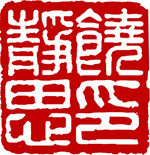
Kawashima Takashi [
Factions of Jikishinkage-ryū do not consistently describe the role of Kawashima Takashi in its 20th century history. Information from the memorial stele erected to Kawashima at Kotoira shrine in Chiba by Ōnishi Hidetaka Namiki Yasushi, Itō Masayuki and others can be found here.
Early Life
Kawashima was born in Chiba, studied Fujishin-ryū (不二心流)1 in his youth and aspired to be a Confucian scholar. At age 22 he entered the Imperial Navy, and fought in the Russo-Japanese War (1904–05). He was part of the Yokosuka naval corps, receiving his Ittō-ryū license during service. He crossed to Taiwan in spring 1910, settling in Tainan that June.
His memorial stele states plainly that “in the spring of his twenty-ninth year he took up the post of kendō instructor to the Taiwan police” from roughly 1911–12. Other sources write that he moved to Taiwan in 1910 at age 27.
Kyudō
In Taiwan he began a lifelong study of Kyudō. He became a kyudō disciple of Sakai Hikotarō (opens in a new tab) (酒井彦太郎; 1867-1951) Heki-ryū Sekka-ha kyudō/kyūjutsu, reaching the Butokukai level of hanshi.
Further details of his life are drawn from kyudō researchers (opens in a new tab):
- In 1927, he took employment as an educator in Tainan Commercial High School.
- In 1930, he worked with the Police Affairs Department and opened a kyudō dōjō, the Kakushinkan (覚眞館).2
- In 1934, he was declared a kyudō hanshi, following his Heki-ryū Sekka-ha teacher.3
- In 1952 he published, “Kyudō Retrospective,” in Kamisakai Village, Chiba Prefecture.
Kawashima is listed on koma 128, 弓道 (kyūdō) 範士 subsection, with Kaminaga (神永) adjacent exactly as in the 1939 Asahi list: kyūdō hanshi, Shōwa 9.5 (May 1934), born Meiji 16.4 (April 1883), Tainan Hakkin-chō 1-56. Three independent sources now agree.
The Japanese Academy of Budo conference abstract (48th Annual Conference, 2015; abstract IA-2, p.16) by Matsuo Makinori (International Budo University) and Goga Tomotsugu (Tsukuba), two kyūdō historians whose research program is specifically colonial-Taiwan kyūdō.
Working from Sakai Hikotarō’s disciple register (門人名簿) — which records 515 disciples in Taiwan, 104 in the mainland prefectures, and 5 in Korea/Manchuria, 619 in all — the authors find Kawashima was one of those granted a shinan menkyo (指南免許; teaching license) by Sakai and was the first person to enroll in Tainan. He crossed to Taiwan as a kendō teacher (剣道教師として渡台), taught kendō and jūdō, then shifted toward kyūdō; in 1931 (Shōwa 6), the year his dōjō opened, he resigned his kendō teaching post at the police normal school (警察師範学校) to devote himself to kyūdō. The dōjō, at his residence 台南市白金町一丁目五六, is identified as the 覚眞館.
It is an independent attestation of his practice of Sekka-ha. Kawashima was a licensed Sekka-ha disciple under Sakai Hikotarō. That confirms the entry’s 雪荷派 attribution and consigns the 1939 Asahi’s 竹林派 to error.
The 九州帝大師範 line — effectively refuted. The abstract’s trajectory is entirely Tainan-bound (police-normal-school kendō → 1931 Kakushinkan kyūdō → visiting school instruction), with no Kyūshū Imperial University thread. It doesn’t name and deny the affiliation, so this is refutation by a documented alternative rather than explicit contradiction, but combined with the timeline mismatch it’s enough to treat the Asahi’s 九州帝大師範 as that source’s error.
The documentary name of the dōjō is 覚眞館 (likely Kakushinkan), with its opening dated to 1931 rather than 1930; the “Mishinkan” form is preserved in Taiwan eyewitness recollection with different kanji (see the note above).
Kawashima died on August 17, 1957. He was buried in Yamamu City, Chiba Prefecture with the posthumous name “Butokuin Kyuu no Yoshisei.”
Kendō
Kawashima is regarded as being a skilled kendō exponent. The Butokukai had a Taiwan honbu (台湾本部) from 1906, and its fundraising and structure ran through the police, of whom he was a senior kendō instructor. So, he would have been known to that organization.
Ōnishi Hidetaka wrote of Kawashima:
Mr. Kawashima Takashi, a kendō master in Tainan, had a great reputation as the best swordsman in Taiwan and had mastered both kendō and Kyudō. However, he was burning with a desire to further master the mysteries of kendō. By chance, he heard rumors about Mr. Yamada Jirokichi, a kendō master at Tokyo University of Commerce who was also from Chiba Prefecture, from Mr. Kojima Masashi, a kendō instructor at the Hualien Port Authority at the Taipei branch of the Dai Nippon Butokukai. He decided that this was the great teacher he should be taught by.
This indicates Kawashima returned to Japan to train with Yamada Jirokichi — it is unclear how many times and for how long. His memorial stele names him as having been the most skilled kenshi in Taiwan, and held a training session where he faced 70 opponents without losing control of his breathing.
Jikishinkage-ryū practice in Taiwan is documented by the academic study of Kawashima. The furibō group photo — held by a Kawashima family member, placed at the first Tainan Butokuden — is the first concrete evidence of Kawashima’s actual Jikishinkage-ryū kenjutsu activity in the colony, which is the premise the dōtō narrative rests on.
An interior photograph of the first-generation Tainan Butokuden was matched (by ceiling and window forms) to a group photo — held by Kawashima Katsuko (川島勝子) — of kenjutsu practice with a furibō (振り棒), the swinging bar the abstract explicitly identifies as used in Jikishinkage-ryū, placing that photo at the first Tainan Butokuden.
There are on the order of 330 Taiwan-address occurrences across the Butokukai HQ register, island-wide (Tainan, Taihoku, Taichū, Kīrun, Takao, Karenkō, Penghu, Taitō), and the striking pattern is that the entries are overwhelmingly police-attached — 警察署, 州警務部, 警務課, and the Governor-General’s own 臺灣總督府警察官練習所 (police training institute, koma 119).
That is documentary confirmation, external to secondary sites, that Butokukai title-holders in the colony sat inside the police apparatus — the “kendō diffused through the police-and-school structure” claim, now with a roster behind it rather than an inference.
Kawashima went to Taiwan explicitly as a kendō teacher and held a kendō post at the police normal school — firm support for the “Tainan police kendō instructor / serious kendō figure” framing, independent of any Butokukai sword rank.
16th Dōtō of Jikishinkage-ryū Seitō-ha
Several lines maintain that Kawashima was Yamada Jirokichi’s chosen successor:
- The Hōjōkai / Seitō-ha (正統派) and the Yokohama Hōjōkai records itself as founded in 1997 by the 20th-generation Yoshida-shihan, now under the 21st-generation Tanaka-shihan.
- The Ichiken-kai (一劔会) at Kawaguchi in Saitama asserts that it is directly descended from the orthodox (seitō) Jikishinkage-ryū, using the same 正統 vocabulary.
- Issei-kai (一誠会) also count Kawashima as the 16th-generation dōtō holder — with Onishi as 17th generation dōtō. 4
In contrast, the Hyakuren-kai (百錬会) / Sō-honbu (宗本部) account, as given through the Nihon Kobudō Kyōkai, lists the dōtō down through the fifteenth, Yamada Jirōkichi Ittokusai (山田次朗吉一徳斎), and then treats it as having lapsed — the post-war figures are entered by administrative title rather than generation number: Ōnishi Hidetaka Hyakurensai as “Hyakuren-kai chairman,” Hayakawa Kōichi Shōkensai (早川幸市匠建斎) as “first Sō-honbu head,” Iwasa Katsu Kyōshūsai (岩佐勝橋舟斎) as second and Wakabayashi Satoru Beishūsai (若林悟米舟斎) as third. They maintain Kawashima declined the headmastership of Jiki Shinkage-ryu and thus the line of transmission ended with Yamada, and say that Onishi later revived the art.5
This seems to be contradicted by documented evidence. There is likely something much more to his early story in Taiwan between 1910 and 1925 that is not easily available to researchers today, but he was indeed considered the 16th-generation head by several strong lines of practice. 6
Time in Taiwan
Kawashima does not appear on the Butokukai Taihoku-branch roster, the Tainan or Karenkō police kendō rosters available online, or a pacification-campaign personnel list. He is, however, listed in the Butokukai’s national shōgō register — the 1937 名鑑 places him among the kyūdō (弓道) hanshi (see above) — so the absence is from the local and branch rosters, not the central record.
The Taiwan kyūdō historian who tags him places his activity in the Tainan colonial-school milieu (alongside Tainan, Taichū, Kīrun and the Kansai Gakuin archery tour); and after returning to Japan and accepting, then relinquishing, the succession in 1925 he taught at a high school in Taiwan and ran a Heki-ryū Sekka-ha (日置流雪荷派) kyūdō dōjō under Sakai Hikotarō until his death in 1957. Kawashima is known to have mastered archery, much of the information of him online is written from that perspective.
As a Taiwan police kendō instructor, he was at the training core of exactly the apparatus that carried out the riban (理蕃) pacification campaigns through 1915 and the suppression of the Tainan-centred Tapani / Xilai’an Incident of 1915. Whether he personally was involved in those actions remains undocumented, but his students or colleagues may have indeed performed actions on behalf of those campaigns. The experience would have left a lasting mark.
On February 7, 1929, the Taiwan Daily News published news about a group of archery instructors arriving in Taiwan:
In the early Shōwa era, a group of six, including Sasaki Morisui, an instructor of the Dai-Nippon Butoku-kai (Great Japan Martial Virtue Association), arrived in Taiwan from Keelung Port aboard the Mizuho Maru, and traveled and lectured throughout northern and southern Taiwan.Sasaki Morisui, also known as Sasaki Kikutaro Hanji, was from Fukuoka Prefecture. He studied under Yamaji Michishige of the Hioki-ryu Seika school and was active in Kyushu and Korea.The famous quote from his archery manual, “The arrow moves like flowing water, the body blooms like a flower,” is attributed to Sasaki Hanji.
The Dai Nippon Butokukai established a Taiwan honbu (台湾本部) — a full headquarters, not a mere branch — in April 1906 (Meiji 39), one of only three colonial honbu alongside the later Manchuria and Korea bodies. And the Butokukai’s machinery ran on the police: while other public bodies used ordinary municipal staff for fundraising, the Butokukai’s solicitation was carried mainly by police officers, with prefectural and local governors heading the branches. In the colony this is more than a funding detail — kendō diffused through the police and school apparatus that was the instrument of colonial control. Kawashima’s own route to Yamada confirms the texture: it ran through Kojima Masashi, described as a Hualien-area kendō instructor under the Butokukai’s Taipei branch. So whatever his title, a leading Tainan kendō figure in 1910–1925 sat inside, or immediately adjacent to, that police-and-school structure.
Taiwan keisatsu kyōkai zasshi (台湾警察協会雑誌), which surfaced in one search and ran kendō and personnel notices, and the digitized Taiwan Nichinichi Shinpō for embu and tournament reports that might name a Tainan kendō instructor. His Tainan window coincides with the two most violent episodes of the colonial project, both police-driven, and the geography lines up with his and Kojima’s postings. As a police kendō chief instructor, he was adjacent to these activities at the time:
- The riban (理蕃; “aborigine-management”) campaigns under Governor-General Sakuma Samata ran 1906–1915, with the 1914 Truku/Taroko campaign fought in the Hualien hinterland — exactly where Kojima was stationed.
- In Tainan itself, the Tapani / Xilai’an Incident (Seirai-an jiken, 西来庵事件) of 1915 was the largest Han-led uprising of the colonial era: Han and aboriginal fighters stormed multiple Japanese police stations, and the suppression was severe — around 1,412 killed in the crackdown and roughly 1,424 (other counts ~1,900) arrested and tried, with more than 800 death sentences, of which 95 were carried out before the remainder were commuted under domestic and parliamentary criticism, plus village-level reprisals beyond the recorded totals.
Given that colonial kendō ran through the police and the police were the instrument of both events, it would be interesting to research this further.
Memorial Stele
The Kawashima Takashi memorial stele provides clarifying information. Both the stele (“upon being asked, he succeeded as the 16th generation of that school”) and the kyūdō researcher’s timeline (“June 1925, succeeded as the 16th-generation inheritor; subsequently resigned for some reason” — 繼任…其後因故辭任) say he accepted and then resigned, not that he refused.
This is an important distinction.
Kawashima often opened enbu with formal purification rituals associated to Heki-ryū. Kenshi like Namiki and others also practiced Heki-ryū Sekka-ha kyūdō alongside their Jikishinkage-ryū, due to Kawashima’s influence. After Itō Masayuki died and Namiki’s son separated from the dōjō his father had founded, he still demonstrated Heki-ryū annually at Kashima shrine enbu as an official representative of that art, while maintaining a private practice of Jikishinkage-ryū.
Kawashima is also remembered for saving the school’s transmission texts from Occupation confiscation in Taiwan, not destroying them, or ending a lineage. If accurate, that makes him a custodian of material related to Jikishinkage-ryū and thus at that time, regardless of viewing himself as its nominal head, still cared about its legacy.
Regarding succession. Kawashima seems to have been settled at the time in Taiwan. A 16th-generation head whose career and family were rooted in colonial Tainan, not Tokyo, was poorly placed to actually hold a Tokyo-centred koryū headship, which makes a resignation (rather than an outright refusal) understandable. Ōnishi would then have been the nominal head while Kawashima was in Taiwan, possibly not taking on the mantle himself until Kawashima’s passing, simply out of respect for his senior.
Kawashima was repatriated to Japan during 1945-1946 to Kitashimizu in Chiba, where he continued to teach kyudō.
Associated Figures
Kojima Masashi
Kojima Masashi is attested only in Ōnishi’s essay, as the Hualien-area (花蓮港) kendō instructor under the Butokukai’s Taipei branch who told Kawashima about Yamada Jirōkichi and so set the succession in motion.
Aoyagi Kumakichi
A different Hualien-linked figure in the kyūdō timeline, Aoyagi Kumakichi / Shida Utanosuke (青柳熊吉/信太歌之助), is whom Kawashima travelled to Hualien Port to receive in 1916.
The newspaper Taiwan Nichinichi Shinpō (7 February 1929) reports a six-man Butokukai kyūdō teaching party led by Sasaki Kosui (佐々木鼓水) — hanshi, of Fukuoka, also known as Sasaki Kikutarō (佐々木菊太郎) — arriving at Kīrun (Keelung) on the Mizuho Maru and touring north and south with an itinerary that includes a Tainan stop. The detail that ties it to Kawashima is the school: Sasaki was a Heki-ryū Sekka-ha (日置流雪荷派) archer under 〔Yamaji Michishige 山地道重〕, the same kyūdō line in which Kawashima trained under Sakai Hikotarō (酒井彦太郎). A Sekka-ha Butokukai delegation passing through Tainan in 1929 would almost certainly have been received by the resident Sekka-ha authority there — Kawashima — even though he is not named in the notice itself.
Disciples
The memorial stele was inaugurated by 13 initiators plus 10 supporters (23 total). Ōnishi Hidetaka (大西英隆) is the first initiator, Namiki Yasushi (並木靖) the 7th and Itō Masayuki (伊藤雅之) the 12th.
End Notes
-
Fujishin-ryū (不二心流; ふじしんりゅう) is a late-Edo kenjutsu school — the first installment of the All-Japan Kendō Federation’s “Bakumatsu village kenjutsu” (幕末在村剣術) research series is devoted to it. Its founder, Nakamura Isshinsai (中村一心斎, orig. Nakamura Hachihei 中村八平), studied Asayama Ichiden-ryū and later became head student (jukutō) of Suzuki Onohachirō’s Shintō Munen-ryū dōjō — the connection that places 不二心流 in the Nen-ryū / Munen-ryū cluster. In Bunsei 1 (1818), after hundred-day austerities on the sacred peak, he attained the realization “in my heart there is no divided mind” (我が心に二心無し) and named the school Fujishin-ryū (不二 carrying a deliberate double sense: the mountain, and “non-dual / undivided”), opening a Hatchōbori dōjō said to have had two thousand students. A transmission scroll (不二心流兵術覚) survives in the Kumamoto Prefectural Library’s Tominaga collection, and the line is still transmitted today by the Kokusai Suigetsujuku Bujutsu Association. A widely-diffused Kantō village-kenjutsu school is exactly what a Chiba (Kazusa/Shimōsa) native would have picked up in early regional training, fitting the stele’s sequence of Ittō-ryū and Fujishin-ryū licenses “in his twenties,” before the Navy, Taiwan, and his later Jikishinkage-ryū study under Yamada. ↩
-
The documentary reading, from Matsuo and Goga’s academic study (2015), is 覚眞館 (Kakushinkan), which dates the dōjō’s opening to Shōwa 6 (1931). Taiwan eyewitness accounts recall it as the “Mishinkan,” with different kanji, and place the opening in 1930; that first-hand recollection is preserved here alongside the documentary form rather than dismissed as error. ↩
-
The kyūdō blog gives 1931; the Butokukai’s own 1937 register (武道範士教士錬士名鑑) records the kyūdō-hanshi conferral as Shōwa 9.5 (May 1934), followed here. ↩
-
The Issei-kai opens its own doctrinal homepage with preserved 1940s rhetoric, invoking hakkō ichiu (八紘一宇), “world renovation,” and national survival – highly militaristic language. ↩
-
Early versions of my book on Jikishinkage-ryū favored the Hyakuren-kai account too charitably. ↩
-
It may be that the Hyakuren-kai needs his refusal to be final, because foregrounding Ōnishi’s revival is the whole point of its self-account. As someone who studied under a branch from Seitō-ha, I follow that line’s convention in naming Kawashima as sixteenth. ↩