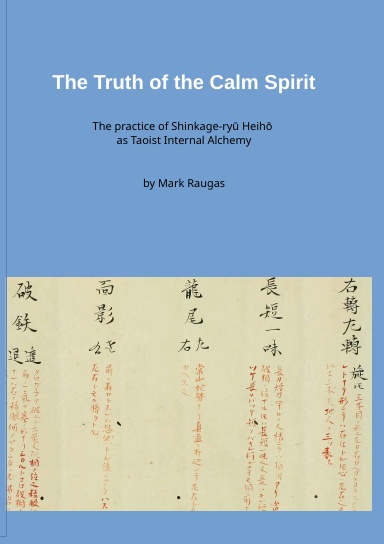
Kashima-shinden Jiki Shinkage-ryū (opens in a new tab) (直心影流) is an important line of Shinkage-ryū. My earlier writing on the art, from 2017–2025, is now available as a book:
Inner Dharma, 2025 — paperback (opens in a new tab) · about the book (opens in a new tab)
It details the technical composition of its kata (drawing on mokuroku held at Waseda University) and some of the inner principles by which it is organized, with attention to the Daoist and esoteric Buddhist currents that run broadly through Shinkage-ryū. Please consider purchasing a copy to help support the maintenance of this site.
In this book I examine densho of the art and describe some of the higher principles, or gokui, associated to its practice. People often assume that the higher principles, or gokui, of a surviving ryūha (流派; school, tradition) are private to each school. Their detailed explanations frequently were. But historically the gokui were listed in densho (伝書; transmission document) precisely so that they could, on occasion, be inspected by the central authorities — in effect, to attest that a group was not teaching anything that might threaten the Shogunate. Alongside the written gokui sat kuden 口伝, oral teachings that could go further, unlocking the realizations needed to approach the founders’ original inspiration, especially where that inspiration was couched in philosophical, religious or visionary language. The word also carried a polemical use. To name the gokui could be a way of asserting dominance or priority in a matter of faction or succession. Ishigaki Yasuzo, who inherited a line of Jikishinkage-ryū practice (from the Odani-ha to the Nomi-ha) that had stopped training some time after the Second World War, gathered his family’s documents, poems and commentary into Kashima Shinden Jikishinkage-ryū Gokui Denkai (鹿島神伝直心影流極意伝開) in part to assert the standing of that line. The book is, for all that, a valuable record of much of the surviving writing of the art.
Yamada Jirokichi catalogued the teachings of Jiki Shinkage-ryū in an effort to preserve the tradition. Because Jikishinkage-ryū had a number of practitioners of high social standing at the close of the Tokugawa period, there was considerable interest in it toward the end of the nineteenth century. The art’s emphasis on shiai (試合; contest) contributed, in part, to the development of modern kendō. The transmission of advanced material ran heavily through guided drills and pointing-out instructions on topics called koto (事; matters) or katsu (かつ; resuscitation shout/revival cry) — material that a curriculum of formal kata alone does not preserve.1
The gokui of an art are not fixed across the centuries, and the Jikishinkage-ryū literature shows this directly. Karukome Yoshitaka (軽米克尊) of Tenri University, in his 2020 monograph Jikishinkage-ryū no Kenkyū (直心影流の研究, Kokusho Kankōkai), compares the mokuroku (目録; catalogue scroll of transmission)2 of Jikishin Seitō-ryū (直心正統流) with later Jikishinkage-ryū mokuroku and shows that several items were added by Naganuma Kunisato (長沼国郷) when the school took its current name. Sōjaku no Koto (相尺之事), Tome Sandan no Koto (留三段之事), Kiri Otoshi no Koto (切落之事) and Ginmi no Koto (吟味之事) are absent from Yamada Heizaemon Mitsunori’s Heihō Zakki (兵法雑記) but appear in Naganuma’s Jikishinkage-ryū Mokuroku Kuden-sho (直心影流目録口伝書), which suggests they represent Naganuma’s own innovations to the curriculum. The same period saw a broader reframing. The lineage was revised to place Matsumoto Bizen no Kami as founder, and the art was renamed to include “Kashima-shinden,” asserting divine inspiration from the Shintō deity Takemikazuchi (建御雷) as part of its identity. Over the Edo period the earlier esoteric Buddhist and Daoist influences were progressively downplayed.
[ The history section of my own account was later expanded on the basis of an additional densho by Ogawa Yashichi from 1800 (opens in a new tab). ]
Many of the gokui of Jikishinkage-ryū are common to more than one line of Shinkage-ryū and have been discussed elsewhere — Marubashi (転; rolling/tumbling [technique]) and Shinmyōken (神妙剣; divinely subtle/mysterious sword) among them, with matters such as kiri otoshi (切り落とし; cutting-down counter) also found across several arts in different sections of their surviving densho. A 1978 study by Okada Kazuo (岡田一男) of Kokugakuin University, “Yagyū Shinkage-ryū Genryū-kō” (柳生新陰流源流考, Budōgaku Kenkyū 10:3, 1978), argued that the “three steps” teaching (san no kazu) attributed to Yagyū Jūbei — in which the logic of receiving and responding is the logic of ten, rolling or turning — is fundamentally the same principle as Jikishinkage-ryū’s Marubashi. That the art’s central principles recur in related lines is consistent with the structural overlap between early Shinkage-ryū and Chinese martial theory, rather than with any single hidden transmission.
End Notes
-
An example from Shintō-ryū are the gokui shichijō (極意七条) — seven “essential articles,” presented in Katori Shintō-ryū as three kata each expressing a different initiative sente (先手; initiative). The kata are intended to teach seven gokui, which are named in the academic scholarship on Shintō-ryū, but one cannot recover the gokui simply by watching or learning the physical kata. ↩
-
The ten evils to be avoided, now found as admonitions in several lines of kenjutsu practice, sit at the end of the historical mokuroku before the capstone. ↩