Tenjin Shin’yō-ryū descends from the Yōshin-ryū grappling stream, but its founding by Iso Mataemon at Kitano Tenmangū is a Tenjin-cult devotional act, not a mountain-Shugendō revelation like Kage-ryū’s — the tengu and Kurama material survives only as okuden iconographic residue. Its Chinese-origin legend likewise collapses on inspection to a Nagasaki medical/kappō residue, while the actual technical lineage runs through its own period of inspriation and innovation.
Founding at Kitano Tenmangū: Iso and the giri bind
The shrine Iso visited to found his art was the Kitano Tenmangū (北野天満宮) in Kyoto, but Iso’s founding story has almost no Shugendō overlay — not merely because of the Edo period founding date, but because the Tenmangū is the wrong kind of shrine for that.
Caught in a giri (義理; social obligation) bind between two teachers, Iso could not found his own art under the Shin-no-Shintō-ryū (真之神道流) name (which would fail his obligation to Hitotsuyanagi 一柳, his Yōshin-ryū teacher) or under the Yōshin-ryū name (which would fail his obligation to Homma 本間, his Shin-no-Shintō-ryū teacher). Iso instead sought neutral sacred ground: he took his inner disciples to Kitano Tenmangū and, at the votive-tablet hall (絵馬堂; ema-dō) before the shrine, devised new techniques and merged the two schools into 124 kata of Tenjin Shin’yō-ryū.
What Iso brought to that merger was a conviction about striking won in the field. On the musha-shugyō (武者修行) that followed his mastery of both parent arts, at the Kusatsu post-station (草津宿) on the Tōkaidō in Ōmi, he and a single disciple, Nishimura (西村), fought off more than a hundred assailants in defence of a third party; in that fight he first grasped the effectiveness of atemi (当身; striking) in earnest combat, and afterward drilled toward what the tradition calls the shin-no-ate (真の当て; “true strike”) — the blow placed on a physiological weak point. It is that realization, rather than any willow observation, that the school’s own later accounts and the standard encyclopedic biographies foreground as the decisive moment, and it is the atemi-and-kyūsho emphasis from it that was then built into the new curriculum.
The “Tenjin” of the name is the Tenmangū deity — the deified Sugawara no Michizane (菅原道真).1
Tenjin: Sugawara no Michizane and the double-natured kami
The kami Tenjin (天神) is the deified spirit of Sugawara no Michizane (菅原道真, 845–903). Michizane was a Heian scholar, poet and statesman who rose unusually high for his middling birth: advanced by Emperor Uda as a counterweight to the Fujiwara and made Minister of the Right (udaijin, 右大臣) by 899 under Emperor Daigo. In 901 Fujiwara no Tokihira accused him of plotting against the throne, and he was exiled to Dazaifu in Kyūshū, where he died in 903 — the episode known as the Shōtai Incident (昌泰の変). What made him a kami was what followed: a run of calamities in the capital — Tokihira’s sudden death at thirty-nine, and in 930 a lightning strike on a hall of the imperial palace (the Seiryōden, 清涼殿) that killed courtiers — read as the work of his vengeful spirit (onryō, 怨霊). To appease him the court restored his rank (923) and later built Kitano Tenman-gū (北野天満宮) in Kyoto (947), enshrining him as Tenjin, a god of sky and storms; the full title was Tenman Dai Jizai Tenjin (天満大自在天神), a deity wielding thunder and storm. Only over time did the thunderous, vengeful aspect soften into the benign kami of scholarship, the deity students still petition for examination success, with Tenmangū shrines now numbering in the thousands. His emblems are the plum (ume, 梅) — the tobiume (飛梅), the “flying plum” of legend said to have flown to him in exile — and the ox. So the deity invoked is double-natured: a thunder-and-vengeance power as much as a patron of letters, which is part of why a martial school could reach for him.
The link to the school is concrete. Iso Mataemon (磯又右衛門, 1790–1863),2 having mastered Yōshin-ryū and Shin-no-Shintō-ryū, undertook seishin tanren (精神鍛錬; spiritual-physical forging) at Kitano Tenmangū in northern Kyoto and named the school by drawing “Tenjin” (天神) from Michizane enshrined at that shrine, “shin” (真) from Shin-no-Shintō-ryū and “yō” (楊; willow) from Yōshin-ryū: 天神真楊流. The willow itself is older than Iso — the parent Yōshin-ryū’s own legend has its reviver Akiyama Shirōbei Yoshimasa (秋山四郎兵衛義昌) performing a hundred-day seclusion at Dazaifu Tenmangū (太宰府天満宮), the other great Michizane shrine, and naming Yōshin-ryū after watching willow shed its snow. Japanese accounts note that because Akiyama’s story duplicates Tenjin Shin’yō-ryū technique-names, it may be a later back-formation — but either way, the Tenjin-shrine-plus-willow image is the shared origin signature of the whole Yōshin family.
The body-knowledge core: atemi, kyūsho, the dōshaku-no-maki
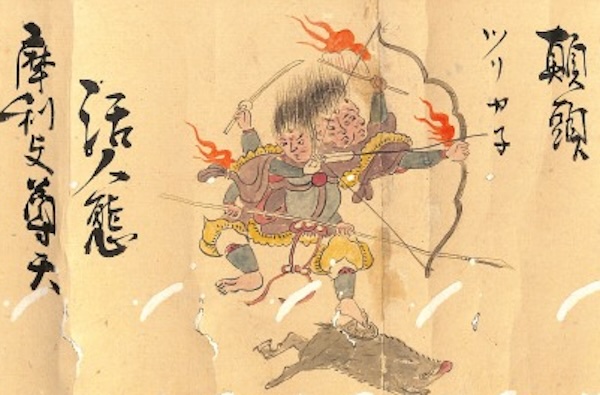
Marishiten (摩利支天; Skt. Marīcī) is found depicted in upper-level densho of the art. The highest-level scroll of Akiyama Yōshin-ryū involved atemi (当身) and kyūsho (急所; vital-point) targets on the body, and this is carried forward in Tenjin Shin’yō-ryū. The dōshaku-no-maki (胴釈之巻) — the vital-points and atemi (当身; strikes to anatomical targets) scroll that is the recognized Yōshin-ryū esoteric core — flows downstream into the Tenjin Shin’yō-ryū Hito-no-maki (人之巻; scroll of mankind). That is a body-knowledge transmission, not Shintō or Buddhist, except that Buddhist elements are often listed on the body diagrams, possibly to signify importance. This is common to several old jūjutsu styles.
The weighting is itself telling. The tradition casts Akiyama as a pediatric physician (小児医師), and Tezuka Masataka’s survey treats kappō — resuscitation — rather than any fighting curriculum as the connective tissue running from Yōshin-ryū through Tenjin Shin’yō-ryū and into Kōdōkan jūdō, with Tenjin Shin’yō-ryū the school in which that resuscitation study was most developed (Tezuka Masataka 2002); Nagaki Kōsuke’s two-part study of the school’s medical basis reaches the same conclusion from the founder documents (Nagaki Kōsuke 1984).
The curriculum carrying this material is set out in the school’s own 1893 Tenjin Shin’yō-ryū jūjutsu gokui kyōju zukai (天神真楊流柔術極意教授図解), the illustrated manual of the fifth Iso Mataemon and Yoshida Chiharu (吉田千春) that Tezuka draws on: the kata begin with te-hodoki (手解) and run in fixed order through idori (居捕) and tachiai (立合) sets, the Ten-no-maki (天之巻) alone holding ten tachiai and ten idori, with a Unjō-no-maki (雲上之巻) reserved for atemi and kyūsho (Yoshida Chiharu and Iso Mataemon 1893). The resuscitation side is graded in step with the kata as a four-article kappō (四ヶ条の活法): sasoi-katsu (誘活) conferred on completing shodan, eri-katsu-hō (襟活法) after chūdan, kin-katsu-hō (金活法) after the nagesute, and sō-katsu-hō (総活法) after gokui-jōdan, over a keiraku (経絡; meridian) and yakuhō (薬法; pharmacopoeia) apparatus for treating strikes.3 Tezuka sets the whole against the older Yōshin-ryū material visible in dated densho, notably the Genbun 3 (1738) document of the Kōno Sōan Nyūdō Hiromasa (河野巣安入道弘昌)4 whose archaic form-names show how little the core set shifted on its way into the late-Edo system.
Akiyama or Ōe? The contested founder
Akiyama himself is contested, with Takahashi Masaru (高橋賢) arguing the real founder of Yōshin-ryū to be the second-generation Ōe Senbei, and Akiyama an embellished or fictional figure (Takahashi Masaru 〔serialized c. six years; ran into the 2000s, unfinished〕). Nagaki Kōsuke (永木耕介) presses the doubt from a different direction: although most sources make Akiyama a man of Hizen Nagasaki, the Higo Budō-shi (肥後武道史) domain-teacher genealogy records him as a retainer of the Matsudaira (Asano) lord of Aki (松平安芸守), and the Seishi Kakei Daijiten (姓氏家系大事典) and Geihan Tsūshi (芸藩通志) place the Akiyama surname natively in Aki (安芸; Hiroshima) rather than Kyushu, so even the founder’s home province is unsettled (Nagaki Kōsuke 1982). Wataya Kiyoshi (綿谷雪) separately doubts the China-voyage narrative of Akiyama because overseas travel was then banned (Wataya Kiyoshi and Yamada Tadachi 〔expanded/revised editions; year-of-edition to be fixed〕). A partly fabricated origin legend is the opposite of evidence for a lived Shugendō practice.
Kurama behind Tenjin
Tengu (天狗) influence is not the province of weapons traditions like Kage-ryū (陰流) alone. Some grappling styles have clear markers of tengu as important portions of their composition at higher levels of practice, but Chinese medical or anatomical influence seems more prominent than mountain seclusion. This may be due to the time periods in which these arts developed and flourished. The Akiyama Yōshin-ryū (楊心流) has tengu orthography or depictions in its advanced teaching scrolls, but important descendent schools such as the Tenjin Shin’yō-ryū (天神真楊流) of Iso Mataemon Masatari (磯又右衛門正足, Ryūkansai 柳関斎) do not.
The Shugendō register is thin because of the kind of shrine Tenmangū is. It is the urban, civic Tenjin cult of a deified human (a goryō 御霊 turned patron of letters and the arts), not a yamabushi (山伏) mountain like Udo (鵜戸), Kumano (熊野), Hikosan (英彦山) or Kirishima (霧島). Founding at a Tenmangū is a Tenjin-devotional act, categorically distinct from the Shingon/Ryōbu-Shintō (両部神道) mountain Shugendō that produced the Kage-ryū revelation. This holds independent of the date, and the late (mid-nineteenth-century) context then compounds it.
Iso’s pressure is social obligation, not the religious or martial anxiety of musha shugyō (武者修行). The “realization” he obtains is naturalistic and pedagogical (the willow’s flexibility), thus modern in outlook. The school itself is an urban enterprise — a Kanda Otamagaike (神田於玉ヶ池) dōjō (the Gyokubukan 玉武館), instruction at the Bakufu Kōbusho (講武所), five thousand students, feeding directly into Kanō’s Kōdōkan (講道館).
The willow motif is an inherited topos rather than live austerity: it is the older Akiyama Yōshin-ryū origin story, in which Akiyama performed a hundred-day sanrō at Dazaifu Tenmangū (太宰府天満宮), saw snow failing to settle on the willow, grasped the yielding principle and devised some three hundred techniques.
The documented influence runs through Kurama, as do many arts, not through any Tenmangū. Yōshin-ryū carries a tradition placing its remote ancestry with Kiichi Hōgen (鬼一法眼) and Minamoto no Yoshitsune (源義経) and drawing its lineage from the martial arts of Kurama, and offshoots such as Kurama Yōshin-ryū (鞍馬楊心流) explicitly claim Kurama-martial origin.
This is similar to many other subsequent arts. Kurama is a tengu mountain par excellence — Sōjōbō’s (僧正坊) instruction of Ushiwakamaru (牛若丸) — and its own cult is esoteric: the Sonten (尊天) of Kurama is a trinity of Senju Kannon (千手観音), Bishamonten (毘沙門天) and the Gohō Maō-son (護法魔王尊), figured as moon, sun and earth, the last of these the tengu-king figure.
The public, named patron is the respectable Tenjin (Michizane) cult, exactly the legitimating face an urban late-Edo school presenting at the Kōbusho would want. The inherited Kurama-tengu narrative sits in the okuden of the art as an iconographic residue from the older stream — a mountain-inspired warrior inspiration hidden behind an exoteric Tenjin face. The Kurama-based Yoshitsune and Kiichi Hōgen tengu ancestry is the school’s own documented tradition, but not verifiable.
From Aisu Ikōsai at Udo (c. 1500, a lived Shingon-Shugendō mountain revelation with tengu as a transmission event) to Iso Mataemon at Kitano Tenmangū (c. 1830, a Tenjin-cult devotional founding with tengu surviving only as okuden iconography), the esoteric register thins from practice to literary-pictorial residue, tracking exactly the institutionalization of these legends as being what is expected of arts, rather than what makes them unique.
The Kiichi Hōgen / Yoshitsune / Kurama remote-ancestry tradition belongs to the Yōshin-ryū stream as a whole, with the offshoot Kurama Yōshin-ryū making the Kurama-martial origin explicit. Tenjin Shin’yō-ryū descends straight from that stream and carried the parent corpus forward fairly intact — the shizuma-no-maki (静間之巻; reading tentative) form-names pass into the late-Edo jūjutsu system almost unchanged (Ōe Senbei 〔undated; pre-TSR Yōshin-ryū〕). So at minimum the Sōjōbō and Kurama motif is itself an influence, inherited alongside the kyūsho nomenclature, not conjured later on by Iso Mataemon’s circle.5
Curating the pedigree: the Tōryū Taii-roku
Early-to-mid Tenjin Shin’yō-ryū practitioners were demonstrably curating the school’s pedigree in precisely the window of time in which a tengu-centric overlay or gloss would be plausible. The Tōryū Taii-roku (当流大意録), a mid-nineteenth-century Tenjin Shin’yō-ryū text, is where the Akiyama / China-voyage / Dazaifu-Tenmangū willow story is worked up. A school producing that kind of origin document is editing its lineage, not passively transmitting it.
If early Tenjin Shin’yō-ryū foregrounded or re-elaborated Kurama tengu iconography (such as Sōjōbō) while compiling its own okuden densho, that is prestige-borrowing — dignifying a school whose actual founding was a naturalistic willow-observation with a Kurama-tengu descent.6
It is also well after the time that the popular Yagyū Shinkage-ryū utilized images of tengu in its emokuroku (絵目録) and the Edo-period tengu compilation and “ranking” was available.7
The China-voyage Legend
Akiyama, a Japanese physician, supposedly sailed to China and learned a few techniques and resuscitation methods from a Chinese physician (唐人博転; Hakuten, reading uncertain) before the Dazaifu Tenmangū seclusion.
The fullest form of the narrative comes from the Tōryū Taii-roku (当流大意録), a mid-nineteenth-century Tenjin Shin’yō-ryū text, and runs as follows: Akiyama Shirōbei (秋山四郎兵衛), a physician, crossed to China for medical training (医術修行), and there studied under a Chinese man called Hakuten (博転; reading uncertain), from whom he received jūjutsu san-te and kappō nijūhachi-te — three jūjutsu (柔術) techniques and twenty-eight methods of kappō (活法; resuscitation). Back in Japan he taught these, but the handful of techniques was too meager to attract students, so he secluded himself for a hundred days at Dazaifu Tenmangū (太宰府天満宮); observing that snow would not pile up on the willow (楊) — the supple branch sheds the load the rigid one would snap under — he grasped the essence of yielding, expanded the art to 303 techniques (三百三手) and named it Yōshin-ryū (楊心流; “willow-heart school”) (Tenjin Shin’yō-ryū (compiler unknown) 〔mid-19th century〕).
Akiyama learned three combat techniques against twenty-eight resuscitation methods. The substance is the sakkatsu-hō (殺活法; “killing-and-reviving methods”) — kyūsho (急所; vital-point) knowledge and its medical counterpart, the reviving techniques. This is exactly the body of learning Yōshin-ryū became famous for and propagated downstream; the kyūsho nomenclature of modern budō — names such as suigetsu (水月), jinchū (人中) and murasame (村雨) — largely descends from it by way of the Kōdōkan. Parallel transmissions survive and are evidenced by the early licenses awarded by Matsuoka of Shindō Yōshin-ryū (神道揚心流).
The same graded ladder survives in Shindō Yōshin-ryū, the line Matsuoka Katsunosuke (松岡克之助) built in 1864 out of Tenjin Shin’yō-ryū — learned under the third head Iso Masatomo (磯正智) — together with Totsuka-ha Yōshin-ryū (戸塚派揚心流). A mid-Edo offshoot reproducing the same kappō-by-grade structure is further evidence — with Tōdō Yoshiaki’s reading of the school’s atemi as a medical system grounded in an internal-organ model (Tōdō Yoshiaki 1977) — that the transmitted core was the medical and anatomical apparatus, not the founding legend. In the art’s own words, “Chinese transmission” is far more a medical/resuscitation acquisition than a fighting curriculum, with the actual fighting system credited to the domestic willow revelation rather than to China.
There are competing narratives as well:
- The Bujutsu Ryūso-roku (武術流祖録, 1843) gives the same 3-plus-28 content but has him learn it from a martial official (武官) resident in Hizen Nagasaki (肥前長崎), with no voyage, before the Tenmangū seclusion, and a total of 300 seizing techniques (Author unknown 1843).
- Matsumiya Kanzan’s (松宮観山) Jūjutsu-ki (柔術記, 1700s) inverts the sequence — the Tenmangū willow-dream of an old man bearing snow-laden willow comes first, and only afterward does he acquire twenty-five sakkatsu forms (殺活二十五勢) from a foreign visitor (蕃客) on Japanese soil (Matsumiya Kanzan 〔early-to-mid 18th century〕).
- A deeper pseudo-genealogy in the Yōshin-ryū Sakkatsu-nihō (楊心流殺活二法) traces the reviving art from the Zhou-era physician Bian Que (扁鵲; Biǎn Què) through a retainer of Wei’s Cao Cao (曹操; Cáo Cāo) named Bukan 〔reading/identity uncertain〕, whose Dōshaku-no-maki (胴釈之巻; a vital-point chart) was received at Nagasaki.
- The Kurama Yōshin-ryū licence drops China entirely, having Akiyama receive an eight-volume tiger scroll (八巻の虎之巻) from the treasure house of Kuramayama (鞍馬山) — the tengu version we discussed.
Sakoku, Chén Yuánbīn, and the prestige of a Ming pedigree
Maybe the tengu origin is the most plausible. Tokugawa Sakoku’s (鎖国) prohibition on Japanese going abroad or returning (the 1635 edict, hardening to 1639) bites on the Akiyama-sailed-to-China claim — which is precisely where Wataya Kiyoshi aimed it — but it has no purchase on Chén Yuánbīn (陳元贇; Chin Genpin), who was resident in Japan and whose movement was inbound and took place before 1635.
The oldest documented jūjutsu line, Takeuchi-ryū (竹内流), dates to 1532, well before Chén Yuánbīn and Akiyama — and Takahashi is the same researcher who reads Akiyama as a fictional founder, with Ōe Senbei the real founder of Yōshin-ryū.
In early Edo, claiming a Ming-dynasty pedigree carried more prestige than naming a domestic teacher, a borrowing pattern common in koryū. The same commentary explicitly likens it to Jikishinkage-ryū (直心影流), which in the Edo period surfaced the nittō (入唐; journey to Ming China) travels of Ogasawara Genshinsai (小笠原源信斎) while at the same time projecting its founder back into the Sengoku, via the Matsumoto retrojection.
How does Kurama-dera fit in?
Giving Kurama priority is a confirming piece rather than a lever used to establish an argument. A school carrying both a domestic Yoshitsune/Kurama descent and a foreign China descent is displaying competing prestige-narratives, not a transmission record. The existence of the robust Kurama alternative shows the China story was never relevant.
The travel ban, plus the prestige-borrowing pattern, plus Takahashi’s analysis, in combination weaken the Chinese-origin claim for Yōshin-ryū.
The combat-transmission claim collapses while a narrower medical residue survives. Nagasaki was the one channel of Sino-Japanese contact left open under sakoku, so the part of the Akiyama legend that is actually plausible is not that he learned jūjutsu in China but that he absorbed Chinese-style resuscitation/kappō (活法) and medical framing from the Chinese presence in Nagasaki. That medicine-not-method distinction is the defensible core; the tengu/Kurama material and the native Sengoku grappling traditions carry the actual technical lineage. The China-voyage claim itself rests solely on the Tōryū Taii-roku — the parallel Bujutsu Ryūso-roku (1843) has Akiyama learn from a military officer resident in Nagasaki, not in China.
The two streams meet: Kōbusho randori
Tenjin Shin’yō-ryū’s presence at the Kōbusho was through its practitioners training there as shugyōnin (修行人) rather than through holding that headship. There, however, the two streams of Yōshin-ryū met, in randori.
The clearest instance is Matsuoka Katsunosuke (松岡克之助), as related by Fujiwara’s school history (Fujiwara Ryōzō 1983): summoned as a Kōbusho shugyōnin in 1860, he grappled Totsuka Hikosuke (戸塚彦介) in randori (乱捕) and lost two of three, thereafter took Totsuka as a second teacher and cross-trained in the Totsuka-ha (戸塚派), and later created his own approach, Shindō Yōshin-ryū. The episode rests on that account alone — no primary-source attestation of his Kōbusho attendance has surfaced, as his own entry sets out.
Grappling being concerned with anatomy, the later emphasis of Tenjin Shin’yō-ryū and its descendent Shindō Yōshin-ryū on atemi and resuscitation is congruent with a medical or anatomical influence, which would have been located in Chinese medical practices, possibly to be found in Nagasaki.
No travel to China is required to sustain that influence; but if direct Ming transmission was of political benefit when founding these approaches, given the culture at the time, then it is not surprising those arguments and narratives would have been adopted — just as it was socially congruent for Kanō to later deny those influences.
Kanō Jigorō’s own first teacher of Tenjin Shin’yō-ryū was Fukuda Hachinosuke (福田八之助), under whom he trained before founding the Kōdōkan.
References
The academic anchor for the relationship among the three schools is Oimatsu Shin’ichi; the contested founder-question runs through Takahashi Masaru and Wataya Kiyoshi. The Akiyama origin legend in its fullest form is the Tōryū Taii-roku, with competing tellings in the Bujutsu Ryūso-roku and Matsumiya Kanzan’s Jūjutsu-ki. The archival test for the Kurama/Sōjōbō inheritance is the two Ōe densho below.
-
The Nihon Kobudō Kyōkai’s telling makes the naming explicit: Iso performed sanrō (参籠; ritual seclusion) at Kitano Tenmangū, observed the willow swaying flexibly in the wind (柔軟性; its pliancy) and attained realization, then built the name from “Tenjin” plus the “Shin” (真) of Shin-no-Shintō-ryū and the “Yō” (楊) of Yōshin-ryū. The wind-willow observation is specific to that account; the Wadō Renmei history, the Japanese Wikipedia entry and Kotobank instead make Iso’s defining insight the atemi realization from the Kusatsu fight and treat Kitano as the site where he combined and named the schools rather than as a willow revelation in its own right. ↩
-
Iso’s birth year is disputed: the standard figure is Kansei 2 (1790), with 1786 and 1804 also on record; the Oimatsu study back-calculated 1804 from a family genealogy (Oimatsu Shin’ichi, n.d.). He died in 1863. The earlier draft date of 1787 does not match any of the attested variants. ↩
-
The same activations surface under variant graphs: where the 1893 manual writes 金活法 (kin-katsu-hō) and 総活法 (sō-katsu-hō), the Nipponica entry gives 陰嚢活 and 惣活 (Shōgakukan 1994). ↩
-
Tezuka numbers Kōno Sōan the fourth-generation (四世) head; Watanabe Ichirō’s Nipponica account instead places him as a pupil in the Miura Jirōbei Nagamasa (三浦次郎兵衛永政) branch, of the Nakatsu domain, and gives only the nyūdō name Hiromasa (弘昌) — not the 尚茂 found in some web bios. The two reckonings of his lineage position remain to be reconciled (Watanabe Ichirō 1994). ↩
-
We see a similar emphasis placed in the Kashima Shin-ryū, which might indicate a Yōshin-ryū origin to its jūjutsu (possibly derived from an art named Myōdō-ryū 明道流). ↩
-
Kiichi Hōgen and Sōjōbō are two faces of the same Kurama–Yoshitsune transmission legend, so a specific Sōjōbō emphasis (as against the Kiichi-Hōgen/Yoshitsune framing) could itself be the later inflection. ↩
-
A potential research direction would be to contrast Ōe Senbei’s Shizuma-no-maki at the Nagasaki Prefectural Library and the 1670 Ōe densho with its Kagami-no-maki (鏡之巻) kyūsho genealogy at the Kumamoto Prefectural Library (Ōe 〔given name unverified〕 1670). If they contain tengu imagery, then the later material would be an inheritance; if not, then post-1830 Tenjin Shin’yō-ryū scrolls would be their own overlay. ↩