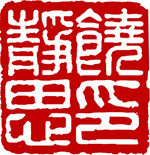
Kyōshin Meichi-ryū (鏡新明智流) was founded by Momonoi Hachirōzaemon Naoyoshi (桃井八郎左衛門直由, 1724–1774), the first to bear the name Momonoi Shunzō (桃井春蔵; the surname 桃井 is also romanized Momoi, and both readings are current). Originally a retainer of the Yanagisawa house of Yamato Kōriyama, he became a rōnin and, after study of Toda-ryū iai, Ittō-ryū, Yagyū-ryū and other lines, devised his own school on the basis of a Toda-ryū secret cut, adding elements of Muhen-ryū spear.
The name was first written 鏡心明智流 — the kyōshin (鏡心; “mirror-heart”) taken from a Toda-ryū form name — and later 鏡新明智流. In An’ei 2 (1773) he opened the Shigakukan (士学館) in a tenement at Minami-Kayabachō in Nihonbashi, Edo; under the second head, Naokazu (直一), the dōjō moved to the Asari-gashi (蜊河岸), by which it was long known. The school nearly foundered under the third head but revived decisively under the fourth, Naomasa, after whom the Shigakukan was counted one of the “three great Edo dōjō.”
Its hallmark was kurai (位; poise, bearing, dignity) rather than force, summed up in the contemporary tag “poise — that is Momonoi” (位は桃井), set beside “technique — that is Chiba” and “power — that is Saitō.” The fourth head, Momonoi Naomasa (桃井直正, 1825–1885) — a Numazu-han samurai’s second son who took full transmission at twenty-three — is the one under whom the Shigakukan’s standing and enrollment rose most sharply.
As a continuous transmission Kyōshin Meichi-ryū did not survive the Meiji period intact, and it is best treated today as a largely historical school; what circulates under the name rests on later reconstruction rather than unbroken lineage, so caution is warranted before describing any present-day practice as the original tradition.
In the Gekiken Sōdan (1790)
Mikami’s kan 5 entry is polemical and unusually candid — hostile to the founder, favorable to his son — and it complicates the received genealogy above.
一、鏡心明智流は近比江戶萱葉町に大束七流軒伴山と云者有り。四流の劔術を合せて一流を結構して私に明智流と云。
He names the founder not as Momonoi Naoyoshi but as Ōtsuka Shichiryūken Banzan (大束七流軒伴山), recently active at Kayabachō (萱葉町) in Edo, “who combined the swordsmanship of four schools to construct a single school, calling it, on his own authority (私に), Meichi-ryū.” One year Banzan hung a boastful placard (自賛の額) at a shrine, declaring that his training had taught him not how to defeat others but how not to be defeated, and offering to instruct even the poor and the unfit. Many went to challenge him — pupils of Naganuma Shirōzaemon (長沼四郞左衞門) among them — but he pleaded illness and never once fought; someone pasted a notice over his placard mocking him, and he was ill spoken of throughout Edo.
されど子春藏は今以て明智流を指南し、稽古場も繁昌する也。此流勝負を專とし、跡をも詰てきびしく打合ふ也。
“But his son, styled Momonoi Shunzō (桃井春藏), teaches Meichi-ryū to this day and his training hall thrives. This school specializes in bouting (勝負を專とし), pressing the follow-up and striking hard.” That last clause is the substantive datum: a c. 1790 attestation of vigorous full-contact shiai at the Momonoi dōjō.
This account differs from the received genealogy: the Gekiken Sōdan makes the first Momonoi Shunzō the son of a founder named Ōtsuka Banzan, whereas the later tradition (above) makes Momonoi Naoyoshi himself the founder and first Shunzō. The discrepancy — a synthetic founder disowned by his own school’s later self-image, or a garbled report — is unresolved, and turns partly on whether the “son” here is Naoyoshi (直由) or the second head Naokazu (直一). Mikami adds that the placard dispute is recorded in detail elsewhere, so he does not elaborate.1
Momonoi Naoyoshi (1st Shunzō)
Founder of Kyōshin Meichi-ryū and the Shigakukan (士学館), opened at Nihonbashi Minami-Kayabachō in 1773. He signed as Hachirōzaemon (八郎左衛門) and never bore “Shunzō” — the “1st Momonoi Shunzō” numbering is a retroactive scholarly label; the myōseki proper begins with the 2nd holder, Naokazu. He is the only holder with a recorded gō (士流軒伴山, reading provisional).
Momonoi Naokazu (2nd Shunzō)
Second head of the Shigakukan and first to bear the myōseki “Shunzō” (春蔵) — the founder Naoyoshi’s disciple and adopted son. He moved the dōjō to Tsukiji Asari-gashi (築地蜊河岸). The succession then passed to his own son, Naoo.
Momonoi Naoo (3rd Shunzō)
Third head of the Shigakukan, the natural son of the 2nd, Naokazu; the school declined during his tenure and recovered under his successor and adopted son-in-law, Naomasa. His imina 直雄 is read Naoo or Naokatsu across sources, and some accounts collapse him with the 2nd generation — see the myōseki header.
Momonoi Naomasa (4th Shunzō)
The fourth head of Kyōshin Meichi-ryū, Momonoi Shunzō Naomasa (桃井春蔵直正, 1825–1885), was born into the Tanaka (田中) family, a second son of Tanaka Toyotane, a chief retainer (karō) of the Numazu domain; his childhood name was Jinsuke (甚助), his common name Sōhachirō (左右八郎).
“Momonoi Shunzō” was the name successively assumed by the heads of the Shigakukan, and Naomasa was the fourth to hold it. After about two years of Jikishinkage-ryū training in Numazu he came to Edo in Tenpō 9 (1838), aged fourteen, and entered the Shigakukan under the third Momonoi Shunzō. Earning the first mokuroku at seventeen and marked out for his talent, he was taken in as adopted son-in-law; he received full transmission (kaiden) at twenty-three and the inner transmission (okuden) at twenty-five. In Kaei 5 (1852), at about twenty-seven, he succeeded as the fourth head of Kyōshin Meichi-ryū (鏡新明智流).2
Under Naomasa the Shigakukan recovered from a period of decline and rose to its lasting fame, counted with the Genbukan and the Renpeikan as one of the three great Edo dōjō. His swordsmanship was the model for the school’s reputation for kurai, and he was widely styled the most dignified swordsman of his day.
He came to the Kōbusho later than the original cohort, appointed kenjutsu kyōju-kata in Bunkyū 3 (1863) — a few secondary accounts give Bunkyū 1 (1861) — and promoted to shihan-yaku-nami in Keiō 2 (1866); with the bakufu’s military reorganization he was transferred to a directorship of the Yūgeki-tai (遊撃隊), leading five hundred men. In Keiō 3 (1867) he accompanied Shōgun Tokugawa Yoshinobu to Kyoto, and afterward moved to Osaka, where he served at the temporary Tamatsukuri Kōbusho (玉造講武所) as a kenjutsu master-instructor before resigning that eleventh month over an internal dispute.
He later resigned his gokenin status. His dōjō, the Shigakukan (士学館, opened under that name in 1773), was one of the famous dōjō of the bakumatsu. Among his students were Takechi Hanpeita Zuizan (武市半平太), the Tosa loyalist leader, who served as head student (jukutō) at the Shigakukan and came up to Edo with a party that included Okada Izō; the “four kings” of the Shigakukan, such as Ueda Umanosuke (上田馬之助), also trained under him, along with Sakabe Daisaku, Kubota Shinzō, Kanematsu Naokado, and Henmi Sōsuke. He passed his last years in the Osaka region and died on 3 December Meiji 18 (1885).
-
Mikami also cautions against a look-alike. Adjacent in the same column he records a placard reading 明也心鏡流 (Meiya Shinkyō-ryū), which on investigation he found to be 「全く今枝流にして流名をかへたる物」 — “entirely Imaeda-ryū (今枝流) under a changed school-name,” noted here only because it resembles 鏡心明智流. It is not a variant of Kyōshin Meichi-ryū. ↩
-
The Kyōshin Meichi-ryū was formed by studying Toda-ryū, Ittō-ryū, and Yagyū-ryū and adding new swordwork to them. The founder, 〔Momonoi〕 Naoyoshi, opened a dōjō at Kayabachō, Nihonbashi. The third-generation Momonoi Shunzō Naoo was of extraordinary talent and skill. ↩