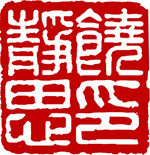
The Hōzōin-ryū at the Kōbusho was the Takada-ha (高田派): the line running from the founder In’ei through his disciple Nakamura Naomasa to Takada Matabei Yoshitsugu, who served Kokura-han, after which a high disciple, Mori-hira Masatsuna, and two others went to Edo and spread the method — which is why the bakumatsu Kōbusho era had many Hōzōin-ryū shihan. They shared the Takada-ha transmission as a common ancestry.
In’ei learned the sword from Kamiizumi Ise-no-kami alongside Yagyū Munetoshi before working out the cross-spear he became famous for. So, the dominant Kōbusho spear school traces, at its root, straight into the Shinkage-ryū lineage. It is not clear, however, if the Kōbusho sōjutsu instructors had a single immediate common teacher — the school’s Kōbusho men are named far less consistently than the kenjutsu instructors are.
One source does list them individually, and it shows how nearly total the school’s hold on the department was. The Tōkyō shishi gaihen volume on the Kōbusho quotes the Fujiokaya nikki on “the schools and transmissions of the martial artists who entered service as kyōju-kata,” giving a school, a guard unit and sometimes a teacher for each man.1 Of the twelve spear instructors it lists, eleven are of the Hōzōin lines:
- Hōzōin-ryū (寶藏院流): Jinbo Sahyōe (神保左兵衛) and Iimuro Magobei (飯室孫兵衛), both of the koshō unattached companies; Komai Hangorō (駒井半五郎), of Yokota Chikugo-no-kami’s company in the koshōgumi; Yamaguchi Benzō (山口辨藏) of the shoin-ban; Yoshida Katsunosuke (吉田勝之助), entered as a pupil of Inō Ichiunsai (伊能一雲齋); Andō Sōbei (安藤惣兵衛); Ihara Bunzaemon (菴原文左衛門) and Tamon Kamanosuke (多門鎌之助), both of the great guard; and Katō Heikurō (加藤平九郎) of the kobushingumi.
- Kama-Hōzōin-ryū (鎌寶藏院流), the sickle-spear line the diarist names separately: Nagao Kohei (長尾小兵衛), and Katsu Kenzaburō (勝顯三郎), entered as Nagao’s pupil.
The twelfth, Takahashi Kenzaburō (高橋鎌三郎) of the accounting office — the later Takahashi Deishū — is the department’s one Jitokuin-ryū man.
The list still yields no single common teacher. The only pupillages it records are Katsu’s under Nagao, both of them serving instructors, and Yoshida’s under Inō Ichiunsai, who was not on the staff. What it does establish is that the bakufu’s own diarist could name a school for every man in the department, and that the department was Hōzōin almost to a man — which is the concrete form of the observation that the bakumatsu Kōbusho had many Hōzōin-ryū shihan.
A pupil of one of these men supplies the liveliest surviving picture of Hōzōin spear at the academy. Ido Kinpei, who trained under the instructor Komai Hangorō and “handled the Hōzōin-ryū spear well,” beat the Kōbusho’s teaching staff at will by closing inside their guard and throwing them with a foot-entanglement — until Takahashi Kenzaburō forestalled it and the technique was given up. The episode is told in his record and in Yoshida Katsunosuke’s.2
Curriculum
Hōzōin-ryū Takada-ha is a living school with a published curriculum. Hōzōin-ryū’s weapon is the jūmonji kamayari (十文字鎌槍; cross-bladed sickle-spear) and its use is based around the school’s ensui, irimi, kama (円錐・入身・鎌; “cone, entering, sickle”) triad through a signature vocabulary of maki-otoshi (巻落し; winding-drop technique), kiri-otoshi (切落し; cutting-drop technique) and suri-komi (摺込み; sliding-press technique), a battlefield art assuming armor, a low stance and fighting against the sword, plain spear, bow and naginata.
The founder In’ei (胤栄) was a Kōfuku-ji monk. Takada Matabei Yoshitsugu — originally from Iga, and also trained in Gotsubo-ryū spear, Anazawa-ryū naginata and Shinkage-ryū sword — entered Ogasawara Tadazane’s service in 1623 and carried the school into Kokura-han, distinguishing himself at the Shimabara siege.
Its present curriculum is the paired-spear set, yari-awase no kata (槍合せの型), in three sections — Omote (表) 14 forms, Ura (裏) 14 forms and Shin-shikake (新仕掛, “new techniques”) 7 forms, totaling 35. Those 35 are what Ishida Kazuto restored out of a historical set of fifty (槍合わせの型五十本; fifty spear-matching forms), the line having nearly lapsed before being preserved through the First Higher School kendō club under Yamazato Tadanori and then returned to Nara in 1976.
Ishida is known to have transmitted only the kata and was not given inka, and did not call himself sōke. This distinction was lost over time as later sōke titles in the Nara revival were adopted. The Nara line is a 20th-century continuation rather than an unbroken lineage — in contrast to the documented Kokura-han transmission of the school’s earlier centuries. This is similar in spirit to Yamada Jirōkichi (opens in a new tab) declaring there was no longer an Odani-ha and founding a new Seitō-ha of Jikishinkage-ryū in the early 20th century, and then formal Jikishinkage-ryū lineage being revived by Ōnishi after Kawashima Takashi refused Yamada’s request to lead the art.
-
東京市史外編, 講武所 (NDL 1225131, image 46, printed p. 27). The passage runs 「これら教授方に出仕した武藝者の流儀傳統に關しては、藤岡屋日記に録して下記の如くに見える」, followed by the sōjutsu list transcribed above and then a kenjutsu list. Note that 横田筑後守組 here is Komai’s guard company, not an instructor of that name, and that the 長尾小兵衛門人 tag belongs to Katsu Kenzaburō. ↩
-
東京市史外編, 講武所 (NDL 1225131, image 52, printed p. 39); his subsequent appointment — 「後井戸は教授方世話心得を命ぜられて大に威を振つて居た」 (“afterwards Ido was made acting assistant to the instructors and wielded great authority”) — opens image 53. The same page explains what the bout cost him: Takahashi knew the foot-entanglement was coming, and after one or two crossings of the spear Kinpei prostrated himself and said he was much obliged. It is added that the ashigarami was abandoned from that day. ↩