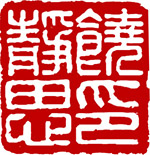
Ogasawara Genshinsai
Ogasawara Genshinsai came from one of the most prestigious samurai houses: Ogasawara of Shinano Province (信州 / 信濃国) — based at Matsumoto Castle are the same Ogasawara who developed Ogasawara-ryū reishikei (etiquette) that formed the basis for samurai conduct.
The 18th century mokuroku of Naganuma Kunisato attests that Ogasawara went to China and there obtained e myō-jutsu (得妙術; dé miào shù, “marvelous technique”) through some type of training. Additionally, it maintains he traveled via a route that passed through Korea and could not return to Japan for some time.
Shin-no-shinkage heihō (真之心陰兵法) is the name Ogasawara Genshinsai used to describe his swordsmanship after his return. Two works survive by Ogasawara Genshinsai and can be found in the Odawara City Library collection. Regarding the rise of his tradition, Genshinsai wrote (Ogasawara Genshinsai (小笠原源信斎) 1670):
I am calm and composed. Although I have tried various streams, I have not yet reached the deepest level of the art. Because I have crossed the river differently, people are in harmony with each other and they are diligent in their studies. I am thinking about it with a sincere heart.
One explanation, from Karukome and Sakai (Karukome Yoshitaka 2015), is as follows:
The content of this record roughly says that he has studied various schools since he was young, but was unable to reach their profound meaning. However, by traveling overseas and learning from others, he reached the profound meaning and after carefully thinking about these, he named it Shin-no-shinkage heihō.
The martial arts exchanges between China and Japan in the Ming Dynasty were certainly far more than the Kage-ryū crossing of the sea related to General Qi and the single-sword method related to Liu Yunfeng from Zhejiang. The example here can be called the second Kage-ryū crossing of the sea in terms of the inheritance of Kage-ryū.
The Quanzhen School (
is one of the two dominant denominations of Daoism in China. One of its founders was master Wang Chongyang (1113–1170). When the Mongols invaded China the Quanzhen Daoists exerted great effort in keeping the peace, thus saving most Han Chinese lives. Qiu Chuji, a major disciple of Wang, founded the Dragon Gate lineage (
龍門派 Lóngmén pài), along with the White Cloud Monastery in Beijing. This tradition remains one of the largest Daoist sects in China.
I think it is no accident Ogasawara returned from China using the character 真 to describe his heihō, given the strong influence Daoist concepts of yin and yang complementarity and five element theory continue to have on the practice, even over four hundred years later.
Early writings on the art by Ogasawara cite a number of esoteric Buddhist guardian deities instead of Takemikazuchi-no-kami, the patron deity of Kashima, as providing protection to its adherents, including: Fudō-o (Acalanātha;
The core Shinkage-ryū kata called empi, said to be the essence of Kamiizumi Ise no Kami’s Shinkage-ryū, is present in Ogasawara’s writing, using the homophone
Those kata, along with the set called kuka, are said to be the core of what Kamiizumi Ise no Kami received from Aisu Kage-ryū. Sangakuen, in contrast, which bears a resemblance to Hōjō (most clearly in the names of several of the kata within the set), is said to have been derived from enpi no tachi as a set of explanatory or introductory practices. The name Hōjō literally means “foundational practices” and derives from Sangakuen.
また,流儀を興した経緯について,源信斎は,「予 自リ レ若,雖モ レ試ルト 二諸流ヲ一,未ダレ至ラ 二其奥儀ニ一,異朝ニ渡ル故,人ニ相応ズル之旨叶ヒ,忩テ勤メレ之ヲ,倩々思レ之ヲ以テ真之心陰ト云 26)」(送り仮名,返り点,読点筆者)と述べている。[…] しかし,国郷以前の伝書に「鹿島神伝」と記されることはなかったようである。
Most lines of Jikishinkage-ryū no longer practice empi, kuka or tengu-sho. Ogasawara’s practice and the earlier teachings of Kamiizumi Ise-no-kami are clearly connected in this manner, the latter which credits Aisu Kage-ryū as its inspiration, as quoted above. Ogasawara is said to have learned spear techniques attributed to the Han dynasty general Zhāng Liáng and from them developed an insight called hassun no nobegane (八寸の延がね) that allowed him to defeat the famous master Hikita Bunguro in a match upon his return without attacking.
Wú Shū and the Single Sabre
Wú Shū (吳殳, 1611–1695) was a Ming–Qing transition military scholar and martial artist. His major work, 《手臂錄》(Shǒubì Lù), contains a third volume called 《單刀圖說》(Dāndāo Túshuō, “Illustrated Discussion of the Single Sabre”), with a preface dated renyin year 1662 (Kangxi 1). The opening of that preface:
唐有陌刀,戰陣稱猛,其法不傳。今倭國單刀,中華間有得其法者,而終不及倭人之精。
In the Tang [era] there was the mòdāo [a Tang-period broad sabre], renowned for ferocity on the battlefield, but its methods are no longer transmitted. Today, the Wō-country (Japanese) single sabre — within China there are those who have obtained its methods, but ultimately none reach the refinement of the Wō-people.
Note the construction is 「得 + [skill/method/technique]」 — “to obtain [the methods].” Wú Shū’s 得其法 (“obtained its methods”) and the Jikishinkage-ryū densho’s 得妙術 (“obtained the marvelous techniques”) are the same Sino-Japanese idiom, applied to cross-strait martial transmission.
What makes this important is the direction of the documented flow in Wú Shū’s preface. Wú Shū is describing transmission from Japan to China, not China to Japan. He continues:
斫削粘桿,余本得之漁陽老人之劍術,單刀未有言者,移之為刀實自余始。安得良倭一親炙之。
Hewing, shaving and adhering to the spear-shaft — I originally obtained these from the swordsmanship of the Old Man of Yuyang; no one had spoken of them in single-sabre [literature]; I was the first to transpose them to the sabre. If only I could meet a true Wō [Japanese] master and study under him directly.
The documented seventeenth-century reality is:
- Japanese sword arts entered Chinese discourse through the wakō coastal raids of the sixteenth century.
- Chéng Zōngyóu (程宗猷, styled Chōngdǒu 沖斗) wrote 《單刀法選》(Dāndāo Fǎxuǎn, 1621) explicitly crediting Japanese origins: “its techniques excelled in the wakō” (其技擅自倭奴).
- Wú Shū in 1662 built on Chéng’s work and on the Yuyang Laoren swordsmanship to compose his eighteen sabre postures.
- Throughout the early Qing, 倭刀法 (Japanese sabre methods) is a recognized technical category in Chinese saber literature, with a stock vocabulary around 「得其法」 — “obtaining the methods.”
The 1800 Jikishinkage-ryū densho claim — 入唐更得妙術還 (“entering Tang [China] and further obtaining marvelous techniques, then returning”) — is then doing something quite specific. It uses the same Sino-Japanese vocabulary that appears in Chinese saber literature, but inverts the direction of prestige:
- Wú Shū (1662, China): Japanese methods are superior; Chinese practitioners can only partially “obtain” them.
- Jikishinkage-ryū densho (1800, Japan): A Japanese master crosses to China and “obtains” methods from the Chinese.
There are several possibilities. Either the Sino-Japanese martial vocabulary was genuinely shared in this period, and the densho is using standard idiom appropriate to a real (if undocumented) Ogasawara journey. Or, whoever drafted the lineage section in the Naganuma circle was familiar with Chinese saber discourse — Wú Shū and Chéng Zōngyóu were widely known and reproduced through the Edo period via imported Chinese books — and consciously or unconsciously used the 得妙術 phrase, while flipping the directional flow to credit Japanese mastery with Chinese provenance. Or, there was some level of common vocabulary between China and Japan for phrases relating attainment of skill at arms.
The ‘cribbing’ hypothesis is most likely, as by 1800, Edo-period Japanese intellectuals had access to Wú Shū’s writings through the imports cataloged in Tosen Mochiwatari-sho (唐船持渡書) — Chinese books arriving via Nagasaki — and the Bubishi tradition derived from Mao Yuanyi’s 《武備志》 was actively circulating in martial circles.
The timeline of Ogasawara’s travel strongly suggests the Bunroku–Keichō Korean invasions (1592–1598) as the historical context: an Ogasawara retainer serving in Toyotomi’s Korean campaigns would have had plausible (if unusual) opportunity to cross from Korea into Ming China. It is believed by some lines of Jikishinkage-ryū that Ogasawara changed sides one too many times during the late Sengoku period, and angered Tokugawa — thus waiting some time before his return. This document seems to maintain he was instead not allowed to leave China.
The nittō (入唐; travel to China to receive knowledge) description — that Genshinsai personally trained in China — is the most contested element of the Jikishinkage-ryū origin story in modern scholarship. The marginal note is interesting precisely because it tries to make the literal-journey version more plausible by supplying details (route, duration, reason for delayed return). Whether the literal journey occurred or not, the marginal note represents the school’s effort to make the claim historically concrete by 1800. [3-5]
Nittō (入唐) literally means “entering Tang” — the verb 入 (nyū, “to enter”) plus 唐 (tō, “Tang”). In Japanese usage it’s the standard idiom for traveling to China, regardless of what dynasty was actually in power at the time. The dynastic anchor is the Tang (618–907) because that was the formative period of large-scale, formalized Japanese contact with China — the kentōshi (遣唐使, “embassies to the Tang”) sent between 630 and 894, which carried Buddhist monks, scholars and officials to study at the Chinese capital and bring teachings back. The institutional memory of those embassies fossilized Tō (唐) as the generic name for China in Japanese. By Ogasawara Genshinsai’s time, the actual dynasty he would have encountered was Ming (明, 1368–1644), but a Japanese narrative would still call the journey nittō. By the 1800 densho’s writing, the dynasty in power was the Qing (清, 1644–1912), but the term nittō persists unchanged.
The use of the word nittō implicitly aligns Genshinsai’s journey with the kentōshi tradition of going to China to acquire foundational learning and return with it to Japan. That’s a deliberate echo. The densho isn’t just saying “he went to China”; it’s saying “he made a nittō-style journey of acquisition” — placing his martial study in the same cultural category as Saichō, Kūkai or Ennin returning from the Tang with Buddhist transmissions. This is part of why the nittō claim functions as a prestige assertion regardless of whether the literal journey occurred. In 1800, knowledge from China is still considered important, or at the very least, exotic.
Whether or not Ogasawara personally crossed to China, the way the claim is articulated in the 1800 densho is recognizably part of a real seventeenth- and eighteenth-century Sino-Japanese discourse on martial transmission. the canonical text of Wú Shū’s preface is most easily accessed in 《泽古斋丛抄》本《手臂錄》 (Zegu Zhai Congchao edition) or the 山西科学技术出版社 2006 reprint(Wú Shū (吳殳) 2006).
The text 《手臂錄》卷三《單刀圖說·自序》is a relevant phrase in either edition.
References
The sources cited on this page are collected in the site source register.
Image credit: the picture shown with this article in the list of writing is a guandao in the Inner Mongolia Museum, Hohhot: “Weapons” (opens in a new tab) by Sam / Olai Ose / Skjaervoy, 2007, licensed CC BY-SA 2.0 (opens in a new tab); cropped.