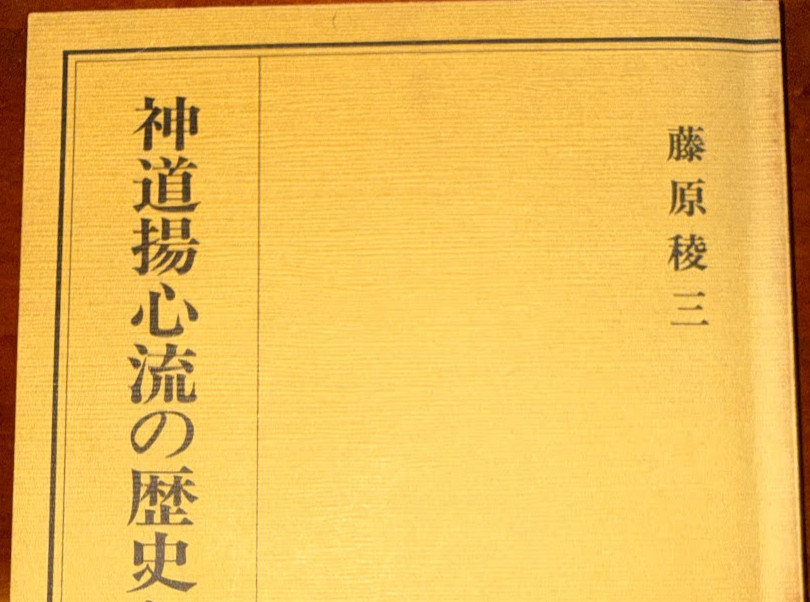
Matsuoka Katsunosuke (松岡克之助, 1836–1898), regarded as the founder of Shindō Yōshin-ryū (神道揚心流) jūjutsu, was the second son of a Kuroda-han (Fukuoka) physician. The account of Matsuoka’s life before 1870 rests almost entirely on Fujiwara’s 1983 school history (Fujiwara Ryōzō 1983). That work is measured in tone, but it draws on family anecdote transmitted through Matsuoka’s grandson. By its own admission the school’s pre-1870 records were lost to flood, so statements made there need to be taken as family oral history based on interviews until they are corroborated by external primary source scholarship. The 1983 book was also written before the digitization of bakufu-era rosters, some of which are now searchable and do not mention Matsuoka Katsunosuke.
What we do know is that Matsuoka Katsunosuke, a Kuroda-han baishin (sub-vassal), was a different man from the higher-ranking hatamoto (旗本; banner-man) Matsuoka Yorozu (松岡万, 1838–1891) — tsūshō 昌一郎, gō 古道 — of a falconer-head (鷹匠組頭) house, who was a Torao-no-kai member, one of the rōshigumi/shinchōgumi torishimari, and later commander of the Seieitai. Matsuoka Yorozu held an administrative post under the Kōbusho magistrate (講武所奉行支配) but no teaching appointment there, despite being a skilled swordsman. Several later claims about Katsunosuke’s military career appear to be Yorozu’s biography wearing the wrong name; the evidence is set out in the Boshin War section below. For example, Matsuoka Yorozu had studied several ryūha and could have been a surrogate teacher for Sakakibara Kenkichi at times. Matsuoka Katsunosuke was almost certainly not, at least during the pre-Meiji Bakumatsu time period, due to his age and institutional standing as a Kōbusho trainee.
Early Martial Education
Matsuoka Katsunosuke is said by Fujiwara to have been enrolled in Hōzōin-ryū sōjutsu (宝蔵院流槍術; Hōzōin-ryū spear art) under Komazawa Yoshitsugu (駒沢義次) in the 5th month of 1842 — as a young child, so perhaps partly a formality, given the size of spear used in the art. He trained into adolescence and received inka (印可; master’s certification seal) in the 5th month of 1852, at sixteen. In the 1st month of 1853, at seventeen, he entered the Tenjin Shin’yō-ryū at Kanda Otamagaike; in the 9th month of 1855 he received menkyo kaiden from its third head, Iso Masatomo (磯正智) and thereafter is said to have served as shihan-dai (assistant instructor) at the Iso dōjō. Matsuoka Katsunosuke is also said to have studied Ittō-ryū kenjutsu at the Genbukan (玄武館) of Chiba Shūsaku in the same Otamagaike neighborhood. All of this needs to be confirmed by primary sources. [^genbukans]
Kanda Otamagaike is in the same the quarter where Chiba’s Genbukan (玄武館) stood. Chiba Shūsaku died in 1855, so training under him there is chronologically possible. But the rural Genbukan (元武舘) later inherited by Matsuoka’s Jikishinkage-ryū student Nakayama Tatsusaburō differs from Chiba’s only in the first character (玄 “dark” versus 元 “origin,” both read gen) and a variant form of the last (館/舘, the same character). The two names are phonetically identical, and in oral transmission they are the same word. If a source recalled that Matsuoka trained “in the line of the Genbukan” may instead mean the rural dōjō associated with the Kimura family of the Odani-ha, rather than a third style, especially since Matsuoka is known to have taught Jikishinkage-ryū to Nakayama Tatsusaburō.
A listener unfamiliar with that dōjō could easily have converted the reference into a study of Hokushin Ittō-ryū at the famous Edo school, instead of Matsuoka both teaching and continuing his own Jikishinkage-ryū practice locally in Ibaraki.
Kōbusho Years
Fujiwara writes that Katsunosuke was sent by his domain to the Kōbusho as a shugyōnin (修業人; trainee) in the 1st month of 1860, at age twenty-four. He was by then no beginner — he had opened a dōjō in the precincts of Asakusa Kannon even before entering — yet in a three-bout randori match with the jūjutsu instructor Totsuka Hikosuke Hidetoshi (戸塚彦介英俊, 1813–1886; gō Isshinsai 一心斎) he lost two of three. He took Totsuka as his second master and trained earnestly in Yōshin-koryū at Totsuka’s dōjō after Kōbusho hours, which ran from 10am to 4pm; jūjutsu practice at the Kōbusho itself was held five times a month (every five days), kenjutsu likely more often.
His time at the Kōbusho drew him into the orbit of Sakakibara Kenkichi (opens in a new tab): Fujiwara writes that upon seeing Sakakibara defeat Takahashi Kenzaburō in an exhibition match, the trained spearman resolved to study under him. Fujiwara does not, however, record any traditional license in Jikishinkage-ryū held by Matsuoka Katsunosuke. Fujiwara writes in summary that Matsuoka trained under Sakakibara and later taught Jikishinkage-ryū. Most likely Matsuoka Katsunosuke learned portions of the art during his Kōbusho years, much as his Totsuka training supplemented his earlier jūjutsu studies. Fujiwara lists Matsuoka’s keiko-nakama (稽古仲間; training companions) as including Chiba Michisaburō (千葉道三郎), Okano Toranosuke (岡野虎之助, 25), Odani Tetsutarō (男谷鉄太郎, 25) and Katō Sutesaburō (加藤捨三郎, 26).
Matsuoka Katsunosuke does not directly appear in rosters of the Kōbusho reproduced in Rikugun rekishi (陸軍歴史; 陸軍省総務局編, 1889; NDL pid 988906).
In the 4th month of 1862 (Bunkyū 2) Fujiwara writes that Matsuoka Katsunosuke was made jūjutsu kyōju-kokoroe hosa (柔術教授心得補佐; assistant to the provisional jūjutsu instructor), a junior teaching-aide grade. When the shogunate abolished Kōbusho jūjutsu training on October 6, 1862, Matsuoka Katsunosuke — who, in accordance with the domain’s wishes, resigned his position as okuzume (奥詰; inner-castle guard) — was released from trainee status the same day, after two years and nine months in all.
Matsuoka likely did not teach kenjutsu at the Kōbusho.
A jūjutsu shugyōnin sat at the bottom of the institutional ladder: trainee, then sewa-kokoroe, sewa-yaku, kyōju-kata shutsuyaku, kyōju-kata, and only then shihan-yaku. The founding charter sorted appointments by bakufu status as well as demonstrated skill.
Baishin (陪臣; sub-vassals) like Matsuoka Katsunosuke were capped below the bannerman-only shihan-yaku title regardless of ability — Totsuka himself, the strongest jūjutsuka in the division, was barred from it for being a sub-vassal. Sakakibara, by contrast, was a hatamoto and was appointed kenjutsu kyōju-kata from the 1856 opening who rose to shihan-yaku, teaching under Odani in the discipline where he already held Jikishinkage-ryū transmission.
With 246 identified kenjutsu men and 132 spearmen in Toda’s register alone — and cross-appointments to a second discipline running to a handful of individuals — the kenjutsu cadre was not a thin bench that would reach outside itself, still less into the jūjutsu trainee pool, to staff instruction. Several licensed Jikishinkage-ryū men were in any case present in Sakakibara’s own circle under Odani.
Chūjō Kinnosuke in contrast was an example of a genuine cross-appointee. He was an established kenjutsu kyōju-kata who was also pulled into jūjutsu as a randori assistant, grounded in a Totsuka-ha mokuroku he held.
Matsuoka could not have acted as delegate head of a Sakakibara-led dōjō in 1860–62, as Sakakibara Kenkichi (opens in a new tab) did not have one at the time.1
Matsuoka leaves no positive trace in the sources that document the Kōbusho at the individual level. He is absent from the jūjutsu roster2 covering the 1860–62 division and its assistant grades, and from the ranking spear and sword instructors in Japanese-language primary sources, which list the high-level instructors and their grades in detail.
In the Kōbusho appointment registers found in the 1898 陸軍歴史 volumes — 上, 巻1–15 (dl.ndl.go.jp/pid/988905 (opens in a new tab)) and 下, 巻16–30 (dl.ndl.go.jp/pid/988906 (opens in a new tab)), no Matsuoka appears in the rosters of instructors and trainees at koma 96–108, searching under either 克之助 or 克之.
Unlike Amano Shōshō (opens in a new tab), whose enrollment card survives, we were unable to discovery primary source attestation of Matsuoka related to Kōbusho attendance. The absence bounds what can be claimed: the record is compatible with Fujiwara’s trainee-and-assistant account and incompatible with anything grander. More extensive searches of late Tokugawa records would be useful to conduct.
Bakufu Recall and the Boshin War
Matsuoka was a Kuroda-han baishin by birth — his family were domain physicians — and his Kōbusho years would have themselves been a domain posting: a han could command a retainer into active service, and the Kuroda would have done exactly that in sending him there in 1860.
When he was released in the 10th month of 1862 and married into a Hitachi family two months later, he settled outside both Edo and Kuroda territory, to all appearances fully a civilian. Matsuoka left Edo and in the 12th month of 1862 he married into the Ishizuma (石妻) family of Ueno village (上野村) in rural Hitachi (modern Ibaraki) — some distance from Edo. This is not to be confused with Edo’s Ueno ward, whose battle would figure in his biography later. He set up as a kanpō and bone-setting doctor, opening a clinic in the village.
Fujiwara relates that with no training partners in Hitachi, he examined his practice alone — shutting himself in his room after seeing patients to analyze Tenjin Shin’yō-ryū, Totsuka-ha and Jikishinkage-ryū and work out their riai (理合; coordinating principle). In 1864 (元治元年) it is said that he founded his own school of jūjutsu, combining the Tenjin Shin’yō-ryū he had first learned with Totsuka-ha methods and folding in the riai of the Jikishinkage-ryū he had experienced. He is said to have taught first in the courtyard of his clinic, before building a dōjō.
Fujiwara writes that Matsuoka Katsunosuke was re-appointed to bakufu service in 1866 and was sent to help quell the Keiō-2 uchikowashi (打ちこわし; rice-riot) uprisings and afterwards ordered to report to Edo Castle, where a number of former Kōbusho trainees were formed into an okuzume inner-guard corps. On May 1 of 1867 he and other former Kōbusho men served as bodyguards to the shogun Yoshinobu in Kyoto.
Accounts differ on what specific unit he served with.
Fujiwara places Matsuoka among those escorting Tokugawa Yoshinobu to Kyoto, records the shogunal defeat at Toba-Fushimi and Yoshinobu’s flight from Osaka Castle to Shinagawa aboard the Kaiyō-maru (開陽丸) and introduces the two bakufu corps: the Seieitai under Chūjō, over one hundred blood-oath comrades guarding Yoshinobu, and the Shōgitai (彰義隊) under Shibusawa Seiichirō (渋沢成一郎) and his deputy Amano Hachirō (opens in a new tab), swelling to about three thousand.
Fujiwara (page 89) repeats the Seieitai-under-Chūjō assignment and that he was shot at Ueno. He then (page 90) concedes that all pre-1870 school records were lost to flood.
This is important to highlight: the school itself holds no contemporaneous document for the founder’s earlier life, the military period included.
A challenge with Fujiwara’s narrative is that the Seieitai left Edo with Yoshinobu for Mito and then Suruga and never fought at Ueno; a wound at Ueno and a flight toward Aizu is the course of an Ueno defender, not a Seieitai guardsman. If Matsuoka served in the Seieitai’s ranks, its movements kept him away from Ueno altogether; if he was shot at Ueno, he fought in a Shōgitai or Ueno-defender role — and he appears in the records of neither corps.
Yamazaki Arinobu’s Shōgitai Senshi (彰義隊戦史; 山崎有信, 1910), whose section 26 (精鋭隊の性質, “the nature of the Seieitai”) rosters the corps, is decisive on the Seieitai side (山崎 有信 1910). In summary:
Among those gathered at Ueno to guard the lord was a corps not belonging to the Shōgitai but separately organized, the Seieitai — taichō Chūjō Kinnosuke, with Yamaoka Tetsutarō, Sekiguchi Ryōsuke (関口良輔), Ōkusa Takijirō (大草瀧次郎), Matsuoka Yorozu (松岡萬), and Umeda Katsutarō (梅田勝太郎), over seventy men, mostly bannermen’s sons and all skilled with the sword. When Yoshinobu entered Tōeizan the Seieitai guarded him exclusively; when he withdrew to Mito, Chūjō and the rest accompanied him; later the corps entered Shizuoka and petitioned to open Kanaya-ga-hara.
Yamazaki closes that the Seieitai was “an entirely separate thing from the Shōgitai” (精鋭隊は彰義隊とは全然別物なり).
The one Matsuoka the roster names is Matsuoka Yorozu (松岡萬) — a jikisan (直参; direct retainer) officer whose post-1868 path ran to Suruga and Makinohara.
Katsunosuke as a Kuroda baishin,lacked a jikisan appointment and would have been a poor fit for a corps of stipend-surrendering direct retainers. He also is absent from the Seieitai and Shōgitai records, including the Tōkyō Shishi Gaihen’s account of the Ueno defenders.3
The likeliest explanation is a Seieitai/Shōgitai conflation in the house biography Fujiwara drew upon, with the name of Chūjō — the noted Seieitai head — drawn in from his earlier time as one of Matsuoka’s jujutsu instructors at the Kōbusho.
Other accounts from within the tradition place Matsuoka instead at the Battle of Toba-Fushimi (鳥羽伏見の戦い; near Kyoto, 1st month 1868). 4 A Toba-Fushimi wound would be plausible for a man posted to Kyoto with the Seieitai.
It is more likely that Matsuoka served with the Seieitai and was wounded at Toba-Fushimi, as stated in English-language accounts than in Fujiwara’s 1983 account.
Returning to Ueno-machi Matsuoka Katsunosuke is said to have taken the alias Ishizuma-no-suke (石妻之助), from his wife’s family name, to escape the Satchō searches, and to have convalesced there rather than going west to Sunpu with the other bakufu retainers. In the 9th month of 1870 his Shindōkan (神道館) dōjō was built. One early student of his who became well known in kendō circles was Nakayama Tatsusaburō.
Matsuoka is said to have referred the promising Nakayama to a Jikishinkage-ryū teacher, Hakomori Yosaburō Suokuni (箱守与三郎祐郷), to continue his training in that art — consistent with Matsuoka holding no Jikishinkage-ryū teaching license of his own, as discussed above. Nakayama would eventually inherit Hakomori’s Genbukan (元武舘) dōjō.
The region had its own kenjutsu infrastructure. The Tsuchiura Seikensha was an institutional node for a local line of Jikishinkage-ryū (眞影流)5 founded by Yokogawa Shichirō (横川七郎) Hiroharu, a monjin of Odani Seiichirō and retainer of the Odani household, with Inō Naoyoshi as its licensing head — active in the very area where Matsuoka lived. A parallel network of kenjutsu instruction stemmed from the Kimura family, who taught Hakomori, the man to whom Matsuoka sent Nakayama.
Betsuden
The license that attached to Matsuoka’s early sword teaching of Nakayama, according to Fujiwara, is his school’s betsuden (別伝; separately-transmitted line) menjō. This included:
- kodachi-dori (小刀捕; short-sword capture)
- ōdachi-dori (大刀捕; long-sword capture)
- gokui atemi (極意当身; secret-essence striking)
- kappō (活法; resuscitation) material
- ki-ate (気当; spirit strike technique)
Matsuoka considered the betsuden the ura-waza (裏技; the “back techniques”) of kenjutsu; it was associated with an upper-level license, though it may also have been awarded to those who trained only in kenjutsu.6
Resuscitation, fitting for a physician’s school, appears early in the curriculum. The entry kirigami (切紙) license required yūkatsu (誘活; lure-and-resuscitate technique) and eri-kappō (襟活法; collar resuscitation method) — precisely the opening pair of the parent school’s four-article scheme — while the mokuroku (目録) adds koppō (骨法; bone methods) and some hundred named kyūsho (急所; vital points) taught under sappō (殺法; killing methods), holding the death-mode revivals — san-kappō (三活法; for drowning, falling, hanging) and yon-kappō (四活法; for steam, smoke, cold, blow) — back as betsuden (Wikipedia contributors 2023).
A note on orthography: Matsuoka’s school appears as both 神道揚心流 and 神道楊心流, used interchangeably — the hand-radical 揚 (“raise”) matching the Totsuka-ha Yōshin-ryū (揚心流) and Yōshin-koryū (揚心古流) wood-radical 楊 (“willow”) of the parent. Its use of shin is Shintō (神道; “divine way”), but the Obata–Takamura offshoot took the homophone 新道 (“new way”), so the modern Takamura-ha line is written 高村派新道楊心流.
All of these can be romanized as “Shindō Yōshin-ryū.”
Later Life in the Civil Record
The Ibaraki biographical dictionaries (茨城人名辞書 / 茨城人名録, 1915–1939) are local, near-contemporary — the 1915 edition appeared seventeen years after his 1898 death — and wholly independent of the Shindō Yōshin-ryū tradition (いはらき新聞社 1915).7 Across four editions they hold a consistent picture: Matsuoka Katsunosuke of Naka-Ueno, Ueno village, Makabe district (中上野・上野村・真壁郡), a locally famous bone-setter (整骨医) and Shindō Yōshin-ryū jūjutsu master, referred to as 故 (the late). No edition mentions bakufu military service.
The dictionaries also carry some lineage and succession detail:
The 1932 reprint Ibaraki jinmei jisho (茨城人名辞書 再版, 弘文社編; “biographical dictionary of Ibaraki”) holds a biographical entry on Sakurai Yūnosuke (櫻井勇之助) of Iwase-machi, Nishi-Ibaraki-gun (西茨城郡岩瀬町), a bone setter (接骨醫) born Ansei 4/9/15 (1857), eldest son of Sakurai Moheiji (櫻井茂平次): from Genji 1 (1864) he studied Chinese learning (漢學) under one Ikeda, from Meiji 8 (1875) he took up Shindō Yōshin-ryū jūjutsu under Matsuoka Katsunosuke of Ueno, Makabe-gun (眞壁郡上野), learning bonesetting (骨術) alongside it, received the mokuroku in Meiji 19 (1886), and from Meiji 20–28 studied clinical bone-setting under Nakamura Gendō (中村元道) at Hōjō (北條町). The same succession is carried in the earlier editions.
The 1915 volume adds the household line: Hoshino Motoshichi (星野元七), a famous bone setter described as son-in-law and successor (keigyōsha) of the late Matsuoka, resident at Naka-Ueno exactly where Matsuoka settled — a Tochigi man (second son of a Hoshino of Shimotsuga-gun) who married Matsuoka’s daughter in 1879, entered the household in 1897 to assist Matsuoka’s son Teizaburō (貞三郎) in the practice, and on Teizaburō’s death in 1914 took over both the medical practice and the local postmaster-ship to keep the family business alive. Another notable’s grandfather, one Bunjirō (文治郎), is recorded as a 神道揚心流 shihan in his line. The 茨城県真壁郡統計 (Fukuda Ken 福田賢 ed., Watanabe Kappansho, Meiji 28 / 1895), a district-statistics table, places a Matsuoka Katsunosuke (松岡克之助) in a village of Makabe-gun ca. 1895 among that village’s principal landholders or taxpayers — congruent with a prominent local doctor, though see the caution below.
The Kikuran Kamon (武術名家伝; 菊巒加門 ed., Meiji 35 / 1902) complicates the picture with a younger namesake. Its Ueno-village jūjutsu section (上野柔術家之部) carries a Matsuoka Katsunosuke (松岡克之助) — an exact name match, at aza Naka-Ueno (字中上野), in the 神道揚心流 (correctly with 揚, distinct from Tenjin Shin’yō-ryū’s 楊) — whose affiliation line reads 入江正雄門人, student of Irie Masao (入江正雄), and whose birth annotation is 明治三年生: born Meiji 3, i.e. 1870. (The entry directly above, Inose Motokichi (猪瀬元吉), carries the same school, teacher, and aza, born 1833.) This is evidently a successor or heir one generation down, plausibly by shūmei (襲名; name succession). It also complicates the 1895 landholder entries: at Meiji 28 the elder would be roughly 59 and the younger 25, so a leading village landholder is more likely the established elder — and if the 1895 entries (the 統計 and 紳士鑑, one dependent source-stream) and the 1902 entry all resolve to the same aza, a single family estate is suggested — but the attribution to the founder specifically is probable rather than settled.
Irie Masao is the documented hub of the Makabe/Tsukuba 揚心流 network: of the fourteen 神道揚心流 names in Table 1 of Sugie’s study of the Mito-edition Nihon bujutsu-mei kaden (日本武術名家伝; “The Legends of Famous Japanese Martial Arts Masters”). Nine are Irie’s students (three in Makabe-gun, six in Tsukuba-gun) and the authority Sugie cites for him is the Bugei Ryūha Daijiten, whose Shindō Yōshin-ryū entry names only two figures: Asada Kanshirō (浅田勘四郎) in Kagawa and Irie Masao in Hitachi/Makabe-gun (杉江 正敏 1979; Watatani Kiyoshi and Yamada Tadashi 1978). Neither work names the elder Matsuoka Katsunosuke at all. Nor does the Butokukai register: Sugie’s filtering of the seirenshō (精錬証) recipients shows none in jūjutsu in Ibaraki through Meiji 35, against six in kenjutsu and two each in sōjutsu and bajutsu.
Within the externally corroborated record of Shindō Yōshin-ryū in Meiji Ibaraki, then, the representative figure is Irie, and Matsuoka’s centrality rests on the school’s own tradition (the Fujiwara history) plus the local dictionaries gathered here — the 茨城人名辞書 attesting him as Sakurai’s teacher, and the 武術名家伝 entry for the younger namesake learning from Irie Masao. The work’s compiler Kikuran Kamon was himself a Hokushin Ittō-ryū (北辰一刀流) swordsman under Ozawa Torakichi (小沢寅吉) so may have put less effort into tracking jūjutsu lines of practice.
Conclusion
When I began this essay, I did not know I would be examining such a wide variety of Japanese language sources. Overall, to summarize:
- Primary sources locate Matsuoka Katsunosuke inside a regional Meiji-era jūjutsu network, with Irie Masao as its documented central figure.
- Matsuoka is known to have taught in Ueno-machi in Ibaraki and practiced medicine there.
- Primary sources do not corroborate his attendance at the Kōbusho, specific membership in the Shōgitai or Seieitai.
- Accounts of his travels before 1870 rest on Fujiwara’s assertions — based on family anecdote of Matsuoka’s grandson, since records were destroyed in flood.
Claims about Matsuoka Katsunosuke before 1870 — Kōbusho seniority, military service — should be viewed with caution proportional to their distance from that core. Also, it appears he had a practice of Jikishinkage-ryū kenjutsu but did not issue licenses in that art. Instead he forwarded his most promising student to a local school of Jikishinkage-ryū for further instruction.
End Notes
-
Sakakibara traveled with the Tokugawa in 1863 — after Matsuoka was already residing in Hitachi. The jūjutsu section in which Matsuoka served ran only from 1860 to its abolition in 1862, before the escort, and Matsuoka was, per Fujiwara, released from his assignment, not reassigned to the kenjutsu or sōjutsu cadre. ↩
-
東京市史外編 ↩
-
While Matsuoka, by the school account, was drawn into the bakufu’s resistance and wounded at Ueno, his former teacher Sakakibara Kenkichi (opens in a new tab) took the opposite course — resigning his bakufu post and declining to join the Shōgitai. Sakakibara did not avoid the Battle of Ueno itself, but spent it escorting the Rinnōji-no-miya (輪王寺宮) to safety rather than fighting alongside Amano Hachirō (opens in a new tab). ↩
-
Internet Archive of https://koryu.com/library/tthreadgill1/ (opens in a new tab) — the English essay, by a master practitioner of a descendant line, contains several statements that contradict Fujiwara. ↩
-
Jikishinkage-ryū is written with different kanji at times, based on geographical area — Ibaraki-area groups seem to have used 眞. ↩
-
Ki-ate in the betsuden is an example of an advanced matter of Jikishinkage-ryū (opens in a new tab) that Matsuoka may have learned while at the Kōbusho. ↩
-
Source available at lab.ndl.go.jp (opens in a new tab). ↩