Our final martial arts ranking was
called menkyo-kaiden (
Unfortunately, these claims were false.
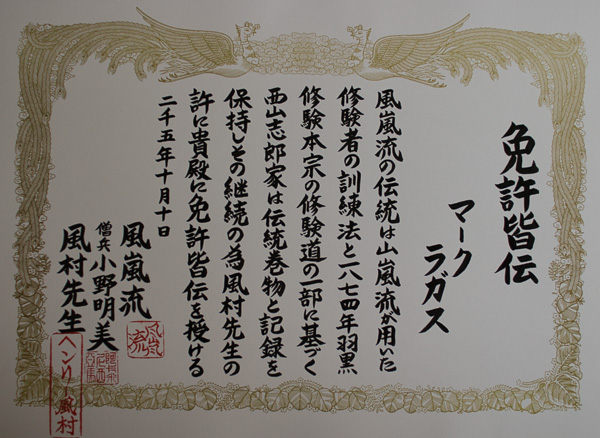
風嵐流の伝統は山嵐流が用いた修験者の訓練法と八七四年羽 黒修験本宗の修験道の部に基づく西山志郎家の伝統巻物と録に保持しその絶え 間なき風村先生の許に貴殿に免許皆伝を授ける
The tradition of Kaze-arashi ryū is preserved in the training methods of the shugensha employed by Yama Arashi-ryū and in the traditional scrolls and records of the Nishiyama Shirō family, based on the Shugendō division of Haguro Shugen Honshū from 874. Under the unbroken [transmission of] Kazemura Sensei, this menkyo kaiden is hereby conferred upon you.
The document is dated October 10, 2005 — just five weeks after the Nishiyama family letter on September 5, 2005. The letter and the diploma appear to have been prepared together, the letter providing the historical narrative that the diploma then cites as its authority. The diploma claims continuity back to 874 — the year Shōbō founded Daigo-ji in Kyoto. This is the Tōzan-ha date, not a Haguro or Honzan-ha (Tendai) date, yet the certificate says "Haguro Shugen Honshū." The same conflation and mistake found in the 1999 student manual is embedded in the diploma itself.
The diploma claims Shiro Nishiyama founded Haguro Shugen Honshū, but that is also not possible, due to the dates cited for his life (1846-1932).
The signatures on the diploma raise further questions:
僧兵 小野明美 — Sōhei (warrior monk) Ono Akemi風村先生 — Kazemura Sensei with seal (hanko)ヘンリ・風村
Several things are worth noting. The hanko has instructor's given
name in katakana, and his adopted Japanese name Kazemura
directly visible on the seal. The signatory is listed as
Sōhei is an odd title, as sōhei were considered lower-level
warrior monks at Buddhist temples during the Heian and later periods,
not head abbots or leaders of religious movements.
A person holding genuine religious standing in a Shugendō context would use a title like
Ono is used with the same kanji as Ono-ha Ittō-ryū, a style of
sword supposedly practiced by Sokaku Takeda. Ono-ha Ittō-ryū (
Ono-ryū is the line of Shingon mikkyō founded by Shōbō. I believe this to be another confusion or appropriation.
Every name associated with the KAR school traces back to either the instructor's own identity or to figures orbiting Daitō-ryū or Shugendō that is distinct from Haguro Shugendō:
- Kazemura (
風村 ) — translation of the instructor's French surname - Nishiyama (
西山 ) — possibly derived from Nishikawa, the historical Haguro gūji; used as the "budo name" - Ono (
小野 ) — the "real name," sharing its characters with Ono-ha Ittō-ryū, a sword school linked to Takeda Sokaku - Yama Arashi (
山嵐 ) — the signature technique of Saigō Shirō, adopted son of Saigō Tanomo, who is connected to Takeda Sokaku - Saigō Tanomo — appears in the 1999 manual as a direct teacher of the fictional Nishiyama Shirō
If Nishiyama is a "budo name" rather than an actual family name, then the family letter's entire premise — that Nishiyama is an ancestral surname going back to 19th-century Haguro — is contradicted by the school's own explanation. Either Nishiyama is the real maternal family name and the letter is a genuine family history, or Nishiyama is an adopted budo name and the letter is fiction dressed as family history. The two claims can't both be true, and the school apparently made both at different times depending on context.
Looked at in total, none of these names appear to be accidental. Each one was selected from the constellation of historical figures surrounding Takeda Sokaku and Daitō-ryū, then repurposed into a fabricated lineage. The "budo name" versus "real name" distinction conveniently allowed multiple borrowed names to coexist without contradicting each other — until you look at where they all point.
It is odd that Kazemura is written explicitly as 'Kazemura Sensei'
as that would generally never be done by a native speaker. It is likely
the text was dictated to a calligrapher who gritted their teeth.
Generally, no Japanese person who trained in a legitimate school
would sign as "sensei" on a formal document.
Signing as sōhei on a menkyo kaiden suggests whoever chose the title was drawn to the martial-religious imagery — warrior monk sounds impressive in English — without understanding where sōhei actually sit in institutional hierarchy, as low-level figures.
These are mistakes that someone with genuine training in either Japanese martial arts or Shugendō institutional culture would not make. The fact that the diploma's Japanese is otherwise competent but this error survived suggests that the instructor deliberately chose how he wanted to be identified and the calligrapher accommodated it, even though it is not how Japanese formal documents work.
So on one diploma we have: a French surname translated into Japanese, a family name that may be a one-character alteration of a historical Haguro figure, a self-applied honorific no Japanese practitioner would use, a warrior-monk title from the wrong level of the Buddhist hierarchy, a date (the 874 and Shōbō conflation) from the wrong Shugendō lineage, and possibly the spiritual advisor's name replaced with one borrowed from koryū kenjutsu history. Every single name and title on the document is fabricated or altered to serve the fiction.
- Shōbō (
聖宝 , 832–909), posthumously Rigen Daishi (理源大師 ), founded Daigo-ji in Kyoto in 874 and is the patriarch of the Tōzan-ha (当山派 ) branch of Shugendō, which is affiliated with Shingon Buddhism. He has no connection to Haguro Shugendō. See Miyake Hitoshi, Shugendō: Essays on the Structure of Japanese Folk Religion, ed. H. Byron Earhart (Ann Arbor: University of Michigan Center for Japanese Studies, 2001), and the Daigo-ji temple's own history at daigoji.or.jp. - Haguro Shugendō traces its founding to Nōjō Shōja (
能 除聖者 ), identified with Prince Hachiko (蜂子皇 子 , c. 542–641), son of Emperor Sushun. After his father's assassination by Soga no Umako in 592, the prince is said to have fled north and opened Mt. Haguro, Mt. Gassan, and Mt. Yudono as sacred sites for mountain practice. See Earhart, H. Byron, A Religious Study of the Mount Haguro Sect of Shugendō (Tokyo: Sophia University, 1970), and the Dewa Sanzan Jinja and Haguro-san Shōzenin institutional histories, both of which identify Nōjō Shōja — not Shōbō — as the founder. - Hagurosan Shugen Honshū (
羽黒山修験本宗 ) is the postwar institutional continuation of Haguro Shugendō, based at Arasawa-ji Shōzenin (荒澤寺正善院 ) in Tsuruoka, Yamagata Prefecture. It was reconstituted after WWII under Japan's 1947 constitutional guarantee of religious freedom, inheriting the tradition maintained at Shōzenin through the Meiji disruption. The claim of affiliation with Haguro Shugen Honshū refers to this specific, existing religious corporation — the same institution the author visited the day after receiving the diploma, where no one had heard of the NYC school. See hagurosan-shozenin.or.jp. - Why Haguro at all? Haguro's significance to the school was likely not drawn from any genuine Shugendō connection but from the fact that the Dewa Sanzan region was already a known pilgrimage destination among Daitō-ryū and Aikidō practitioners such as Takeda Sokaku, Okuyama Yoshiji of Hakko-ryū, Shirata Rinjirō, and Saitō Morihiro, making it a natural inspiring choice for someone later assembling a lineage from those sources.