Register record
Identity & authority
- Disambiguation
- Odani-ha Jikishinkage-ryū swordsman, b. ca. 1819; Kōbusho kenjutsu kyōju-kata from Bunkyū 3 (1863) on a 200-hyō lifetime stipend; the fellow-disciple Sakakibara beat at Nijō Castle. NOT the Shōgitai leader Amano Hachirō (天野八郎).
- Reliability
- Migrated skeleton. His bakufu appointment card and an 1851 match ledger (both shown in body) fix the baishin origin, the 1863 direct-service appointment, and the ca. 1819 birth; death date unrecorded here.
- Attestation
- corroboration: external
Names
| type | kanji | romaji | reading |
|---|---|---|---|
| myoji | 天野 | Amano | あまの |
| tsusho | 将曹 | Shōshō |
Dates
- Born
- (1819)
- Floruit
- Kaei–Keiō (1851 match ledger → 1863 appointment)
Origin & status
- Province
- 武蔵
- Status
- Baishin (陪臣; sub-retainer) house — grandfather Amano Sōza〔burō〕 and father both retainers (家来) of Matsudaira Ōi-no-kami (松平大炊頭). Newly taken into direct shogunal service Bunkyū 3 (1863) at yoriki rank with a 200-hyō lifetime stipend, appointed kenjutsu kyōju-kata (剣術教授方).
Amano Shōshō (天野将曹, also written 将監) trained in Jikishinkage-ryū under Odani. Accompanying the shogun’s 1863 procession to Kyoto, at Nijō Castle he fought and was defeated by Sakakibara Kenkichi. He would not concede out of pride, so Sakakibara knocked him over with a fierce two-handed morote-zuki (諸手突き) thrust.
His bakufu appointment card survives. Its transcription (right to left):
高 貳百俵 本國河内/生國武藏 祖父 天野宗三〔郎〕 松平大炊頭家来 實父 天野〔◯◯〕郎 松平大炊頭家来 天野将曹 當四十五歳 文久三癸亥年九月八日新規被召抱、〔◯◯〕与力格被仰付、一生之内御切米貳百俵被下置、同年 同月十四日剣術教授方被仰付候
Translation:
Stipend (高): 200 hyō (俵; rice bales). Ancestral province (本国): Kawachi (河内). Province of birth (生国): Musashi (武蔵). Grandfather: Amano Sōza〔burō〕 (天野宗三〔郎〕), retainer (家来) of Matsudaira Ōi-no-kami (松平大炊頭). Real father: Amano 〔…〕rō, likewise a retainer of Matsudaira Ōi-no-kami. Name: Amano Shōsō (天野将曹), presently 45. On Bunkyū 3 (癸亥; 1863), 9th month, 8th day, newly taken into direct service (新規被召抱); granted 〔…〕 yoriki rank (与力格); given a lifetime rice stipend (一生之内御切米) of 200 hyō; and, in the same year, on the 14th of the same month, appointed swordsmanship instructor (剣術教授方).
His family were baishin (陪臣; sub-retainers) — grandfather and father both served Matsudaira Ōi-no-kami — so, exactly as with Matsuoka Katsunosuke, he rose from a daimyō retainer’s house into direct shogunal service, here as a 剣術教授方 with a 200-hyō lifetime (non-hereditary) stipend. That places him in the same Kōbusho-era instructor world as Sakakibara (師範役) and Matsuoka (jūjutsu 教授心得補佐), which is why an Odani-line man of his standing was worth taking on and worth the anecdote.
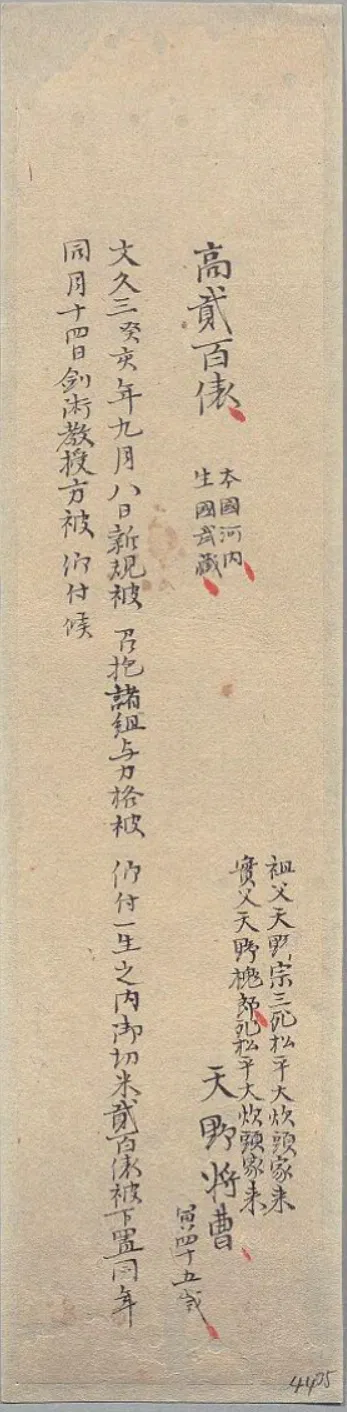
The card dates his appointment to Bunkyū 3/9 (autumn 1863), but Iemochi’s first procession to Kyoto had already ended — he returned to Edo by sea in the sixth month of 1863. A Nijō Castle match in which Amano appears as a serving instructor accompanying the shogun therefore cannot belong to that spring-1863 visit; it fits better with the shogun’s later processions, Genji 1 (元治1; 1864) or Keiō 1 (慶応1; 1865), by which time Amano was in post and could still be described as a recent appointee.
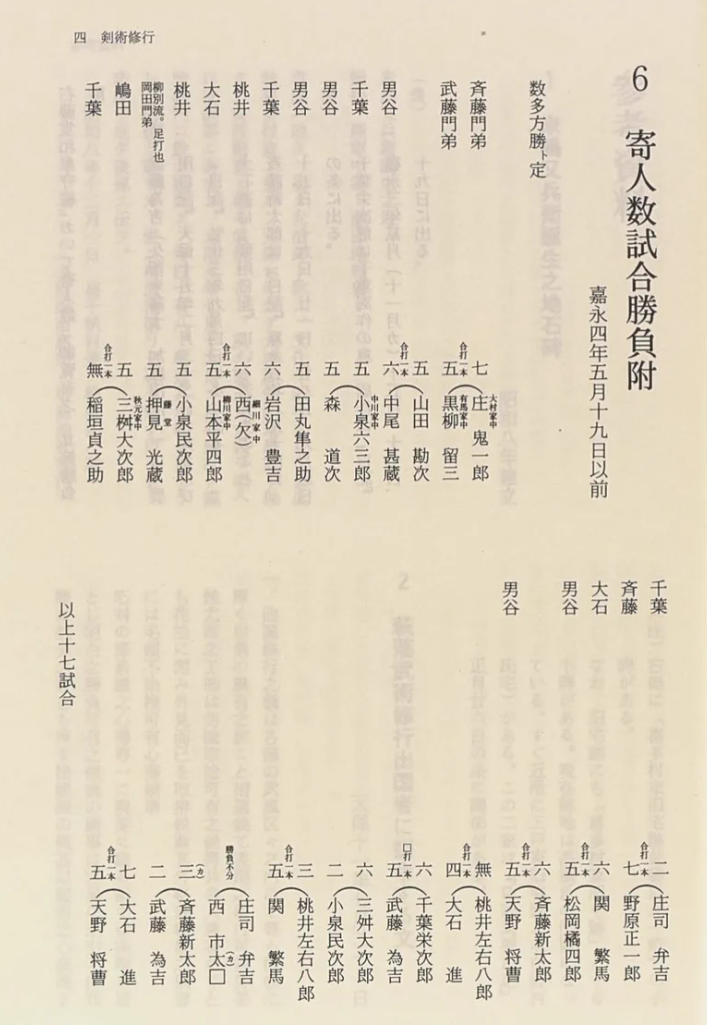
Also available is a match-meet ledger with Amano Shōsō is one of the fighters in it. The running head is Kenjutsu shugyō (剣術修行; swordsmanship training), the section is headed Yorihito kazu shiai shōbu-tsuki (寄人数試合勝負附; “record, with results, of the bouts of the attached men”), dated Kaei yonen gogatsu jūkunichi izen (嘉永四年五月十九日以前; on or before Kaei 4 [1851], 5th month, 19th day), and it closes ijō jūnana shiai (以上十七試合; seventeen bouts in all). It records a single competition of seventeen bouts held in the summer of 1851.
At age 45 in Bunkyū 3 (1863) on the card he was born about 1819, which makes him roughly 33 in 1851.
His father and grandfather were retainers (家来) of Matsudaira Ōi-no-kami (松平大炊頭); this ledger carries other challengers annotated Ōi-no-kami kachū (大炊頭家中; of the Matsudaira Ōi-no-kami house), which places him in exactly the sub-retainer circle the bakufu card describes. Together, they turn the “newly taken-on, too proud to yield” figure of the Sakakibara anecdote into a documented, competitive swordsman of the Odani circle who was fighting alongside the top Edo names well before 1863 — not a literary foil.
On the field he kept: the “home” side is the great dōjō — Odani (男谷), Chiba (千葉, including Chiba Eijirō 千葉栄次郎), Ōishi (大石, including Ōishi Susumu 大石進 of Yanagawa), Saitō (斉藤, including Saitō Shintarō 斉藤新太郎), and Momoi (桃井) — against guest challengers carrying daimyō-house tags (Akimoto 秋元, Yanagawa 柳川, Hosokawa 細川, Ōi-no-kami 大炊頭). One name to keep separate from your other work: a Matsuoka Kitsushirō (松岡橘四郎) appears here, unrelated to Katsunosuke or Yorozu.
Beside Odani the note reads roughly jūdaime seitō taru 〔jūichidai〕 (十代目正統たる〔十一代〕; “the tenth-generation legitimate [holder]” 〔eleventh generation〕).
Beside Masui (桝井) a note Yanagi-betsuryū, Okada monte, ashi-uchi nari (柳別流、岡田門弟。足打也; of the Yanagi-betsu line, Okada’s pupil).
Bouts appears to have been scored in gohon (五本; five-point) form.
Reading each pairing as challenger–opponent with the small annotations above the bracket (合打 = aiuchi, a drawn/simultaneous bout; 口打 = kuchi-uchi, likely a scoring/strike notation; 勝負不分 = shōbu wakatazu, no decision; 無 = none/no score), and the point-counts in gohon (五本; five-point) form:
- 七 大石 進 — 五(合打) 天野将曹
- 六 松岡橘四郎 — 五(合打) 斉藤新太郎
Amano Shōsō fought two bouts in this meet, and lost both by the same 5–7 margin.
In the first he took five points against Ōishi Susumu’s (大石進) seven, the pairing marked 合打 (aiuchi). Ōishi Susumu of Yanagawa was the celebrated tsuki specialist with the extra-long shinai whose Ōishi Shinkage-ryū grew in fame. A five-against-seven showing against him is respectable.
In the second, marked with the 口打 annotation, he took five against six. So, in Kaei 4 (嘉永4; 1851) Amano Shōsō, then about 33, was competing directly against the strongest names on the board — Ōishi Susumu (大石進), Saitō Shintarō (斉藤新太郎), Chiba Eijirō (千葉栄次郎), the Momoi (桃井) and Ōishi houses — and holding to within two points of them. That is a serious competitive standing a dozen years before his 1863 direct-service appointment as a kenjutsu kyōju-kata (剣術教授方), and it substantiates why an Odani-line man of his caliber was worth taking on.
It also points to how skilled Sakakibara was, to be able to cleanly knock him down.