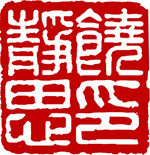
Tokunō Sekishirō (得能関四郎, 1842–1908; imina Michihisa 通久) was a Keishichō gekken instructor who received both the first seirenshō and the first hanshi title from the Dai Nippon Butokukai, and was reckoned the foremost of the “three elders” of the Tokyo kendō world. His swordsmanship was Jikishinkage-ryū of the Naganuma line — which places a second Naganuma-ha figure, after Kawaji, at the heart of the Meiji police layer.1
Born the son of a samurai of the Numata domain, he entered at fifteen (1856) the Shiba-Atagoshita dōjō of the domain’s Jikishinkage-ryū instructor Naganuma Junkyō (長沼恂教; gō Shōbee, 笑兵衛), took full transmission (menkyo kaiden) at twenty-one in 1862, and after his teacher’s death studied under the son, 可笑人 (Kashōjin), serving as juku-head of the Naganuma dōjō. After the abolition of the domains he became a city warden in Tokyo, and in 1880 was taken into the Keishikyoku as a guard-officer (警衛掛); as a gekken sewakari he joined in compiling the Keishi-ryū (Japanese Wikipedia, n.d.; Japanese Wikipedia, n.d.). His match record ran strong through the 1880s, including an 1882 imperial-review win. He met Matsuzaki Namishirō twice in 1884 — a draw at the Imperial Household Ministry’s Saineikan and a win over him at the Mukōgaoka Yayoi-sha tournament on 8 November (Meiji 17); no source records the reverse result.2
At the first Butoku-sai great embukai in 1895 he defeated Okumura Sakonta and was awarded the first seirenshō (精錬証); across the following annual meetings he was never beaten, and in 1903 he received the Butokukai’s first hanshi (範士) title (Japanese Wikipedia, n.d.; Dai Nippon Butokukai (大日本武徳会), n.d.). In his last years he was named foremost of the “three elders of the Tokyo kendō world” (東都剣道界の三元老), the other two being Shingai Tadaatsu (真貝忠篤) and Negishi Shingorō. On an early morning in July 1908 he took his own life at home by cutting his throat — leaving no note, the act was ascribed to the stroke he had suffered that spring — at the age of sixty-seven.3
The Naganuma-ha teacher’s name is given variously (恂教 Junkyō / 恂郷 / gō 笑兵衛 Shōbee). The son he continued under, 可笑人 (Kashōjin), may by its reading match the gō associated with Naganuma Michisato (称郷), last head of the 正兵衛家 branch. This identifies Tokunō directly with that branch-house line as both pupil and successor.4
The Keishichō put Sakakibara Kenkichi in charge of vetting the first gekken sewakari recruits (1879), and the Meiji-16 intake that brought in Tokunō and Shimoe Hidetarō went on to codify the Keishi-ryū gekken kata.
End Notes
-
The Naganuma-ha of Jikishinkage-ryū is the same broad school this register otherwise follows, but a distinct sub-line from the Odani-ha / Fujikawa-ha; Tokunō and Kawaji together give the police layer two Naganuma-ha swordsmen, which is worth noting against the assumption that the Keishichō drew only from the sword schools popular in Edo. (Japanese Wikipedia, n.d.) ↩
-
Anchor this bout by its date — Meiji 17, 8 November 1884 — not by an ordinal. The secondary literature disagrees on the numbering of the Yayoi-sha meets (the same 8 Nov 1884 tournament is called both the 2nd and the 3rd), and the Keishichō budō history separately calls the 1885 Yayoi meet “the first national kenjutsu tournament,” which cannot be squared with 1884 already being a zenkoku (全国) event. That Okumura Sakonta’s record lists five individually named opponents at this one meet (one loss, one draw, three wins) shows it was decided by direct head-to-head bouts, so the win over Matsuzaki is a real result, not a bracket artifact. (Japanese Wikipedia, n.d.) ↩
-
The seppuku is reported consistently — the blade wiped and returned to its sheath before death — but the cause is given as uncertain, most often attributed to the stroke of that spring; treat the “no reason known” framing as the sources leave it rather than resolving it. (Japanese Wikipedia, n.d.) ↩
-
The readings (恂教/恂郷, 笑兵衛/正兵衛, 可笑人/称郷) are secondary and want a primary check. ↩