護身法次第
We look at the 1675 Goshinhō Shidai, a Mikkyō (esoteric Buddhist) self-protection ritual manual dated Enpō 3 (1675) by Masatake or Yokoi:
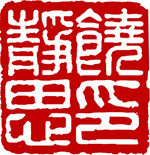
正武 Masatake [横井 Yokoi?] (recipient/transmitter); seal of Dai-Ajari Hōin 大阿闍梨法印. Goshinhō shidai 護身法次第 [Order of self-protection methods]. Manuscript scroll, Enpō 3 (1675), 12th month [kinoto-u year]. 18.1 × 840.0 cm; ink annotations; insect damage; scroll mounting; appended catalog of contents (附: 目録之次第). Call no. ケ05 01033. Waseda University Library Kotenseki Sōgō Database, Tokyo.
The Yokoi 1675 Goshinhō Shidai, classified by Waseda University Library under "ancient military affairs" (軍事-古代兵事), is preserved in the same archival cluster (call no. ke05 01033) as the Jikishinkage-ryū transmission scrolls ke05 01032 0001–0003. Although Waseda does not directly identify the Yokoi document as Jikishinkage-ryū school material, the institutional classification as military rather than religious, combined with the archival proximity, supports interpreting the 1675 Goshinhō as the spiritual-protection counterpart of the bujutsu transmission documented in the later scrolls.
This document is contemporary with the Takahashi Danjō Shigeharu (6th-generation, Jikishinsai) and Yamada Mitsutoku (7th-generation, Ippūsai) period of Jikisin Kage-ryu transmission and thus from the cultural milieu in which that formalization was happening. It is likely appended to, or was collected with, the Naganuma kirigami I previously examined, and is denoted as being of the exact same height.
Yokoi / Masatake may have been a samurai who studied protective ritual practices, a yamabushi who transmitted both martial and esoteric Buddhist material, or a specific lineage holder of the Goshinhō Shidai.
The seal 大阿闍梨法印 (Dai-Ajari Hōin):
- 大阿闍梨 (Dai-Ajari) — "Great Ācārya," from Sanskrit ācārya. This is the highest rank for a Buddhist master qualified to transmit esoteric (mikkyō) teachings. The title is used in Tendai (天台宗) and Shingon (真言宗) Buddhism, and also in Shugendō (修験道), which integrates esoteric Buddhist transmission with mountain asceticism.
- 法印 (Hōin) — "Dharma-Seal," the highest of three formal Buddhist ranks (above 法眼 Hōgen and 法橋 Hokkyō).
Dai-Ajari Hōin identifies the seal-holder as a fully-ranked esoteric Buddhist master with authority to perform transmission rites. This is the title of either Yokoi Masatake's master (the figure from whom he received the transmission), or possibly Yokoi's own posthumous Buddhist title if he himself was an ordained ācārya. The structure of the colophon — Yokoi's name below, master's title-and-seal above — suggests the former: this is Yokoi receiving from a Dai-Ajari Hōin in 1675.
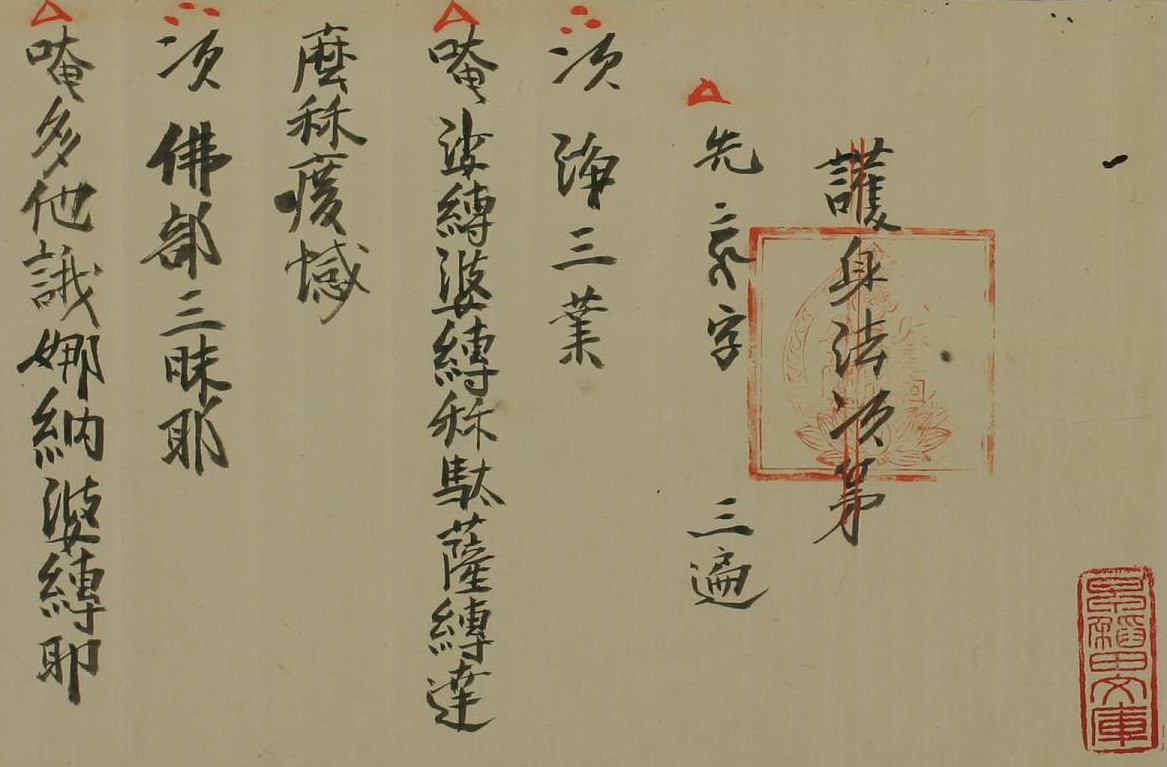
護身法次第 (Goshinhō Shidai)
This document is titled "Order of Self-Protection Methods" and begins with a series of Mikkyō (esoteric Buddhist) protection rituals, each with a Sanskrit mantra transliterated in Chinese characters and a procedural rubric:- 三業浄 (sangō-jō) — Purification of the Three Karmas: 唵婆縛婆縛秫駄薩縛達摩 (Om svabhāva-śuddha sarva-dharma)
- 佛部三昧耶 (Butsu-bu sanmaya) — Buddha-Family Samaya
- 蓮華部三昧耶 (Renge-bu sanmaya) — Lotus-Family Samaya
- 金剛部三昧耶 (Kongō-bu sanmaya) — Vajra-Family Samaya
- 被甲護身 (hikō goshin) — "Donning Armor for Self-Protection"
The opening sequence is the canonical goshu goshin (五種護身, Five Protections) sequence used in Tendai and Shingon kaji (加持) rituals. This part of the document is not school-specific; any Mikkyō master would transmit this. Its presence simply confirms the document is from authentic esoteric Buddhist transmission, not a popular or syncretic adaptation.
九字不事 (Kuji Fuji)
The famous Nine-Character Mantra, each character paired with its prescribed mudrā (hand seal): Character Reading Mudrā
- 臨 Rin 普賢三昧耶印 (Fugen Samaya-in)
- 兵 Pyō / Hyō 金剛輪印 (Kongōrin-in)
- 鬪 Tō 内獅子印 (Naishishi-in)
- 者 Sha 外獅子印 (Geshishi-in)
- 皆 Kai 外縛印 (Gebaku-in)
- 陳 Jin 内縛印 (Naibaku-in)
- 烈 Retsu 智拳印 (Chiken-in)
- 在 Zai 日輪印 (Nichirin-in)
- 前 Zen 宝瓶印 (Hōbyō-in)
This is the kuji-in practice originally derived from the Daoist Baopuzi but incorporated into Japanese Mikkyō and Shugendō, widely used as a pre-combat protective ritual.
Chiken-in is distinctively Vajra-realm mandala-based. This particular mudrā assignment is the Shugendō standard set as transmitted through Tendai-affiliated Shugendō lineages (particularly the Honzan-ha 本山派 centered on Shōgo-in 聖護院 in Kyoto).
The inclusion of 智拳印 (Chiken-in) for 烈 is especially indicative: Chiken-in is the central mudrā of Mahāvairocana in the Vajra-realm mandala (金剛界曼荼羅), the Tendai-favored mandala interpretation.
Also, Shingon-affiliated Tōzan-ha 当山派 Shugendō tradition uses slightly different mudrā assignments (particularly for 鬪 and 陳). This places Yokoi's transmission most plausibly in the Tendai-affiliated Shugendō (Honzan-ha) tradition, though Tendai proper (without a Shugendō overlay) is also possible.
十字大事 (Jūji daiji)
Next follows 十字大事 (Jūji daiji) — "The Ten Characters Great Matter" — an extension giving ten additional characters for use in specific dangerous situations: Character Application context (paraphrased from text)
- 天 Ten When facing high officials or great men of rank
- 龍 Ryū When crossing bridges or rivers
- 虎 Ko When traveling through deep mountains, wilderness, far-field
- 王 Ō When facing bows, soldiers, mountain bandits, sea pirates
- 命 Mei When traveling at night
- 鬼 Ki In crowds, when troubled by thoughts in someone's presence
- 勝 Shō Regarding tea, sake, poisoned foods
- 唵 On When buying or selling
- 大 Dai At places of water, boats, water-related danger
- 水 Sui For swallowing things, water-related circumstances
This Jūji extension is the more idiomatically Japanese piece of the document — the Nine-Character core is Sino-Japanese standard Mikkyō, but the Ten Character list with situational applications is a school-specific elaboration.
A possible 11th entry near 大/水 mentions 瘧病 (gyaku-byō, intermittent fever/malaria) and 疫病 (eki-byō, epidemic disease) — this may either be a separate entry or part of the explanation for one of the existing characters (most likely linked to 命 or 水).
The Nine Characters are pan-Japanese esoteric Buddhist; thousands of documents transmit them. The Ten Character extension with practical situational applications is far rarer, and its specific content here is highly suggestive:
- Travel-protection emphasis (crossing rivers, deep mountains, night travel) — this is the practical world of an itinerant practitioner. Yamabushi (mountain-ascetic Shugendō practitioners) and shugenja (their lay associates) were exactly this kind of itinerant figure, moving between mountain pilgrimage sites and lay communities.
- Combat/danger emphasis (王 for soldiers and bandits) — this fits both Shugendō practitioners (who needed protection in remote areas) and martial practitioners (who needed it in combat).
- Commerce protection (唵 for buying/selling) — Shugendō practitioners often served as itinerant ritual specialists for lay communities, including merchants, and the Jūji daiji with commerce protections is the kind of practical kuji-yōhō (九字用法, "applied uses of the kuji") that Shugendō transmission collected.
- Disease protection (the 瘧/疫病 mention) — Shugendō practitioners served as kitōshi (祈祷師, prayer-specialists) for plague mitigation and healing rituals; this fits.
- Status-related protection (天 for high officials, 大 for entering great residences) — relevant to both warrior-class practitioners and Shugendō figures who served warrior patrons.
The composite picture is of a practical protection-ritual handbook designed for someone who moves through a range of mundane situations carrying spiritual risk — i.e., either a Shugendō practitioner in his pastoral role or, equally plausibly, a lay practitioner who received this transmission as a personal protection set for his own life situations. Yokoi Masatake's name without a Buddhist title (he is just Yokoi Masatake, not Yokoi Masatake Hōin or similar) suggests he was a lay recipient, probably a samurai, who received the Goshinhō from a Dai-Ajari Hōin master as a personal protection transmission.
Historical Context
In December 1675, some relevant cultural-historical conditions:
- Tokugawa Ietsuna's reign (4th shogun, r. 1651–1680). The bakufu had stabilized; samurai families were transitioning from active warriors to administrative officials, but the cultural memory and practice of martial-spiritual integration was still very alive.
- Shugendō was at a peak of institutional power in this period, with both Honzan-ha (Tendai-affiliated, Shōgo-in) and Tōzan-ha (Shingon-affiliated, Daigo-ji Sanbō-in) operating substantial networks. The Edo bakufu had regulated Shugendō with the Shugendō Hatto of 1613, formalizing the two-school structure, but the practice itself remained widespread.
- Samurai patronage of mikkyō and Shugendō transmission was standard. Many samurai families had ongoing relationships with specific temples or Shugendō lineages for protective ritual purposes. A samurai receiving a Goshinhō transmission in 1675 from a Dai-Ajari Hōin master would be entirely normal.
- Yokoi (横井) is a recognizable samurai surname, including notable lines in Owari and Mikawa provinces (the Yokoi of the Hosokawa-Owari household later produced Yokoi Shōnan, the famous late-Edo political theorist) — the surname is consistent with samurai status.
This document is co-located with Jikishin Kageryu holdings at Waseda University Library I used in drafting my book. If they are received from a single family collection, then the Yokoi family (or the family that preserved this archive) may have maintained a unified bujutsu and protection-ritual transmission across at least 125 years.
The 1675 Goshinhō represents the spiritual-ritual layer that contemporary practice integrated alongside the kenjutsu transmission documented in the later scrolls. One could identify Yokoi Masatake's family connections — particularly whether they later patronized the Jikishinkage-ryū line at the Yoshida or Naganuma transmission point — there would then be a documented case of integrated bun-bu (文武) plus shū-gen (修験) practice in a single samurai family.
An open question is whether the Yokoi family member was a Jikishinkage-ryū practitioner or if there happened by coincidence to be members who were Shugendō practitioners in 1675 and the holdings became associated to parallel documents (the mokuroku and kirigami I examine).
延寶三年卯暦十二月吉日 横井正武 大河閣斂法印 [seal]
Enpō 3 [1675], Year of the Rabbit, 12th month, auspicious day. Yokoi Masatake (横井正武). [Seal of] Daikaku-an Renpō-in" (or similar — the seal characters 大河閣斂法印 may also be read 大河閣・斂法印 or as part of a longer formal Buddhist title)
Comparing against Shingon Kuji
Comparing against another Kuji document from 1812:
本間百里(写), 文化9[1812]honmahyakuri(sha) 7.5×135.9-17.5×30.1cm(外寸17.5×200.4cm)本間叢書奥書:水嶋卜也ほか一部朱書欠落あり巻子装印記:源百里印,百里,伯爵本間百里旧蔵九字大事. 十字秘曲. 護身法大事. 護身法
This document is from the Honma Sōsho (本間叢書), the Honma family collection from Sakata in Dewa Province (modern Yamagata), formerly owned by Count Honma Hyakuri (伯爵本間百里旧蔵) and has four titled sections:
- 九字大事 (Kuji Daiji) — Great Matter of the Nine Characters
- 十字秘曲 (Jūji Hikyoku) — Secret Composition of the Ten Characters
- 護身法大事 (Goshinhō Daiji) — Great Matter of the Self-Protection Method
- 護身法 (Goshinhō) — Self-Protection Method
The document is dated Bunka 9 (1812), late mid-spring (around March of 1812). Copyist is Honma Hyakuri (本間百里) with seals 源百里印 and 百里. The transmission chain visible in the colophon includes Mizushima Bokuya (水嶋卜也), Itō Jin'emon (伊藤甚右衛門), and several individuals using the Yuki-character (幸氏, 幸尭, 幸督, 辛督) as a family-marker — these appear to be members of a samurai house whose dōji-character (shared given-name component) is 幸. Final endpoints Matsuoka Seisuke (松岡清助) and Honma Yoichi/Hyakuri (本間與一/本間百里).
Both documents share the same broad ritual architecture, but have siginificant differences.
The Yokoi 1675 document for Rin lists 普賢三昧耶印 (Fugen Samaya), whereas the 1812 document lists 小釼印 (Shōken-in, "Small Sword"). In the 3rd and 4th places of the kuji, the inner and outer lion depictions are swapped. This is true for different kuji transmissions — they are from different lineages.
The Honma includes a second column for each character giving its associated deity:
- 臨 多聞天 (Tamonten / Vaiśravaṇa)
- 兵 持國天 (Jikokuten / Dhṛtarāṣṭra)
- 鬪 増長天 (Zōchōten / Virūḍhaka)
- 者 廣目天 (Kōmokuten / Virūpākṣa)
- 皆 降三世 (Gōzanze / Trailokyavijaya)
- 陳 軍荼利 (Gundari / Kuṇḍalī)
- 烈 金剛夜叉 (Kongōyasha / Vajrayakṣa)
- 在 大威徳 (Daiitoku / Yamāntaka)
- 前 不動明王 (Fudō Myōō / Acalanātha)
This is the canonical Four Heavenly Kings + Five Wisdom Kings (四天 王 + 五大明王) deity-pairing system — a standard Shingon arrangement also found in Tendai. The first four characters get the four heavenly kings (the protectors of the four directions); the last five get the five wisdom kings (the wrathful manifestations who subdue obstacles).
The Jūji content is substantively different:
- Yokoi 1675 (十字大事): 天 龍 虎 王 命 鬼 勝 唵 大 水 — primarily samurai-life situations: facing officials, crossing rivers, mountains, soldiers/bandits, night travel, crowds, poisoned food, commerce, great houses, drinking.
- Honma 1812 (十字秘曲): 行 虎 善 神 佛 散 心 破 勝 一 光 — primarily religious-practice situations: road prayers, mountain paths, shrine visits, Buddha images, when enemies come, night travel, facing the enemy, boat-boarding
Only 虎 (Ko, mountain paths) and 勝 (Shō, victory/combat) appear in both lists. The rest of the character set differs entirely. These are not variants of the same Jūji tradition — they are parallel ten-character extensions developed independently within different transmission lines.
The titles themselves are distinct: 大事 ("Great Matter") for the Yokoi vs. 秘曲 ("Secret Composition/Tune") for the Honma. The "Secret Composition" framing in the Honma suggests a more liturgical conception (something to be recited as a ritual sequence); the "Great Matter" framing in the Yokoi suggests a more doctrinal conception (something to be understood and applied).
The Honma 1812 is designed to be teachable from the scroll itself — a practitioner with no prior instruction could approximate the mudrās from the diagrams. The Yokoi 1675 requires prior instruction — the text descriptions alone (内獅子印, 外縛印, etc.) presume the reader already knows what these mudrās look like. The Yokoi is a mnemonic transmission for someone already trained; the Honma is closer to an instructional manual.
The Honma colophon names a chain of human transmitters: Mizushima Bokuya → Itō Jin'emon → multiple Yuki-named figures → Matsuoka → Honma. This is traceable lineage. The Yokoi document gives only the seal-title of the Dai-Ajari Hōin master (whose personal identity is not stated) and Yokoi Masatake's signature. This is anonymous master + named recipient.
The Honma format is consistent with how non-clerical bujutsu transmission lines documented their inheritance — by listing named human teachers. The Yokoi format is consistent with how clerical Mikkyō transmission documented inheritance — by an authoritative master-seal whose specific identity was secondary to the institutional authority. The Honma document, which has the explicit Four Heavenly Kings + Five Wisdom Kings pairing that is most strongly associated with formal Shingon transmission and uses the opposite 鬪/者 mudrā configuration from the Yokoi.