Mountain, Sword, and Mind Volume I
Inner Dharma began because of my interest in the Japanese mountain religion called Shugendō. Mountain, Sword, and Mind is a project on the influence of mountain religion on medieval Japanese martial arts that began on Inner Dharma and grew into two volumes that span almost nine hundred pages.1
The companion volume Mikkyō, Zen, and Daoist Sources in Shinkage-ryū then examines the source writings of and scholarship on Shinkage-ryū in terms of the art’s philosophical influences. I hope you find one or both volumes to be of interest, regardless of whether you practice an older Japanese martial art or are simply interested in Japanese military and religious history.2
Shugendō and Heihō
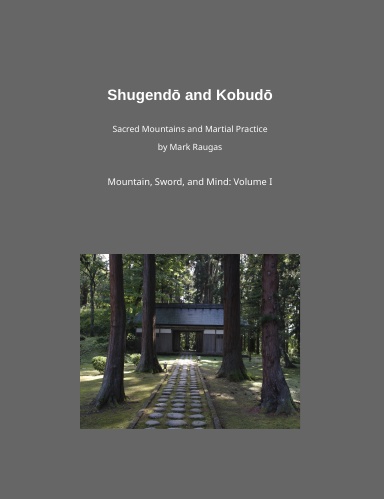
Shugendō and Heihō: Sacred Space and Martial Practice, Mountain, Sword, and Mind, Volume I (opens in a new tab). Inner Dharma, 2026. 397 pages.
In this work we begin by examining the practice of peak entry, discuss the Buddhist ten realms, the concept of tengu and their relationship to gongen, and provide a brief overview of two important early Shugendō figures: En no Gyōja and Rigen Daishi (Shōbō).
We provide an inventory of the tengu and yamabushi-related material in the Bujutsu Sōsho and then discuss historical sacred sites in Japan and the martial traditions attached to them, drawing from the Honchō Bugei Shōden (本朝武藝小傳) and Bujutsu Ryūso-roku (武術流祖錄) and other sources. This includes Kuramadera, Atago, Kashima, Katori, Dewa Sanzan, Kumano Sanzan, Udo, and Hikosan.
We translate Kūkai’s Secret Key to the Heart Sūtra commentary. We then examine the Shugendō canon’s pantheon, including Manjushri (Monju), Fudō Myōō, the Five Wisdom Kings, Zaō Gongen, Sanbō Kōjin, Māra, Marishiten, Mahakala (Daikoku) and Bishamonten. We close with a discussion on military Shugendō including the kuji (nine syllables), goshinhō (protective rites), and the concept of the diamond (vajra) body.
End Notes
-
A work of this scale would not have been possible for me to accomplish without the use of AI – some information on research methods and conventions is available, including the use of automated tools for optical character recognition, translation, search, and proofreading. ↩
-
These volumes attempt to be precise but are not academic histories. Instead they are close readings of historical sources. In doing so, we relate the statements made about many older martial traditions by their witnesses and practitioners, but each surviving faction or group will have their own in-tradition orthodoxy. ↩