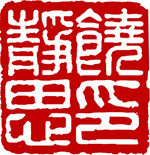
The founder was Ōshima Hanroku Yoshitsuna (大島伴六吉綱; 1588–1657), also recorded under the common names Shinpachi (新八) and Unpei (雲平). He was born in Mino (美濃; Gifu), son of Yokoe Kiyomoto (横江清元), and was adopted by his maternal grandfather Ōshima Mitsuyoshi (大島光義); his spear came from Yuasa Shinroku (湯浅新六), a spear adept in the service of the Saitō. He served Katō Kiyomasa, took part in the Bunroku–Keichō campaigns, then followed Maeda Toshinaga and was active at the Siege of Osaka, where he was badly wounded in the leg by an enemy bullet, left the Maeda, and became a rōnin.
In 1633 (Kan’ei 10), at age 46, on the recommendation of Yagyū Munenori he entered the service of Tokugawa Yorinobu of Kishū at a 300-koku stipend, exempt from duties and enrolled in the ō-bangumi, and taught spear within the domain; he was raised to 750 koku in 1636.
His signature weapon was a long suyari with a fixed shaft length of one jō one shaku eight sun (≈3.6 m) and a ginnan-ho (“ginkgo-leaf”) head.
Two lineage points connect outward. Among his students were Totsuka Gozaemon Katsumasa — founder of a Totsuka-ryū — together with Takada Hachizaemon and Okuno Hangorō; note that this Totsuka is a spear line and is unrelated to the Totsuka-ha Yōshin-ryū jūjutsu.
His second son, Unpei Tsunehisa (號 Sōan; 1623–96), inherited and refined the art; Tsunehisa’s line came to be called Sōan-ryū (草庵流) and the founder’s line Ōshima Ko-ryū (大島古流). Tsunehisa’s outstanding students included Taneda Heima Masayuki, founder of Taneda-ryū, the second main kudayari school in addition to Kan-ryū. Within Kishū, the school sat among several domain spear traditions (Toyama-ryū, Kasai-ryū, Risō-ryū, and others), recorded there specifically as “Ōshima-ryū (Ōshima Ko-ryū).
The school had a well-known rivalry with Hōzōin-ryū. an Ōshima master matched the Hōzōin-ryū adept Takada Matabei Yoshitsugu and, after being pushed back, caught the off-guard Matabei’s sleeve to save face — since which the suyari-using Ōshima-ryū and the cross-spear Hōzōin-ryū have stood opposed. As for survival, Ōshima-ryū is not among the spear arts the standard accounts list as surviving to the present (Kan, Saburi, Fūden, Hōzōin Takada-ha), so it should be treated as a discontinued tradition now known through documents and academic study — there is, for instance, a 2016 budō-gaku conference paper on Ōshima-ryū and Taneda-ryū technique.
Waseda University holds a 6.74m long densho of this style from Kansei 4 (1792) under 文庫08 J0047 titled ōshimaryū sōjutsu densho (大島流槍術伝書).
This appears to be a comprehensive transmission scroll of the founder’s line (Ōshima Ko-ryū) — not the Sōan branch — running from a catalogue of forms through the innermost/situational teachings, with a full lineage and colophon. Its closest published genre-cousin is the “Ōshima tōryū sōjutsu hiden meikan kana-shō” kaiden-sho recorded in the cultural-heritage database; like that text, this scroll is heavily kana, with the deeper material in katakana.
Structurally it moves through:
- A mokuroku of paired-engagement categories — tachiai (太刀合; against the sword), sōai (鎗合; spear vs spear), jūmonji-ai (十文字合; cross-spear), naginata-ai (長刀合), and a recurring nuri-ai (塗合) set — organized by transmission level (omote 表 / oku 奥 / kae 替), with kata numbered within each set, and a gokui (極意) tier that includes a form named kurenai (紅).
- A detailed weapon-specification section (headed roughly tōryū … koshirae sunpō, 當流…拵寸方) giving, for each weapon, the length, shaft (柄), blade/穂, butt-cap (石突), balance/core (心), and weight in monme (匁) — the ni-ken figure noted above sits here.
- A long hiragana kuden section of named techniques — among the legible ones, nanae (七重), zanshin (残心), a kuruma (車) group, ōzumi (大積), betsu (別), san-zun no kaeshi (三寸之返), enkin (遠近), yaegaki (八重垣), and sakate (逆手; reverse grip). The graph 塗 (nuri; a smearing/sliding action) recurs as a technical term — mura-nuri (村塗), uwa-nuri (上塗), nuri-saki (塗先) — which looks like a core element of the school’s long-spear method, though I’d want your read on that.
- A katakana “sotomono” (外物; outer/extra items) and kuden section, each item tagged kuden (口傳): taikyoku (太極), towaki (戸脇), bajō no kurai (馬上之位; mounted), yoru no kurai (夜ルノ位; night), shuriken-dome (シュリケントメ; defense against thrown blades), hitotsubashi (ヒトツ橋), mikoshi, and a numa-watari (沼渡り; marsh-crossing) reference. The breadth — mounted, night, marsh, and thrown-weapon defense — reads as a battlefield-oriented curriculum, fitting a founder who was an Osaka-campaign veteran, and it pairs with the school’s documented irimi training (entering against the long suyari with sword, naginata, jūmonji, or kagiyari, drilled as “thousand entries”).
The whole catalogue down through 極意 is what the colophon calls the 中通 (chū-tōri, “middle transmission”); the 外物 stands apart as a supplementary set of oral teachings. The 表 / 替表 / 奥 (omote / kae-omote / oku) leveling cuts across the sections — most visibly within 鎗合 — so a given “section” is really a set of forms re-treated at successive levels rather than a flat list
The engagement categories track the opposing weapon (sword, spear, cross-spear, naginata), consistent with the school’s documented 入身 training of entering against the long spear with each of those.
Ōshima-ryū sōjutsu — catalogue (mokuroku) sections
| Section | Gloss | Approx. kata |
|---|---|---|
| 太刀合 (tachiai) | engagements vs the sword | ~4 (firmest — うき小袖, あけまき, おて入, ゑんさん) |
| 鎗合 (sōai) | spear vs spear — the core body | by far the largest; on the order of two-plus dozen across its 表/替表/奥 sub-levels |
| 塗合 (nuriai) | the “smearing/sliding” engagements | a handful (~4–5) |
| かき塗合 (kaki-nuriai) | “hooking” nuri variant | ~6–7 (bottom numbering runs up toward 七) |
| 十文字合 (jūmonji-ai) | cross-spear engagements | ~4 |
| 長刀合 (chōtō-ai) | naginata engagements | ~4 |
| 極意 (gokui) | innermost teachings | ~4 (incl. 紅 kurenai, 八重垣 yaegaki) |
| 外物・外物中本 (sotomono / -nakahon) | “outer items” appendix, each tagged 口傳 | ~12–14 situational entries (馬上之位 mounted, 夜ルノ位 night, シュリケントメ thrown-blade defense, 戸脇, 堀宗, ヒトツ橋, ミコシ, etc.) |
Notes
- Counts are approximate. The catalogue appears twice — a named listing (pp. 1–3) and a numbered one (pp. 9–10) — and the two do not reconcile cleanly; the cursive numerals (二 / 三 / 五 are easily confused in this hand) make an exact tally unreliable. Treat the figures as orders of magnitude, not citable totals.
- Levels. The 表 / 替表 / 奥 (omote / kae-omote / oku) grouping cuts across the sections — most visibly within 鎗合 — so each “section” is a set of forms re-treated at successive levels rather than a flat list.
- Scope. Everything through 極意 is what the colophon calls the 中通 (chū-tōri, “middle transmission”); the 外物 stands apart as a supplementary set of oral teachings.
- Organizing principle. The engagement categories track the opposing weapon (sword, spear, cross-spear, naginata), consistent with the school’s documented 入身 training of entering against the long spear with each of those.
Lineage
The colophon closes with the standard injunction that the art turns on the recipient’s character and that the secret matters be transmitted in full, then gives the transmission lineage (with personal names in small script):
- Ōshima Unpei 〔Yoshitsuna〕 (大嶋雲平〔吉綱〕, the founder)
- Toda Hikoku’emon 〔Naoshige〕 (戸田彦九右衛門〔直重〕)
- Miyake Gyōbu-uemon 〔Koremitsu〕 (三宅刑部右衛門〔伊光〕)
- Miyake Denjūrō 〔Iza?/伊汎?〕 (三宅傳十郎)
- Kobayashi Kōkuemon 〔Katsufusa〕 (小林幸九右衛門〔勝房〕)
- Sasayama Kichinosuke 〔Mitsufusa〕 (篠山吉之助〔光房〕).
It is then issued by Ōta Kozen, gō Eiki (太田小膳/榮煇), described as a student (門人) of Sasayama Kichinosuke, with his kaō and two red seals, dated Kansei 4, mizunoe-ne, 2nd month (寛政四壬子年二月 = 1792) — matching the Waseda catalogue — to a recipient that is obscured 宇〔野?〕茂安〔…〕殿.
The chain runs from the founder out through Toda and the Miyake rather than down the Ōshima family itself, which is consistent with this being an Ōshima Ko-ryū transmission carried by Kishū retainer houses.
Ōshima Unpei could in principle be either the founder or his same-named son, but the nanori 吉綱 fixes it as the founder.
We previously examined a 1812-document and had a question on whether 幸 is a surname or a given-name element — here Kobayashi Kōku’emon (小林幸九右衛門) has 幸 sitting inside a common name under the surname 小林, with a separate nanori 勝房; it’s a clean instance of 幸 as a kemyō element rather than a surname, though it’s a different lineage and so not direct evidence about the Honma-collection.
當流塗行刀拵寸方 (the school’s weapon-construction dimensions) appears right after the kuden list closes with 以上. It lists dimensions for plain yari, jumonji yari, and naginata.
Ōshima-ryū sōjutsu — weapon dimensions
Source: Ōshima-ryū sōjutsu densho (大島流槍術伝書), Waseda University Kotenseki Sōgō Database, call no. 文庫08 J0047; manuscript copy, Kansei 4 (1792). Figures transcribed from the dimension section headed 當流塗行刀拵寸方. Metric values are approximate; densho figures follow in parentheses.
| Weapon | Shaft length | Blade length | Blade/head weight |
|---|---|---|---|
| Plain spear — suyari (素鎗) | ≈ 3.64 m (柄 二間 = 2 ken) — firm | ≈ 6.7 cm 〔?〕 (身 長サ ≈ 二寸二分; looks too short — unverified) | ≈ 338 g (九拾目 = 90 monme) — firm |
| Naginata (長刀) | ≈ 2.12 m 〔?〕 (柄 ≈ 七尺) | not legibly read (blade section gives そや・そぐ, no clear 長サ) | ≈ 300 g (八拾目 = 80 monme) — fairly firm |
| Cross-spear — jūmonji-yari (十文字) | ≈ 2.7–3.0 m 〔?〕 (柄 ≈ 九尺〔九寸?〕) | ≈ 20–26 cm 〔?〕 (身中 ≈ 〔六/八〕寸六分, leading digit uncertain) | ≈ 375 g (百目 = 100 monme) — firm |
The weights read cleanly (90 / 80 / 100 monme ≈ 340 / 300 / 375 g, the cross-head heaviest, as expected). Cells marked 〔?〕 rest on readings of 1792 cursive numerals for a tradition with no living check, so the shaft figures — and the entire blade-length column — should be treated as provisional rather than citable.
Conversions (kanejaku basis): 1 ken = 6 shaku ≈ 1.82 m; 1 shaku ≈ 30.3 cm; 1 sun ≈ 3.03 cm; 1 bu ≈ 3.03 mm; 1 monme = 3.75 g.