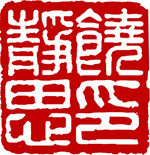
Fujishin-ryū (不二心流; ふじしんりゅう) is a late-Edo kenjutsu school, and the All-Japan Kendō Federation’s research series on “Bakumatsu village kenjutsu” (幕末在村剣術) devotes its first installment to it. The founder was Nakamura Isshinsai (中村一心斎), originally Nakamura Hachihei (中村八平). His path was unusually colorful: he first studied Asayama Ichiden-ryū, at seventeen entered the Shimabara-domain Hanamura household in Edo as an adopted son-in-law and continued in that school, then around twenty-two — for reasons unknown — feigned madness and deliberately made himself a rōnin. He then made a circuit-pilgrimage (kaikoku shugyō) of the provinces, trained at a Kawara Shōshin-ryū dōjō near Zenkō-ji in Shinano under the name Nakamura Hachihei, and on returning to Edo was taken on as head student (jukutō) of the Shintō Munen-ryū dōjō of Suzuki Onohachirō. That Shintō Munen-ryū connection is why the standard kenjutsu listings place 不二心流 in the Nen-ryū / Munen-ryū cluster.
In Bunsei 1 (1818), at thirty-six, he undertook great austerities on the sacred peak — abstaining from grains, eating wild plants, and continuing for a hundred days — and attained the realization “in my heart there is no second/divided mind” (我が心に二心無し), naming his school Fujishin-ryū; he styled himself Fuji Ken’ō (不二剣翁) and opened a dōjō in Edo’s Hatchōbori said to have had two thousand students. So 不二 carries a deliberate double sense: the mountain (Fuji, written 富士 but here 不二) where the insight came, and “non-dual / undivided” — an undivided mind (cf. 一心, echoed in his name Isshinsai). It is a thoroughly Bakumatsu, Edo-and-countryside school, and it spread widely.
The artt left transmission documents: the Kumamoto Prefectural Library’s Tominaga collection — the same collection you were checking for the Gunpō Hikiri-sho yomi — catalogues a Fujishin-ryū heijutsu oboe (不二心流兵術覚; Fujishin-ryū martial arts scroll), with the internal title 發氣不二心流兵術覚, naming Ōkōchi Sōshirō Fujiwara no Naonobu and Ebato Kuninoshin. Second, the line is still transmitted today: the Kokusai Suigetsujuku Bujutsu Association lists Fujishin-ryū kenjutsu (不二心流剣術; Fujishin-ryū swordsmanship) among the traditions it preserves
This art was an early practice Kawashima Takashi, of Jiki Shinkage-ryū. A widely-diffused Kantō village-kenjutsu school is exactly the kind of thing a Chiba (Kazusa/Shimōsa) native would have picked up in early regional training, which fits the stele’s sequence — Ittō-ryū and Fujishin-ryū licenses “in his twenties,” before the Navy, Taiwan, and his later Jiki Shinkage-ryū study under Yamada.
References
- Kazuma Kōji (数馬広二), “幕末在村剣術と現代剣道 第1回 不二心流・中村一心斎の巻” (Bakumatsu zaison kenjutsu to gendai kendō, no. 1: Fujishin-ryū and Nakamura Isshinsai), All-Japan Kendō Federation, Public Relations and Materials Subcommittee column, at https://www.kendo.or.jp/knowledge/books/zaisonkenjutsu_01/ — this carries the founder’s biography (Nakamura Isshinsai / Nakamura Hachihei), the Asayama Ichiden-ryū and Kawara Shōshin-ryū training, his time as head student in Suzuki Onohachirō’s Shintō Munen-ryū dōjō, the 1818 Mt. Fuji austerity and naming (“我が心に二心無し”), the Fuji Ken’ō sobriquet, and the Hatchōbori dōjō with its reported two thousand students.
- The Kumamoto Prefectural Library catalogue of the Tominaga-family donation, 「富永家寄贈 武道関係資料 剣術関係資料(冊子)Ⅱ」, lists the Fujishin-ryū heijutsu oboe (不二心流兵術覚 / internal title 發氣不二心流兵術覚), with the names Ōkōchi Sōshirō Fujiwara no Naonobu and Ebato Kuninoshin: http://www.library.pref.kumamoto.jp/DigitalArchives/mokuroku/m-tominaga/kenjutu_sassi2.pdf
- For modern transmission, the Kokusai Suigetsujuku Bujutsu Association (国際水月塾武術協会) lists Fujishin-ryū kenjutsu (不二心流剣術) among the traditions it preserves: https://japanbujut.exblog.jp/34368393