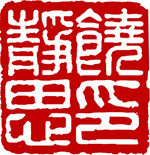
The fourth head of Kyōshin Meichi-ryū, Momoi Shunzō Naomasa (桃井春蔵直正, 1825–1885), was born into the Tanaka (田中) family, a second son of a Numazu-domain samurai (the father’s name is given variously in the sources); his childhood name was Jinsuke (甚助), his common name Sōhachirō (左右八郎). “Momoi Shunzō” was the name successively assumed by the heads of the Shigakukan, and Naomasa was the fourth to hold it. After about two years of Jiki Shinkage-ryū training in Numazu he came to Edo in Tenpō 9 (1838), aged fourteen, and entered the Shigakukan under the third Momoi Shunzō. Earning the first mokuroku at seventeen and marked out for his talent, he was taken in as adopted son-in-law, received the inner transmission in his twenties, and in Kaei 5 (1852), at about twenty-seven, succeeded as the fourth head.
Under Naomasa the Shigakukan recovered from a period of decline and rose to its lasting fame, counted with the Genbukan and the Renpeikan as one of the three great Edo dōjō. His swordsmanship was the model for the school’s reputation for kurai (位; poise), and he was widely styled the most dignified swordsman of his day — “poise, that is Momoi.” Among his students was Takechi Hanpeita (Zuizan, 武市半平太), the Tosa loyalist leader, who served as head student (jukutō) at the Shigakukan and came up to Edo with a party that included Okada Izō; the “four kings” of the Shigakukan, such as Ueda Umanosuke (上田馬之助), also trained under him.
He came to the Kōbusho later than the original cohort, appointed kenjutsu kyōjukata in Bunkyū 3 (1863) — a few secondary accounts give Bunkyū 1 (1861) — and promoted to shihan-yaku-nami in Keiō 2 (1866); with the bakufu’s military reorganization he was transferred to a directorship of the yūgekitai. In Keiō 3 (1867) he accompanied Shōgun Tokugawa Yoshinobu to Kyoto, and afterward moved to Osaka, where he served at the temporary Tamatsukuri Kōbusho (玉造講武所) as a kenjutsu master-instructor before resigning that eleventh month over an internal dispute. He passed his last years in the Osaka region and died on 3 December Meiji 18 (1885).
Kyōshin Meichi-ryū (鏡新明智流)
Kyōshin Meichi-ryū was founded by Momoi Hachirōzaemon Naoyoshi (桃井八郎左衛門直由, 1724–1774), the first to bear the name Momoi Shunzō. Originally a retainer of the Yanagisawa house of Yamato Kōriyama, he became a rōnin and, after study of Toda-ryū iai, Ittō-ryū, Yagyū-ryū and other lines, devised his own school on the basis of a Toda-ryū secret cut, adding elements of Muhen-ryū spear. The name was first written 鏡心明智流 — the kyōshin (鏡心; “mirror-heart”) taken from a Toda-ryū form name — and later 鏡新明智流. In An’ei 2 (1773) he opened the Shigakukan (士学館) in a tenement at Minami-Kayabachō in Nihonbashi, Edo; under the second head, Naokazu (直一), the dōjō moved to the Asari-gashi (蜊河岸), by which it was long known. The school nearly foundered under the third head but revived decisively under the fourth, Naomasa, after whom the Shigakukan was counted one of the “three great Edo dōjō.” Its hallmark was kurai (位; poise, bearing, dignity) rather than force, summed up in the contemporary tag “poise — that is Momoi” (位は桃井), set beside “technique — that is Chiba” and “power — that is Saitō.”
As a continuous transmission Kyōshin Meichi-ryū did not survive the Meiji period intact, and it is best treated today as a largely historical school; what circulates under the name rests on later reconstruction rather than unbroken lineage, so caution is warranted before describing any present-day practice as the original tradition.