Kodachi Kata
Eighteenth and early ninteenth century mokuroku of the Nagnanuma line of Jikishinkage-ryū kenjutsu do not explicitly mention the six kodachi kata practiced in the Seito-ha today. In the Odani-ha, those we imported from the Fujikawa-ha (藤川派) into what today is sometimes called the Seito-ha by Yamada Jirōkichi. The Seito-ha now maintains five kata sets: Hōjō (法定), Tō no kata (韜之形), Kodachi (小太刀), Habiki (刃引) and Marobashi (丸橋) but its parent, the Odani-ha, by the end of the nineteenth century only practiced Hōjō as kata. Upper-level tactics and teachings were explored instead during shinai-uchikomi-geiko.
The Naganuma family line of Jikishinkage-ryū today has a larger curriculum, including saya no uchi (methods of battō and iai). The kodachi curriculum may be a 19th century addition in the Fujikawa-ha, but there is an alternate explanation I would like to explore, which would explain its presence in other factions of the art (including the Naganuma).
It is said that Yamada "learned the Kojō" kata or "learned the ura of Hōjō" from Saitō. This is typically thought to mean the older arrangement of Hōjō, which is Habiki. This is likely true, diven the above focus on shiai when he was training at Sakakibara's dōjō. However, there is also another layer of meaning that relates to Jikishinkage-ryū kodachi practice.
Gokui Kyōju Zukai
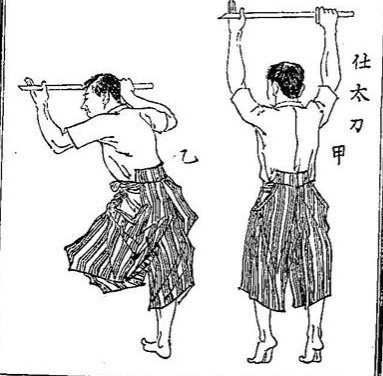
Saitō Akinobu's Gokui Kyōju Zukai (国立国会図書館デジタルコレクショ ン) from 1901 contains material on what is now the current Seito-ha curriculum, including ink drawings of kata, as does Yamada's 1915 treatise with extensive professional photogrpahy for the time. In it, the table of contents entry for the 小鞱之形部 (Kodachi Forms section) [page 12], the closing prose reads:
此形は[六]本なれども法定の裏の手の形なるが故に名所は法定と二本目三本目とついけて打つ故に他見する時は三本の形の儀に見へるるものなり
These forms, [though] six in number, are [in essence] the back-hand form (裏の手の形) of the Hōjō. For this reason, the names connect with the Hōjō 2nd and 3rd kata, and when seen by others, they appear as the [three] Hōjō forms in their ritual aspect.
This implies that the six kodachi kata, even if not listed in the Naganuma mokuroku I have available, are not an independent imported set. The kodachi as a concept (kodachi-side practice of Hōjō movements) may have existed informally as kuden-level training, but their codification into named six kata with specific weapon specifications is a Fujikawa-ha development, finalized in published form by Saitō. Looking at the introduction to the work in 1901, the daishō (大小, big-and-small) bokutō pairing is mentioned only in passing. The presence of kodachi was likely normalized in the Fujikawa-ha curriculum to the point where practice had been in the school long enough by 1900 for the kodachi-side equipment to feel routine.
Ura Kata
The six kata are framed by Saitō as the ura-no-te-no-kata(chi) (裏の手の形, "back-hand form") of the Hōjō — i.e., the kodachi-side perspective of practicing the foundational Hōjō kata. This could be said to be more concisely, colloquially, "the ura of Hōjō", or even kojō, if the character for small is used instead of old. Then, the listing of kojō in the earlier mokuroku gokui sections might actually refer to two kata sets, or practices that turned into kata sets: the kodachi practice and the practice of Hōjō with metal swords (the Habiki arrangement).
In Yagyū Shinkage-ryū, kodachi is taught explicitly. The Yagyū kodachi to mutō-dori developmental process is documented in primary sources. Sekishūsai (柳生石舟斎 / 柳生宗厳, 1529–1606) received the mutō no ryū ("art of no-sword") concept from Kamiizumi, but Munenori (1571–1646) systematized it for Edo Yagyū transmission in the Heihō Kadensho.
Ippūsai's Edo Yagyū training would have been with material descended from Munenori's codification, several generations removed from Sekishūsai's original reception — so the Sekishūsai connection would be the ultimate source of the practice, but the immediate source for Ippūsai is the Edo Yagyū transmission line.
Munenori's systematization in the Heihō Kadensho (1632), has the kodachi-side practice functioning explicitly as a stepping-stone toward eventually facing an armed opponent with no weapon at all. The doctrinal sequence of moving from equal-length tachi to short-sword (kodachi), and then no-sword (mutō), is Yagyū's distinctive architecture, and the kodachi material is its key middle term.
I wonder if initially these kodachi (and habiki) practices were gokui (inner teachings) listed only as part of the kuden related gokui entry in the mokuroku, to obscure their presence, especially if Yamada Ippūsai had imported variations of Edo Yagyū Shinkage-ryū he had learned as an adjunct or embellishment of the earlier Jikishinkage-ryū curriculum he had learned from Takahashi Jikishinkai, and did not want to explicitly denote the appropriation.
The reading of ura-no-te-no-katachi as "the ura of Hōjō" and then kojō works as a philological collapse, with the 小 / 古 homophones. Both characters read ko- in compounds, and in cursive kana mokuroku transcriptions where the entry might appear as こじょう (or similar), the kanji disambiguation could go either way. The two readings — 古 (old, archaic, foundational practice) and 小 (small, kodachi-side practice) — are not really competing meanings but complementary aspects of the same conceptual territory: non-standard / specialized practice of the Hōjō movement.
Analysis
A mokuroku that didn't disambiguate between the two would be perfectly readable to insiders and opaque to outsiders. The unifying logic — that both habiki (Hōjō with real blades) and kodachi (Hōjō from the short-sword side) are non-standard practices of the same Hōjō movement — is what Saitō's 「法定の裏の手の形」 framing claims for the kodachi. Extending the same to habiki is natural: habiki is Hōjō arranged in a more combative fashion using a real weapon, kodachi is Hōjō with a different weapon entirely (which then leads to a practice with steel kodachi in the Fujikawa-ha).
All are then different ura projections of the same foundational forms, which ties back to the phrase from the 1800 mokuroku, that all practice is Hōjō.
If anyone in the Jikishinkage-ryū lineage imported this architecture, Yamada Ippūsai is by far the most plausible vector. Ippūsai's Edo Yagyū training is established and his renaming of the school to Jikishinkage-ryū is the moment when the school's identity is consciously reformulated — the institutional moment most receptive to integrating outside material. The cross-school kata-name vocabulary (Ittō Ryōdan, Uten Saten, Chōtan Ichimi shared with Yagyū's Yagyū Kenpō Kyojō) is concrete evidence that Ippūsai's generation was working with the Kamiizumi-era technical glossary in common with the Yagyū line. Ippūsai's documented injury and convalescence would have created an explicit life-phase in which he could re-examine and consolidate material from multiple sources into a unified curriculum.
The picture that emerges is not of Ippūsai borrowing wholesale from Yagyū, but instead recognizing that the kodachi-side practice common in Yagyū could have an analog in the Jikishinkage-ryū kuden-level Hōjō-ura practice, and then consolidating these into a coherent gokui-level teaching. This is then preserved as a single mokuroku entry ("kojō") rather than formalized into named kata at that stage.
The "obscured nomenclature" claim is consistent with koryū practice generally. The use of placeholder names in mokuroku to obscure the actual content of gokui-tier teachings is widespread across Edo-era koryū — Saikōsui (西江水) is exactly such a placeholder, drawn from a Zen kōan and meaning nothing to a casual reader of a transmission document but everything to a transmitted student. Kuchi-jō Gokui (口上極意) is explicitly defined as oral-only. The principle is that the mokuroku documents the existence of the teaching while the kuden transmits the content.
Possible Kuden: Kojō
A teaching described orally as "kojō" — whether disambiguated to 小定 / 古定 / 小法 / 古法 / 小韜 / 古韜 / 小條 / 古條 or some other compound — that functions to flag "the ura practices of Hōjō, specifically the kodachi-side and metal-blade versions" as a compressed gokui-level placeholder is not surpising. This is also exactly the kind of entry that would later bifurcate as the school grew and the practices were formalized: the placeholder term would split into its component practices as those practices acquired enough discrete identity to warrant their own kata sequences, and lines of practice that did not receive the explicit kuden of kojō would lack the associated physical practices — or, more charitably, it could be that in the Odani-ha kodachi was explored in shiai, and the Fujikawa-ha that did not emphasize free practice instead developed additional kata, based on oral teachings or gokui-level examples, thus formalizing some of the kuden into additional kata sets.
While this is conjectural, it might explain both some of the content of the kuden mentioned but not described in the mokuroku densho, and provide a reasonable explanations for what kojō was. At the very least, it explains when Yamada learned "the ura of Hōjō" from the Fujikawa line, what was meant — Saitō Akinobu explictly refers to kodachi practice as being derived from Hōjō Ittō Ryōdan and Uten Saten practice and calls them the ura-no-te-no-katachi (裏の手の形, "back-hand form") of the Hōjō, where the instantiation of the core principle of Chōtan Ichimi is made explicit through the use of different sized weapons.
Additionally, the 1800 mokoroku by Ogawa mentions roku kuden and there are six kata in the kodachi set. This may be further evidence in support of this line of thinking.