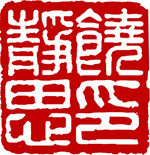
The Chinese poem by Yu Xin (513-581) titled "A visit to the newly built mountain land of the duke of Heyang" has had an effect on contemporary culture. The excerpt above reads:
Behind a rock in the dark probably hides a tiger, and the coiling giant root resembles a crouching dragon.
One translation of the four word phrase
Some thoughts on training and teaching, inspired by the above phrase:
It is best to not teach early in one's development or be too quick to accept the first opportunity to share one's skill. Without being very grounded in an art, it is easy to provide the wrong view of it to someone, which will color their perception of the practice. Beyond that, it is important to make sure you have a deep understanding of what you are doing before you try to share it. Sharing your practice is not simply repeating what you remember from when you yourself were being instructed. That is sort of a minimum on a surface level, but ideally your instructor was applying a process of discernment when they were instructing you. Repeating the gross pattern of that process, through the fog of memory, without a similar process of discernment or using good judgement, isn't going to wind up with the same outcome you experienced.
In my own case, I had good fortune with the first person I shared internal martial arts ideas with. He had been my student in the mix of Aikidō, Daitō-ryū Aiki-jujutsu and Shorinji Kempō I had learned in NYC. He was used to working with me and I think both appreciated the positive aspects of my approach and had patience with my limitations.
My first bagua teacher was kind enough to let me work with him on what I had learned, despite my inexperience — after I left my first dōjō, we reworked the Aikidō and Kempō we had been practicing, using what I felt was a better model for body mechanics and tactics than I had learned in NYC. With what I know now, I would say our approach was half external, half internal — for us at the time, it was not too far a bridge to cross.
I continued on to learn Tàijíquán, that was a path my student chose not to follow. He was willing to work with me on one thing, and keep large parts of what we had practiced together intact, but a total rewiring of everything, all the assumptions, was not in the cards — even if that would have allowed him to work with the people who were much better than me by attending the same classes I was.
I think the reason my first mentorship role in Baltimore worked out is I was operating from a basis of an approach (modern goshin-jutsu) I knew extremely well, with someone who had a similar background and skill. The process was then an exploration of how to approach and refine that curriculum with a relatively small set of teachings of Bagua that maybe were not as 'advanced' or 'high-level' as some of what I do now, but were more approachable, being closer to what we started with, and more easily explained.
Because my colleague already trusted me and wanted to keep working with me, he was willing to put up with me as I experimented with new ideas. He also provided clear feedback, and when sometimes things didn't feel correct, we worked together to come up with solutions. So, it began as a mentorship, as I had been his teacher, but by the end it was a collaboration and he could stand on his own as my peer.
That was probably the most successful experience I had as a novice teacher, one that has been difficult to repeat. I think this was because I was excited to continue what I was most interested in and had the least emotional encumbrance — but does not mean it was what I was best at, or most qualified to teach.
I later taught internal martial arts not to hold myself out as a teacher, but to simply continue my training. The lineage I am part of has some famous masters in its history, which sometimes attracts interest, but being a normal person and not a master means I can only provide a partial view of the promise of internal martial arts training.
In recent years I have had more success teaching kenjutsu informed by internal martial arts principles than internal martial arts themselves. I think this is because it is something closer to my earlier experience — half external, half internal — and easier for people to understand.
What then, if I do not have many people to work with on internal martial arts?
Skilled people talk about solo training, and all I can say is listen to what they say. What I add to that conversation as someone who is not a well-known teacher myself is not very important, other than to encourage the reader to stop, listen, and pay attention to the admonitions masters make about its value — the masters are right.
Now, when I do train with others in internal martial arts, it is mostly to: 1) visit senior Taiji colleagues to do application work with and share a little bit of what I have figured out to get their feedback, 2) talk at length with friends who practice internal martial arts and kenjutsu whose skill have eclipsed my own, and 3) return to my own Taiji instructor for further pointing out instructions along the way. The insights I obtain wind up being very valuable feedback to me in an endeavor that is otherwise largely solitary. In the case of kenjutsu, my teacher passed away last year, so much of this writing has to do with grappling with that fact, and what my path forward is.
When I visit one senior colleague's Taiji practice, and look at him and his students, I see them express such high quality movement that I know I made the right decision in stepping back from thinking of myself as an exemplar or teacher. My understanding slowly improves over time, and I have cultivated certain skills that work for me, but I am still far from a proper model to do justice to these matters for others.
I am grateful for the time to conduct solo practice and cultivate a greater sense of center and calm. I am also grateful for the few unscripted opportunities I have had to test my skill. They have shown me that indeed, continued solo practice works, even if I still have far to walk along the path.
After engaging in an impromptu freestyle grappling practice a few years ago — at a Lunar New Year's gathering I asked if anyone wanted to feel taijiquan and instead of asking for set or scripted attacks, I engaged in some free grappling with another teacher — a friend mentioned that either the teacher was going very easy on me or I was better than when we had both done push hands together a few years back. Likely both were true. It gave me a little more confidence to keep working at these kinds of skills, even if initially they seem difficult or unreliable compared to other approaches, or if my early efforts at teaching lead to frustration.
One metaphor for solo practice could be that of water polishing a stone over a very long time, but I appreciate the idea of hidden force or hidden skill, especially in internal martial arts, so the poem about the dragon and tiger came to mind. It is okay to remain hidden — not everyone needs to be a teacher — even if we are not as majestic as those archetypes of pure yin and pure yang.
A collected set of works on Shinkage-ryū heihō is available as a book: The Truth of the Calm Spirit: The practice of Shinkage-ryū Heihō as Taoist Internal Alchemy, 2025.