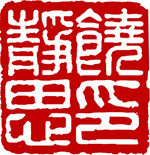
心遍萬境 (Shin-hen Bankyō; xīn biàn wàn jìng; “the mind pervades all realms”), is a gokui (極意; inner teaching) recorded in a Kyūshū Shinkage-ryū densho.
The exact four-graph string 心遍萬境 is not attested in the transmitted Chinese Buddhist canon, nor in searchable Japanese Buddhist or Edo-period printed corpora. It is internally attested only in the densho under study.
On present evidence it is most economically read as a recasting of the ubiquitous Chan gāthā Shin zui bankyō ten (心隨萬境轉; xīn suí wàn jìng zhuǎn; “the mind turns following the myriad realms”) attributed to Manura (摩拏羅), substituting 遍 (“pervade”) for the passive 隨…轉 (“be turned by”), and drawing conceptually on Huayan mind-only doctrine (三界唯心 / 一切唯心造) without quoting any single sutra.
Method. Full-text search / grep using AI (Opus 4.8) across (a) the transmitted
Chinese canon; (b) the open web index; (c) modern Japanese printed
corpora; (d) Edo-period kotenseki full text. Controls were run in
each interface; a target null is reported only where controls fired.
Findings
- CBETA, whole canon (~240 million CJK characters), controls fired. 心遍萬境 = 0. Controls: 心隨萬境轉 = 136 occ / 100 works; 萬境 = 1210 / 535; 心遍 = 761 / 362; 遍一切境 = 30 / 23; 心遍一切處 = 39 / 20. The nearest canonical idioms use 一切 where the densho uses 萬. → hard null.
- Avatamsaka (華厳経) attribution — claimed and rejected. A web/AI explainer sourced the phrase to the Kegon-kyō; 心遍萬境 is absent from T278/T279/T293 (all within the CBETA scan). The genuine Huayan mind-only doctrine is worded 三界唯心 (十地品) and 一切唯心造 (覚林菩薩偈, 八十華厳 巻19; Taishō vol. 10, 102a) — neither is this string. → refuted; conceptual pedigree only.
- Open web index (Google-backed), three exact-phrase probes (plain, OR-variant, Zen/bugei context). 0 exact hits; only 心隨萬境轉 surfaces. → soft, index-limited.
- SAT2018. Not independently re-run: shares the Taishō base text with CBETA-T, so it is not an independent witness for this query.
- NDL Ngram Viewer (modern printed books/magazines). Blank; subject to an LFU frequency floor that can suppress near-hapax n-grams, so weaker than absence.
- NDL 次世代デジタルライブラリー (Edo woodblock kotenseki). 心遍萬境 and 心遍万境 both blank; subject to kuzushiji-OCR error → soft null, needs image confirmation.
- NDL Digital Collections (broad full-text). 心遍 returns hits; 心遍萬 and 遍萬境 both return none, forcing the 4-gram to 0 by substring monotonicity; the 萬 leg independently confirmed present (e.g. in 武術名家傳, 1902). → hard null.
- Hanazono IRIZ Denshi Daruma / Zenseki. NOT YET SEARCHED — no public search interface located; curated Edo Rinzai/Ōbaku transcription with no OCR discount; the single corpus most able to overturn the null.
- Takuan Sōhō corpus (沢庵和尚全集) — NOT YET SEARCHED. NDL-digitized (pid 1218309 ff.) but released only via 図書館・個人送信 (no open view; 個人送信 excludes overseas residents); its clean movable-type text is nonetheless indexed by NDL full-text search, so the phrase check is runnable there. Prime Edo Zen/bugei candidate alongside IRIZ (Fudōchi shinmyōroku, Taiaki).
Residual limitation. Genuinely vernacular Japanese bugei/Zen manuscript material (the Fudōchi shinmyōroku register, Yagyū Heihō *kadensho, Shinkage-ryū densho) is not comprehensively searchable, so *the affirmative “Japanese coinage” reading cannot be proven the same *way; only the canonical/print null half is established.
Manura gāthā — first occurrence and context
The verse is the transmission gāthā (fugeju 付偈) of Manura (摩拏羅), the 22nd Indian patriarch, spoken to his successor Heikḷanna (鶴勒那). In the corpus its earliest extant occurrence is the Zutang ji (祖 堂集; Sodōshū, 952; CBETA B25n0144), whose Manura chapter opens with “具如寶林傳也” (“as fully given in the Baolin zhuan”), crediting the now largely-lost Baolin zhuan (寶林傳, 801) as its source. (靜筠二禪師 (Jing and Yun, comp.) 952 AD)
The most-diffused version is the Jingde chuandeng lu (景德傳 燈錄, 1004; T2076); across the corpus the gāthā recurs in ~90 works (lamp records, Dahui yulu T1998A, Biyan lu T2003, and much of the Zokuzōkyō / Jiaxing Chan literature). (道原 (Daoyuan) 1004)
Text (earliest witnesses agree): 心隨萬境轉/轉處實能幽/隨流認得 性/無喜復無憂 — the earliest reading is 無喜復無憂 (fù), not the later-circulating 無喜亦無憂 (yì).
Narrative frame:
Manura entrusts Heikḷanna with the shōbōgenzō (正法眼藏; treasury of the true dharma eye) — “guard it, let it not be cut off” — and speaks the verse; the Jingde chuandeng lu recension ties it to liberating a flock of cranes (鶴眾, former disciples reborn in avian form), after which Manura enters final quiescence.
The verse is therefore a transmission teaching on the mind–object relation: the mind is carried through the myriad realms (境), yet one who recognises [self-]nature within the flux is beyond joy and sorrow — the passive “turned by” polarity that the densho phrase 心遍萬境 inverts. In the Xu chuandeng lu (續傳燈錄, T2077) a Song-court speaker even cites the verse and misattributes it to the third patriarch’s Xinxin ming (信心銘) — evidence it circulated detached from its Manura source.
Contrast to the Avatamsaka (華厳経)
The Avataṃsaka-sūtra (大方廣佛華嚴經; Daihōkō butsu Kegon-kyō; “Flower-Ornament Sutra”) is a large composite Mahāyāna scripture assembled in Central Asia by c. the 4th century from originally independent texts. Three Chinese recensions are standard: the 60-fascicle (T278, trans. Buddhabhadra, 418–420), the 80-fascicle (T279, trans. Śikṣānanda, 695–699), and the 40-fascicle (T293, the Gaṇḍavyūha alone).
Its cosmology centres on Vairocana (毘盧遮那) and the mutual interpenetration of all phenomena — ichi-soku-issai (一即 一切; “one is all”) and hokkai engi (法界縁起; dharmadhātu dependent-arising). Its two oldest and most influential chapters are the Jūji-hon (十地品; Daśabhūmika, the ten bodhisattva grounds, source of 三界唯心 “the three realms are mind-only”) and the Nyū-hokkai-hon (入法界品; Gaṇḍavyūha, the pilgrim Sudhana / 善財童子 visiting fifty-three teachers).
It is the doctrinal basis of the Huayan (華厳宗) / Kegon school (historically at Tōdai-ji). The mind-only line 一切唯心造 — belongs to the Yuishin-ge (唯心偈) of the Kakurin Bosatsu ge (覚林菩薩偈), 80-fascicle, fasc. 19 (Taishō vol. 10, 102a) but the phrase 心遍萬境 does not occur in it. (實叉難陀 (Śikṣānanda, trans.) 699 AD)
References
Primary Sources
Corpora consulted (with result and independence limits)
Edo-period primary corpus (open test)
Source under investigation
Corpus access (downloads)
- CBETA XML P5 — full canon, all collections (Taishō, Zokuzōkyō, Jiaxing, Bubian, etc.); the corpus searched in this dossier. Repo: https://github.com/cbeta-org/xml-p5 · tarball (~530 MB): https://codeload.github.com/cbeta-org/xml-p5/tar.gz/refs/heads/master
- DILA CBETA-txt — Taishō only, plain text. Repo: https://github.com/DILA-edu/CBETA-txt · tarball (~325 MB): https://codeload.github.com/DILA-edu/CBETA-txt/tar.gz/refs/heads/master
- CBETA text-analysis data / download hub: https://cbdata.dila.edu.tw/static_pages/download_fulltext
- CBETA offline reader (CBReader) and site: https://www.cbeta.org
- SAT Daizōkyō (online search; Taishō): https://21dzk.l.u-tokyo.ac.jp/SAT/
- NDL Ngram datasets (PDM ngram dumps): https://github.com/ndl-lab/ndlngramdata
- NDL classical-OCR text datasets: https://lab.ndl.go.jp/data_set/ocr/
Conventions
- Tier in
keywords:primary= classical text / archival document;secondary= modern reference, database, or scholarship. reliability= one-sentence provenance/evidentiary note stating independence limits.archive/shelfmark/accesson primary entries only.