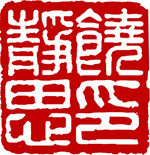
Chiba Shūsaku (千葉周作) — childhood name Ototsumatsu (於菟松), imina Narimasa (成政) — was the founder of Hokushin Ittō-ryū (北辰一刀流) and, through the Genbukan (玄武館), the most consequential kenjutsu pedagogue of the late Edo period.
For a register tracing the passage from Edo gekken (撃剣) to the standardized kendō of the Dai Nippon Butokukai (大日本武徳会), he is a pivotal node: not the inventor of shinai-and-bōgu practice, but the man who rationalized its curriculum, compressed its licensing, and diffused it on a mass scale — and whose Mito line supplied much of the Butokukai’s founding kendō leadership.
His dates are given as Kansei 5 or 6 (1793/1794) to Ansei 2 (17 January 1856).1
Born near Kesennuma in Rikuzen and raised at Araya village in Kurihara district (栗原郡荒谷村, now Ōsaki, Miyagi), he first learned his family’s Hokushin Musō-ryū (北辰夢想流) under his grandfather Chiba Kichinojō (千葉吉之丞), instructor to the Sōma domain (Chiba Shūsaku (千葉周作), n.d.; Hokushin Ittō-ryū (北辰一刀流), n.d.).
Relocating toward Edo to serve the hatamoto Kitamura Iwami-no-kami Masahide (喜多村石見守正秀), he entered the Ono-ha Ittō-ryū Nakanishi-ha (小野派一刀流中西派) under Asari Matashichirō Yoshinobu (浅利又七郎義信) and trained at the Nakanishi dōjō — the house of Nakanishi Chūbei (中西忠兵衛) — receiving instruction alongside such figures as Terada Muneari (寺田宗有), Shirai Tōru (白井亨), and Takayanagi Matashirō (高柳又四郎). He became Asari’s adopted son-in-law (mukō-yōshi, 婿養子) and took the name Asari Mataichirō (浅利又一郎).2
Wishing to revise the Ittō-ryū kata and unable to do so within an inherited tradition, he separated from Asari and, combining Hokushin Musō-ryū with the Nakanishi-ha Ittō-ryū, proclaimed Hokushin Ittō-ryū — a fusion his own licenses record explicitly.3
After a period of musha-shugyō and the Ikaho Shrine votive-plaque affair (伊香保神社掲額事件) with the Maniwa Nen-ryū (馬庭念流), he opened the Genbukan in Bunsei 5 (1822) at Nihonbashi Shinagawa-chō, moving it around 1825 to Kanda Otamagaike (神田於玉ヶ池), where it grew into the largest sword school in Edo and one of the “three great dōjō” (江戸三大道場) (Chiba Shūsaku (千葉周作), n.d.; Hokushin Ittō-ryū (北辰一刀流), n.d.).
His pedagogical reforms are what make him a transitional figure. Where the Ono-ha Ittō-ryū transmission ran to eight ranked stages, he reduced licensing to three — sho-mokuroku (初目録), chū-mokuroku menkyo (中目録免許), and dai-mokuroku kaiden (大目録皆伝) — removing the graduated gift-payments that had gated advancement and opening the school to commoners (Hokushin Ittō-ryū (北辰一刀流), n.d.). He centered training on kakari-geiko (掛かり稽古) and shinai-and-bōgu strike practice — methods the Nakanishi-ha had pioneered — and taught by rational, demystified explanation rather than esoteric transmission, such that training reputedly took five years where rival schools took ten.4 His often-cited maxim, that the sword is the work of an instant, the union of heart, spirit, and strength (心・気・力), anticipates the modern kendō formula of ki-ken-tai-no-itchi (Chiba Shūsaku (千葉周作), n.d.). He also gave his curriculum a systematic technical vocabulary, with named okugi such as 蓮折, 長短の矩, 捨目付 (sute-metsuke), and 星王剣 (seiōken).5
In Tenpō 6 (1835) he taught Hokushin Ittō-ryū as a guest at the Mito domain academy, the Kōdōkan (弘道館); invited by Tokugawa Nariaki (徳川斉昭), he became the Mito domain kenjutsu instructor in 1839 and was raised to umamawari (馬廻役; mounted-guard rank) at 100 koku in 1841 — an unusually high station for a professional swordsman — with his sons Eijirō (栄次郎) and Michisaburō (道三郎) likewise serving Mito (Chiba Shūsaku (千葉周作), n.d.).
The Genbukan, together with the Okemachi branch dōjō (桶町千葉道場) under his younger brother Chiba Sadakichi (千葉定吉), trained a striking share of bakumatsu figures: Arimura Jizaemon (Satsuma), Kiyokawa Hachirō, Yamaoka Tesshū, Yamanami Keisuke, Itō Kashitarō, and, at the branch, Sakamoto Ryōma. It was reckoned the foremost great dōjō in Japan, with over three thousand disciples.6
The line that carries Chiba into the modern institutions ran chiefly through Mito. His student Ozawa Torakichi (小澤寅吉), a Kōdōkan kenjutsu instructor, opened the Mito Tōbukan (水戸東武館) in 1874 and kept the Hokushin Ittō-ryū transmission alive into the Meiji period; the Genbukan juku-head Shimoe Hidetarō (下江秀太郎) taught there before his Metropolitan Police career (Hokushin Ittō-ryū (北辰一刀流), n.d.; Mito Tōbukan (水戸東武館), n.d.). From the Tōbukan came Naitō Takaharu (内藤高治) and Monna Tadashi (門奈正), both of whom passed through Keishichō gekken service (撃剣世話掛, gekken sewakari) and then became the Dai Nippon Butokukai’s leading kendō instructors. Naitō in particular served as kendō hanshi and chief kendō instructor at the Butokukai’s teacher-training institute — later the Budō Senmon Gakkō (武道専門学校, “Busen”) — where he trained the future tenth-dan holders Mochida Moriji and Saimura Gorō, and was paired with Takano Sasaburō in the saying “Naitō in the west, Takano in the east” (西の内藤、東の高野).7 In 1911 Monna, Naitō, and their Tōbukan colleagues sat on the committee that drafted the Dai Nippon Teikoku Kendō Kata (大日本帝国剣道形), so a Hokushin Ittō-ryū cohort had a direct hand in the standardized forms adopted as the Butokukai consolidated shinai kenjutsu into modern kendō — the same body that unified the terms “kenjutsu” and “gekken” under the single name kendō in 1919.8
The Genbukan headship did not long outlast him. His eldest son died young; the gifted Eijirō (“the little tengu of Chiba,” 小天狗), a renowned thrust specialist, also died early; and the third son Michisaburō, who succeeded, died in 1872, after which the main house lapsed and only teaching lines remained. It was the Mito Tōbukan (Ozawa) line, and separately an Otaru line, that carried the school into the twentieth century.9
Open Questions
- The chronology of his early training is unsettled: the popular account (entry to Asari at about fifteen, Nakanishi study afterward) conflicts with an archival reconstruction placing the Nakanishi connection much earlier. Which sequence the primary sources support, and at what ages, needs settling against the archival record rather than the reference literature.
- The reading of the Nakanishi generational names (中西子正, 中西子啓) and of several okugi (e.g. 蓮折) is not secured; seek a furigana or densho source.
- The exact nature and grade of Chiba’s own Nakanishi-ha license before independence — what he held when he “returned” it to Asari — would clarify the fusion narrative and the 1834 rupture.
- The extent to which specific bakumatsu students trained under Chiba personally versus at the branch or under his sons varies by figure and would bear individual verification.
References
primary
secondary
End Notes
-
Birth is given as Kansei 5 (1793) or Kansei 6 (1794), first day of the first month; death as Ansei 2, twelfth month, tenth or thirteenth day (17 January 1856), at about sixty-one. The variance is standard across the reference literature. The father’s name also varies between sources (Chūzaemon 忠左衛門 and Kōemon 幸右衛門; later Urayama Jusada 浦山寿貞, a horse-doctor), as does the family’s claimed descent from the Chiba clan. (Chiba Shūsaku (千葉周作), n.d.; Chiba-shi keizu / Chiba Shūsaku denki shiryō (千葉氏系図・千葉周作伝記資料), n.d.) ↩
-
The popular chronology — entry to Asari at roughly fifteen, Nakanishi training following — diverges from a more detailed genealogical reconstruction drawing on the Tōhan shikō (東藩史稿), the Suifu keisan (水府系纂), and the yuisho-gaki (由緒書) in the Sakai-ke monjo (酒井家文書, Obama City Library), which places his Nakanishi study substantially earlier and complicates the teacher sequence. Readings of the Nakanishi generational names (子正, 子啓) are not secure. The chronology should be anchored to those archival sources rather than to popular accounts. (Chiba Shūsaku (千葉周作), n.d.; Chiba-shi keizu / Chiba Shūsaku denki shiryō (千葉氏系図・千葉周作伝記資料), n.d.; Tōhan shikō (東藩史稿), n.d.; Suifu keisan (水府系纂), n.d.; “Yuishogaki, Sakai-ke monjo (酒井家文書 由緒書),” n.d.) ↩
-
The school’s own licenses state the fusion of Hokushin Musō-ryū with the Nakanishi-ha Ittō-ryū, and early Hokushin Ittō-ryū certificates reproduce a waka carried over from the Hokushin Musō-ryū license — an internal, primary attestation of the composite. The relationship with Asari ended in a formal divorce (離縁) recorded in the Sakai-ke monjo for Tenpō 5 (1834), which the household framed as “immaturity” (不熟); a dispute over Chiba’s refusal to lower the Hokushin Ittō-ryū name in favour of the Ono-ha line is the likelier reading. “Amicable independence” therefore understates a documented rupture. (Hokushin Ittō-ryū (北辰一刀流), n.d.; Chiba-shi keizu / Chiba Shūsaku denki shiryō (千葉氏系図・千葉周作伝記資料), n.d.; “Yuishogaki, Sakai-ke monjo (酒井家文書 由緒書),” n.d.) ↩
-
The reduction from the Ono-ha eight-stage transmission to three ranks, the removal of advancement-gifts, and the kakari-geiko / shinai-bōgu emphasis are consistently reported across the reference literature and the school’s own material. The attribution matters: shinai and protective armour development is credited to the Nakanishi-ha (Nakanishi Chūbei), so Chiba’s contribution is systematization and mass diffusion, not invention. The “five years, not ten” figure is a traditional characterization, likely traceable to the school’s own historiography rather than an independent measure. (Hokushin Ittō-ryū (北辰一刀流), n.d.; Chiba Shūsaku (千葉周作), n.d.) ↩
-
The dai-mokuroku kaiden content and okugi names are drawn from Hokushin Ittō-ryū school sources and the Chiba Shūsaku ikō (千葉周作遺稿); treat as internally attested. Readings of several okugi (e.g. 蓮折, 長短の矩) are provisional pending a furigana source. (Hokushin Ittō-ryū (北辰一刀流), n.d.; Chiba Shūsaku, n.d.) ↩
-
Student rosters derive from school and biographical sources of varying grade. The celebrated names are widely reported, but the strength of each attachment differs — Sakamoto Ryōma, for instance, trained at the Okemachi branch under Chiba Sadakichi, not at the Genbukan under Shūsaku — and each would bear individual checking before use. (Chiba Shūsaku (千葉周作), n.d.; Hokushin Ittō-ryū (北辰一刀流), n.d.) ↩
-
Naitō Takaharu (内藤高治, 1862–1929): Mito Tōbukan under Ozawa Torakichi → Keishichō gekken sewakari (1888, on Shimoe Hidetarō’s introduction) → Dai Nippon Butokukai (seirenshō, 精錬証, 1897; appointed to the Kyoto honbu teaching staff in 1899) → chief kendō instructor at the Bujutsu Kyōin Yōseijo (武術教員養成所), later the Budō Senmon Gakkō. Corroborated across the reference entries for Naitō, the Mito Tōbukan, and Hokushin Ittō-ryū. Note the cross-reference to the Nakayama entry: Takano Sasaburō appears here as Naitō’s east–west counterpart. (Naitō Takaharu (内藤高治), n.d.; Mito Tōbukan (水戸東武館), n.d.; Hokushin Ittō-ryū (北辰一刀流), n.d.) ↩
-
In 1911 Tōbukan men (Monna Tadashi, Naitō Takaharu, Ozawa Ichirō, Sasaki Masayoshi) were named to the Butokukai’s kendō-kata drafting committee. The Butokukai unified the terms kenjutsu / gekken under kendō in 1919, and administered the shōgō system — the seirenshō, then the hanshi and kyōshi titles from 1902–03 and the renshi title from 1934. This institutional consolidation is the hinge the register’s title names; the Hokushin Ittō-ryū presence on the kata committee is the concrete point of contact between Chiba’s lineage and it. (Mito Tōbukan (水戸東武館), n.d.; Dai Nippon Butokukai (大日本武徳会), n.d.) ↩
-
Succession per the Hokushin Ittō-ryū reference entry: eldest Kisotarō (奇蘇太郎孝胤) died young; Eijirō (栄次郎成之) died young; Michisaburō (道三郎光胤) succeeded and died in 1872; the main house then lapsed, leaving teaching lines. The Mito Tōbukan (Ozawa) line and an Otaru line continued. Modern sōke claims within the school are later reconstructions and contested, and lie outside this entry’s scope. (Hokushin Ittō-ryū (北辰一刀流), n.d.) ↩