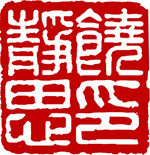
There is no single romanization of 直心影流 — choices made about how to separate each character from the compound reflect an emphasis being placed that may not be there in the original, which is why in current koryū research some authors are starting to use hiragana when writing the name.
Jikishinkage-ryū
This is the version that appears in most modern Japanese kendō and koryū reference works (the Nihon Budō Taikei, the Nihon Kobudō Kyōkai registry, most academic articles in Budō Gaku Kenkyū). The argument behind it: by Yamada Mitsutoku's renaming in the late 17th century, the four characters were established as the school's unitary name — the internal etymology is historical context rather than current parse structure.
Jiki Shinkage-ryū
This parses the name as Jiki (直, "direct" or "correct") modifying Shinkage-ryū (心影流, "Heart Shadow-school" — the Kamiizumi tradition, using Heart instead of New to denote the concept of Jikishin). On this reading, Jiki is a qualifier identifying which branch of the broader Shinkage-ryū this school is, and that it is correct one. That is, Yamada Ippūsai restored Shinkage-ryū in his collation of the current curriculum.
The school originated as a re-formulation within the Shinkage-ryū tradition (via Okuyama Kyūbasai and his successors), and its formal identity is the Jikishin variety of Shinkage-ryū — explicitly contrasted with the Yagyū variety of Shinkage-ryū.
This is how the school understood its own self-identification when the name was first established by Yamada in the late 17th century. Yamada himself was clear that he was renaming his line of Shinkage-ryū — the direct-mind (直心) qualifier specified the doctrinal-philosophical character of the rename, distinguishing his branch from others that had also evolved out of Kamiizumi's tradition.
Jikishin Kage-ryū
This parses as Jikishin modifying Kage-ryū (影流, "Shadow School"). The argument behind it: Kage-ryū (the Aisu Ikō tradition) is the grandparent school, antecedent to Shinkage-ryū. The 影 character anchors the school to the Kage lineage, with both Jikishin and Shin (in Shinkage-ryū) being qualifying additions made by successive generations. Reading the four characters as 直心 + 影 + 流 invokes the deeper lineage back to Aisu Ikō rather than just Kamiizumi.
The 1800 Heihō Denki anchors the school in Sugimoto's Kashima Shinryū → Kamiizumi's neologism (the school named 神陰 by Kamiizumi, then 神影 by Okuyama, then 真新陰 by Ogasawara, etc.). The school's own documents consistently trace through Shinkage-ryū-via-Kamiizumi, not through Kage-ryū-via-Aisu. Reading the name as "Jikishin Kage-ryū" thus collapses the school's self-historiography in a way that "Jiki Shinkage-ryū" does not.
Conventions
Different romanization systems (Hepburn, Kunrei, modified Hepburn) all treat compound-parsing differently, and koryū community usage is split. The Nihon Budō Taikei and most kendō organizations write "Jikishinkage-ryū." Bennett writes "Jikishin Kage-ryū." David Hall wrote "Jiki Shinkage-ryū." Waseda follows Bennett's pattern. Other published koryū researchers (Skoss, Friday) tend to follow the modern Japanese unitary-compound convention.
Japanese-language convention in current koryū research is increasingly to write the school's name in hiragana — じきしんかげりゅ う — which sidesteps the parsing question by leaving the compound's internal structure unmarked. This is how some Japanese researchers write it in Budō Gaku Kenkyū articles when they don't want to commit to one of the four-character parses.
"Jiki Shinkage-ryū" is the parse that most closely matches the school's own self-historiography as documented in the 1800 Ogawa densho and the parallel Yoshida mokuroku. Yamada Mitsutoku renamed his line as a branch of Shinkage-ryū, not as a branch of Kage-ryū. While "Jikishinkage-ryū" is the form most readers will recognize from other English-language koryū literature, but please allow me this indulgence in memory of my teacher.