Shunkashūtō
Shunkashūtō (春夏秋冬; Four Seasons) is an organizing principle used in Jikishinkage-ryū. Its curriculum is structured to follow the natural cycle of the year: beginning with the growth and blossoming of Spring, moving into the intense activity of Summer, maturing into precise control of Autumn, and resolving into the unified silence of Winter. The mid-17th century assignment is as follows:
- Spring (Wood): Hassō Happa, Ittō Ryōdan, Uten Saten, Chōtan Ichimi
- Summer (Fire): Ryūbi, Menkage
- Autumn (Metal): Teppa, Matsukaze, Hayafune, Kokushaku
- Winter (Water): Enren
From as early as 1800 onward [13], Hōjō is considered to encompass all the seasons (and is the phase of earth, emphasizing the changes between seasons). Tō no Kata is then performed with spring kiai, Kodachi with summer kiai, Habiki with autumn kiai, and Marubashi with the silent kiai of winter.
Godai and Gogyō
Shunkashūtō encodes both Yin-Yang and Gogyō (五行; “five phase” or wǔxíng) structures. The character 行 means to go, to move, to act, and the five phases (gyō) are dynamic states of transformation (wood gives rise to fire, fire to earth, etc., in cyclical generation and overcoming). They aren't material substances but instead modes of process. Each is associated to a season.
In contrast, the Godai (五大) or mahābhūta ("great elements") are the foundational constituent realities of physical existence in Indian Buddhist cosmology: pṛthvī, ap, tejas, vāyu, ākāśa. They are conceived as substantial — irreducible constituents of matter and perception. They are distinct from the Western Aristotelian elements.
In Mikkyō , rokudai (六大) adds shiki (識; vijñāna or consciousness) distinct from shin (心; "mind"): this is Kūkai's signature framework in Shingon — the six great elements as the substance of the Dharmakāya. The shichidai (七大) scheme — from the Śūraṅgama Sūtra and inherited into Tendai and some Mikkyō analysis — adds ken (見; perception/seeing) as the seventh element.
This is somewhat in contrast to Vajrayāna-influenced arrangements, which may include the concept of prabhāsvara (Skt., clear light or luminosity; Tib. 'od gsal), or in Sino-Japanese kōmyō (光明). This appears in Tantric layered cosmologies (notably Kālacakra and Dzogchen in Tibetan systems), where the elements have progressively subtler manifestations, with clear light as the most refined. Clear-light is not part of standard Shingon or Tendai doctrine.
A-Un Kokyū
How does Hōjō practice relate to Godai theory?
Niō-dachi (仁王立; lit. “Deva king standing posture”) is a characteristic ritual posture inspired by the paired temple guardians, who are two Deva kings, and relates to balancing yin and yang in the body as expressed through the practice of a-un kokyū (阿吽・呼吸; (a-hūṃ in Sanskrit) breathing) — paired open and sealed breaths in mirror of the Niō guardians The guardians are depicted in pairs. Both figures are viewed in Esoteric Buddhism as manifestations of Shūkongōshin (執金剛神) also known as Vajrapāni (वज्रपाणि), the vajra thunderbolt-wielding Bodhisattva who symbolizes the Buddha’s power. Nārāyaṇa (那羅延金剛; Naraen Kongō) or Un-gyō (吽形) stands on the left, with his mouth closed, symbolizing death and completion making the sound of the last Devanagari character HUM(हूँ). He is the Buddha’s warrior attendant, the Yaksha Deity (夜叉神), and wields Indra’s lightning bolt vajra as a weapon.
Vajrapani was venerated at the historical Shaolin Temple from the eighth century, his thunderbolt eventually becoming the monk’s staff. He also is associated with the Greek deity Zeus and the hero Heracles in the Greco-Buddhism of the 3rd and 4th centuries.
Originally in India, Nārāyaṇa was a singular figure, but in China, a mirror figure named Guhyapati (密迹金剛; Misshaku Kongō; “Lord of Secrets”) or A-gyō (阿形) in Japanese was introduced. They both typically stand outside temple gates, the figures as a pair being known as in China as Heng and Ha (哼哈二將), Guhyapati is positioned on the right with his mouth open, symbolizing birth and beginning making the sound of the Devanagari character AH (आः).
The mantra oṃ āḥ hūṃ (ॐआःआः) is an important three syllable mantra representing the enlightened body, speech, and mind of the Buddha.
A-un kokyū (阿吽呼吸), the characteristic breathing style of Jikishinkage-ryū is named in homage to these guardians and their symbolism of life and death, yin and yang, initiation and completion.
Physical adoption of postures modeled after the Niō guardians may be due to an import of ideas from the Niō Zen Buddhism of Suzuki Shōsan (鈴木正三; 1579–1655), an early Edo period samurai who studied in the Ōtōkan (應燈關) lineage of Rinzai Zen at Myōshin-ji (妙心寺; also called Shōbōzan 正法山) in Kyoto, and independently claimed attainment of a form of Zen self-actualization called Mushi-dokugo (無師独悟; ”independent realization without a master”), is one potential source for the Niō-dachi practice.
Suzuki popularized the idea of imitating the postures of the Niō guardians and using their form as an object of meditation. This may be the early Edo period influence upon what later became organized as the four-part Hōjō practice we see today, as characteristic a-un kokyū and niō-dachi are not found in other approaches to Shinkage-ryū that diverged from one another around that time.
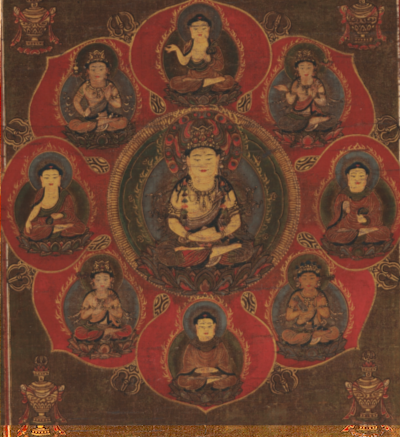
But, underneath the apparent surface of the Niō duality, Vajrapani is an important figure in esoteric Buddhism, symbolizing the Buddha's power. They are depicted as part of the inner retinue of protective deities in the Womb Manadala (pictured above). If the dual aspect of the Niō can be thought of evocative of yin-yang complementarity, then Vajrapani might be symbolic of the Taiji concept in Daoist cosmology — infinite potential, and thus power.