Sōjaku-no-koto
Sōjaku-no-koto (相尺之事; mutual distance or measure) is one of the formal matters listed in historical mokuroku of Jiki Shinkage-ryū kenjutsu. We examine its relationship to Sino-Japanese philosophical concepts.
The matter of sōjaku-no-koto (相尺之事; mutual distance or measure) or sōjaku-no-katsu is grouped with three others (tome sandan no koto 留三段之事, kiri otoshi no koto 切落之事, and ginmi no koto 吟味之事) by Karukome, in that all those matters were added by Naganuma Kunisato when he authored 直心影流目録口伝書, and are absent from the earlier (circa 1700) 兵法雑記 of Mitsunori. In Kunisaito's work, annotations are found as follows:
右同断〔ニ〕。但シ流義ノ寸法ト云フ別ニナシ。自分カラ三相應ヲ好ムヘシ。然レトモ凡尺ハ二尺三寸ヨリ五寸七寸迫ナルヘシ。且其内ハ大脇指〔モ〕長短一味ニナリ。
There is no fixed measurement (寸法) peculiar to the school. Reckoning from your own body, you should favor the three accordances (三相應). Even so, the ordinary measure should press in some 5 to 7 sun closer than 2 shaku 3 sun. And moreover, within this, [whether] long sword or wakizashi, it all becomes 'long and short, one flavor' (長短一味).
Note that ōwakizashi (大脇指) is read 大〔刀〕・脇指 — the long sword and the short sword. The sōjaku-no-koto maps to chōtan-ichimi (長短一味) directly and relates that concept to san-sōō ( 三相應; さんそうおう) — the description that follows does not appear to present in the secondary literature.
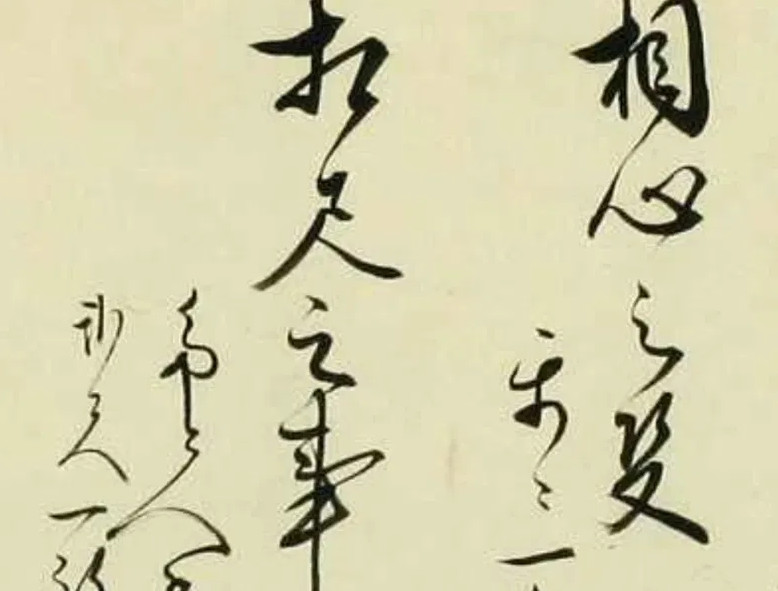
The 1800 densho by Ogawa in contrast has a very brief annotation in cursive that I find very difficult to read. It contains what looks like the characters for one ki, relating this topic for that author possibly to the kitō no koto ( 氣當之事 ) and the gokui called ikki-tō (一氣當; “striking with one spirit”).
Three Resonances
The compound sōō (相應) is the kyūjitai (舊字體; old character form) of 相応, which is a Sino-Japanese compound, not a kun reading. Its origin is from the Chinese xiāngyìng (相應), which is technical language for "mutual correspondence, resonance, accordance."
Consider tenchijin (天地人) the accordance of the three powers ( 三才相應) heaven-earth-mankind. They relate to the autumn kata uten saten (右転左転) densho narrative. Three accordances read as high-middle-low or self-ground-opponent, in addition to heaven-earth-mankind, fits with a teaching on universality in ma-ai.
The 1768 densho does not however enumerate the three powers. It says only 「自分カラ三相應ヲ好ムヘシ」 and leaves the individual members to kuden. So as a fixed compound, 三相應 is most likely the school's own coinage on this classical 相應 vocabulary rather than a quotation from any single classic.
The characters 相應 have two principal classical homes: Yijing theory and Buddhist Abhidarma. The former is more likely the influence here, but we discuss both in turn.
Book of Changes
Yijing line-theory is the most direct source for anything that counts three correspondences. In hexagram analysis, the six lines split into a lower trigram (positions 1–3) and an upper (positions 4–6). The positionally-paired lines form three xiāngyìng pairs:
- 1 and 4
- 2 and 5
- 3 and 6
A pair then "has response" yǒu yìng (有應; has response) or zhèng yìng (正應; proper response) when the two lines are of opposite kind, one yin and one yang. A pair is wú yìng (無應; without response) or dí yìng (敵應; "hostile or opposed correspondence) (無應 / 敵應) when they match. The central pair of 2 and 5 is called subject and ruler in 中正之應.
The doctrine saturates the Tuàn (彖; Judgement) commentary of the Shí Yì (十翼; Ten Wings) and is systematized in Wang Bi's (王弼; 226-249 CE) Zhōuyì lüèlì (周易略例; General Remarks on the Zhou Changes).
Reading this concept of three contrasts against the Yijing is natural given the school's 八卦 / 八方 substrate. The three contrasts are then the sān xiāngyìng (三相應; three line-resonances of a hexagram).
Abhidharma
Buddhist Abhidharma is the other place the resonance concept is found in classical writing, but not as three resonances. Abhidharma is:
Early Buddhism's systematic-analytical philosophy: the project of taking the doctrine scattered across the sūtras and recasting it as an exhaustive, rigorous taxonomy of experience. Its method is to resolve all phenomena — mental and physical — into dharmas, the irreducible, momentary factors that are the real constituents of any given moment, then to define each, classify them (under matrices, mātṛkā; through the skandhas, āyatanas, and dhātus), and map their causal and associational relations.Its two great streams are the Theravāda Abhidhamma (seven Pali books) and the northern Sarvāstivāda line, synthesized and critiqued in Vasubandhu's Abhidharmakośa (c. 4th–5th c.), the single most influential text in the genre; the Yogācāra later produced its own in Asaṅga's Abhidharmasamuccaya. The characteristic "dharma theory" — reality as a flux of momentary dharmas, each with its own nature — is precisely what Madhyamaka would later target with the doctrine of emptiness (śūnyatā).
The characters 相応 are read in Sanskrit as saṃprayukta, the "association/concomitance" in abhidharma by which mental factors (caitta) are conjoined with consciousness (citta): sharing basis, object, and moment. This is the other place an Edo period Japanese reader would meet 相應 as a fixed term.
Conclusions
The use of the term san-sōō in the Jiki Shinkage-ryū densho shows that the author had an education in Daoist-adjacent divination methods (onmyōdo or gogō inyō setsu) from the Book of Change, which then ties into earlier observations I have made about a Daoist current running through Jiki Shinkage-ryū.
The presence of Zen and Mikkyō imagery in the densho, second in frequency to Daoist concepts, actually cuts against the abhidharma being the intended reference of the author. The abhidharma is a highly scholastic project in contrast to Rinzai Zen (and Mikkyō), which is direct and experiential, contemplative and in the case of Zen, at times anti-analytical. The word 相応 is, however, genuinely Buddhist-colored in Japanese, and the commentator did command Buddhist terminology with the use, for example, of 有相/無相, the Mahāyāna Prajñāpāramitā signlessness pair (one of the three liberation-doors: 空・無相・無願). This is Buddhist doctrinal but again not abhidharma dharma-analysis.
Edo learning was thoroughly syncretic, so the author was most likely a Zen-and-mikkyō-formed swordsman working inside a Chinese-cosmological technical apparatus, not an Abhidharma phenomenologist.
Related Work
Discussions of sōjaku are not found in Karukome's thesis or articles on Jiki Shinkage-ryū. Karukome does in his disseration associate inyō (e.g., 陰陽二つの気) and the koto or gokui of i-ki:(一 気) framing with 「 上半円・下半円 」 read as 「 天地創造 」 (p. 150), alongside the four-seasons and chōtan-ichimi (長短一味) as a seasonal (冬季陰蔵) scheme (p. 130, cited to 秘書一・二 and Yamada).
The Hyakurenkai website page on kata consider the winter kata 長短一味 in openly internal-energetic language, invoking the rising and falling of mind-and-ki and yin-yang, the 三焦 (triple-burner), and the circulation of 虚実, teaching that as the body floats the ki sinks.