The Hōjō (法定) are the first kata a student of Kashima-shinden Jiki Shinkage-ryū learns — and, in truth, the ones a swordsman returns to for the rest of a life. Four paired forms, done with the wooden sword, deceptively plain on the training floor. But the old transmission scrolls treat the same four forms as something far larger: a turning of the year.
Since the fourth generation of the line, the four Hōjō have been arranged as the four seasons, spring through winter. Each kata is glossed in the densho not merely as a way to move a sword but as a figure of the cosmos — heaven and earth, the seasons, the three powers. Reading the eighteenth- and nineteenth-century scrolls held at Waseda against one another, that seasonal architecture comes back into focus, line by faded line.
Hassō Happa
Hassō Happa (八相發破; "eight-aspect breaking-forth") is the first kata of the Hōjō (法定四本之形). The densho gloss its name on two registers at once — what 八相 is, and what 發破 does. The 1800 densho of Ogawa writes:
八ハ天地ノ形、四季ヲ表スナリ。八相ハ八ツノ形ノ物、八分圖ト〔…〕。十分ニ〔勝〕、八分圖ノトコロ〔…〕ノ心〔…〕。…初ノ形ハ八相…、發破ハ和〔…〕。又ハ八…九、重ノ位一ツ加ヘ…實…。
Hachi wa tenchi no katachi, shiki o arawasu nari. Hassō wa yatsu no katachi no mono, hachibu-zu to …. Jūbun ni 〔katsu〕… no kokoro …. Hatsu no katachi wa hassō…, happa wa wa …. Mata wa hachi… ku, [jū] no kurai hitotsu kuwae… jitsu…
The Eight is the form of heaven and earth; it expresses the four seasons. Hassō, as a thing of eight forms, is figured as an eight-part circle (八分圖). To win in fullness (十分), the locus of that circle is held in the mind. … The first kata is hassō; and happa works through harmony (和). … from eight to nine, adding one further degree of weight (重ノ位一ツ加ヘ) … [to] the substantial (實)."
The 1800 densho reads 八相 cosmologically and geometrically before it reads it as movement. The Eight is first the form of heaven and earth and the turning of the four seasons; then it is a figure: eight forms set in an eight-part circle (八分圖), the same wheel the school elsewhere calls the 八方車 (cf. Ikki-tō, TOCS p.221). What makes the entry distinctive is the graded-fullness teaching that follows: the eight-part circle is not won at eight but filled by degrees of "weight" (重ノ位), added one at a time, 八 toward 九 toward 十, until the stance is 十分, complete, and only then does the strike land.
This is the inner face of the warning given under the ten faults, that a hassō spirit not filled (michiru) collapses into negligence (懈怠, TOCS p.243): the same fullness, described not as a danger to avoid but as a process to build. The release itself is then glossed, strikingly, through 和 — harmony.
Then 發破 is the resolution of a completed fullness, not raw agression.
A parallel account, in the densho of Ishigaki's line, glosses the same kata from the perspective of the human body. There 八相 is the 八ツ身姿, the eight-fold body-form innate to the human frame from the womb and ripening to completion (成就), and 發破 is parsed as 発して破る, "issue and break": from the hassō guard the shitachi strikes down toward the head, both sides sounding "yā-eei," substance meeting substance (実と実), the junior's prevailing through the senior's.
The two are complementary, not rival — Ishigaki's line gives the outer mechanic, the clash of 実, while the 1800 densho gives the inner principle, the filling to 十分 and the harmony from which the break issues. The one difference of register is only apparent: his "issue and break" sounds forceful, the densho's 和 sounds yielding, but they name the outside and inside of a single act.
Ishigaki's use of the character 実 (to clash) gives some confidence in the reading of the cursive character 實 (truth, reality) in the densho — both accounts end with substance meeting substance.
Four Seasons in Balance
The four seasons create one another in a circle and balance each other in a cross.
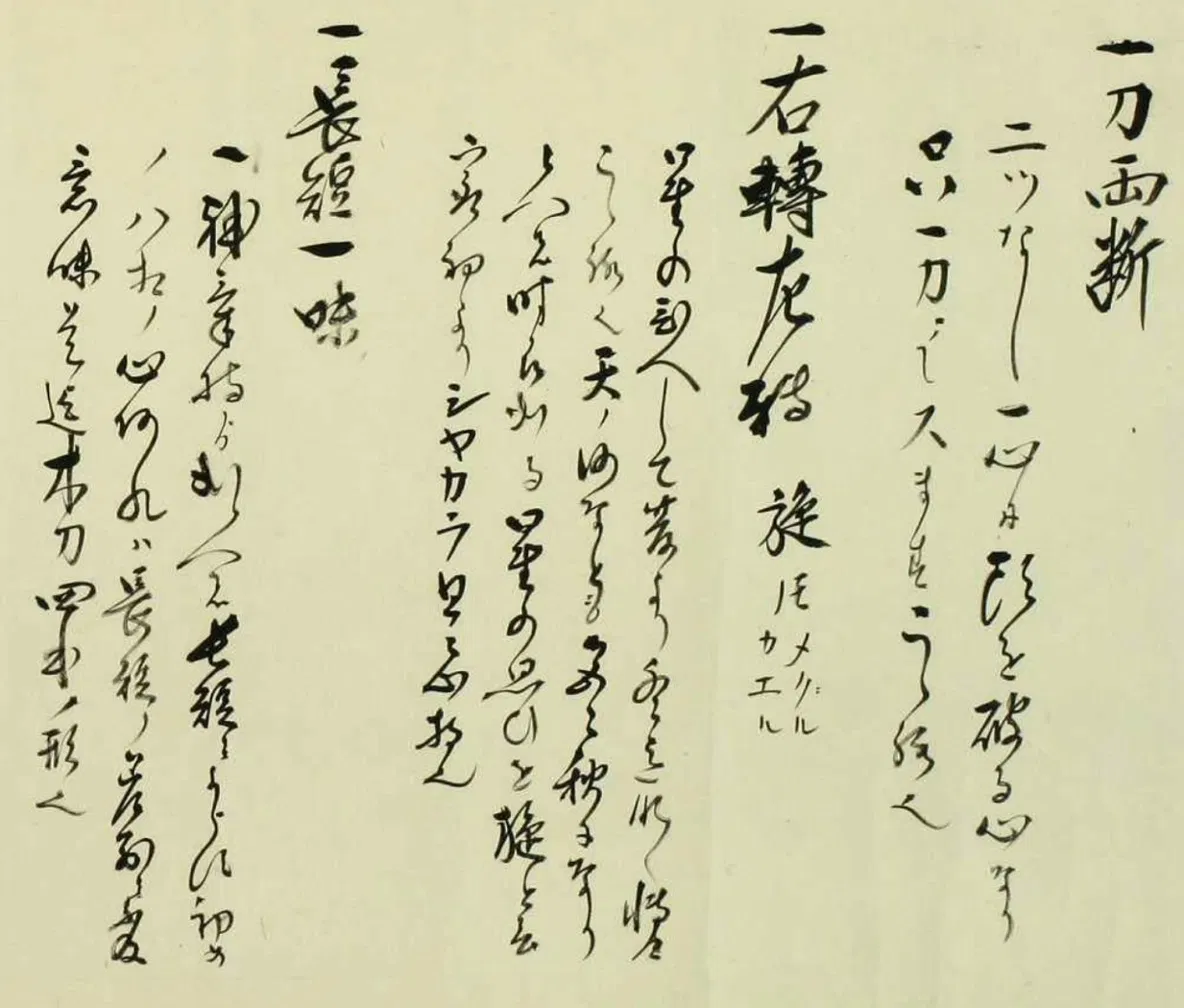
If spring is complete and round, summer is direct. Ittō-ryōdan (一刀両断; "one sword, cut clean in to") has an outer and inner meaning. On the surface it implies completion — cutting completely in two, but the 1800 densho describes a process in which two cuts are bound into one, breaking the opponent's form.
Autumn balances Spring. Spring establishes the round circular structure and autumn then revolves it. Uten-saten (右転左転; "turning left and right") is about circular movement. In the densho, the character meguru (旋; "to turn around") is found alongside the three cosmological powers of ten-chi-jin(天地人; heaven, earth, and mankind).
Winter balances summer. Chōtan-ichimi (長短一味; "long and short, one flavor"). Cuts can be direct, and complete, and sever one into two and combine two into one. Winter consolidates, and quiets, and makes all things possible. In stillness, a sword applied at distance cuts fully, applied at short range, cuts short. Winter balances fullness and emptiness, movement and stillness, weakness and strength.
The fullest expression of each season become the cardinal directions, while the phase of change between each season from one to the next become the diagonals— in total eight expressions or aspects, bringing us back to hassō.
Eight Aspects and Eight Extremes
For many years I have been curious about the concept of hassō happa: alternatively as being explosive 發 (fā) the same as in 發勁 (fājìn), the issuing of stored power, but also opening smoothly but suddenly, like a flower blooming in spring. In the densho there is a description of a release at fullness. Happa is the instant where opening and releasing are one act — this may be why the densho can speak of this action in terms of wa (和; harmony), rather than force.
In internal martial arts, whenb we speak of integrating our force, it is in the sense of 和 — everything having its proper place and working together smoothly, in accord with one another. A blossom is not an act of violence but the completion of a state of fullness. Similarly, when we release force, we need to do so suddenly but smoothly, with all parts of our bodies working soothly together in coordination.
This can be related I feel to eight directional concept of Baji (eight extremes/poles) in Chinese martial arts.
Eight Extremes
In Bājí (八極; "eight extremes / eight poles") power is carried to the eight directions at their utmost; the term goes back to the cosmic 八極 of the Huainanzi, the eight farthest reaches of the world, as described in Chapter Four of those collected works [1,2]:
Between Heaven and Earth lie the Nine Provinces and Eight Extremities.
The eight extremes are the eight outermost reaches of the cosmos: the eight directions carried to their utmost limit. 極 is the ridgepole of a roof, the highest and furthest point, hence "pole / utmost" — the same 極 as in 太極 (the Supreme Pole) and 無極 (the Poleless). 八極 is the spatial cousin of those cosmic terms: not the origin-point but the outer edge, the eight farthest corners where the world runs out.
Thire most distinctively Daoist use is in the Zhuangzi (田子方). Of the 至人, the Perfected Person, it says the Sage 上闚青天、下潛黃泉、揮斥八極、神氣不變 — "peers up at the blue heaven, dives down to the Yellow Springs, ranges freely across the eight extremes, their spirit-energy does not change." The Sage's spirit roams to the eight limits of the world, while their center stays unmoved.
Eight Phases
Hassō is not simply a posture, it is the beginning of all things. It is what sets the practitioner directly between heaven and earth. In the densho, the Fudō bonji placed atop the core gokui is explicitly mikkyō, and mikkyō's central icon is the 八葉蓮華 — the eight-petalled lotus of the Womb-Realm mandala with Dainichi at the center and eight Buddhas opening on the petals to the eight directions. An eight-aspect form that opens outward in eight directions and then issues can be regarded as that lotus flower opening.
The densho's 八分圖 and 八方車 — the eight-part circle, the eight-directional wheel — are that same eight-direction radiation, the body answering to all eight at once. Both rest on the 八卦 / 八方 substrate, the trigrams set around the compass.
A difference is that Jí refers to extremity and Sō (相; aspect, phase, or form) names a configuration. In Japanese it also is evocative of 八相成道, the eight phases of the Buddha's life. Baji points outward to where the power lands; 八相 points back at the form, the eightfold shape that body and cosmos share.
Evocation
This is not to say Bājíquán and Hōjō are related directly, but the imagery seems to draw from similar sources, albeit with a mikkyō overlay in the case of the Japanese art. Zhuangzi's formula, "range the eight extremes, spirit unchanged", is a definition of what the 八方車 wants: the unmoved (不動) center reaching every one of the eight directions at once. The Daoist cosmology gives the wheel its outer rim; and in Tendai Shugendō imagery which draws on Mikkyō and Daoism both, the center may very well be the immovable guardian Fudō.
This is one thread from a much larger weave. In Truth of the Calm Spirit I work through the school's full gokui — the apex teachings and its Fudō seed-syllable, the inner contents of available mokuroku, and the lineage questions the scrolls quietly answer — with the primary sources laid out and translated.
End Notes
- The geography proper is in the Huainanzi (墬形訓), which nests the world in shells: the nine provinces within, then the 八殥 (eight wilds), then the 八紘 (eight "cords"), and outermost the 八極.
- Each of the eight directions gets a mountain and a gate — north the Cold Gate (寒門), south the Heat Gate (暑門), east the Gate of Opening Brightness (開明之門), west the Changhe Gate (閶闔之門), and at the corners the Azure, Yang, White, and Dark-Capital gates, with mountains including the famous 不周山 in the northwest, the broken pillar that tilted heaven.
References
- Ishigaki Yasuzō 石垣安造. 直心影流極意伝開 [Jikishinkage-ryū gokui denkai]. Shimazu Shobō 島津書房
- Karukome Yoshitaka 軽米克尊 (2020). 直心影流の研究 [Jikishinkage-ryū no kenkyū]. Tokyo: Kokusho Kankōkai 国書刊行会. ISBN 978-4-336-07079-1.
- Major, John S.; Queen, Sarah A.; Meyer, Andrew Seth; Roth, Harold D. (2010). The Huainanzi. Columbia University Press. ISBN 978-0-231-52085-0.
- Major, John S. (1993). Heaven and Earth in Early Han Thought: Chapters Three, Four and Five of the Huainanzi. Albany: State University of New York Press.
- Naganuma Shōbe-e 長沼庄兵衛 (transmitter); Ogawa Yashichi 小川弥七 (copyist). [Jikishin-kageryū heihō] Hōjō [直心影流兵法]法定. Manuscript scroll, Kansei 12 (1800). 18.1 × 840.0 cm; ink annotations; insect damage; scroll mounting; includes catalog of contents (目録之次第). Call no. ケ 05 01032 0003. Waseda University Library Kotenseki Sōgō Database, Tokyo.
- ten Grotenhuis, Elizabeth (1998). Japanese Mandalas: Representations of Sacred Geography. Honolulu: University of Hawai'i Press. ISBN 978-0-8248-2081-7. Hawai'i Press, 1998.
- Yamada, Jirokichi; 山田次朗吉 『日本剣道史』 (and 剣道極意義解), 1929.
- Zhuangzi 莊子. Trans. Burton Watson, The Complete Works of Zhuangzi (New York: Columbia University Press, 1968; rev. 2013); or trans. Brook Ziporyn, Zhuangzi: The Complete Writings (Indianapolis: Hackett, 2020)
- Yoshida Katsunori 吉田克礼. Jikishin-kageryū heihō mokuroku shidai 直心影流兵法目録次第. Autograph manuscript scroll, Meiwa 5 (1768). 18.1 × 319.3 cm. Addressed to Isaki Masaki 井嵜政記; with verso endorsements transferring transmission from Shimizu Kiyoyuki 志水清行 to Isaki Kotōta 井崎小藤 太, and from Yoshida Katsutada 吉田克忠 to Isaki Minato 井崎湊 dated Tenpō 14 (1843); seals: 克礼, 清 行, 克忠. Call no. ケ 05 01032 0001. Waseda University Library Kotenseki Sōgō Database, Tokyo.