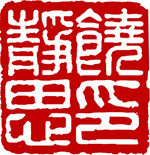
The Chinese idiom
Behind a rock in the dark probably hides a tiger, and the coiling giant root resembles a crouching dragon.
One translation of the four word phrase
Some thoughts on training and teaching, inspired by the above:
It is best to not teach early in one's development or be too quick to accept the first opportunity to share one's skill. Without being very grounded in an art, it is easy to provide the wrong view of it to someone, which will color their perception of the practice. Beyond that, it is important to make sure you have a deep understanding of what you are doing before you try to share it. Sharing your practice is not simply repeating what you remember from when you yourself were being instructed. That is sort of a minimum on a surface level, but ideally your instructor was applying a process of discernment when they were instructing you. Repeating the gross patern of that process, through the fog of memory, without a similar process of discernment or using good judgement, isn't going to wind up with the same outcome you experienced.
In my own case, I had good fortune with the first person I shared internal martial arts ideas to. He had been my jujutsu student and was used to working with me — he I think both appreciated the positive aspects of my approach and had patience with my limitations. When I realized my aiki-jujutsu teacher was exaggerating his lineage and background, I stopped traveling to work out with my peers, teach my remote students, or visit his dojo. I also ended the weekly class I taught in Federal Hill park in Baltimore, and lost a great number of opportunities for my own training in the process. There probably was a better way, but many people were caught up in the myths he told, so it was an all or nothing kind of martial arts group I was part of.
I wound up chosing nothing, or almost. I started over, spending time at learning older martial arts. One was bagua, that I had started exploring a few years prior, after moving to Maryland. Others became taiji, xingyi, and older styles of weapons from both China and Japan.
For a time, I kept working with one senior aiki-jujutsu student instead on Gao Bagua I had learned in Silver Spring — my first bagua teacher was kind enough to let me do that, despite my inexperience — and we reworked the Aikido and Kempo we had been practicing, using a better model for body mechanics and tactics. With what I know now, I would say our approach was half external, half internal. When I continued on to learn Taijiquan, that was a bridge too far. He was willing to work with me on one thing, and keep large parts of what we had practiced together in the same jujutsu art, but a total rewiring of everything, all the assumptions, was not in the cards. While I love my practice of Taijiquan, I now realize I was much too novice to share it with others at that time.
He made the right choice.
I regret I did not bring my other colleague Jeff along with us on that ride, as we wound up seeing much less of each other over time, and that is a loss that has nothing to do with martial arts. He always trained hard and was tough as nails, having practiced karate and aikido in Chicago. I was very glad to reconnect with him when I was back in DC during the pandemic, if only to catch up about old times.
I eventually became very dedicated to the group I wound up shifting the bulk of my efforts towards, but was never a teacher in it. After ten years, I wound up becoming a formal student, but when I moved to Seattle I never formally 'opened my door'.
Instead, I had several opportunities to work with experienced martial artists individually. They were either friends, or colleagues of friends, or people who discovered my blog (back when blogs were more discoverable, before the rise of social media). Each one was excellent at certain aspects of training and all of them were interested in internal martial arts — some having studied under various skilled teachers, many who were much more skilled than me, some of them for a substantial amount of time. Those opportunities were blessings.
But, in retrospect, while I tried in earnest to be a good model, I wasn't really up to the task. I had lived through the curse of bad lineage earlier in my martial arts career but now was suffering a different challenge — having good lineage but not being able to live up to it.
I think the reason my first mentorship role in Baltimore worked out is I was operating from a basis of an approach (modern jujutsu) I knew extremely well, with someone who had a similar background and skill. The process was then an exploration of how to approach and refine that curriculum with a relatively small set of teachings of Bagua that maybe were not as 'advanced' or 'high-level' as some of what I do now, but were more approachable, being closer to what we started with, and more easily explained.
Because my colleague already trusted me and wanted to keep working with me, he was willing to put up with me as I experimented with new ideas. He also provided clear feedback, and when sometimes things didn't feel correct, we worked together to come up with solutions. So, it began as a mentorship, as I had been his teacher, but by the end it was a collaboration and he could stand on his own as my peer.
That was probably the most successful experience I had as a novice teacher, one that has been difficult to repeat.
I have no idea if he continued training in bagua or if he went back to another jujutsu style closer to the nostalgia we both felt for hard training we had access to in the the school we had left. But it felt like we worked on something together to a point of completion and there was some satisfaction I felt about that time of my life, despite the difficulties in leaving a style I had practiced for a long time, losing many friends and colleagues along the way.
I later tried showing a kenjutsu colleauge in DC some Xingyi and he was very disciplined about training but I think my understanding of the art was not deep enough to convey it well to others — when he had joint problems that surfaced during practice I didn't know how to guide him towards a better posture and alignment in a way that resolved those problems.
Looking back fifteen years later, that is something incredibly hard to do without also being trained in Chinese medicine, but it was still another way in which I failed.
When I moved to Seattle and began working with a few people, the results for distinct reasons in each case wound up to a similar failed result
A good friend exchanged ideas with me for a bit until some injuries — not related to our own sharing of skills together — intervened and he focused his interests in other directions. His skill, after his recovery, has since far eclipsed my own.
One person who has tried just about everything, tried working with me, and moved back on to better things. I appreciated all the stories he had of encountering so many Seattle area masters and characters.
The pandemic intervened for the last two people I had been mentoring — each of those two individuals were much better martial artists than I was, albeit at other practices, but interested in Xingyi.
I want to thank all of them for their interest to be willing to encounter something different that I cherised, and for their patience at having to do so through an imperfect conduit. Working with them allowed me to realize over time, that while I had some small skill at the practice of internal martial arts, I was not really good enough or ready enough to teach them to others.
Instead, I kept practicing.
People talk about solo training, and all I can say is listen to what they say. What I add to that conversation as someone who has abandoned teaching is not very important, other than to encourage the reader to stop, listen, and pay attention to that admonition — the masters are right.
I continue to work on my own, and when I do train with others in internal martial arts, it is to visit senior colleagues to do application work with and share a little bit of what I have figured out to get their feedback. Like my first colleague in Baltimore, we can meet at the same point of departure with the same frame of reference and explore the same ideas together as colleagues. The insights I obtain up being very valuable feedback to me on a path that is otherwise largely solitary.
When I visit my senior colleague's practice, and look at him and his students, and see such high quality movement in their form, I know I made the right decision in stepping back from thinking of myself as a teacher. My understanding slowly improves over time, and I have cultivated certain skills that work for me, but I am still far from a proper model to do justice to these matters. For now, I am grateful for the few unscripted opportunities I have had to test my skill.
What have I learned? Solo practice works. One metaphor could be that of water polishing a stone over a very long time, but I appreciate the idea of hidden force or hidden skill, especially in internal martial arts, so the poem about the dragon and tiger came to mind. It is okay to keep our skill hidden, even if we are not as majestic as those archetypes of pure yin and pure yang.