The six kodachi kata of the Seitō-ha — and the habiki arrangement beside them — are not an independent set imported from outside. They are the ura (裏; back-hand, concealed) face of the foundational Hōjō kata: carried for generations as gokui- and kuden-level oral teaching under a placeholder name, and only later codified into named, weapon-specific kata by the Fujikawa-ha, published by Saitō Akinobu in 1901. The likeliest architect of that consolidation is Yamada Ippūsai, who could have recognized in the Edo Yagyū kodachi-side practice an analog of Jikishinkage-ryū’s own Hōjō-ura. The sections below lay out the evidence.
Kodachi Kata
Eighteenth- and early-nineteenth-century mokuroku of the Naganuma line do not explicitly mention the six kodachi kata practiced in the Seitō-ha and related lines today.
In the Odani-ha those were imported from the Fujikawa-ha (藤川派) into what is now sometimes called the Seitō-ha by Yamada Jirōkichi. The Seitō-ha maintains five kata sets — Hōjō (法定), Tō no kata (韜之形; tactical/encirclement forms), Kodachi (小太刀), Habiki (刃引) and Marobashi (丸橋) — but its parent the Odani-ha, by the end of the nineteenth century, practiced only Hōjō as kata, exploring upper-level tactics instead during shinai-uchikomi-geiko. The Naganuma family line, by contrast, has a larger curriculum today, including saya no uchi (battō and iai). So the kodachi set may be a nineteenth-century Fujikawa-ha addition — but an alternate explanation, pursued below, would also account for kodachi-related material in other factions, the Naganuma included.
It is said that Yamada “learned the Kojō” or “learned the ura of Hōjō” from Saitō. This is usually taken to mean the older arrangement of Hōjō, the Habiki — likely true, given his shiai focus while training at Sakakibara’s dōjō. But there is a second layer of meaning, bearing on kodachi practice.
Gokui Kyōju Zukai
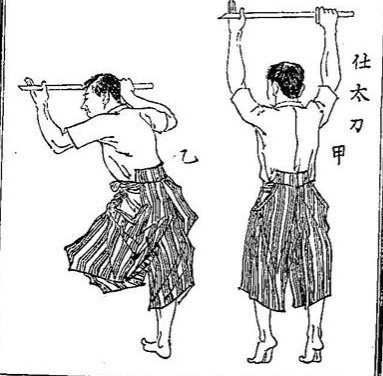
Saitō Akinobu’s Gokui Kyōju Zukai (国立国会図書館デジタルコレクション, 1901) documents what is now the Seitō-ha curriculum, with ink drawings of the kata (as does Yamada’s 1915 treatise, with photography extensive for its time). Its table-of-contents note to the 小鞱之形部 (Kodachi Forms section, p. 12) reads:
此形は[六]本なれども法定の裏の手の形なるが故に名所は法定と二本目三本目とついけて打つ故に他見する時は三本の形の儀に見へるるものなり
These forms, [though] six in number, are [in essence] the back-hand form (裏の手の形; hidden-hand forms) of the Hōjō. For this reason, the names connect with the Hōjō 2nd and 3rd kata, and when seen by others, they appear as the Hōjō forms in their ritual aspect.
This is the pivot: though the six kodachi kata are absent from the Naganuma mokuroku I have, Saitō’s own gloss treats them as the back-hand form of the Hōjō. The concept could have lived informally as kuden-level training; what is demonstrably a Fujikawa-ha development — finalized in Saitō’s print edition — is their codification into six named kata with set weapon specifications. (His 1901 introduction mentions the daishō 大小 bokutō pairing only in passing; by 1900 the kodachi-side equipment already felt routine in the line.)
Ura Kata
Saitō’s term ura-no-te-no-kata(chi) (裏の手の形, “back-hand form”) names the kodachi-side perspective on the foundational Hōjō — colloquially “the ura of Hōjō,” or kojō when the “small” character (小) is used. Read this way, a kojō entry in the earlier mokuroku gokui sections could denote two related practices at once: the kodachi work and Hōjō done with metal swords (the Habiki arrangement).
There is a real philological hinge here. Kojō sits on the 小 / 古 homophones — both read ko- in compounds — and in cursive kana transcriptions, where the entry might appear as こじょう, the kanji could be resolved either way: 古 (old, archaic, foundational) or 小 (small, kodachi-side). The two are less rival meanings than complementary faces of one thing. [ Compare the related gloss Kōjō (向上; 高上 in older mokuroku, “exalted”) from the Yagyū Shinkage-ryū okugi. ]
The Yagyū line shows how such kodachi-side practice functions. In Yagyū Shinkage-ryū kodachi is taught explicitly, as a documented step toward mutō-dori: Sekishūsai (柳生石舟斎 / 柳生宗厳, 1529–1606) received the mutō no ryū concept from Kamiizumi, and Munenori (1571–1646) systematized it in the Heihō Kadensho (1632), where the move from equal-length tachi to short-sword (kodachi) to no-sword (mutō) is the school’s distinctive architecture and the kodachi material its key middle term. Ippūsai’s Edo Yagyū training would have descended from Munenori’s codification — so Sekishūsai is the ultimate source, the Edo Yagyū line the immediate one.
That raises a possibility: these kodachi (and habiki) practices may have been listed only obliquely, folded into a kuden-related gokui entry, precisely to obscure them — especially if Ippūsai had brought in variations of the Edo Yagyū Shinkage-ryū he had learned, as an adjunct to the earlier Jikishinkage-ryū curriculum received from Takahashi Danjō-saemon-no-jō Minamoto Shigeharu (Jikishinsai), and did not want to mark the appropriation outright.
Analysis
A mokuroku that left kojō undisambiguated would read cleanly to insiders and opaquely to everyone else. Habiki extends the same logic — Hōjō arranged more combatively with a live blade — while kodachi carries Hōjō to a different weapon entirely (and, in the Fujikawa-ha, eventually to a steel kodachi).
If anyone imported this architecture, Ippūsai is by far the most plausible vector. His Edo Yagyū training is established, and his renaming of the school to Jikishinkage-ryū is the moment its identity was consciously reformulated — the point most receptive to integrating outside material. The shared cross-school kata vocabulary (Ittō Ryōdan, Uten Saten, Chōtan Ichimi, common with Yagyū’s Yagyū Kenpō Kyojō) shows his generation working from the same Kamiizumi-era glossary as the Yagyū line, and his documented injury and convalescence would have given him the life-phase to consolidate material from several sources into one curriculum. The picture is not wholesale borrowing but recognition: that the Yagyū kodachi-side practice had an analog in Jikishinkage-ryū’s own kuden-level Hōjō-ura, consolidated into a single gokui-level teaching and preserved as one mokuroku entry (“kojō”) rather than formalized into named kata at that stage.
Such placeholder naming is ordinary koryū practice: gokui-tier entries are routinely flagged with cover-terms — Saikōsui (西江水), drawn from a Zen kōan, is exactly this, meaningless to a casual reader and everything to a transmitted student. The 1768 and 1805 mokuroku carry such an entry, Kōjō Gokui no Koto (口上極意之事; “beyond words”), for oral teachings; a term resolved variously as 小定 / 古定 / 小法 / 古法 / 小韜 / 古韜 / 小條 / 古條 that flags “the ura practices of Hōjō — the kodachi-side and metal-blade versions” would fit it naturally. It is also the kind of entry that would later bifurcate as the school grew: the placeholder splitting into its component practices once each had enough discrete identity to warrant its own kata, with lines that never received the kojō kuden simply lacking the physical practices — or, more charitably, the Odani-ha exploring kodachi through shiai while the Fujikawa-ha, less focused on free practice, instead formalized the kuden into additional kata sets.
Conclusion
The reading is conjectural, but it is economical: kodachi and habiki are ura projections of the one Hōjō movement — just what the 1800 mokuroku means in saying that all practice is Hōjō — most likely consolidated by Ippūsai under the single placeholder kojō and only later split into the named sets the Fujikawa-ha codified and Saitō published. It accounts for the kuden the mokuroku name but never describe, for what kojō meant, and for what Yamada is recorded as having “learned the ura of Hōjō” from the Fujikawa line — material Saitō explicitly derives from Hōjō Ittō Ryōdan and Uten Saten, calling it the ura-no-te-no-katachi of the Hōjō, where the principle of Chōtan Ichimi is made explicit through differently sized weapons.
End Notes
- The six kodachi kata can be thought of as being composed of three pairs. The first two use an aggressive kasumi (霞; mist (posture)) entry, drawn from Ittō Ryōdan. The second two use an upward and inward motion, drawn from the randori (乱取り; free practice) section of Uten Saten. The fifth has movements also from Uten Saten (an upward-left sweeping motion on its initial movement), while the sixth has a dramatic nagashi similar to those in both Ittō Ryōdan and Uten Saten.
- Additionally, the 1800 mokuroku by Ogawa mentions roku kuden and there are six kata in the kodachi set. This may be further evidence in support of this line of thinking.