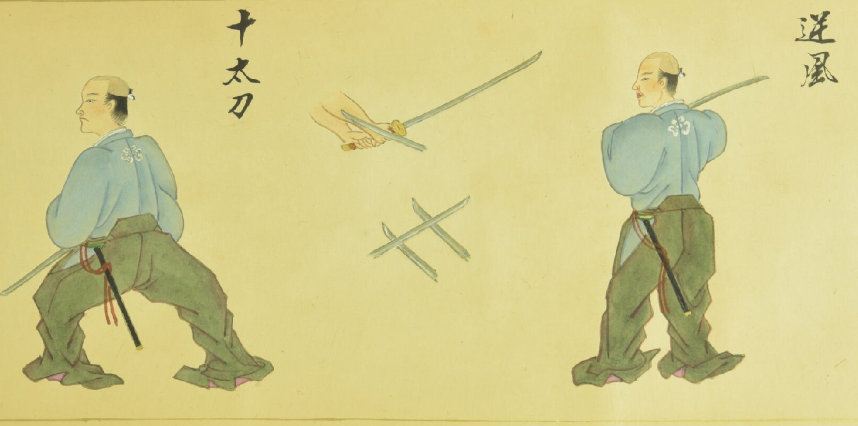
Kuka Densho from Historical Records Section, Manuscript Library, Kyushu University
Extensive documents from Kyushu in 1766 and how they relate to the Edo area Yagyū and Jiki Shinkage-ryū densho contents. We find independent corroboration of common Shinkage-ryū influence in these arts at the same time of the writings of Naganuma Kunisato in 1768. Specifically, the gokui section of Jiki Shinkage-ryū mokuroku overlap substantially with the Yagyū Shinkage-ryū Okugi, suggesting a majority of those concepts were preserved in Jiki Shinkage-ryū.↑
Kuroda-han Shinkage-ryū Densho
The Shūyūkan (修猷館) of Kuroda Han Shinkage-ryū (黒田藩傳柳生新陰流兵法) provided in 2025 a complete set of seven Shinkage-ryū densho from 1766 to Kyushu University Library. The Shūyūkan is a martial arts school that teaches Kuroda Han (Kuroda Province) Yagyū Shinkage-ryū Heihō and Hikita Kage-ryū from the famed swordsman Kamiizumino Kami Fujiwara no Nobutsuna, and Niten Ichi-ryū of Miyamoto Musashi Harunobu.
NOTE: The owner of the original materials is Historical Records Section, Manuscript Library, Kyushu University. The materials are available for public access and download.
We turn towards an analysis of the densho, with an eye on capturing detail that relates back to Kashima Shinden Jikishinkage-ryū, as these densho are written within 2 years of the Naganuma Kunisato mokuroku at Waseda University.
Sōjō (添状)
Seven densho scrolls transmitted in Meiwa 3 (1766), 5th month, from the Fukuoka-han Shinkage-ryū instructor Miyake Saemon Einori (三宅三右衛門栄範, d. 1774) to the karō Kuroda Genzaemon Takatsune (黒田源左衛門隆庸, 1744–1800). The scrolls include color-illustrated mokuroku. The eighth item is an Ansei 6 (1859) accompanying letter from Miyake Tasaemon Eigon (三宅太三右衛門栄権) to Kuroda Yamato Kazumi (黒田大和一美, 1830–1897), explaining that the seven scrolls, which had been returned to the Miyake family after the original transmission, were being re-delivered to the Minaki Kuroda house (三奈木黒田家) upon a new transmission.
The scrolls use the school name 新影流 (Shinkage-ryū), with the character 影 (kage; shadow/reflection) rather than 陰 (in/kage; yin). Image order was arranged by catalogers based on Yagyū Yoshinaga's Seiden Shinkage-ryū (島津書房, 1989) and Imamura Yoshio's Shiryō Yagyū Shinkage-ryū (人物往来社, 1967), as the original scroll order was not specified.
Ansei: Transmittal
The lineage is consistent across all scrolls in the collection:
- Kamiizumi Musashi-no-kami Fujiwara Nobutsuna (上泉武蔵守 藤原信綱)
- Yagyū Tajima-no-kami Taira Muneyoshi (柳生但馬守 平宗厳)
- Yagyū Matsuemon-no-jō (柳生松右衛門尉)
- Arichi Kuranosuke Ienobu (有地内蔵允 家信)
- Arichi Heiemon-no-jō Fujiwara Mitsuzane (有地平右衛門尉 藤原光真)
- Arichi Shirōemon-no-jō Fujiwara Narinobu (有地四郎右衛門尉 藤原就信)
- Miyake Genhachirō Shigenari (三宅源八郎 重業)
- Miyake Saemon Einori (三宅三右衛門 栄範) — the transmitter
The Arichi family (有地) were the initial Shinkage-ryū recipients in the Kuroda domain, with the Miyake family (三宅) succeeding them as domain instructors. The lineage runs entirely within the Yagyū mainline: Kamiizumi → Yagyū → Arichi → Miyake.
The mokuroku (興儀之目録) were originally transmitted (御傳授中有之) and that from this point forward (自今以後) the transmission is formalized. It references the 目録数巻 ("several scrolls of mokuroku") and the 七巻 ("seven scrolls") — matching the seven densho in the collection.
The letter explains that the seven mokuroku scrolls had been originally transmitted from Miyake Einori to Kuroda Takatsune, were later returned to the Miyake family, and are now re-delivered to the Minaki Kuroda house. The letter references the 七巻 (seven scrolls) as a unified set and includes language about exclusive practice of the school (為流専用) and prohibition on unauthorized transmission. Higher-level teachings are to be shared with only "one person in the realm" (一國一人).
The colophon dates reads 安政六未 (Ansei 6, Year of the Sheep, 1859), signed by 栄権 (Eigon) with vermillion seal, addressed with 状如件 ("as stated above"), and 三宅三右衛門 (Miyake Saemon) appears as the formal signatory.
Dated Ansei 6, 12th month (1859), an accompanying letter from Miyake Eigon to Kuroda Yamato, certifying the transmission.
The seven densho are a complete Yagyū Shinkage-ryū transmission set:
- Enpi (燕飛) — the foundational kata
- Sangaku Entachi-bun (三学円太刀分) — analysis of the Three Learnings Round Sword
- Sangaku (三学) — Three Learnings
- Kuka (九箇) — Nine Pieces
- Tengushō (天狗抄) — the Tengu Writings
- Setiai Gokai (截合五箇位) — Five Positions of Engagement
- Soto-mono Taryū (外物他流) — External Matters / Other Schools
Below we examine several that are relevant to our cross-lineage analysis of the composition of 18th century Jikishinkage-ryū.
Empi
The Enpi (燕飛) scroll is stunning, with color illustrations are exceptional for a 1766 document. It contains introductory philosophical preamble discussing the relationship between martial arts and Buddhist wisdom, with references to the Seven Buddhas (七佛), Sanskrit and Chinese traditions (梵漢), Mañjuśrī (文殊; Skt. Mañjuśrī), Prajñā (般若; Skt. Prajñā), wisdom (智慧), and Arhats (羅漢). The text positions the art within a Buddhist framework and discusses the concept of ken-tai (懸待; suspension and waiting).
This is followed by color illustrations of the kata, each labeled, showing paired figures (shidachi in blue/grey, uchidachi in yellow/green):
- Enpi (燕飛; "Swallow Flight")
- Enkai (猿廻; "Monkey Turning")
- Yamakage (山陰; "Mountain Shadow")
- Tsukikage (月影; "Moon Shadow")
- Uranami (浦波; "Shore Waves")
- Ukifune (浮舟; "Floating Boat")
- Shishi Funjin (獅子奮迅; "Lion's Fierce Rush")
- Yamagasumi (山霞; "Mountain Mist")
This maintians the early Sarutahiko inspired monkey imagery in its choice of kanji for the second kata instead of 燕 (swallow). The last two kata are the Empi Oku — in other densho arrangements they sometimes are omitted.
The scroll concludes with homage to Nichirin Marishiten (日輪摩利支天; "Sun Disc of Marīcī Deva"), a lineage chart (as above) and colophon. This is the standard Yagyū Shinkage-ryū Enpi set. The final section invoking Marishiten (摩利支天; Skt. Marīcī) — the Buddhist deity of light and invisibility, patron of warriors — is worth noting. It closes the set with an explicitly devotional frame.
The illustrations themselves show specific moments within each kata — sword positions, body angles, and spatial relationships are clearly rendered, making these potentially useful as technical references.
Jiki Parallels
The Enpi set has no direct equivalent in the Jikishinkage-ryū curriculum — this is part of the "middle layer" that Jikishinkage-ryū does not transmit, having substituted the Tō no Kata (韜之形) tactical forms instead. However, several points of connection exist:
- The Buddhist preamble's emphasis on Prajñā and the relationship between martial technique and spiritual wisdom parallels the philosophical framework of the Jikishinkage-ryū Gokui section, particularly Nenshi (念思; "Thought and Contemplation") and Furyū no Katsu (不立之勝; "Victory of Non-Reliance"), which reference Buddhist concepts of munen musō (無念無想; no-thought, no-conception).
- The concept of ken-tai (懸待; suspension and waiting) appears in the Jikishinkage-ryū gokui as Ken Tai Yū (権躰勇; "Authority, Body, Valor"), where the ancient writing is explicitly noted as 懸待遊 (Ken-Tai-Yū; Suspension, Waiting, Play). The Jikishinkage-ryū mokuroku acknowledges this older orthography.
- The Nichirin Marishiten (日輪摩利支天) invokes the Buddhist warrior deity Marīcī (Skt. Marīcī), connecting to the broader spiritual dimension shared by both traditions. Marīcī as patron deity of warriors provides religious context for concepts like Shinmyōken. In contrast, Jikishinkage-ryū densho typically are adorned with bonji representing the celestial guardian Fudō or the A-Un philosophical concept at the same time (circa 1768 and onward).
Sangaku Entachi-bun
The Sangaku Entachi-bun (三學圓太刀分; "Three Learnings, Round Sword Division") is the master index for the entire curriculum. First, core kata (entachi) are listed: Core kata (Entachi):- Ittō Ryōdan (一刀兩段; "One Sword, Two Halves")
- Zanchō Settetsu (斬釘截鐡; "Cutting Nails, Breaking Iron")
- Hankai Hankō (半開半向; "Half Open, Half Facing")
- Usen Saten (右旋左轉; "Right Rotation, Left Turning")
- Chōtan Ichimi (長短一味; "Long and Short are One Flavor")
Three of these — Ittō Ryōdan, Usen Saten (= Uten Saten), and Chōtan Ichimi — are identical to Jikishinkage-ryū Hōjō kata names. That's three out of four Hōjō sharing names directly with the Yagyū Entachi curriculum. Only Hassō Happa has no direct equivalent here, replaced by Zanchō Settetsu and Hankai Hankō.
Only Hassō Happa (八相発破; Hōjō #1, spring) has no direct equivalent in this list, replaced by Zanchō Settetsu and Hankai Hankō. This three-of-four correspondence strongly suggests the Hōjō were inherited from the common Shinkage-ryū of Kamiizumi and represent the same foundational training layer.
Kuka
Then the full curriculum is listed, including the individual kata in Kuka (九箇; nine places):
- 必勝 (Hisshō; "Certain Victory")
- 逆風 (Gyakufū; "Reverse Wind")
- 十太刀 (Jū-tachi; "Ten Swords")
- 和卜 (Waboku)
- 腰卜 (Koshiboku)
- 小詰 (Kozume; "Small Entrapment")
- 大詰 (Ōzume; "Great Entrapment")
- 八重垣 (Yaegaki; "Eight-Layered Fence")
- 村雲 (Murakumo; "Gathering Clouds")
Hisshō (必勝; "Certain Victory") appears in the Jikishinkage-ryū gokui section under Ikki-tō (一氣當), where 必勝也 (hisshō nari; "this is Certain Victory") is the culminating declaration.
Tengushō
Tengushō (天狗抄) is listed in summary, not providing kata names but simply the summary description Tachi-kazu yattsu (太刀数八ツ; "sword count: eight") denoting eight kata for the set.
Okugi
Next we see listed six teachings that are similar to other Yagyū examples:
- 滅載乱截 (Metsusai Ransetsu; "Extinguishing Chaos, Cutting Disorder")
- 無二劔 (Muni-ken; "Peerless Sword")
- 路人劔 (Rojin-ken; "Sword of the Wayfarer")
- 高上 (Kōjō; "Highest Level")
- 極意 (Gokui; "Deepest Secret")
- 神妙劔 (Shinmyōken; "Mysterious Sword of the Mind")
Jiki Parallels
Notice, katsujinken is replaced with Rojin-ken in this list.
Shinmyōken appears here as the pinnacle of the Yagyū curriculum — the same term, same kanji (though 劔 rather than 剱), same position at the apex.
Shinmyōken is the first gokui of Jikishinkage-ryū and notes it as a teaching shared across the Kashima-area traditions. This scroll places Shinmyōken in a similar stature as the culmination of the Okugi.
Both traditions place Shinmyōken at the summit, both use Hisshō (必勝) as a key concept, and three of four Hōjō (Entachi) kata share identical names. This is strong evidence for common Shinkage-ryū inheritance. Kōjō (高上) as a designation corresponds to Kōjō Gokui (口上極意) in the Jikishinkage-ryū mokuroku — the "beyond words" oral teachings. The character differs (高上 "highest" vs. 口上 "oral/spoken") but the functional position is the same: the layer of teaching that transcends written transmission.
Gokui (極意) is similarly shared as a designation for the innermost teachings, which is standard in many ryūha.
The Sangaku Entachi-bun reveals a three-tier architecture:
- foundational kata (Entachi)
- middle-level sets (Kukka, Tengushō, Setiai, etc.)
- philosophical apex (Gokui, Shinmyōken)
Jikishinkage-ryū shares the first and third tiers but substitutes its own middle layer (Tō no Kata and the Koto/Katsu progression). This suggests Jikishinkage-ryū may be understood as a reformulation that preserved the Kage-ryū foundation and philosophical summit while replacing the middle tactical curriculum — possibly influenced by Ogasawara Genshinzai's (小笠原源信斎長治) documented trip to Ming China.
Tengushō
The preamble establishes the Tengushō as the highest-level transmission document. Key phrases include: 不可傳之一國一人之 ("This must not be transmitted to more than one person in the realm") and 書也口傳多 ("This is written, but the oral transmissions are many").
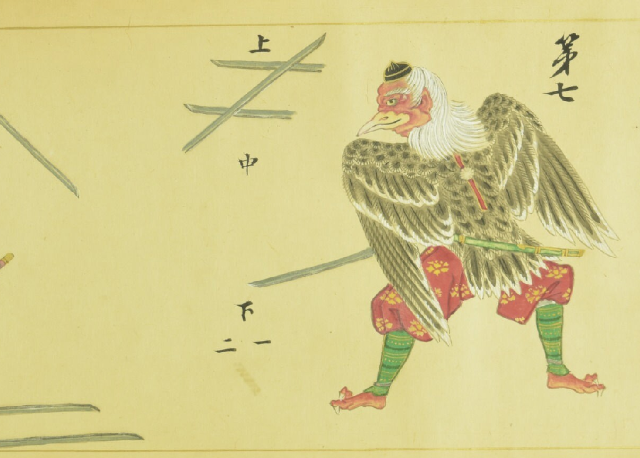
Tengushō Densho from Historical Records Section, Manuscript Library, Kyushu University
Keeping with this, the kata are not named, but simply enumerated. Also absent are the descriptive Tengu names introduced in the Edo line of practice.
The catalog lists the Soto-mono Taryū (外物他流) as a separate scroll specifically for "other school" material, but if Hikita content had already been integrated into the core transmission sets — including the Tengushō — it might not appear separately in the Soto-mono scroll at all.
The close-quarters/grappling techniques in the Soto-mono would then represent only the Hikita material that couldn't be absorbed into existing Yagyū kata structures, while Hikita sword techniques compatible with the Tengushō framework were folded directly into the set as four additional positions.
Typically, there are eight kata in Tengushō practice, including a hidden oku kata called ninin-gakari, for nine total. Here we see twelve tengu depicted and numbered — there are three known Tengushō kata from Hikita Kage-ryū, using the suffix -shō (書; excerpt) instead of 抄, which then make twelve (including the oku kata). Their names are:
- Ranshō (乱勝)
- Chōgoku (釣極)
- Unsetsu (雲截)
The Kuroda-han Miyake transmission appears to have followed a consistent documentary principle of listing everything — oku and Hikita material alike — rather than maintaining the secrecy conventions that other domain transmissions observed. This makes sense in context: these scrolls were being transmitted to a karō, a chief retainer of the domain. The Miyake family may have chosen completeness over concealment precisely because the scrolls were going to the highest level of domain authority.
Depictions
Following the preample is a set of twelve illustrated positions with Tengu. Each of the twelve positions shows a tengu figure with:
- A position number (第一 through 第十二)
- Grey sword-trajectory lines indicating cutting paths
- Level notations: 上 (jō, upper), 中 (chū, middle), 下 (ge, lower) with associated numbers
The numbers after each level appear to indicate the count of cuts directed at that level. The grey lines drawn around each figure correspond to these counts, showing the angle and direction of each cut.
A clause follows the illustrations: 血判可有相傳之節 ("A blood oath [keppan] must be made at the time of transmission"), preceded by a seven-day purification requirement — this practice of having a separate keppan at a high-level of initiation is still maintained by contemporary ryūha influenced by Shinkage-ryū.
Setiai Gokai
This is The Setiai Gokai (截合五箇位; "Five Positions of Engagement") scroll is important for our work on Jikishinkage-ryū. The five positions are numbered 第一 through 第五, each followed by descriptive text in cursive text.
Preface
The Jo (序; "preface") lists several topics, some of which we see in contemporary Jikishinkage-ryū densho:
- 上段 三ツ (Jōdan, mittsu; "Upper level, three [techniques]")
- 中段 三ツ (Chūdan, mittsu; "Middle level, three")
- 下段 三ツ (Gedan, mittsu; "Lower level, three")
- 破 (Ha; "Break/Destroy")
- 弁合結太刀 三ツ (Combination binding sword, three)
- 刀棒 (Tōbō; "Sword and staff")
- 折甲 二ツ (Sekkō/Orikabuto, futatsu; "Breaking armor, two")
- 上段... 左 右 — Directional variants
- 目付之大事 (Metsuke no Daiji; "Important Matter of the Gaze")
- 遠山 (Enzan; "Far Mountain")
- 二畳 (Nijō; "Two tatami")
- 色付 (Irotsuki; "Color Sensing")
- 伍陰微味方三寸之事 — Complex entry, possibly "Matter of the Five Shadows, Subtle, Ally's Three Sun"
- 三調子...事 (Sanchōshi no Koto; "Matter of Three Rhythms")
Philosophical Content
- 真表之事 (Shin-omote no Koto; "Matter of True Surface")
- 待曲事 (Taikyoku no Koto; "Matter of Waiting/Curving")
- 小太刀一尺六寸 (Kodachi issaku rokusun; "Short sword, one shaku six sun [~48cm]") — with associated oral transmission notes
- 集字手利劔大事 (Shūji Shuriken Daiji; "Important Matter of Collected Characters, Shuriken")
- 陰兵閑者... — Reference to hidden/shadow soldiers
- 手裏見 (Shurimi; "Seeing the Hidden Hand")
- 心遍萬境 (Shin-hen Bankyō; "The Mind Pervades All Realms")
- 實就曲随流... — "True accomplishment following the flow"
- 性名... (Seimei/Shōmyō)
- 一國一人傳授之 (Ikkoku Ichinin Denju; "Transmission to one person in the realm")
- 極意也 (Gokui nari; "This is the deepest secret")
Jiki Parallels
Metsuke no Daiji (目付之大事) and Enzan (遠山) align with Metsuke no Katsu in Jikishinkage-ryū mokuroku, which discuss Enzan no Metsuke as a concept. Here it appears in the Yagyū Setiai curriculum as a formal teaching item, confirming the shared conceptual framework between the two traditions.
The Jikishinkage-ryū treatment of the gaze as "mirror of the mind" and the Yagyū treatment as a formal daiji (important matter) may represent parallel developments from a common source (i.e. Kamiizumi).
Irotsuki (色付; "Color Sensing") is similar to the discussion of iro in the Jikishinkage-ryū Metsuke no Katsu as "sensing the opponent's intention." Here it appears as a named teaching within the Setiai framework.
Sanchōshi (三調子; "Three Rhythms") — this could be the Yagyū equivalent of Tome Sandan (留三段), where three levels of rhythm and distance are used to control the opponent. If Karukome is correct that Tome Sandan was a Naganuma addition, the Sanchōshi entry here might represent the earlier Shinkage-ryū source that Naganuma then adapted.
Ha (破; "Break") may relate to the Jikishinkage-ryū concept of Hatetsu (破鉄; "Breaking Iron").
Shin-hen Bankyō (心遍萬境; "The Mind Pervades All Realms") resonates with the Jikishinkage-ryū concept of Sōtai no Zu (惣躰之圖; "Matter of the Whole Body"), where the teaching is to perceive the totality of the opponent rather than fixating on individual parts.
Soto-mono Taryū
The Soto-mono Taryū (外物他流; "External Matters, Other Schools") is a catalogue of techniques from outside the main Yagyū Shinkage-ryū curriculum — techniques from other schools or "external matters" that were incorporated into the Kuroda-han practice.This is an extensive list, which contains several items of relevance to the comparison of Jikishinkage-ryū with other lines of Shinkage-ryū:
Kiri-otoshi (切落) appears as the first entry. In the Jikishinkage-ryū mokuroku, Kiri Otoshi no Katsu (切落之克; "Victory of Cutting Down") is the fourteenth Katsu and one of the entries Karukome identified as a Naganuma Kunisato addition. Its placement in the Yagyū "Other Schools" section raises the question of whether this concept was recognized as originating outside the Yagyū mainline — possibly representing a shared Kage-ryū teaching that the Yagyū classified as "external" and that Naganuma later incorporated into the Jikishinkage-ryū Katsu progression.
Hitotachi (一太刀; "One Sword") relates to the Jikishinkage-ryū teaching of Hitotsu no Tachi (一ノ太刀; "First or Singular Sword"), discussed in the Shinmyōken gokui section as one of the highest-level teachings associated with Kashima no Tachi (鹿島之太刀) and Katori no Ken (香取之剱).
Mu-ikken (無一劔; "No-Sword") connects to the broader Shinkage-ryū tradition of mutō-dori (無刀取; sword-taking without a sword), which has conceptual parallels in the Jikishinkage-ryū teaching of abandoning attachment to technique in Furyū no Katsu (不立之勝).
Ichimonji (一文字; "Horizontal Line") parallels Yoko Ichimonji no Katsu (横一文字之克; "Victory of the Horizontal Line") in the Jikishinkage-ryū Katsu. Its placement in the "Other Schools" section suggests this may have been recognized as a technique shared across other Shinkage-ryū lineages.
Summary
The Kuroda-han Shinkage-ryū scrolls reveal a three-tier curriculum architecture. Its foundation of Sangaku Entachi core kata corresponds to Jikishinkage-ryū Hōjō (法定). Three of four kata names are identical (Ittō Ryōdan, Usen/Uten Saten, Chōtan Ichimi). This is the shared Shinkage-ryū physical inheritance.
The middle layer of Enpi, Tengushō, and Kuka have no direct equivalent in Jikishinkage-ryū. This middle tier seems to have been replaced by the Tō no Kata (韜之形) tactical forms and the Koto/Katsu (事/克) analytical progression in Jikishinkage-ryū. This tactical middle layer may reflect Ogasawara Genshinzai's (小笠原源信斎長治) documented Ming-dynasty training.
Specific Katsu entries (Sōjaku, Tome Sandan, Kiri Otoshi, Ginmi) were later additions by Naganuma Kunisato (長沼国郷) according to Karukome's research.
The philosophical apex of Shinmyōken, Gokui, Kōjō, Hisshō are shared between both traditions. Shinmyōken sits at the pinnacle of both curricula. Kōjō functions identically as the layer of oral/unspeakable teaching beyond written transmission. Hisshō (Certain Victory) appears in both as a key concept. The Gokui designation is shared directly.
Despite the different organizational structures, specific concepts cross over: Metsuke/Enzan (gaze of the Far Mountain), Iro/Irotsuki (reading the opponent's "color"), Sanchōshi/Tome Sandan (three rhythms/three levels), Kiri-otoshi, Ichimonji, Ken-Tai-Yū/Ken-Tai. These suggest a common conceptual vocabulary inherited from Kamiizumi, even when the curriculum structures diverge.
References
- Karukome Yoshitaka (軽米克尊), *Jikishinkage-ryū no Kenkyū* (直心影流の研究, 国書刊行会, 2020).
- Karukome Y., Sakai T., "An Analysis of the Formation of Jikishinkage-ryū in Relation to its Lineage and Transmission," *Budōgaku Kenkyū* 47-3: 119–138 (2015).
- Karukome Y., "直心影流にみる形稽古としない打ち込み稽古の兼修," *Budōgaku Kenkyū* 46-1 (2013).
- Yagyū Yoshinaga (柳生厳長), *Seiden Shinkage-ryū* (正伝新陰流, 島津書房, 1989).
- Imamura Yoshio (今村嘉雄), ed., *Shiryō Yagyū Shinkage-ryū* (史料柳生新陰流, 人物往来社, 1967).
- Ōmori Sōgen (大森曹玄), *Ken to Zen* (剣と禅, 春秋社).